In today's competitive and execution-driven environment, decisions cannot rely on assumptions or delayed reports.
Businesses need real-time, structured, and actionable market intelligence to understand what is happening on the ground and respond quickly.
Market intelligence, when captured and analysed correctly, transforms daily field activities into insights that guide smarter decisions across sales, operations, and people management.
This blog explains how market intelligence supports better decision-making, using practical examples from dashboards, analytics, reports, and operational workflows described in the provided content.
What Is Market Intelligence in Field Operations?
Market intelligence refers to data collected from daily field activities such as attendance, store visits, sales, stock levels, merchandising execution, and employee performance. This information becomes valuable only when it is organized, analysed, and presented in a way that supports timely decisions.
Example from the content:
Data such as attendance reporting percentage, market visit percentage, sales by SKU, merchandising visit status, and store-level stock information are continuously captured and made available through dashboards and reports.
Centralized Dashboards for Immediate Visibility
A centralized dashboard acts as the first layer of market intelligence by giving decision-makers a consolidated view of field activity.
How dashboards support decisions
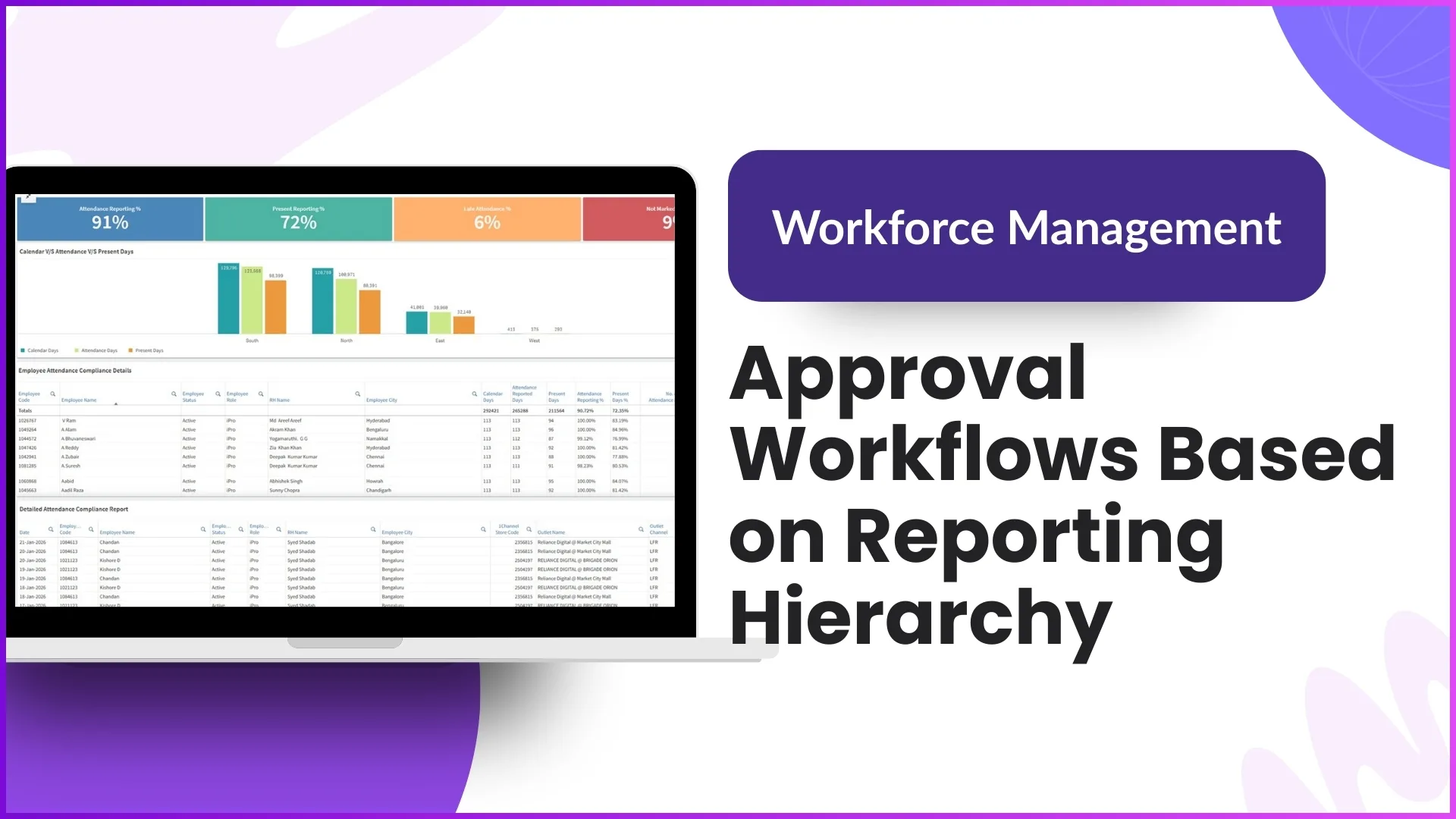
Dashboards display key indicators like attendance compliance, late attendance, market visits, and defaulter percentages in one place. This allows managers to identify issues without waiting for manual reports.
Example:
An attendance dashboard shows present days percentage, defaulted days, and late attendance. If a specific city shows higher defaulted days, managers can immediately investigate and take corrective action.
Attendance and Workforce Intelligence
Workforce discipline and availability directly impact market coverage and sales outcomes. Attendance data becomes a powerful form of market intelligence when analysed correctly.
Key decision benefits
- Identify regions with low attendance compliance
- Track late attendance patterns
- Validate attendance with photo and location data
Example:
Attendance Photo Reports allow managers to see the employee photo and location from where attendance was marked. This helps validate on-ground presence and take decisions on regularization, approvals, or corrective measures.
Market Visit Intelligence for Coverage Optimization
Market visit data reveals whether field teams are executing planned routes and covering the right stores.
How it improves decisions
- Compare planned vs actual store visits
- Identify gaps in beat compliance
- Improve route planning
Example:
The Beat Compliance Report calculates compliance by comparing stores visited against stores defined in the beat plan. If an employee consistently covers fewer stores than planned, managers can revise routes or address productivity issues.
Sales and Productivity Intelligence
Sales data becomes actionable when broken down by date, SKU, store, and category.
Decision-making advantages
- Identify high and low performing SKUs
- Measure store-level productivity
- Track daily and monthly sales trends
Example:
MTD Secondary Sales and Sales Productivity Reports show SKU-wise sales by value and unit. Managers can decide which products need additional focus or promotional support based on real sales performance.
Merchandising and Visual Execution Intelligence
Merchandising execution plays a key role in brand visibility and sales uplift. Market intelligence helps track whether merchandising activities are actually executed.
How it supports better decisions
- Verify merchandising completion
- Identify reasons for non-execution
- Track POSM deployment
Example:
Merchandising Visit Tracker Reports show whether merchandising was done, reasons for non-compliance, and storefront images. This helps managers decide where corrective merchandising actions are required.
Stock and Availability Intelligence
Stock availability directly impacts sales. Timely access to stock data allows businesses to prevent lost opportunities.
Key decision outcomes
- Identify stock shortages at store level
- Align replenishment with demand
- Reduce missed sales due to stock-outs
Example:
Current Stock Reports allow users to view stock details store-wise. If a high-performing SKU shows low stock in a store, replenishment decisions can be taken immediately.
Custom Reports for Targeted Insights
Standard reports may not always answer specific business questions. Custom reporting helps decision-makers focus on what matters most.
Why custom reports matter
- Tailored insights based on role or region
- Flexible dimensions and filters
- Faster decision cycles
Example:
Using the Report Builder, admins can create reports based on dimensions like sales, attendance, merchandising, or stock, filtered by location or role. This enables targeted decision-making without dependency on manual data extraction.
People Management Intelligence for Operational Control
Market intelligence is not limited to sales and stores. People-related data is equally important for smooth operations.
How it improves decisions
- Approve attendance, leaves, and claims efficiently
- Monitor hygiene audits and activity approvals
- Maintain accurate payroll data
Example:
People Hygiene Reports help admins review grooming, uniform, and audit compliance. Based on this data, training or corrective actions can be planned for specific employees or regions.
Market Working and Activity Intelligence
Field questionnaires and audits provide qualitative insights that numbers alone cannot capture.
Decision support benefits
- Understand real market conditions
- Capture feedback and survey responses
- Improve execution quality
Example:
Questionnaire-based market working activities allow employees to submit responses from live locations. Managers can analyse this data to improve campaign execution or refine market strategies.
How 1Channel SFA Enables Market Intelligence
1Channel SFA brings together dashboards, analytics, reports, people management, and market working modules into a single platform.
By capturing every field activity and converting it into structured insights, 1Channel helps businesses move from reactive decisions to proactive planning.
The platform ensures that leaders always have reliable market intelligence to guide operational, sales, and workforce decisions.
Transform Field Data into Actionable Intelligence
Discover how 1Channel Field Activity Management Software enables real-time market intelligence with comprehensive dashboards, analytics, and reporting capabilities.
Explore Field Activity Management →Conclusion
Market intelligence is the foundation of better decision-making in field-driven businesses. When attendance data, market visits, sales, merchandising, stock, and people insights are captured and analyzed in one system, decisions become faster, more accurate, and more impactful.
By leveraging structured dashboards, detailed reports, and real-time analytics, organizations can continuously improve execution, productivity, and business outcomes.