For FMCG brands, consumer goods companies, electronics brands, and retail distribution businesses across India, sales visibility is no longer limited to knowing how much revenue was generated at the end of the month.
Modern sales teams need detailed insights into which SKU is selling, how many units are moving, what value those sales are generating, and where performance gaps exist.
Traditional reporting methods often rely on spreadsheets, delayed updates, and manual data consolidation. This makes it difficult for managers to understand real-time sales performance across stores, distributors, territories, and field teams.
AI-powered Sales Force Automation (SFA) platforms transform this process by collecting sales information directly from the field, organizing it SKU-wise, and presenting actionable insights through dashboards, reports, and analytics. As a result, businesses can track unit sales, value sales, stock movement, and product performance with greater accuracy and automation.
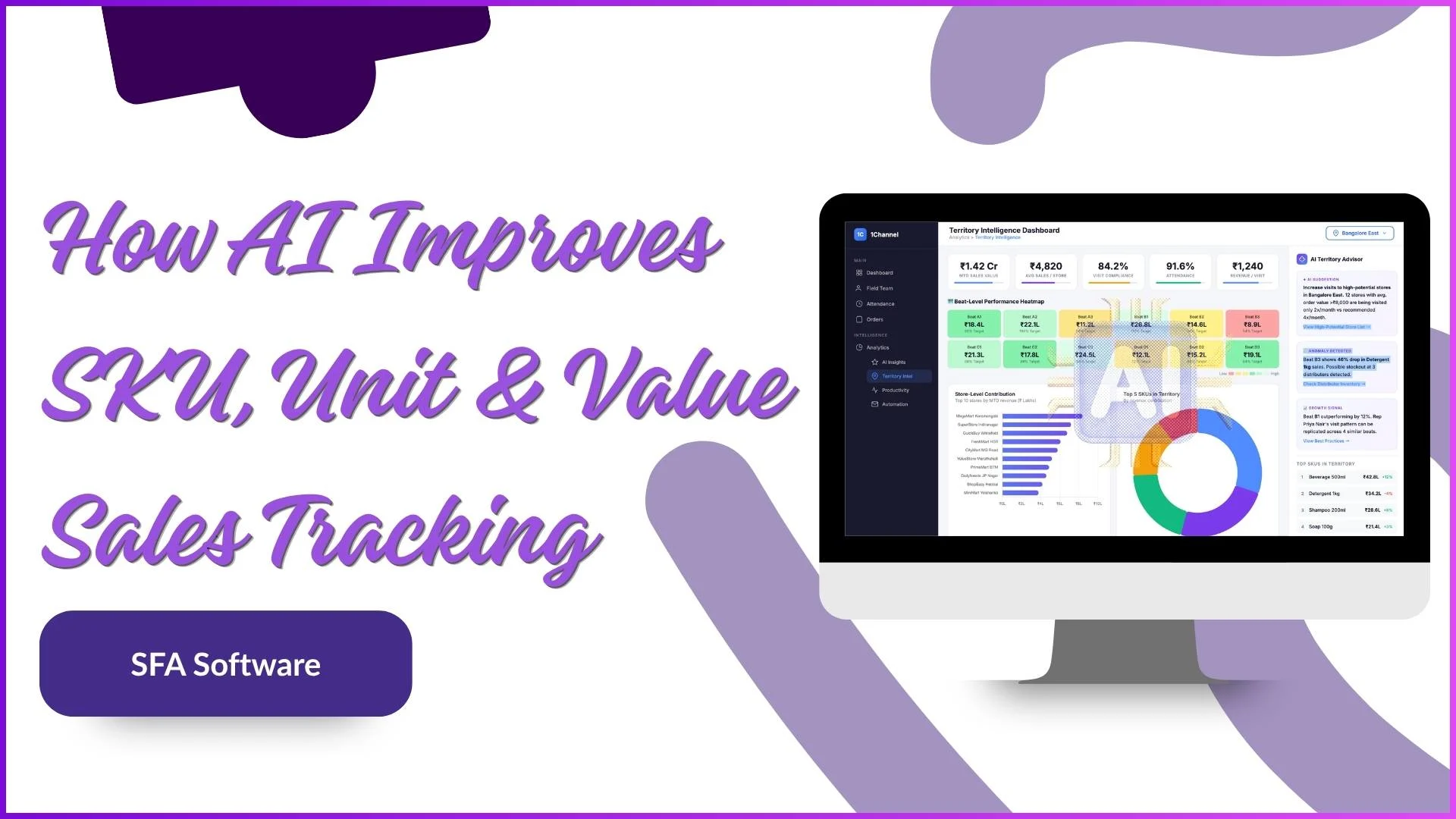
Understanding SKU, Unit & Value Sales Tracking
Before exploring the role of AI, it is important to understand the three key sales metrics businesses monitor:
SKU Sales Tracking
SKU (Stock Keeping Unit) tracking helps businesses monitor the performance of individual products.
Example:
A beverage company sells:
- 250ml Juice Pack
- 500ml Juice Pack
- 1L Family Pack
Each product has a separate SKU. Instead of viewing total sales only, the company can identify exactly which SKU is performing better in a particular market.
Unit Sales Tracking
Unit sales tracking focuses on the quantity of products sold.
Example:
A promoter visits a retail outlet and records:
- 30 units of Product A sold
- 15 units of Product B sold
- 10 units of Product C sold
This information helps businesses understand product movement volume and demand patterns.
Value Sales Tracking
Value sales tracking measures the monetary value generated by sales.
Example:
If:
- 30 units of Product A are sold at ₹100 each
Then:
- Unit Sales = 30
- Value Sales = ₹3,000
This helps management evaluate revenue contribution rather than only product movement.
How AI Enhances SKU Sales Tracking
AI-powered sales automation allows field employees to record sales directly through the mobile application while managers monitor the information through centralized analytics and reporting dashboards.
The system maintains a structured product hierarchy consisting of:
- Brand
- Product Category
- Product
- SKU
This enables businesses to manage thousands of SKUs without losing visibility into individual product performance.
Example
Suppose an electronics company sells:
- Laptop Model A
- Laptop Model B
- Laptop Model C
Field users can record sales against the exact SKU. Management can then generate SKU-wise reports to identify:
- Which model sells most frequently
- Which model underperforms
- Which stores generate maximum SKU movement
This creates product-level visibility that is difficult to achieve through manual reporting processes.
AI-Powered Unit Sales Monitoring
The platform supports Each Unit Sale tracking where field users can record the quantity sold for specific products through the application.
Instead of waiting for end-of-month sales reports, businesses can monitor sales activity continuously.
Example
A promoter visits a retail outlet and updates:
| SKU | Units Sold |
|---|---|
| Shampoo 100ml | 50 |
| Shampoo 200ml | 25 |
| Shampoo 500ml | 10 |
The data immediately becomes available for reporting and analysis.
Managers can quickly identify:
- High-performing products
- Slow-moving inventory
- Store-level sales productivity
- Territory-wise demand trends
Improving Value Sales Visibility Through AI
Revenue visibility becomes significantly stronger when sales are tracked alongside product quantities.
The platform provides value-based reporting that allows businesses to analyze sales performance in financial terms.
Example
A store sells:
| SKU | Units Sold | Price | Value Sales |
|---|---|---|---|
| Product A | 20 | ₹500 | ₹10,000 |
| Product B | 10 | ₹1,000 | ₹10,000 |
Although Product A sold more units, both products contributed equal sales value.
AI-powered analytics help management understand:
- Revenue contribution by SKU
- Store-wise value generation
- Territory-wise sales performance
- Product profitability trends
Key Reports That Support AI-Driven Sales Tracking
The platform includes several analytics reports specifically designed for sales monitoring.
MTD Tertiary Sales Report
This report provides detailed tertiary value sales by:
- Date
- SKU
Example
A sales manager can compare:
- SKU A value sales in Delhi
- SKU B value sales in Noida
and identify which product is generating stronger tertiary demand.
MTD Secondary Sales Report
The report helps businesses track secondary sales performance till date based on:
- SKU
- Date
Example
If a distributor is moving Product X faster than Product Y, management can identify the trend quickly and adjust inventory planning.
MTD Sales by Product Category
This report shows:
- Product category sales
- Units sold
- Date-wise performance
Example
A personal care company may discover:
- Hair Care Category = 8,000 units sold
- Skin Care Category = 3,500 units sold
This allows better category planning and inventory decisions.
Sales Productivity Report (By Unit)
This report provides SKU-wise sales details for each store along with average daily productivity.
Example
Store A:
- SKU A = 100 Units
- SKU B = 80 Units
Store B:
- SKU A = 20 Units
- SKU B = 15 Units
Management can immediately identify productivity differences between stores.
Sales Productivity Report (By Value)
This report focuses on the value generated by SKU-wise sales.
Example
Store A may sell fewer units but generate higher revenue due to premium products.
This helps businesses focus on profitability rather than only volume.
Detailed Sales Report
The system also provides detailed sales reports containing:
- Store-wise sales data
- SKU-wise sales data
- Day-wise sales records
Example
If a regional manager wants to review a specific week's performance, they can generate detailed reports and analyse individual SKU movement across stores.
AI + Stock Visibility = Better Sales Decisions
Accurate sales tracking becomes more powerful when combined with stock information.
The platform enables:
- Stock tracking
- Store-wise inventory monitoring
- Stock uploads through Excel formats
- SKU-wise stock visibility
Example
If:
- SKU A has high sales
- Stock availability is low
The business can replenish inventory before stock-outs impact revenue.
Similarly, if:
- SKU B shows low sales
- Inventory remains high
Managers can initiate promotional activities to improve movement.
How AI Supports Field Sales Teams
Field users can record:
- Sales
- Stock
- Market activities
- Store visits
directly through the mobile application.
The information becomes available for reporting and analysis through the admin portal.
Example
A promoter visits five stores in a day.
For each outlet, the user can:
- Record sales.
- Update stock information.
- Submit activity details.
- Capture store-level execution data.
Managers gain immediate visibility into actual field performance without waiting for manual reports.
Benefits of AI-Based SKU, Unit & Value Sales Tracking
Improved Product Visibility
Track performance of every SKU individually.
Example
Identify whether a 200ml pack is selling better than a 500ml pack.
Faster Decision Making
Access real-time reports instead of waiting for manual consolidations.
Example
A regional manager can identify a drop in sales productivity and take corrective action immediately.
Better Inventory Planning
Combine stock and sales data for more accurate replenishment planning.
Example
High-selling SKUs can be restocked before shortages occur.
Higher Field Force Accountability
Sales information is captured directly from field activities.
Example
Managers can compare store visits with actual sales recorded by field users.
Stronger Revenue Analysis
Measure both quantity and value generated by each product.
Example
A low-volume premium product may contribute more revenue than a high-volume economy product.
Why AI-Driven Sales Tracking Matters for Businesses in India
India's retail and distribution ecosystem involves:
- Multiple distributors
- Large store networks
- Diverse product portfolios
- Extensive field sales teams
Managing thousands of products manually creates reporting delays and visibility gaps.
AI-driven sales automation helps businesses:
- Monitor SKU performance
- Analyze unit movement
- Measure value sales
- Improve inventory planning
- Increase sales productivity
By combining sales reporting, stock visibility, analytics, and automation within a single platform, organizations gain a clearer understanding of product performance across every market, territory, and retail outlet.
How 1Channel Helps Businesses Track SKU, Unit & Value Sales
1Channel provides an AI-powered Sales Force Automation platform that enables businesses to manage product hierarchies, sales recording, stock visibility, field activities, and advanced sales analytics from a unified ecosystem.
The platform offers features such as:
- SKU-wise sales tracking
- Unit sales monitoring
- Value sales reporting
- MTD secondary and tertiary sales reports
- Sales productivity reports
- Stock management
- Field sales automation
- Custom report building
- Dashboard-based analytics
With real-time visibility into store-level performance, businesses can make faster decisions, improve inventory planning, and enhance overall sales productivity across their distribution network.
Explore 1Channel Sales Force Automation
1Channel Sales Force Automation delivers AI-powered SKU-wise sales tracking, unit and value sales monitoring, real-time analytics, stock visibility, and field sales automation to help businesses make faster, smarter decisions across their distribution network.
Explore Sales Force Automation →FAQs
What is SKU sales tracking?
SKU sales tracking helps businesses monitor the performance of individual products using their unique stock keeping unit identifiers. It provides product-level visibility into sales activity.
What is the difference between unit sales and value sales?
Unit sales represent the quantity of products sold, while value sales represent the monetary revenue generated from those sales.
Why is SKU-wise reporting important?
SKU-wise reporting helps businesses identify high-performing products, slow-moving inventory, and category-level sales trends for better decision-making.
How does AI improve sales tracking?
AI improves sales tracking by automating data collection, organizing sales information, generating analytics reports, and providing real-time visibility into sales performance.
Can managers track sales at the store level?
Yes. Managers can access store-wise sales reports, SKU-wise sales data, sales productivity reports, and stock reports to evaluate outlet performance.
How does stock visibility support sales tracking?
Stock visibility helps businesses compare inventory levels with sales movement, enabling better replenishment planning and reducing stock-out situations.
Can sales reports be generated for specific date ranges?
Yes. Reports can be generated based on selected date ranges, allowing businesses to analyse daily, weekly, monthly, or custom-period performance.
How does sales productivity reporting help businesses?
Sales productivity reports show SKU-wise sales performance and average productivity, helping managers identify top-performing stores, products, and territories.