Retail execution has traditionally relied on manual store visits, visual checks, and post-visit reporting. But as retail environments become more complex, businesses need smarter ways to ensure products are visible, available, and placed correctly on shelves.
This is where AI-driven retail merchandising systems step in, not just to track execution, but to identify shelf gaps, compliance issues, and visibility problems in real time.
This blog explains how AI helps detect shelf gaps in retail stores, based entirely on the workflow and system capabilities described in the provided software demo.
Understanding Shelf Gaps in Retail
A shelf gap occurs when:
- A product is missing from the shelf despite being expected
- The number of product facings is below the required benchmark
- Products are placed incorrectly (wrong position, visibility, or grouping)
In traditional retail setups, these gaps are often:
- Detected late
- Reported manually
- Difficult to quantify across thousands of outlets
AI changes this by turning store images and audits into measurable insights.
How AI Detects Shelf Gaps: Step-by-Step Process
1. Defining Shelf Standards (Norms)
Before detecting gaps, the system establishes benchmarks (norms) for every outlet and SKU.
These norms include:
- Minimum number of facings per product
- Shelf placement rules
- Outlet-specific requirements based on size and category
Example:
- A fast-moving SKU may require 7–10 facings on the shelf
- A premium SKU may require only 1–2 facings
- Norms vary based on outlet classification (size of store)
These norms act as the baseline for AI-driven gap detection
2. Capturing Shelf Images in the Field
Field users visit stores and capture images of shelves:
- Center wall
- Left wall
- Right wall
- Close shots or long shots depending on outlet size
This replaces manual reporting with visual proof of execution.
Example:
A merchandiser clicks images of a shelf displaying multiple SKUs like:
- Product A (expected: 3 facings)
- Product B (expected: 2 facings)
3. AI-Based Image Analysis (Emerging Capability)
The system allows integration of AI-based image recognition to:
- Analyse captured shelf images
- Count product facings
- Identify placement and visibility
Instead of relying only on human input, AI can:
- Detect how many units are actually visible
- Compare against predefined norms
- Flag discrepancies automatically
Example:
- Norm: 3 facings required
- AI detects: only 1 facing visible
Shelf gap identified instantly
4. Comparing Actual vs Expected (Gap Detection Logic)
Once data is captured, the system evaluates:
- If actual ≥ norm → compliant (no gap)
- If actual < norm → non-compliant (gap detected)
This works on a binary scoring model:
- 1 = compliant
- 0 = gap
Example:
- Norm = 1 facing
- Actual = 0 → Gap detected (score = 0)
- Actual = 1 or more → No gap (score = 1)
5. Advanced Shelf Gap Parameters
AI doesn't just detect missing products, it evaluates quality of shelf execution through multiple parameters:
a. Facings (Primary Gap Detection)
- Measures if required product count is maintained
b. Hot Zone Placement
- Checks if products are placed in high-visibility areas (eye level: 3–6 feet)
Example:
- Product placed below 3 feet → low visibility → indirect shelf gap
c. Togetherness (Brand Grouping)
- Ensures products of the same brand family are placed together in correct order
Example:
- Premium variant should be placed before lower variants
- If scattered → visibility gap
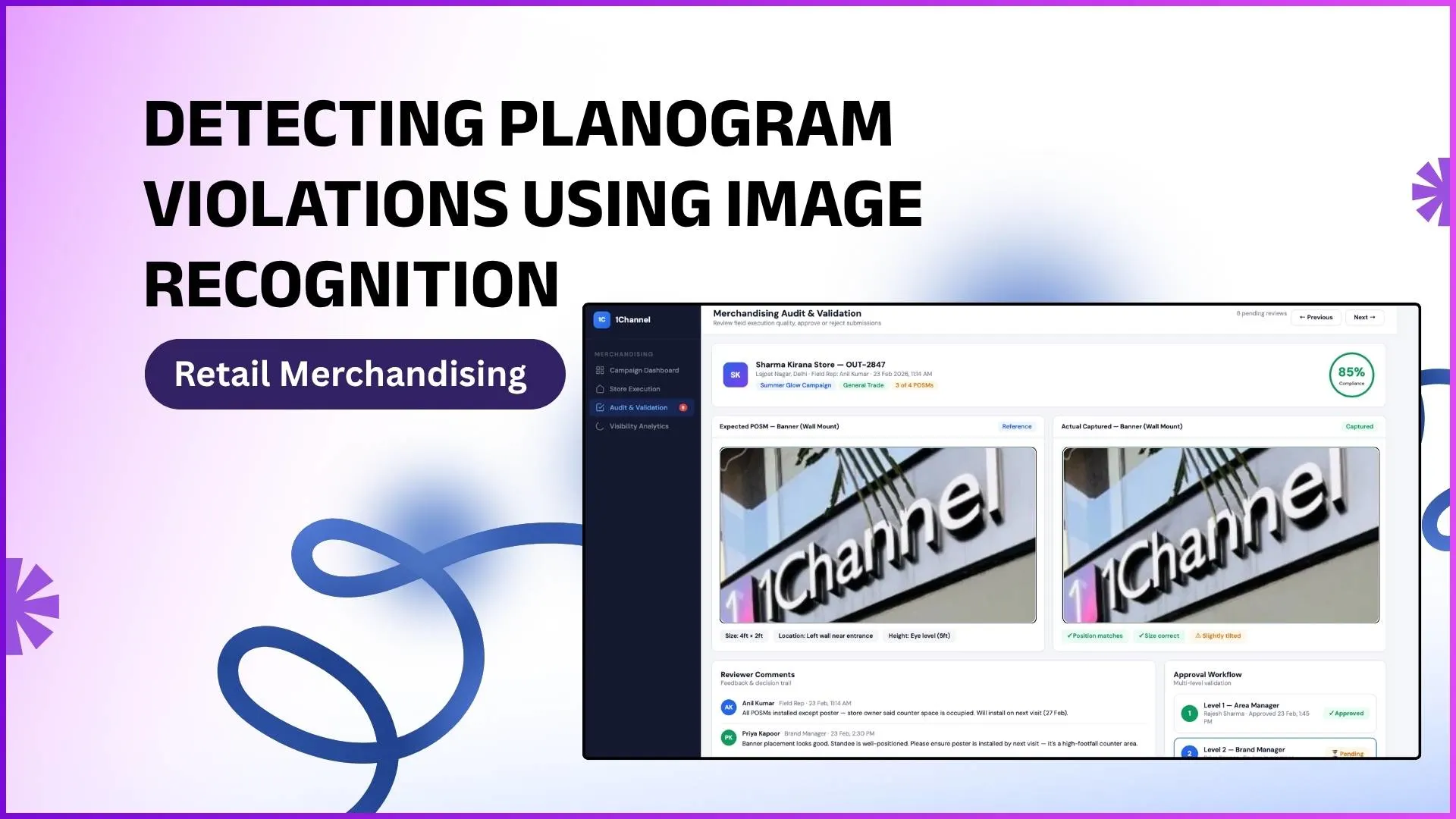
6. Multi-Level AI-Assisted Audits
After data capture, audits validate shelf conditions:
- L1 Audit – Initial verification
- L2 Audit – Secondary validation
- L3 Audit – Supervisor-level accuracy check
AI can assist by:
- Highlighting inconsistencies
- Comparing audit inputs vs image data
- Flagging errors automatically
Example:
If a user reports "3 facings" but the image shows only 2 → system flags mismatch
7. Continuous Automated Auditing
Instead of manually searching data, the system:
- Automatically queues audits
- Presents next store/image for validation
- Enables continuous review
This reduces:
- Time spent searching data
- Human error in identifying gaps
8. Shelf Gap Insights Through Dashboards
AI-powered dashboards convert raw data into actionable insights:
Key Metrics:
- Shelf compliance percentage
- Coverage across outlets
- Visibility index
- SKU-wise performance
Example:
- 42,000 outlets planned
- 62% covered
- 82% compliance within covered outlets
This shows both:
- Where gaps exist (coverage gaps)
- How severe they are (compliance gaps)
9. Identifying Patterns & Repeating Gaps
With continuous data collection, AI helps identify:
- Frequently underperforming SKUs
- Stores with recurring shelf gaps
- Regions with poor compliance
Example:
If a product consistently falls below norm in multiple outlets →
Indicates supply, placement, or demand issue
10. Exception Handling & Real-Time Alerts
The system also allows:
- Users to flag issues (e.g., damaged display, missing products)
- Immediate escalation to supervisors
Example:
- Shelf damaged due to external factors
- Product missing due to stock-out
Marked as exception instead of compliance failure
Key Benefits of AI in Shelf Gap Detection
Real-Time Visibility
No more waiting for reports, gaps are identified instantly
Data-Driven Decisions
Managers can act based on actual shelf performance
Reduced Manual Errors
AI minimizes reliance on subjective human judgment
Scalable Across Thousands of Stores
Handles large retail networks efficiently
Improved Brand Visibility
Ensures products are always:
- Available
- Visible
- Properly placed
Practical Example: End-to-End Shelf Gap Detection
Let's combine everything into a real-world flow:
- Norm set: Product X needs 5 facings
- Merchandiser visits store
- Captures shelf images
- AI analyses image
- Detects only 2 facings
- System flags gap (below norm)
- Audit validates issue
- Dashboard reflects low compliance
- Manager takes corrective action
This entire cycle happens digitally, quickly, and at scale
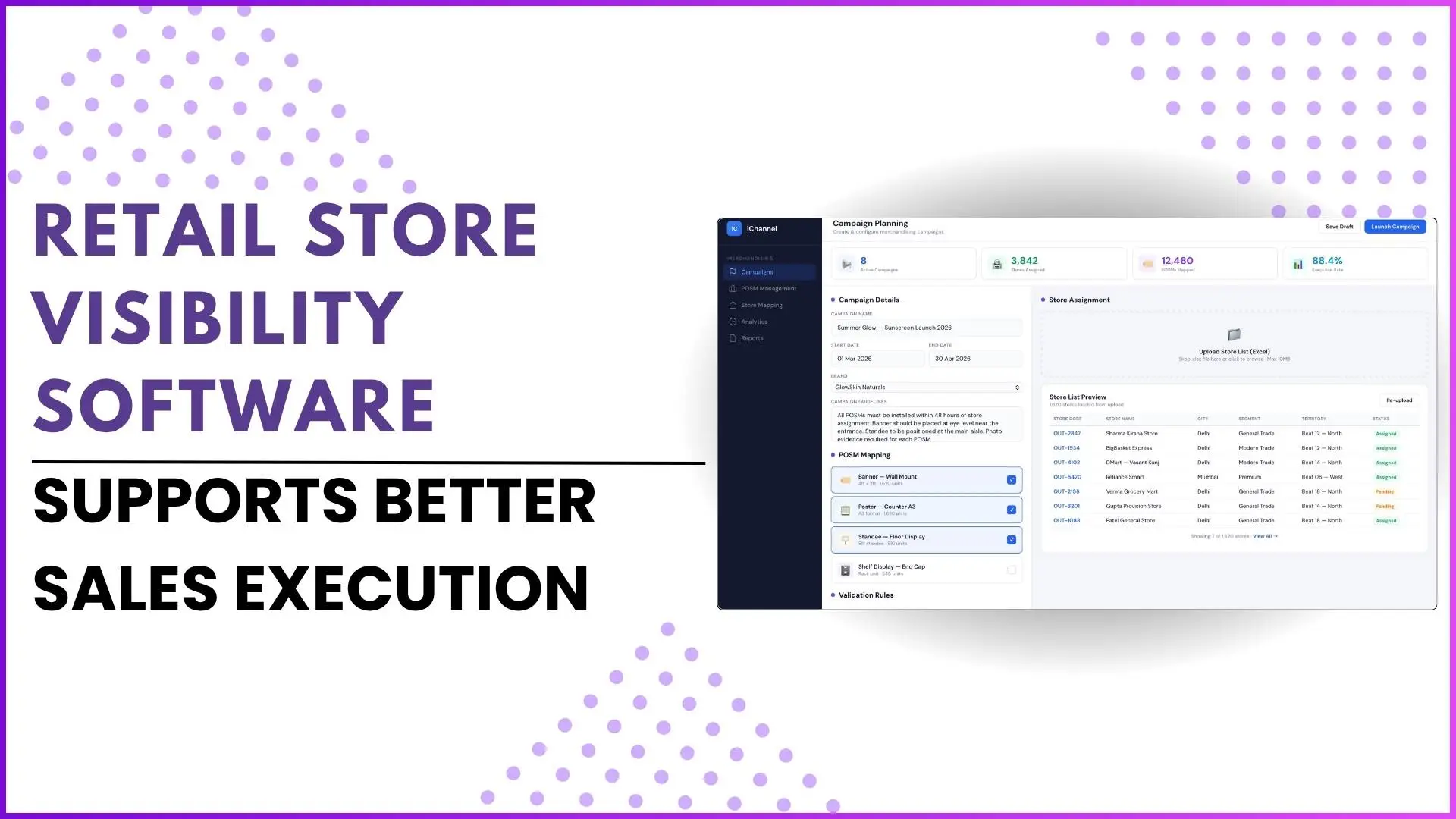
How 1Channel Enables AI-Powered Shelf Gap Detection
1Channel's retail merchandising solution brings together:
- AI-driven image recognition for shelf analysis
- Structured campaign and merchandising workflows
- Multi-level audit systems for accuracy
- Real-time dashboards for visibility tracking
- Automated compliance scoring and gap detection
With capabilities like:
- Facings tracking
- Hot zone validation
- Brand placement checks
- Continuous audit automation
1Channel helps businesses move from:
Manual shelf checks → Intelligent, AI-driven retail execution
Explore 1Channel Retail Execution Management
1Channel Retail Execution Management delivers AI-driven image recognition, shelf visibility monitoring, multi-level audits, real-time dashboards, and automated compliance scoring to help brands detect and fix shelf gaps at scale.
Explore Retail Execution Management →FAQs
1. Which industries benefit the most from AI-powered shelf gap detection?
Industries with strong retail presence and in-store visibility dependence benefit the most, such as:
- FMCG
- Alcohol & Beverage
- Consumer Electronics
- Consumer Durables
- Retail Chains
These industries rely heavily on product placement, visibility, and compliance, making AI-driven detection highly valuable.
2. Why is the FMCG industry highly suited for AI shelf gap detection?
FMCG products have:
- High SKU volume
- Fast movement
- Strict visibility requirements
Example:
A product expected to have 10 facings but showing only 5 can directly impact sales, AI helps detect and fix this instantly across multiple outlets.
3. How does the alcohol & beverage industry benefit from these AI features?
This industry often works with:
- Strict shelf placement norms
- Defined facings per SKU
- Brand-specific visibility guidelines
Example: Different SKUs require different facings based on outlet size and product type. AI helps ensure compliance with these norms across stores.
4. Can consumer electronics brands use AI for shelf gap detection?
Yes, but their use case is slightly different. Instead of facings, they focus on:
- Device display presence
- Demo unit availability
- Branding visibility
Example:
Ensuring demo devices are properly placed and functional rather than counting product units.
5. How do consumer durable companies benefit from this system?
Consumer durable brands (like appliances) use AI to:
- Track product placement
- Ensure display cleanliness and visibility
- Monitor in-store branding
Example:
Tracking whether appliances are properly placed and maintained as per visual merchandising standards.
6. Is AI shelf gap detection useful for retail chains and supermarkets?
Absolutely. Retail chains benefit from:
- Standardized shelf execution
- Centralized visibility tracking
- Large-scale compliance monitoring
Example:
Tracking whether all stores maintain required product placement standards across regions.
7. Can non-retail industries also benefit from these AI capabilities?
Yes, industries that rely on on-ground marketing and visibility can also benefit, such as:
- Banking & Financial Services
- Healthcare
- Service-based businesses
Example:
Campaign-based visibility tracking (like promotional setups or branding installations) can be monitored using similar workflows.
8. How does AI help industries running frequent marketing campaigns?
Industries with seasonal or campaign-driven promotions benefit by:
- Tracking execution in real time
- Measuring campaign visibility
- Identifying gaps instantly
Example:
A seasonal campaign where branding elements must be displayed—AI ensures compliance across all outlets.
9. Is this solution customizable for different industries?
Yes, the system supports:
- Industry-specific parameters
- Custom workflows
- Flexible merchandising rules
Example:
While one industry tracks facings and shelf placement, another may track device security or display hygiene.
10. Which businesses should prioritize AI shelf gap detection first?
Businesses should prioritize this if they:
- Operate across multiple outlets
- Depend on in-store visibility for sales
- Run frequent merchandising campaigns
- Struggle with execution consistency
These businesses gain the fastest ROI from AI-driven retail execution systems.