Training a sales team effectively requires more than uploading content and hoping people watch it. A new promoter joining an electronics brand in Selangor needs different knowledge from a team leader who has been managing retail outlets for two years. Sending both the same training materials wastes the new hire's time with advanced content they cannot yet apply, while boring the experienced leader with basics they already know.
LMS modules with level-based access solve this by structuring training into progressive stages. Each employee sees only the training relevant to their current role and experience level. As they complete modules, pass quizzes, and meet promotion criteria, the next level of training unlocks automatically. This creates a learning path that grows with the employee rather than dumping everything at once.
This article explains how modules work in a sales team LMS, why level-based visibility matters, and how Malaysian businesses can use this structure to train distributed field teams more effectively.
Table of Contents
What Is a Module in a Sales Team LMS
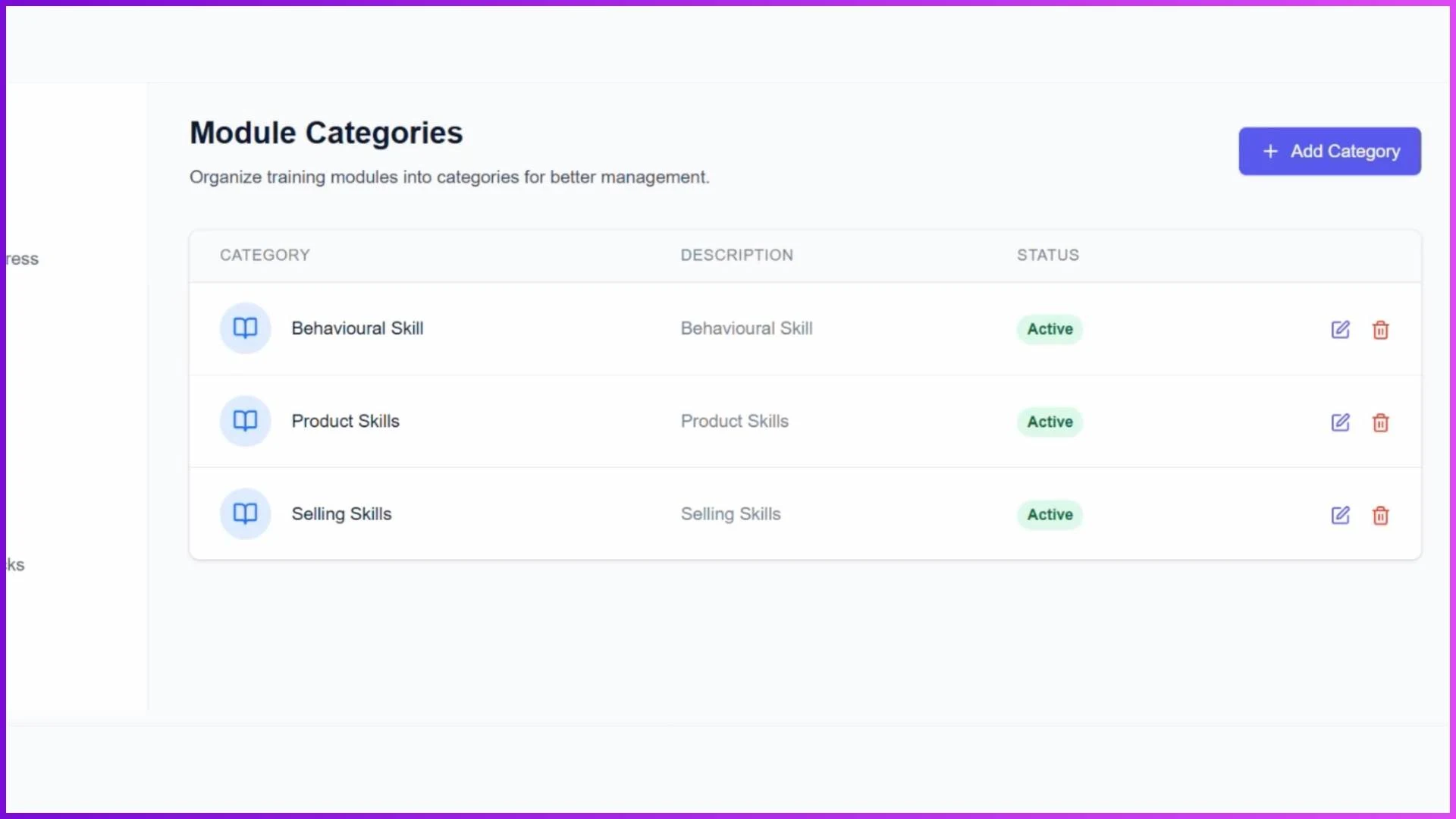
A module is a focused learning unit built under a broader category. Categories represent the type of skill being trained, such as Product Knowledge, Selling Techniques, Compliance, or Behavioural Skills. Each module within a category targets one specific learning objective.
For example, a consumer electronics company might structure their training like this:
- Category: Product Knowledge
- Module: Air Conditioner Range Overview
- Module: Smart TV Features and Comparison
- Module: New Washing Machine Launch Q3
- Category: Selling Skills
- Module: Handling Customer Objections
- Module: Upselling and Cross-Selling Techniques
This structure keeps training organised and measurable. Instead of a single massive training folder, every piece of content sits inside a specific module with a clear purpose. The admin knows exactly what each module covers, and the employee knows exactly what they are expected to learn.
Level-Based Module Visibility
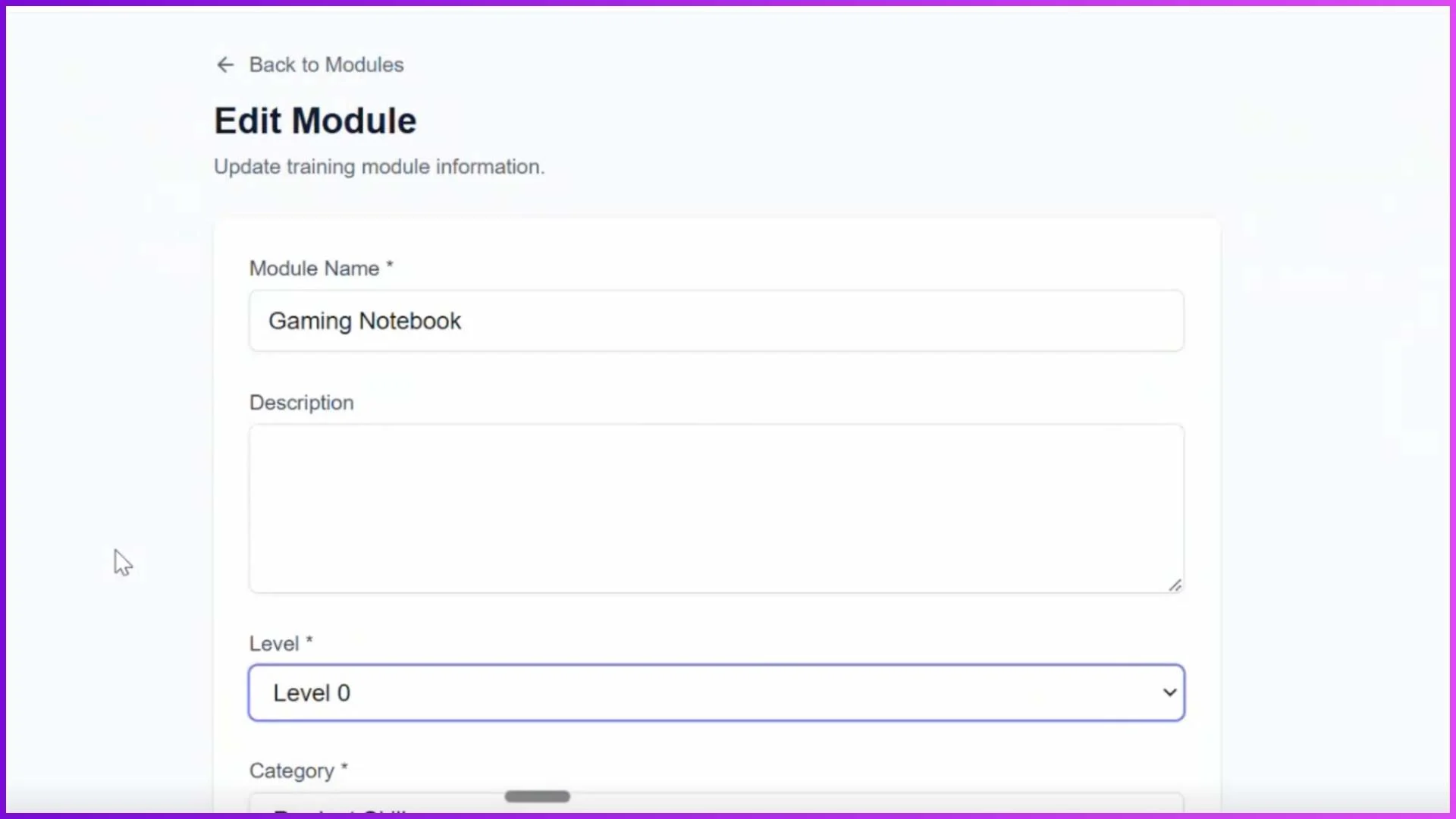
The most operationally valuable aspect of modules is level-based access control. When creating a module, the admin defines which employee level can access it. Employees at other levels simply do not see that module in their app.
Here is how this works in practice for a Malaysian FMCG company with promoters across Klang Valley retail outlets:
- Level 0 (New Joiners): Modules covering company introduction, basic product range, store conduct guidelines, and the attendance and reporting process. A promoter who just started last week sees only these foundational modules.
- Level 1 (3-6 months experience): Modules on advanced product features, competitor comparison, and basic selling techniques. These unlock once the employee completes all Level 0 modules and passes the associated quizzes.
- Level 2 (Team Leaders): Modules on team management, performance reporting, store visit planning, and escalation handling. A promoter who gets promoted to team leader gains access to these modules automatically based on their new role level.
This prevents two common problems. New hires are not overwhelmed with content they cannot yet apply. Experienced employees are not stuck reviewing material they mastered months ago. Every person sees training that matches where they are right now.
How Progressive Learning Works Through Modules
In a well-structured LMS, learning happens step by step rather than all at once. The module system supports this naturally through a progression flow:
- An employee joins the company and is assigned a level (for example, Level 0).
- They can access only the modules assigned to that level in their LMS app.
- Each module contains training sessions in various formats, including classroom sessions for group training, virtual sessions for remote teams, in-store sessions for on-ground demonstrations, or e-learning content they can complete at their own pace.
- Once the employee completes the required criteria for their level, such as finishing all modules, passing quizzes, reaching a minimum tenure, or hitting productivity benchmarks, the next level of modules unlocks.
- New, more advanced content becomes visible in their app, and the cycle continues.
For a telco company training promoters across outlets in Penang, Johor, and Sabah, this means a promoter in Kota Kinabalu and a promoter in Georgetown both follow the same structured progression, even though they were trained through different session formats (one via in-store, the other via virtual). The modules ensure consistency in what is learned, while the session types provide flexibility in how it is delivered.
How Modules Connect to Training Sessions
Modules are not just content containers. They act as the organising layer that holds training sessions together. Under a single module, the admin can add any combination of session types:
- Classroom sessions for physical group training at a central venue.
- Virtual sessions conducted via Google Meet, Teams, or Zoom with embedded meeting links.
- In-store sessions where trainers visit retail outlets and provide on-ground demonstrations with geo-tagged attendance.
- E-learning sessions using PDFs, images, and videos that employees complete at their own pace through the app.
This flexibility is important because the same module might need to be delivered differently in different locations. A product knowledge module for a home appliance brand might be delivered as a classroom session in KL where 30 promoters can gather at a training centre, but as an e-learning module for 5 promoters scattered across rural outlets in Sarawak where physical gathering is impractical.
The module stays the same. The learning objectives stay the same. Only the delivery method adapts to the circumstances.
Tracking and Accountability Through Modules
Every module in the LMS is fully trackable. The admin dashboard shows which employees are enrolled in each module, who has completed it, how long completion took, and performance data broken down by level and region.
This tracking capability turns training from an assumed activity into a verified one. Instead of asking "Did the Penang team complete the new product training?" and getting a vague "Yes, I think so," the admin can see that 28 of 30 Penang promoters completed the module, 2 have not started, and the average quiz score was 78 percent. That precision changes how training decisions are made.
The data also surfaces patterns that would be invisible without module-level tracking. If Level 0 employees consistently score low on a particular module, the content might need simplifying. If Level 1 employees complete a module in half the expected time, it might be too basic for their level and needs upgrading. These insights only emerge when training is structured into measurable modules rather than delivered as unstructured content.
Explore Sales Team LMS
1Channel's LMS platform supports structured modules with level-based access, progressive learning paths, multi-format sessions, and detailed completion analytics for field sales teams.
Explore LMS Software →5 Things to Remember About LMS Modules
- Modules are not just folders. They are structured learning units with defined objectives, assigned levels, linked sessions, and attached quizzes. Treat them as the building blocks of your training system, not as file storage.
- Level-based access prevents information overload. New employees see only what they need to learn now. Advanced content unlocks progressively as they grow. This keeps training relevant and engagement high.
- The same module can be delivered through different session types. A product knowledge module can run as a classroom session in KL and an e-learning module in East Malaysia. The learning objective stays consistent even when the delivery method changes.
- Module completion data is your training audit trail. Instead of guessing whether training happened, the LMS shows exactly who completed what, when, and how they scored. This data is essential for compliance, performance reviews, and identifying skill gaps.
- Modules should evolve as your business does. When a new product launches, add a module. When a process changes, update the relevant module. When an employee level is added, create the corresponding training path. The module structure scales naturally.
Structured modules are what separate a functional training system from a content dump. For Malaysian businesses managing field sales teams across multiple states, the ability to deliver the right training to the right person at the right stage of their career is the difference between a team that improves consistently and one that plateaus after onboarding. Get in touch to explore how LMS modules can structure your team's learning path.