At 2:30 PM on a Wednesday, a regional operations manager in Petaling Jaya receives a call from a key account, a major hypermarket chain, asking why the scheduled merchandising visit at their Bangsar South outlet did not happen. The manager has no immediate answer. She opens her email, scrolls through the morning WhatsApp group, calls the assigned rep, gets voicemail, and finally reaches the team leader who says the rep was "redirected to another store." By the time the situation is understood and a replacement visit is arranged, the store has moved on to another supplier's activation slot.
This kind of operational blind spot does not happen because managers are careless. It happens because the information flow between the field and the office is delayed, fragmented, and reactive. The manager only discovers problems after they have already caused damage.
Real-time visibility into field operations, enabled by cloud-based SFA software, changes this dynamic fundamentally. Instead of waiting for information to arrive through calls, messages, and end-of-day reports, managers see field activity as it happens: who is where, what they are doing, what they have completed, and what has been missed. The shift is from managing by reports to managing by reality.
Table of Contents
What Real-Time Actually Means in Field Sales
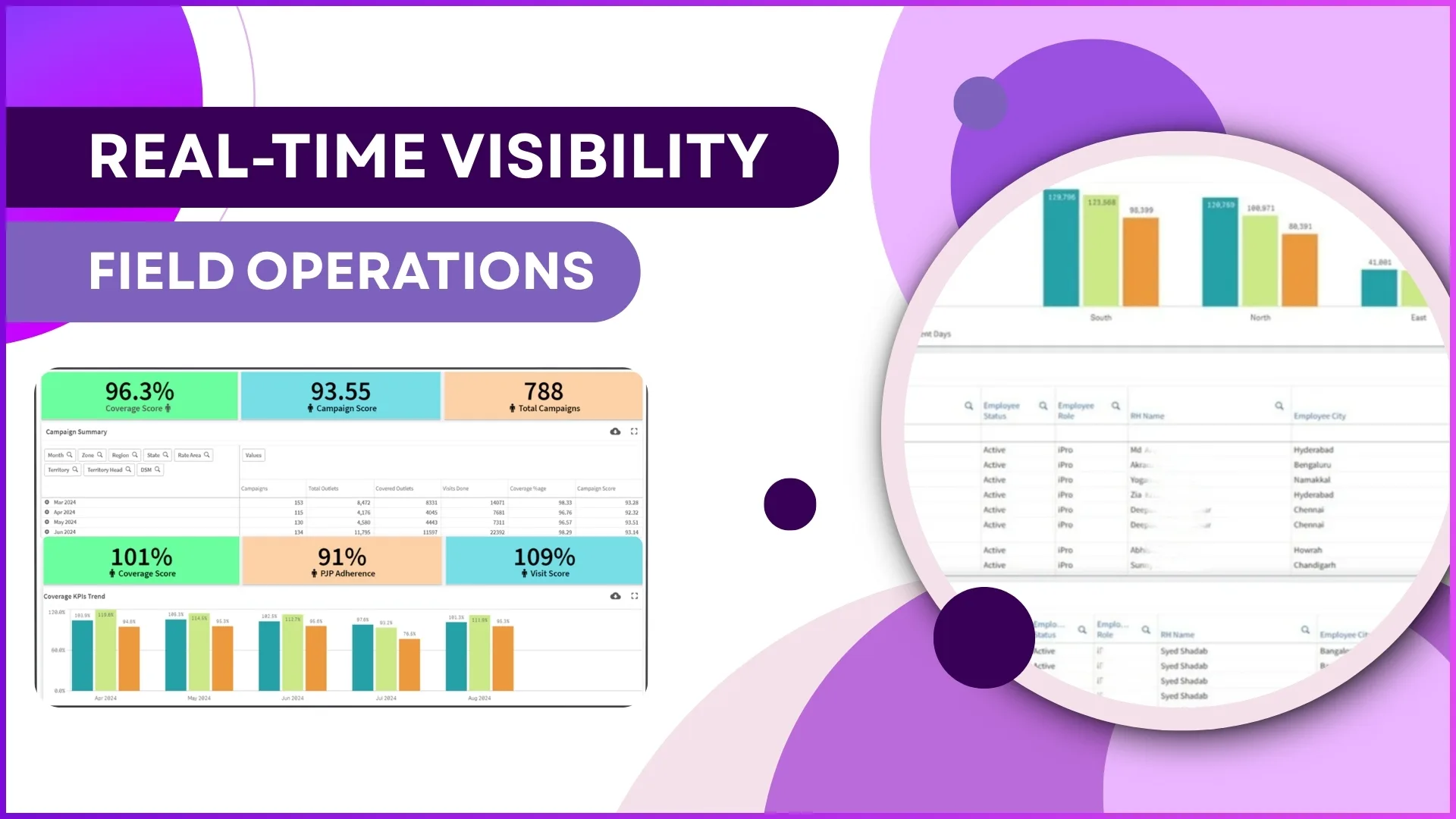
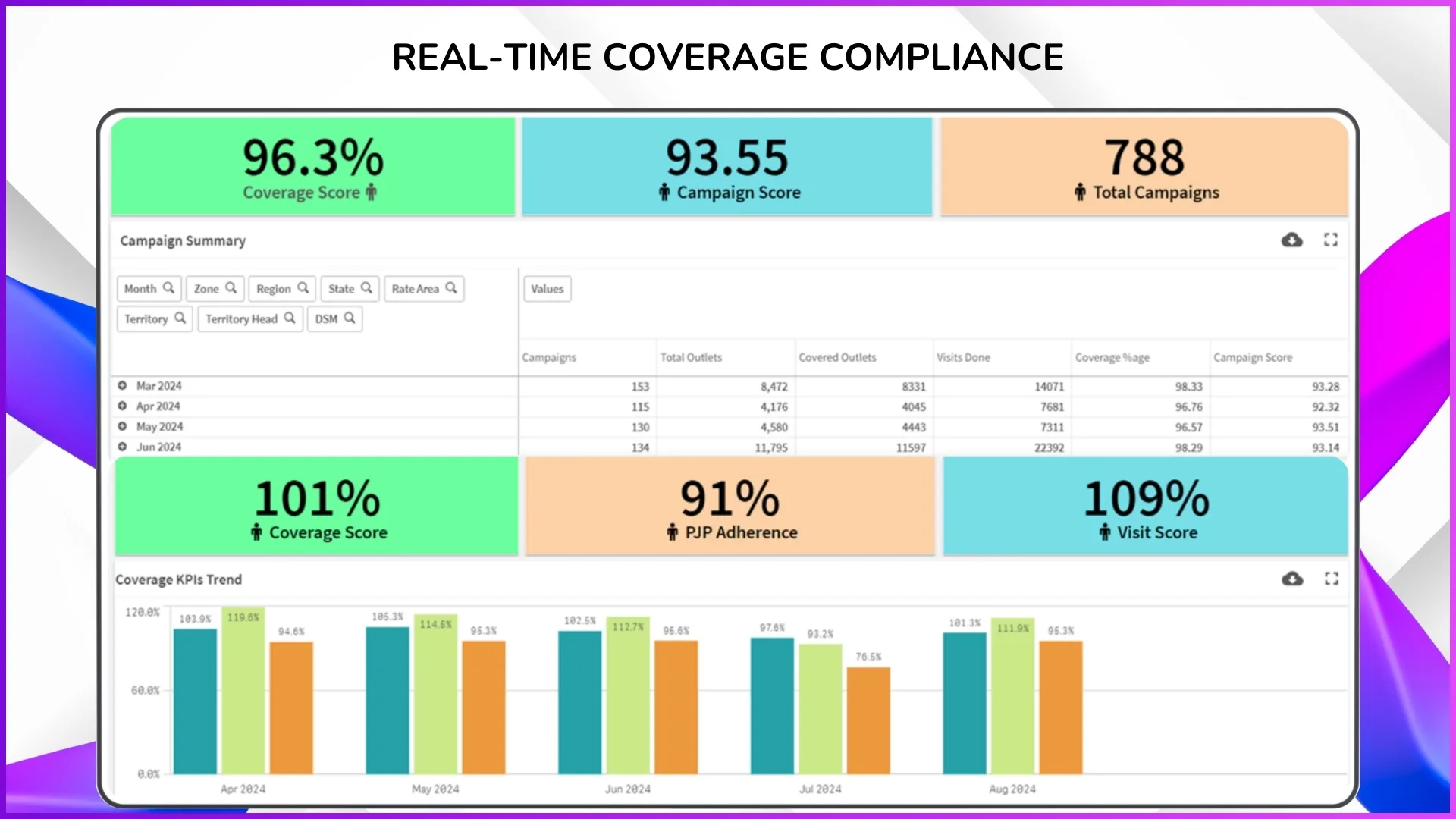
Real-time visibility is not a vague concept. In the context of an SFA platform, it means that every field action, including attendance, store check-in, order placement, photo capture, questionnaire submission, and expense entry, is recorded on the rep's mobile app and synced to the cloud-based admin portal within seconds. The manager's dashboard reflects the current state of field operations, not yesterday's state.
Specifically, this includes:
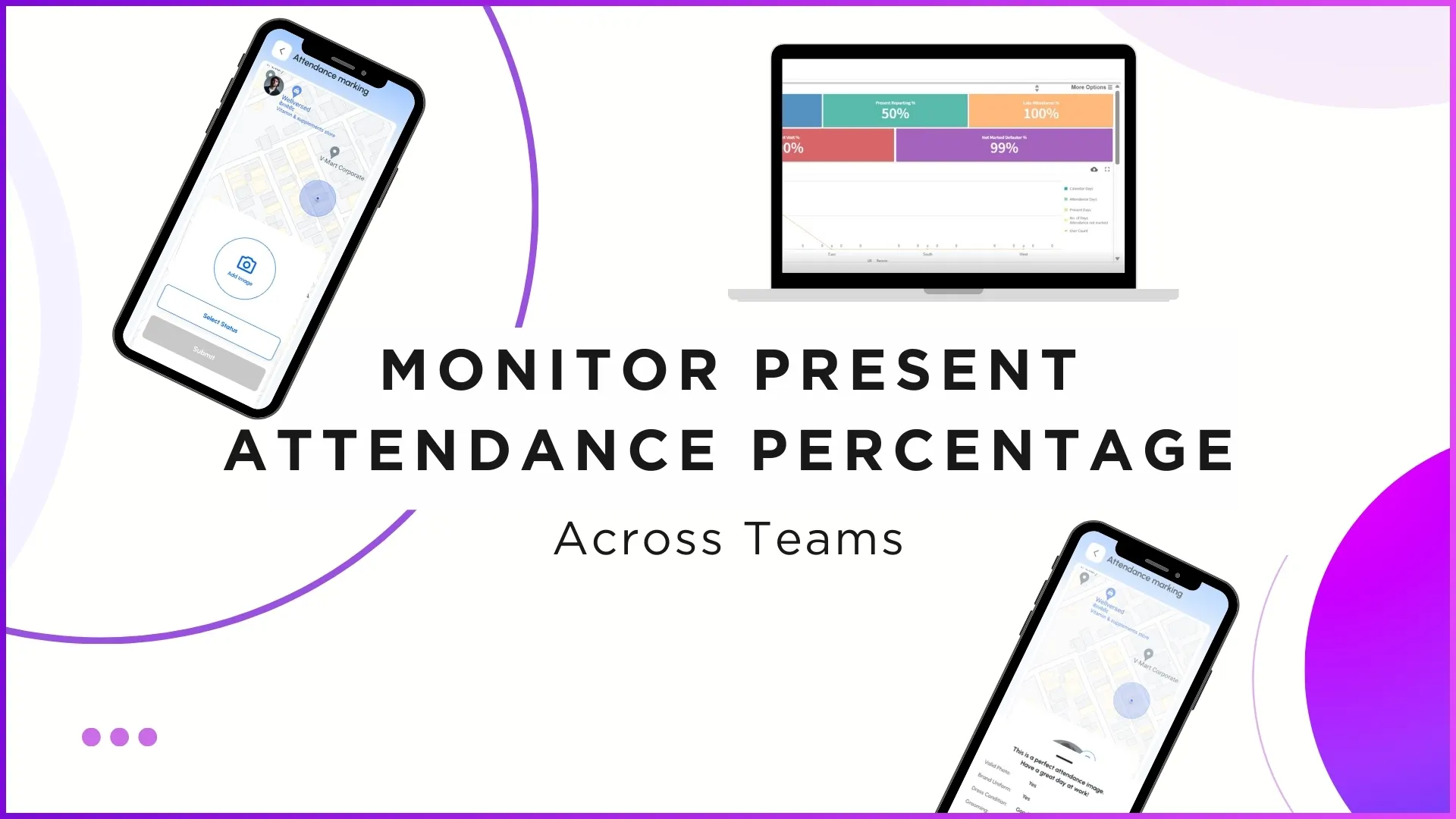
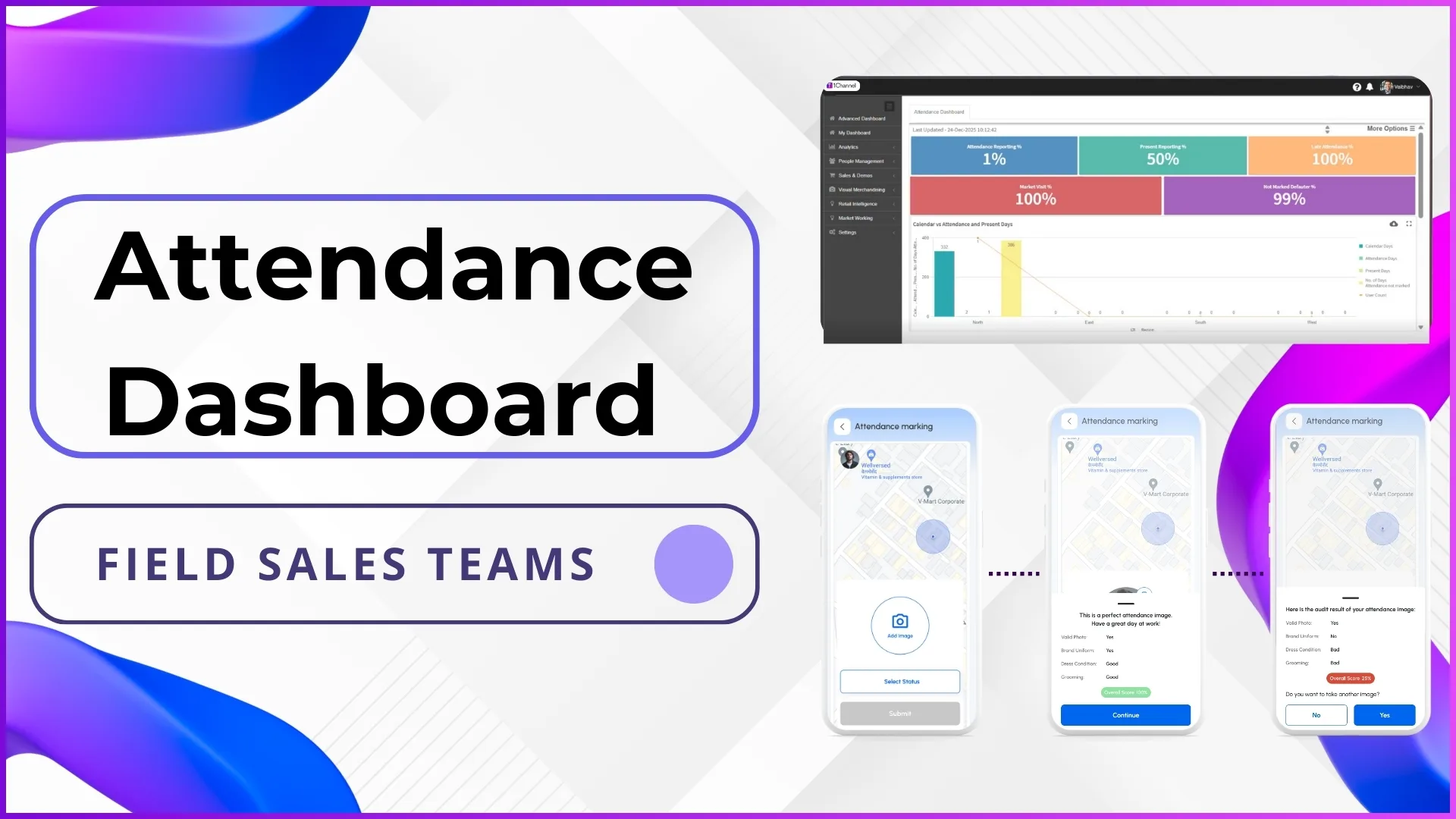
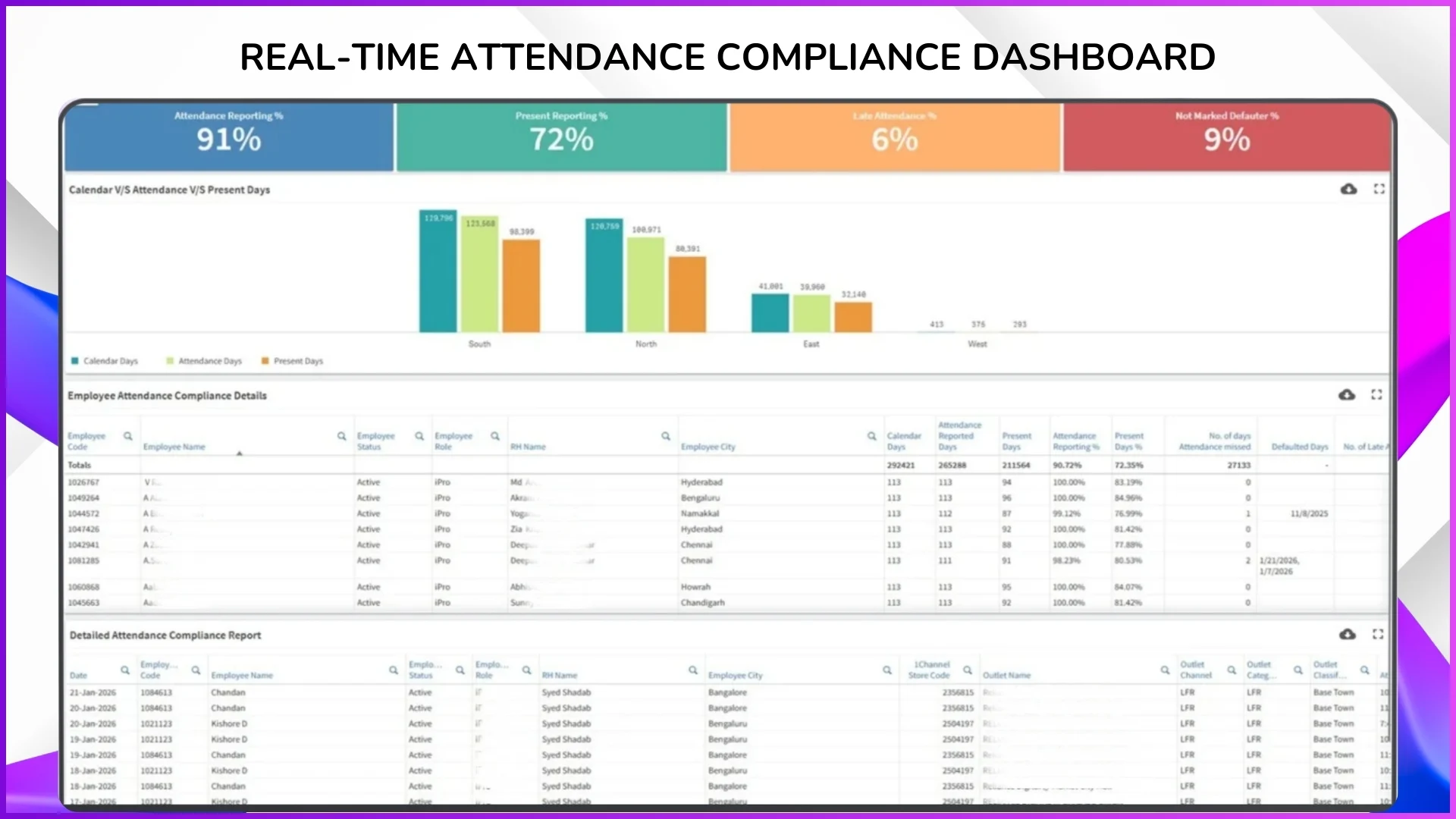
- Live attendance status. At 9:15 AM, the dashboard shows exactly which reps have marked attendance, which are late, and which have not reported. Each check-in includes AI-validated photos and GPS coordinates for each check-in.
- Visit progress tracking. As each rep completes a store visit, the check-in timestamp, GPS location, activities performed, and check-out time appear on the dashboard. A manager can see at any moment how many of the day's planned visits have been completed across the entire team.
- Order and sales data. Orders captured in the field appear on the portal immediately, showing product, quantity, value, and the outlet where the order was placed. There is no waiting for the rep to return to the office or email a summary.
- Activity and questionnaire responses. If reps are conducting store audits, competitor surveys, or hygiene checks, the responses flow into the system in real time, available for review and analytics the moment they are submitted.
- Expense submissions. Claims logged during the day appear in the approval queue as they are submitted, with receipt photos and GPS tags attached.
The underlying mechanism is simple: the mobile app captures data with metadata (timestamp, GPS, device ID, photos) and syncs it to the cloud. The admin portal reads from the same cloud database. There is no batch processing, no file transfer, no manual compilation step.
Six Layers of Visibility That Change How Managers Operate
Real-time visibility is not a single feature. It is an accumulation of six distinct data layers that together give managers a complete picture of field operations at any moment.
Layer 1: Attendance and Presence
Who is in the field right now? The attendance dashboard shows reporting percentage, present percentage, late attendance, and defaulters. For a company with 80 reps across Selangor and Johor, this answers the most basic operational question within seconds of logging in.
Layer 2: Beat Plan Compliance
Are reps following their planned routes? The system compares the day's beat plan against actual check-ins. If a rep was assigned to visit 12 outlets in Subang Jaya but has checked into only 3 by 1 PM, the deviation is visible immediately rather than at the end of the day.
Layer 3: Visit Activity and Quality
What is happening inside each visit? Beyond check-in and check-out, the system captures which activities the rep performed, such as stock checks, order placement, merchandising photos, and questionnaire submissions. A visit with a check-in but no activities may indicate the rep did not actually engage with the outlet.
Layer 4: Sales and Order Data
How much revenue is being generated in real time? As orders are placed through the app, product-level and outlet-level sales data populates the dashboard. Managers can track daily sales progress against targets without waiting for end-of-day compilations.
Layer 5: Expense and Claims
What are field operations costing today? Expense claims submitted during the day appear in the approval workflow with GPS tags and receipt photos. Managers can track field spending as it happens rather than discovering cost overruns at month-end.
Layer 6: Exceptions and Alerts
What needs immediate attention? The system surfaces anomalies automatically, such as reps who have not reported by 10 AM, visits that took less than 2 minutes (possible fake check-ins), orders that exceed credit limits, expense claims that breach daily caps. These alerts enable intervention before small issues become operational failures.
Before and After: How Decisions Change with Real-Time Data
The practical impact of real-time visibility is best understood through the decisions it enables, particularly those that are impossible or severely delayed without live data.
Coverage recovery
Without real-time data: A manager discovers at 6 PM that 15 outlets in Klang were not visited because two reps called in sick. Tomorrow's schedule is already full. Those outlets go uncovered for the week.
With real-time data: At 9:30 AM, the dashboard shows two defaulters in the Klang territory. The manager reassigns 8 high-priority outlets to nearby reps who have lighter schedules. By noon, 6 of those outlets have been visited. Coverage gap reduced from 15 missed outlets to 2.
Sales target intervention
Without real-time data: At the weekly review meeting, the manager discovers that Penang territory is 40% behind its monthly target with only one week remaining. The opportunity for course correction has mostly passed.
With real-time data: By the 15th of the month, the dashboard shows Penang at 35% of target against an expected 50%. The manager identifies three high-potential outlets that have not been visited this month, reallocates focus, and initiates a targeted push. By month-end, Penang reaches 82% of target instead of the projected 60%.
Compliance enforcement
Without real-time data: A quarterly audit reveals that 12% of claimed store visits in East Malaysia had no corresponding GPS data, suggesting some visits may not have occurred. The issue is months old and difficult to address retroactively.
With real-time data: The system flags visits without GPS data on the same day they are submitted. The manager contacts the rep immediately. If the issue is a device problem, it gets resolved. If the issue is fabrication, it is caught on day one, not month three.
The Analytics Layer: From Visibility to Intelligence
Real-time visibility provides the raw data. The analytics layer built on top of that data transforms it into operational intelligence. The SFA platform includes a report catalogue with pre-built reports covering every aspect of field operations:
- Attendance summary reports that provide detailed attendance data for any date range, exportable to Excel for payroll integration
- Beat compliance reports showing stores covered versus planned, calculated daily for each rep
- Visit productivity reports with daily store visit counts per rep, with detailed breakdowns of activities performed per visit
- Sales productivity reports covering SKU-wise sales by store, by value and by unit, with average daily productivity calculations
- Distance and movement reports tracking distance travelled between stores, first and last transaction times, time spent in the field
- Store visit reports providing comprehensive single-visit reports with all captured data, downloadable as PDFs
Beyond pre-built reports, a report builder allows administrators to create custom reports by selecting dimensions (attendance, sales, merchandising, stock), filters (location, role, time period), and output formats. This means the analytics adapt to the organisation's questions rather than forcing the organisation to adapt to pre-defined reports.
What Happens When Connectivity Drops
Malaysia's mobile network coverage is strong in urban centres but inconsistent in rural areas, particularly interior Sabah and Sarawak, parts of Pahang and Kelantan, and some industrial zones with poor indoor coverage. A real-time system that fails when connectivity drops is not truly operational.
Cloud-based SFA platforms handle this through offline-first architecture. The mobile app stores all field actions locally on the device. Attendance marking, visit check-ins, order capture, photo uploads, and questionnaire submissions all work without an active internet connection. When connectivity resumes, whether seconds, minutes, or hours later, the app syncs all pending data to the cloud.
From the manager's perspective, there may be a brief delay before a rural rep's data appears on the dashboard, but the data itself is complete and accurate. GPS coordinates and timestamps are captured at the time of action, not at the time of sync, ensuring the data reflects when and where things actually happened.
Different Roles, Different Views of the Same Data
Real-time visibility does not mean everyone sees everything. The SFA platform implements role-based access that tailors the dashboard to each user's scope:
- National or regional managers see aggregated data across all territories. They focus on coverage rates, target achievement, and team-level compliance trends. They can drill down into any territory for detail.
- Area or territory managers see data only for their assigned teams. They work at the individual rep level, reviewing visit completion, order values, attendance compliance, and exception flags for their direct reports.
- Team leaders see their immediate team's performance. They use the work summary feature to review each rep's daily activities, including attendance timing, stores visited, and tasks completed.
- Field representatives see their own data through the mobile app, including their personal attendance calendar, target progress, order history, and weekly sales trends. They cannot access other reps' data or team-level dashboards.
This hierarchy ensures that sensitive data remains within appropriate boundaries while providing each management level with the visibility they need to perform their role effectively.
Explore Sales Force Automation
1Channel's cloud-based SFA delivers real-time visibility across attendance, visits, orders, expenses, and performance, backed by AI validation, automated analytics, and offline-first architecture.
Explore SFA Solutions →Why Real-Time Visibility Is Particularly Relevant for Malaysian Field Operations
Several characteristics of the Malaysian market make real-time field visibility especially valuable:
- Geographic fragmentation. Field operations in Malaysia routinely span Peninsular Malaysia and East Malaysia, separated by the South China Sea. Managing teams in Kuching and Kota Kinabalu alongside teams in KL and Johor without real-time data means effectively running two disconnected operations.
- Multi-channel retail landscape. Malaysian retail includes hypermarkets (Aeon, Lotus's, NSK), convenience chains (7-Eleven, 99 Speedmart, myNEWS), traditional trade outlets, and pharmacy chains (Watsons, Guardian). Each channel has different visit requirements and service levels. Real-time visibility allows managers to monitor execution quality across all channels simultaneously.
- High field rep mobility. Urban reps in Klang Valley may visit 12 to 15 outlets daily, covering distances of 40 to 60 kilometres. Without live tracking, there is no way to verify whether routes are being followed efficiently or whether reps are spending disproportionate time at specific outlets.
- Competitive intensity. In categories like FMCG, beverages, and personal care, shelf space and visibility at retail outlets are contested daily. A missed merchandising visit means a competitor fills that space. Real-time alerts on missed visits allow immediate recovery actions.
Frequently Asked Questions
Does real-time visibility require constant internet connectivity?
No. The SFA mobile app operates offline and syncs data when connectivity is available. All field actions are captured with accurate timestamps and GPS coordinates regardless of network status. The dashboard updates as soon as sync occurs.
Can real-time data be used for performance reviews?
Yes. The analytics module aggregates real-time data into performance reports covering attendance compliance, visit productivity, sales achievement, and beat plan adherence. These reports provide objective, data-backed inputs for monthly and quarterly performance reviews.
How does the system handle large teams across multiple states?
Role-based access and territory filters allow managers to view data at the level relevant to them. A national manager sees aggregated national data and can drill into any state. A state manager sees only their territory. The platform is designed to scale from 10 reps to 1,000+ without dashboard performance degradation.
Is real-time visibility the same as GPS tracking?
GPS tracking is one component. Real-time visibility includes attendance status, visit completion data, order and sales information, activity responses, expense submissions, and exception alerts, all flowing into a unified dashboard. GPS provides the location context, but visibility encompasses everything the rep does in the field, not just where they are.
Can custom dashboards be created for specific business needs?
Yes. The SFA platform provides default dashboards for common use cases. Beyond that, the report builder and configurable dashboard elements allow administrators to create views tailored to their specific KPIs, industry requirements, or management reporting needs.
Final Thoughts
The difference between a well-managed field operation and a struggling one often comes down to timing. The same piece of information, whether a missed visit, a declining sales trend, or an absent rep, has vastly different value at 10 AM versus 6 PM. At 10 AM, it is actionable. At 6 PM, it is a historical record.
Real-time visibility into field operations is what closes the gap between the moment something happens in the field and the moment management knows about it. For Malaysian businesses operating across diverse geographies, retail channels, and team structures, this visibility is not a reporting upgrade. It is an operational capability that determines whether managers are leading their teams or simply following up on what already happened.
The question is not whether your field teams are working. The question is whether you know what they are doing right now, and whether you can act on that knowledge before the day ends. Get in touch to explore how 1Channel's SFA platform provides real-time visibility for your field operations.