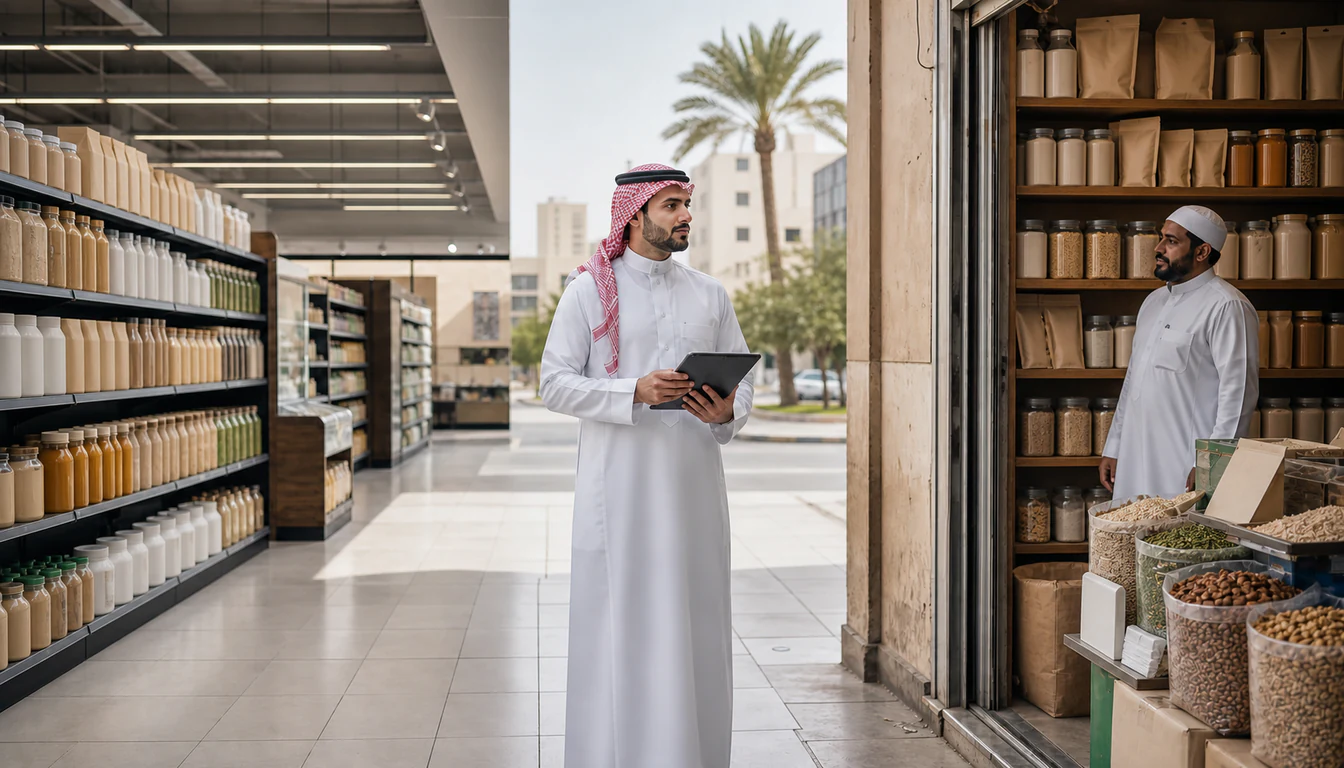
On any given day, a distributor's field team in Riyadh, Jeddah or Dammam might include a Saudi supervisor, a merchandiser from South Asia, a warehouse picker from another expatriate community and a Saudi delivery driver, all working the same route or the same shift. Saudi Arabia's private sector runs on a majority-expatriate workforce, drawing heavily from South Asian and other expatriate communities alongside Saudi nationals, and nowhere is that mix more visible than on the ground: in the van, on the sales beat, in the warehouse aisle.
For a distributor or FMCG brand, that mix is simply how the business works. But it creates a real operational question that head-office software rarely answers well: what happens when the training material, the app interface and the daily instructions only exist in one language? A single-language rollout quietly under-serves part of the team, and the cost shows up later, in missed steps, inconsistent execution and reps who nod along in a briefing without following most of it.
Separately, and just as real, Saudization, known locally as Nitaqat, is a live compliance programme administered by the Ministry of Human Resources and Social Development (MHRSD), with genuine consequences for companies that cannot show their workforce mix clearly. Training a diverse field force well and reporting on that workforce accurately turn out to be two sides of the same HR problem, not two separate projects.

A Field Force Built From Many Nationalities
Walk into a distributor's warehouse in the Eastern Province or a modern trade backroom in Jeddah and the mix of nationalities on the floor is the norm, not the exception. Pickers, loaders, merchandisers and drivers often come from several different countries, working alongside Saudi supervisors and sales staff.
That mix extends to the customer-facing side too. A van sales rep covering a route through Riyadh's suburbs might speak Arabic with one baqala owner, English with a mini-market manager, and rely on a shared second language with a fellow rep to close out the day's paperwork. None of this is unusual, and it is not a problem the business needs to solve by asking everyone to work in a second language.
What it does mean is that any tool, script or training programme built around a single working language will always be optimised for part of the team and merely tolerated by the rest.
The Cost of a Single-Language Training Programme
Most field training gets written once, in whichever language head office defaults to, and handed down as-is. New joiners sit through an induction session, skim a printed manual, and are expected to work independently within days.
When a meaningful share of that group is learning the material in a second or third language, retention drops even when nobody says so out loud. Reps nod through a briefing, pass a basic quiz, and then fall back on whatever a more experienced colleague happens to show them informally on the route. Standard operating procedure quietly becomes "however the last person explained it to me".
The practical symptoms are familiar to most field operations managers: inconsistent visit steps between reps covering the same territory, merchandising standards that vary warehouse to warehouse, and new joiners who take far longer than expected to reach full productivity. None of that is a discipline problem. It is a training-design problem.
Building Multilingual Training That Actually Lands
Multilingual training does not mean producing a slide deck in five languages and hoping someone translates it. It means pairing the classroom with a structured learning management system that pushes the same module out in more than one language and tracks who has actually completed it.
Translate the Material, Not Just the Words
A literal, word-for-word translation of a Saudi Arabic training manual often loses the practical instructions in the process. Effective multilingual training rewrites each module for the language it is delivered in, using terms and examples the audience recognises, whether that covers baqala coverage steps, hypermarket merchandising standards or basic collection procedures.
Let the App Speak the Rep's Language
The field app itself matters as much as the classroom session. A rep who can switch the visit checklist, the order screen and the error messages into their own language makes fewer mistakes and needs less hand-holding from a supervisor. A mobile DMS app that supports multiple interface languages turns training into something the rep reinforces daily, just by using the tool.
Make Refresher Training Ongoing, Not a One-Time Event
New SKUs, seasonal promotions around Ramadan, and updated pricing rules all need to reach the field quickly, in every language the team works in. Short, scheduled refreshers, delivered through the same tool reps already use for their daily visits, keep the whole team current instead of leaving newer joiners to catch up informally.
Keeping Onboarding Consistent Across a Mixed-Nationality Team
Consistency is the real goal, not translation for its own sake. A new merchandiser joining a Dammam distributor should learn the same visit steps, the same photo-proof standard and the same escalation process as a merchandiser joining the same company's Riyadh branch, regardless of which language they are most comfortable working in.
That consistency breaks down fastest at the edges: informal on-the-job coaching that varies rep to rep, manuals that exist in only one language, and induction schedules compressed whenever the business is short-staffed. Standardising the onboarding path across cities, and delivering it in the languages the new joiner actually understands, closes that gap. A workforce management system that centralises employee records across branches makes that standard easier to enforce.
- One onboarding checklist, several languages. The steps stay identical; only the language of delivery changes.
- Track completion, not attendance. A module marked "seen" is not the same as a module understood, so completion and basic competency checks matter more than sign-in sheets.
- Schedule around the working week. Induction and refresher sessions land more reliably when they are planned around the Sunday-to-Thursday working week rather than assumed to fit a different pattern.
Nitaqat and the Workforce-Mix Reporting Question
Saudization, administered under the Nitaqat programme by the Ministry of Human Resources and Social Development, sets real expectations for how a company's workforce is composed, and those expectations carry consequences for visa sponsorship and eligibility for government contracts when a business cannot demonstrate compliance.
For a distributor or FMCG business with field, warehouse and office staff spread across several cities, the practical challenge is visibility. HR and operations need a current, accurate picture of who is employed where and in what role, produced on demand rather than assembled manually from spreadsheets when a request comes in.
This is where training and compliance genuinely intersect. A workforce that is well trained, consistently onboarded and properly recorded is also a workforce that is easier to report on accurately. An HR management system that keeps employee records and roles current supports the kind of workforce-mix reporting Nitaqat calls for, without the business claiming any certification it does not hold. The platform can support Saudization-relevant reporting; it cannot guarantee compliance, which remains a matter of the company's actual hiring and MHRSD's own assessment.
A Warehouse Team in Jeddah: A Scenario
Consider a mid-sized FMCG distributor running a warehouse near Jeddah Islamic Port, with a picking and loading team drawn from several nationalities and a handful of Saudi supervisors. On paper, induction takes two days and every new joiner receives the same manual. In practice, the manual exists only in Arabic, so pickers more comfortable in another language rely on a colleague's informal explanation, and small inconsistencies creep into how orders are picked and checked.
A more deliberate approach closes that gap in a few practical steps:
- Translate the core SOPs into the languages the warehouse team actually uses, not just the language management defaults to.
- Deliver induction through the app new joiners will use daily, so the language setting carries over into real work.
- Track completion per employee, tied to their actual role and record, not just a sign-in sheet.
- Review the workforce-mix report monthly, alongside training completion, so HR always has a current answer ready if MHRSD asks.
None of these steps is complicated on its own. Done consistently, together, they close the gap between a policy that looks good on paper and a warehouse floor that actually runs to one standard.
Common Pitfalls to Avoid
- Assuming English or Arabic is enough. A workforce this diverse needs training and app support in the languages reps and warehouse staff actually use, not just the two most common ones.
- Treating translation as a one-time project. New SKUs, schemes and SOPs need to reach every language group on an ongoing basis, not just at initial rollout.
- Confusing attendance with competency. A signed attendance sheet proves someone was in the room, not that they can execute the process correctly.
- Reporting workforce data manually. Spreadsheets assembled under deadline pressure are where Nitaqat reporting errors creep in.
- Overclaiming compliance. No software guarantees Saudization compliance; it can only keep the underlying workforce data accurate enough to report on properly.
How 1Channel Helps Multilingual Field Teams in Saudi Arabia
1Channel brings field training, onboarding and workforce records into one platform built for exactly this kind of mixed-nationality operation. Reps and warehouse staff can work in the language they are most comfortable with, while HR and operations retain one consistent, current view of the whole workforce.
Training modules push out through the same app the field force already uses for visits and orders, so a refresher on a new scheme or SOP reaches every rep, in their language, without a separate rollout project.
On this topic, the platform helps distributors and brands:
- Deliver onboarding and refresher training modules in multiple languages through the field app.
- Track training completion per employee, tied to role, location and workforce record.
- Maintain current employee and workforce-mix records that support Saudization/Nitaqat reporting.
- Standardise visit steps, merchandising standards and collection procedures across a multinational team.
- Give HR and operations one current view of the workforce instead of manually assembled spreadsheets.
Train and Onboard a Multilingual Field Force, Consistently
See how 1Channel's learning management system delivers training in the languages your field and warehouse teams actually use, and keeps completion records tied to the workforce data your HR team needs.
Explore Sales Team LMS →Key Takeaways
Training and onboarding a multilingual field force is not a side project bolted onto a Saudi Arabia rollout, it is core operational infrastructure. Keep these points in view:
- Design for the languages actually spoken. A single-language rollout under-serves a genuinely multinational field and warehouse team.
- Put language support inside the daily tool. An app reps can use in their own language reinforces training every day, not just at induction.
- Standardise onboarding, then localise delivery. The steps stay identical across cities; only the language of delivery should change.
- Track completion, not attendance. Sign-in sheets do not prove a process was actually learned.
- Treat Nitaqat reporting as a data problem. Accurate, current workforce records make Saudization reporting straightforward instead of a scramble.
- Never claim certification you do not hold. Software can support Saudization-relevant reporting; only the company's actual hiring and MHRSD's assessment determine compliance.
Get the language and the records right, and the rest of field operations, coverage, execution and collections, runs on a team that actually understood its training in the first place.