Managing distributor operations has become increasingly complex with growing product catalogs, multiple sales channels, large customer networks, inventory movement, pricing variations, and increasing order volumes.
Traditional order management methods often depend on spreadsheets, manual communication, and disconnected systems. This creates challenges such as delayed order processing, inaccurate inventory updates, limited visibility, payment tracking issues, and difficulty monitoring distributor performance.
A Distributor Order Management System helps businesses bring all these processes together into one centralized platform. It connects distributors, sales teams, warehouses, customers, inventory, orders, payments, and analytics to create a smoother and more efficient distribution workflow.
With features like automated order processing, real-time inventory visibility, workflow approvals, AI-powered assistance, and advanced reporting, a modern DMS helps businesses improve accuracy, reduce manual effort, and make faster decisions.
What is a Distributor Order Management System?
A Distributor Order Management System is a software solution designed to manage and automate the complete distributor order lifecycle.
It helps businesses handle activities such as:
- Distributor and retailer order creation
- Product and SKU management
- Inventory monitoring
- Pricing and scheme management
- Order approval workflows
- Delivery and dispatch tracking
- Invoice and payment management
- Distributor performance analysis
Instead of managing operations through multiple disconnected tools, businesses can manage the entire distribution process from a single platform.
How Distributor Order Management System Improves Business Operations
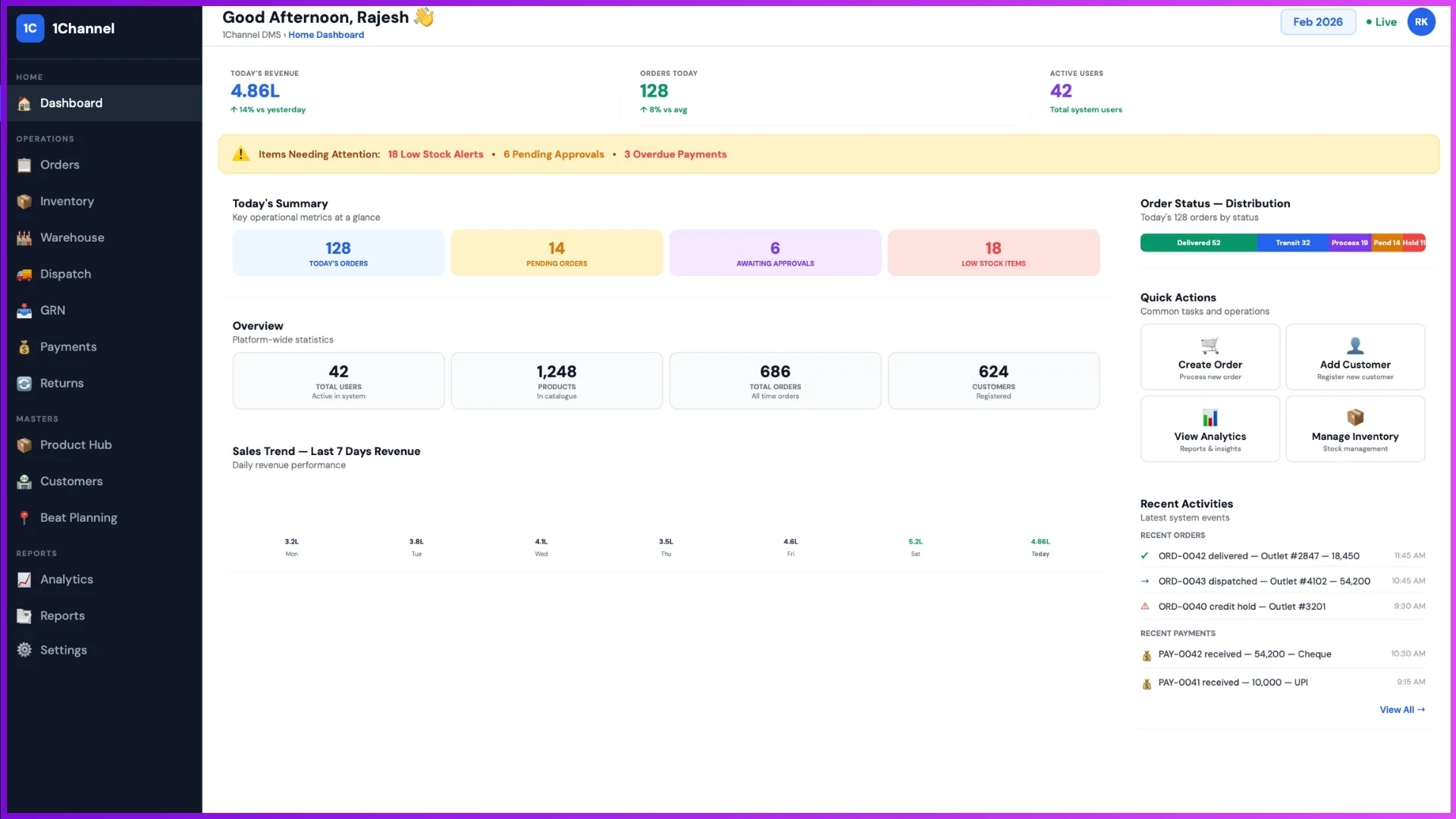
1. Centralized Dashboard for Real-Time Operational Visibility
One of the biggest challenges in distribution management is knowing what is happening across different business areas.
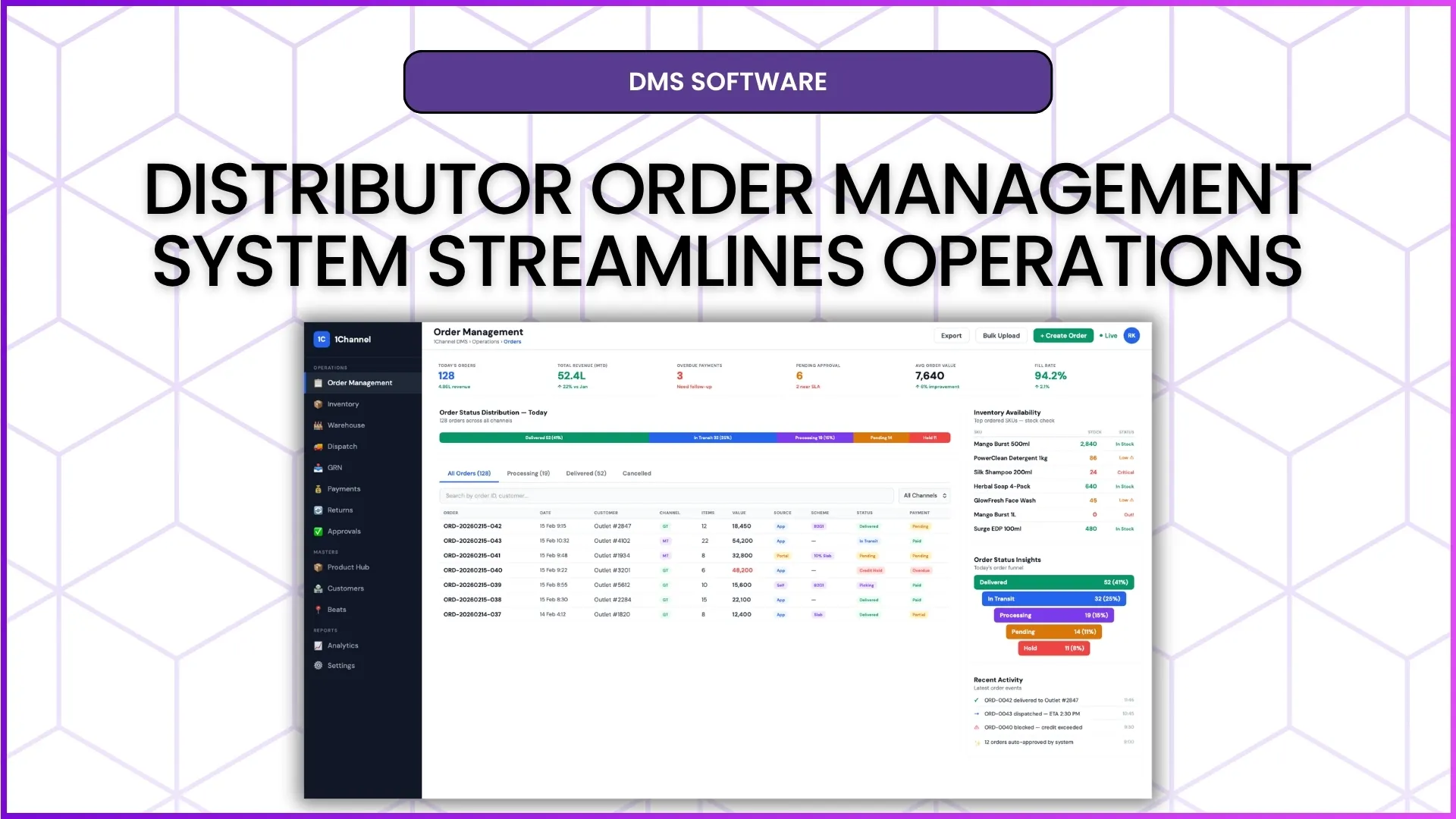
A Distributor Order Management System provides a centralized dashboard where businesses can instantly view:
- Today's orders
- Revenue performance
- Active users
- Pending approvals
- Low stock alerts
- Order status distribution
- Recent activities
- Sales trends
This eliminates the need to collect information manually from different teams and systems.
For example, a sales manager can quickly check whether orders are increasing, which products need attention, and where inventory shortages may impact sales.
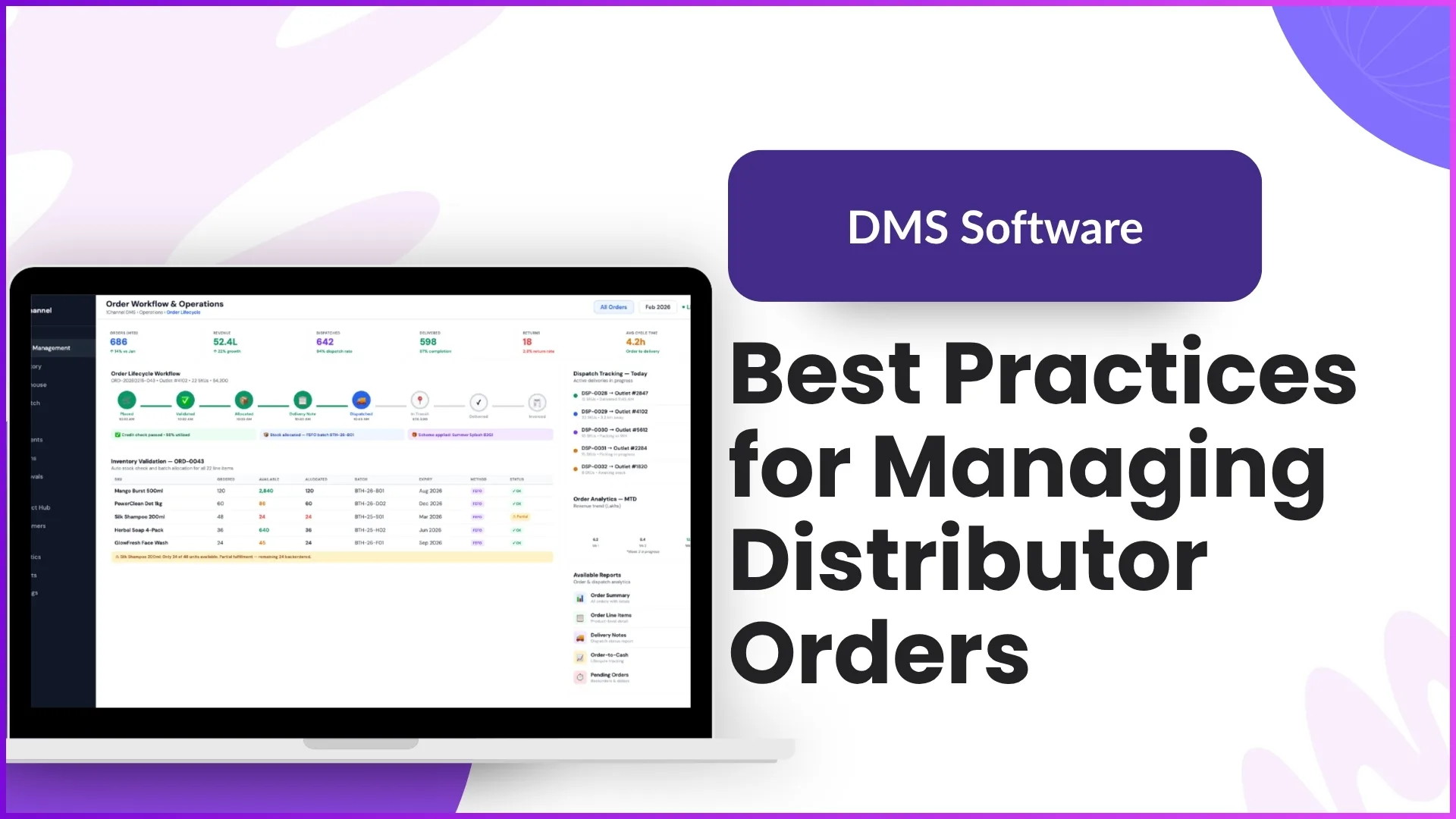
2. Simplifies the Complete Order Management Process
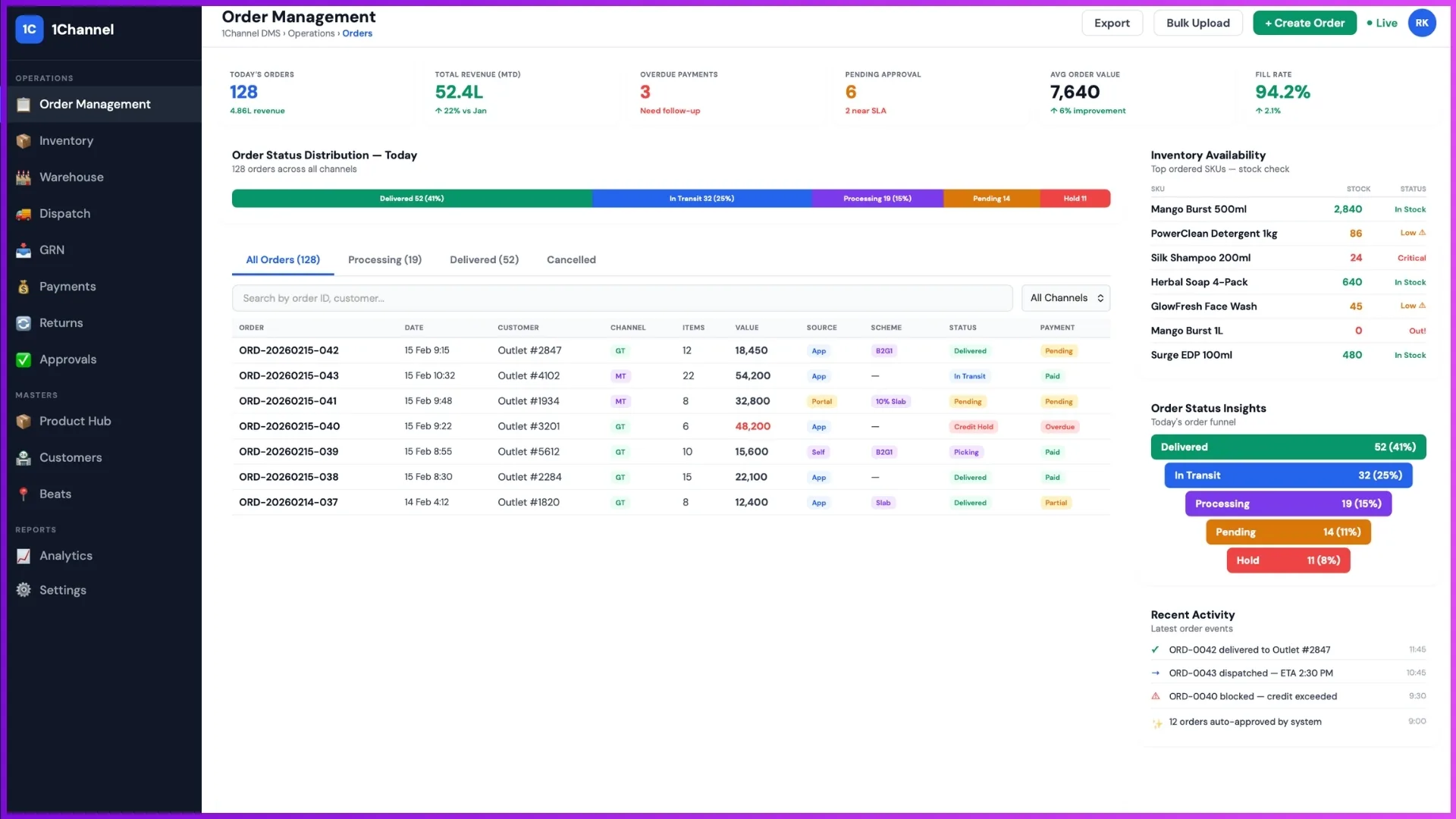
Order processing involves multiple stages, from receiving customer requirements to delivery and payment completion.
A Distributor Order Management System streamlines the complete workflow:
Step 1: Order Creation
Distributors or sales teams can create orders by selecting:
- Customer
- Warehouse
- Products
- Quantities
- Payment details
The system automatically validates important factors such as:
- Available stock
- Applicable pricing
- Active schemes
- Customer credit limits
Step 2: Order Processing
Once the order is created, businesses can track:
- Processing status
- Approval status
- Dispatch progress
- Delivery completion
Step 3: Delivery and Invoice Generation
After order confirmation:
- Delivery notes can be generated
- Dispatch can be completed
- Invoices become available
- Payment tracking starts
This creates a complete order-to-cash workflow.
Example:
A distributor receives a retailer order for multiple products. Instead of checking stock manually, the system automatically verifies availability, applies the correct pricing, checks schemes, and processes the order based on configured rules.
3. Improves Inventory Accuracy and Stock Management
Inventory problems can directly impact distributor sales.
Common challenges include:
- Overstocking
- Stock shortages
- Expired products
- Poor warehouse visibility
- Manual stock reconciliation
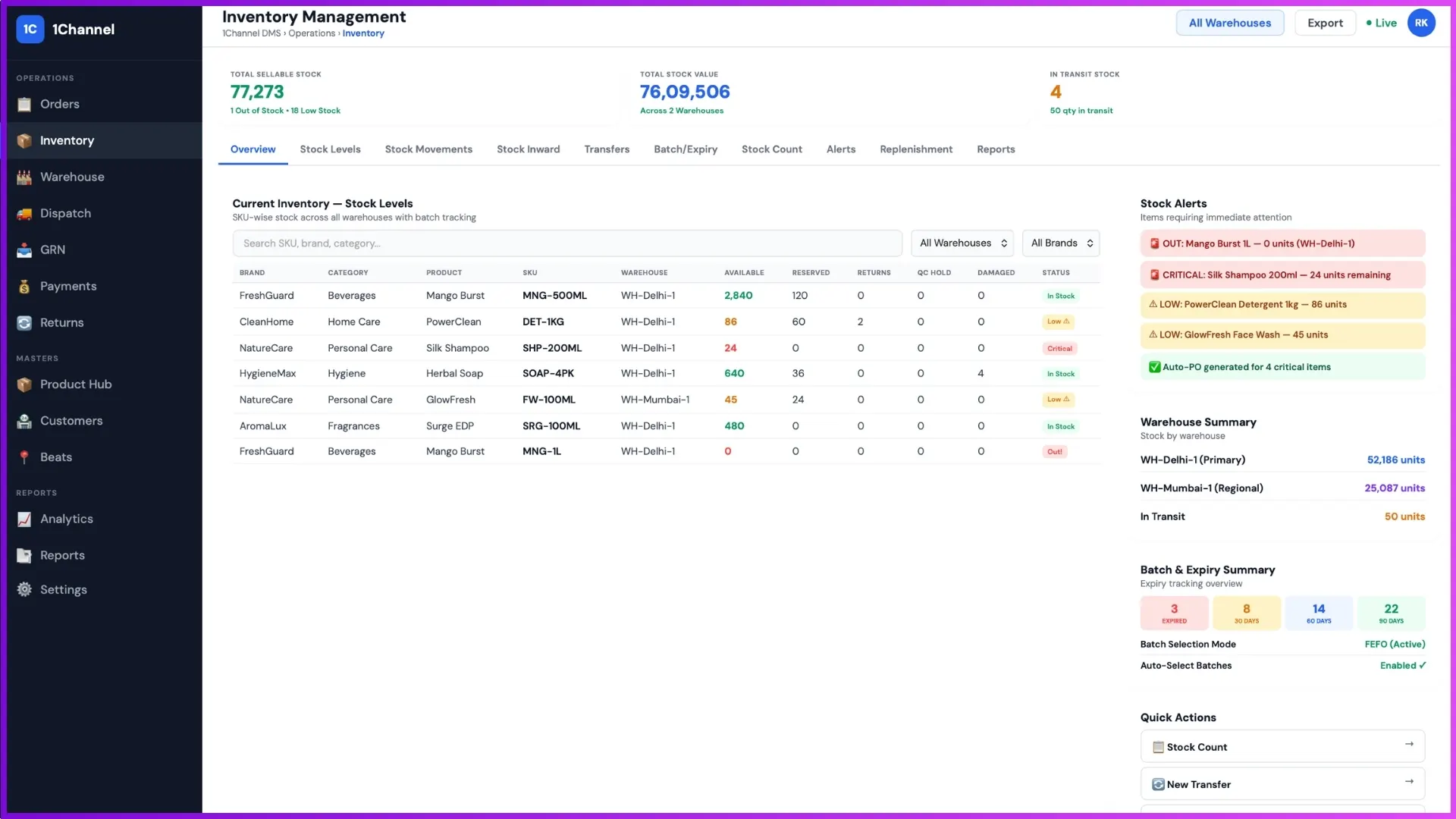
A Distributor Order Management System connects order processing with inventory management.
Businesses can monitor:
- Current stock levels
- Warehouse-wise inventory
- Reserved stock
- Damaged stock
- Stock movements
- Batch and expiry information
The system also supports inventory controls such as:
FIFO (First In First Out)
Older stock is allocated first.
FEFO (First Expiry First Out)
Products with earlier expiry dates are prioritized.
This helps reduce wastage and improves stock utilization.
Example:
If a distributor manages products with expiry dates, the system can automatically allocate batches that expire sooner, reducing the risk of inventory loss.
4. Streamlines Product, Pricing, and Scheme Management
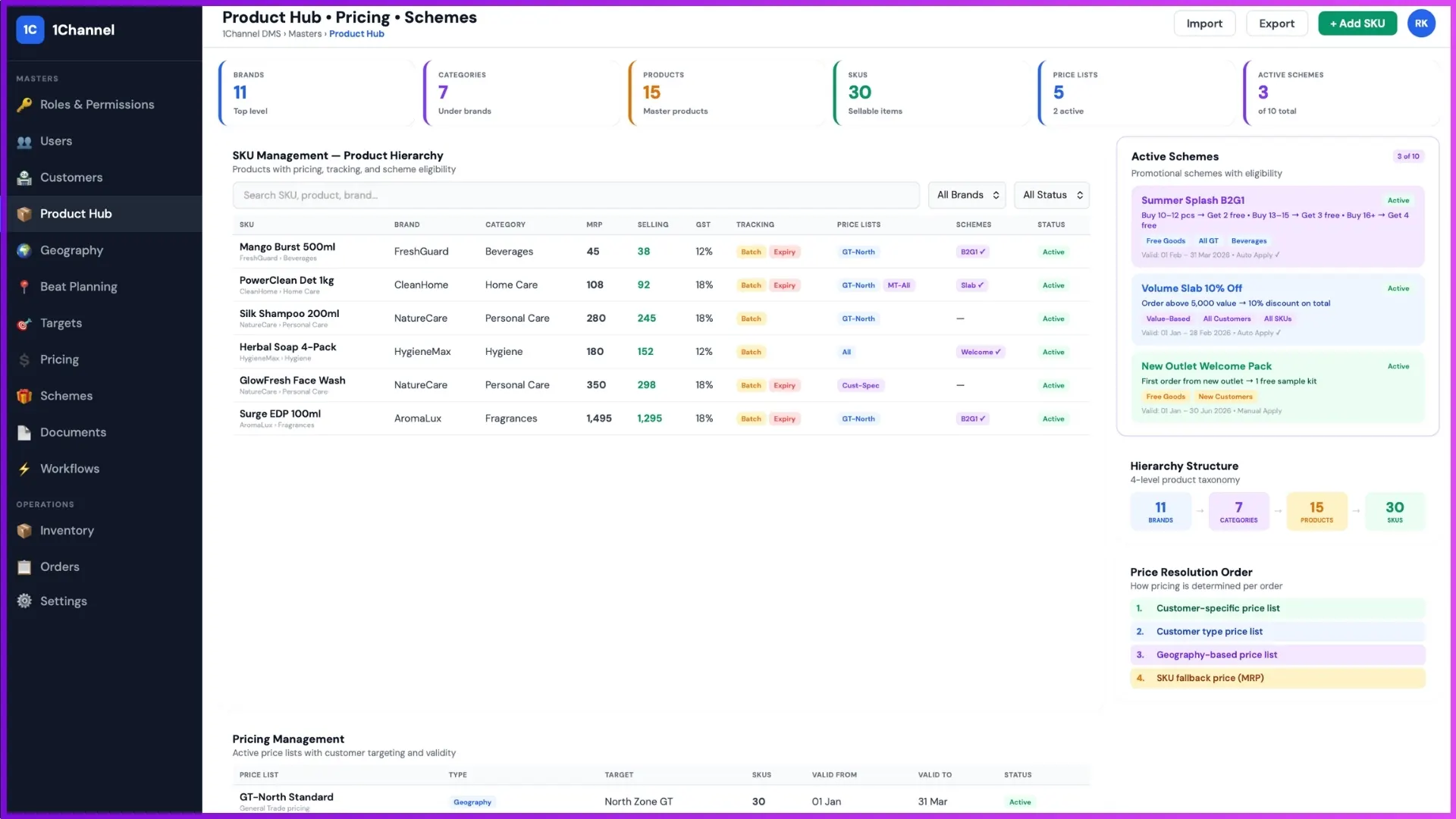
Distribution businesses often manage thousands of products, different SKUs, customer-specific pricing, and promotional schemes.
A Distributor Order Management System provides structured product management through:
- Brand hierarchy
- Categories
- Products
- SKUs
- Units of measurement
Businesses can define pricing based on:
- Customer type
- Geography
- Specific customers
- Default product pricing
The system also manages schemes such as:
- Value-based schemes
- Volume-based schemes
- Free goods offers
Example:
A company can configure:
"Buy 10 units and get 2 free"
or
"Distributor pricing differs from retailer pricing"
The system automatically applies the correct rules during order creation.
5. Automates Approvals and Business Workflows
Every distribution business has different approval requirements.
A Distributor Order Management System allows businesses to create automated workflows for:
- Order approvals
- Customer approvals
- Credit limit exceptions
- Notifications
- Escalations
Workflows can be configured based on:
- User roles
- Business hierarchy
- Conditions
- Transaction values
Example:
If a retailer places an order above the approved credit limit, the system can automatically send it for manager approval before processing.
This improves control while avoiding unnecessary manual follow-ups.
6. Enhances Distributor and Field Team Productivity
Modern distribution operations involve field sales representatives, distributors, and multiple customer touchpoints.
A mobile-enabled DMS helps teams manage:
- Attendance
- Beat planning
- Customer visits
- Outlet information
- Order placement
- Customer interactions
Sales representatives can view assigned beats, visit customers, place orders, update outlet information, and track productivity from their mobile devices.
This improves field execution and ensures better market coverage.
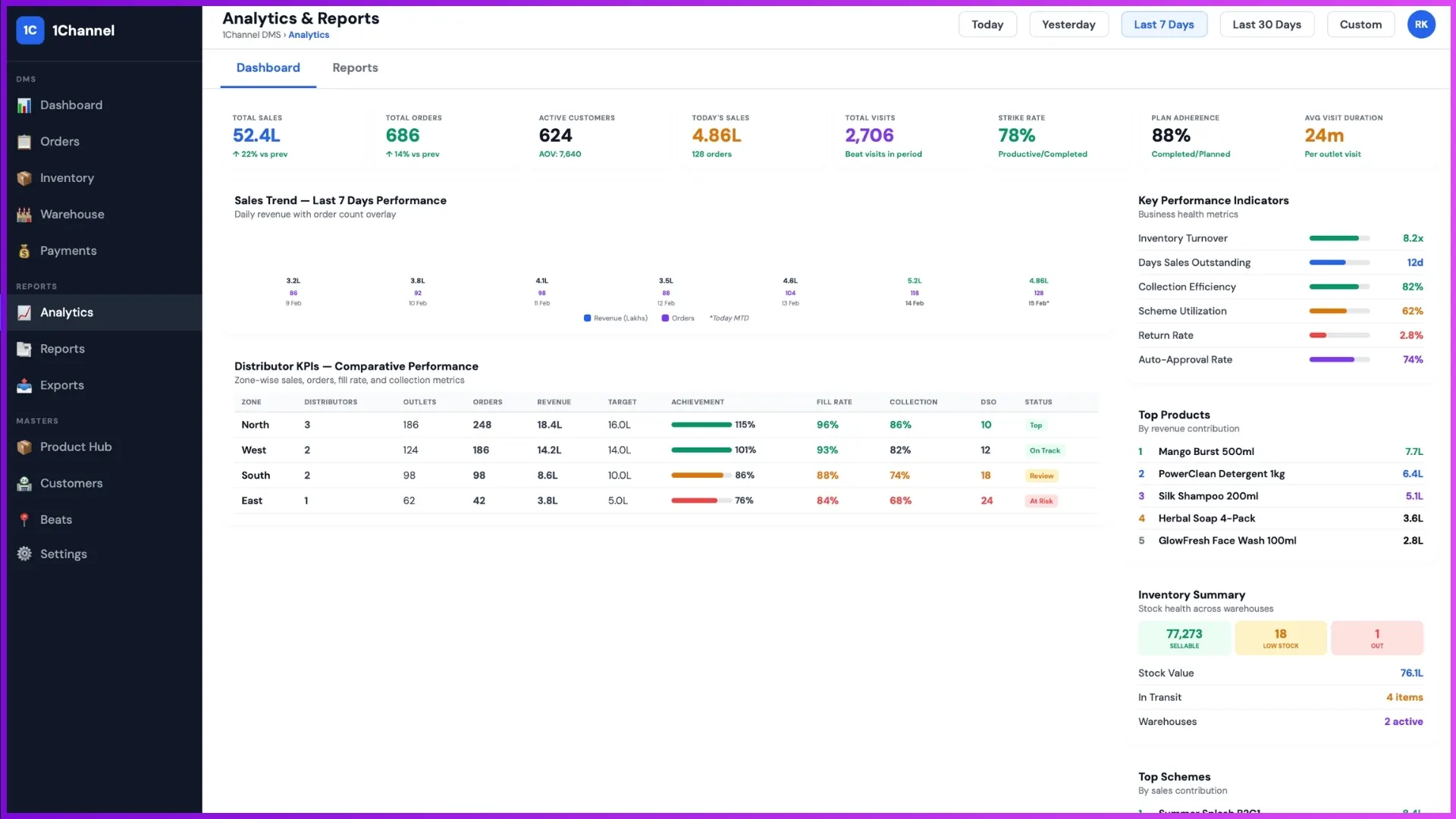
7. Provides Powerful Analytics and Reports
Making decisions without accurate data can slow business growth.
A Distributor Order Management System provides analytics for:
- Sales performance
- Product contribution
- Customer performance
- Inventory movement
- Order trends
- Payment collection
- Distributor productivity
Businesses can access reports such as:
- Order Summary
- Stock Summary
- Sales Reports
- Customer Sales Reports
- Inventory Reports
- Outstanding Reports
- Visit Compliance Reports
Reports can also be filtered and exported for further analysis.
8. AI-Powered Assistance for Faster Business Insights
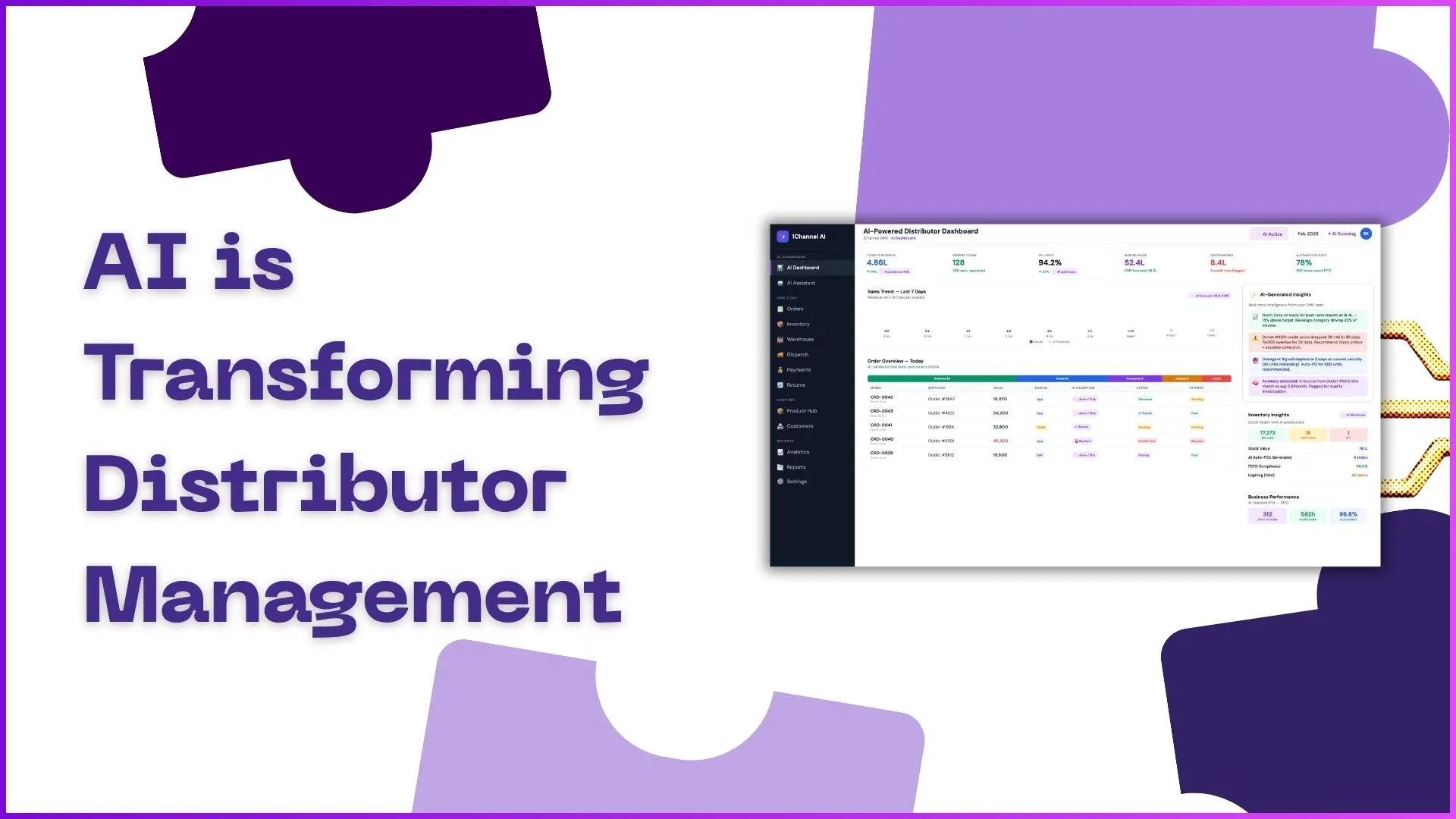
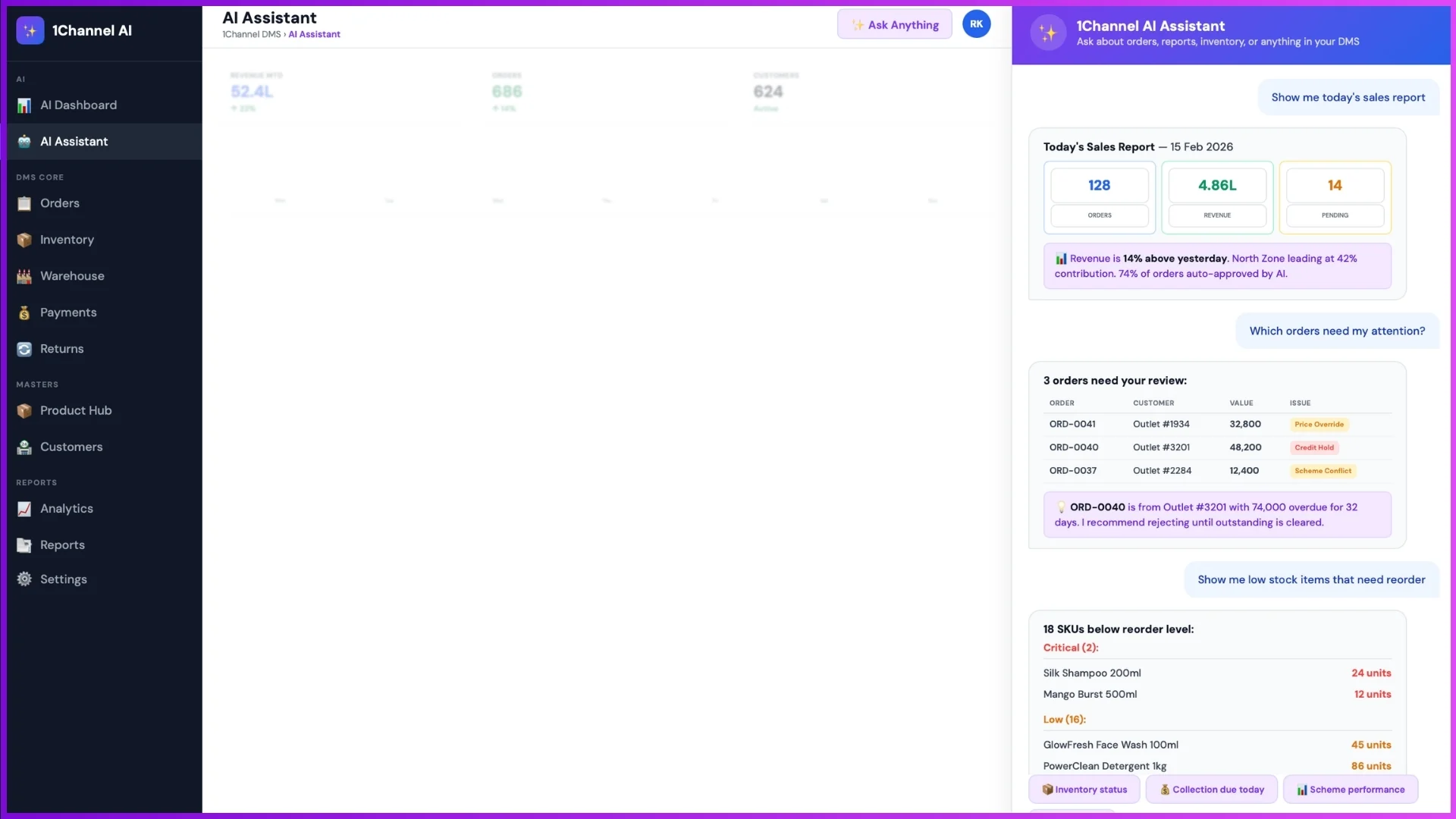
Modern distributor management systems are becoming smarter with AI capabilities.
An AI assistant integrated into DMS allows users to get information quickly by simply asking questions.
Examples:
- "Show my pending orders"
- "Show sales report for last month"
- "Find low stock products"
- "Show orders from a specific area"
Instead of manually searching through multiple reports, users can directly access insights through conversations.
This improves productivity and reduces the time required to find important information.
Benefits of Using Distributor Order Management System
A modern DMS helps businesses achieve:
Faster Order Processing
Automation reduces manual order entry and improves processing speed.
Better Inventory Control
Real-time stock visibility helps avoid shortages and excess inventory.
Improved Distributor Performance Tracking
Businesses can monitor sales, visits, targets, and productivity.
Reduced Operational Errors
Automated calculations reduce mistakes in pricing, schemes, and order handling.
Better Customer Experience
Faster order processing and accurate deliveries improve customer satisfaction.
Smarter Decision Making
Analytics and AI insights help businesses take faster actions.
Why Businesses Need a Modern Distributor Order Management System
As distribution networks grow, manual processes become difficult to manage.
Businesses need a system that can handle:
- Increasing order volumes
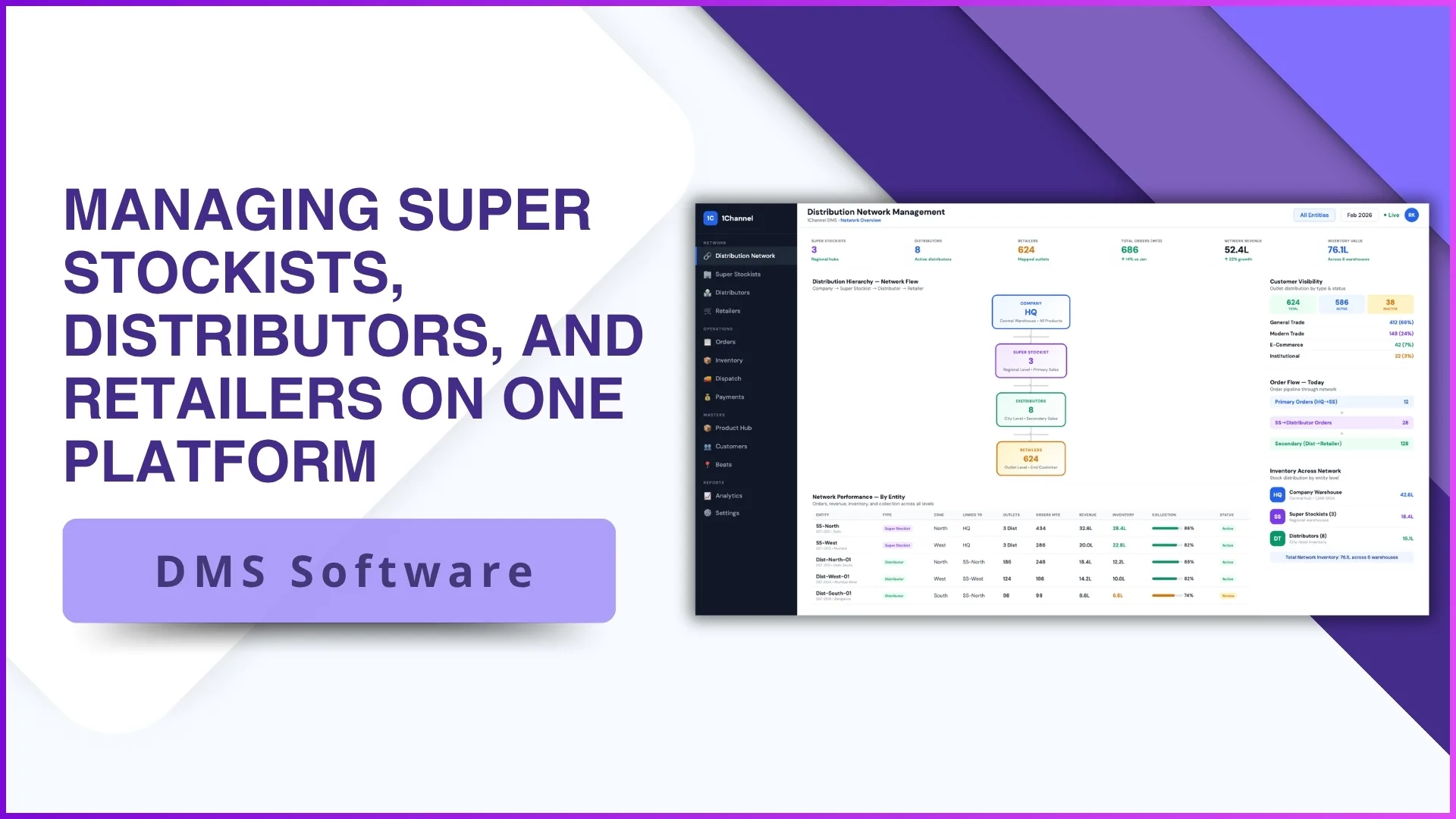
- Multiple distributors
- Complex pricing structures
- Inventory movement
- Field operations
- Customer management
- Business reporting
A Distributor Order Management System provides the required automation, visibility, and control to manage modern distribution operations efficiently.
Explore 1Channel Distributor Order Management Software
See how 1Channel's distributor order management software brings orders, inventory, pricing, schemes, approvals, field teams, analytics, and AI assistance together on one connected platform.
Explore Distributor Order Management →Frequently Asked Questions
1. What is a Distributor Order Management System?
A Distributor Order Management System is software that helps businesses manage distributor orders, inventory, customers, payments, and operations from one centralized platform.
2. How does a DMS improve order processing?
A DMS automates order creation, stock checking, pricing application, scheme calculation, approvals, delivery tracking, and invoice generation, making the entire process faster and more accurate.
3. Can a Distributor Order Management System manage inventory?
Yes. A DMS provides real-time inventory tracking, warehouse management, stock movement monitoring, batch tracking, expiry management, and stock alerts.
4. Does DMS support pricing and schemes?
Yes. Businesses can configure customer-specific pricing, geography-based pricing, distributor pricing, and promotional schemes such as volume-based and free goods offers.
5. How does AI help in distributor management software?
AI helps users quickly access information by answering business queries, generating insights, finding reports, and providing operational information through simple conversations.
6. Is a Distributor Order Management System useful for field sales teams?
Yes. Mobile-enabled DMS solutions help field teams manage attendance, beat planning, customer visits, outlet management, and order placement directly from mobile devices.
Conclusion
A Distributor Order Management System transforms traditional distribution operations by connecting orders, inventory, customers, field teams, and analytics into one intelligent platform.
By automating repetitive tasks, improving visibility, and enabling data-driven decisions, businesses can build a more efficient, scalable, and responsive distribution network.