Managing a distribution network becomes more complex as businesses expand across multiple levels, including super stockists, distributors, retailers, warehouses, field teams, and customers. When information is managed across different systems, businesses often face challenges like limited visibility into stock movement, delayed order processing, unclear customer mappings, and difficulty tracking sales performance.
A modern distribution management platform helps businesses bring all these operations together in one place. From managing users and customer relationships to handling inventory, orders, payments, reports, and field activities, a centralized system creates better coordination between every level of the distribution chain.
With a unified platform, businesses can manage super stockists, distributors, and retailers while maintaining visibility into every important process, including product availability, pricing, schemes, customer orders, credit management, and analytics.
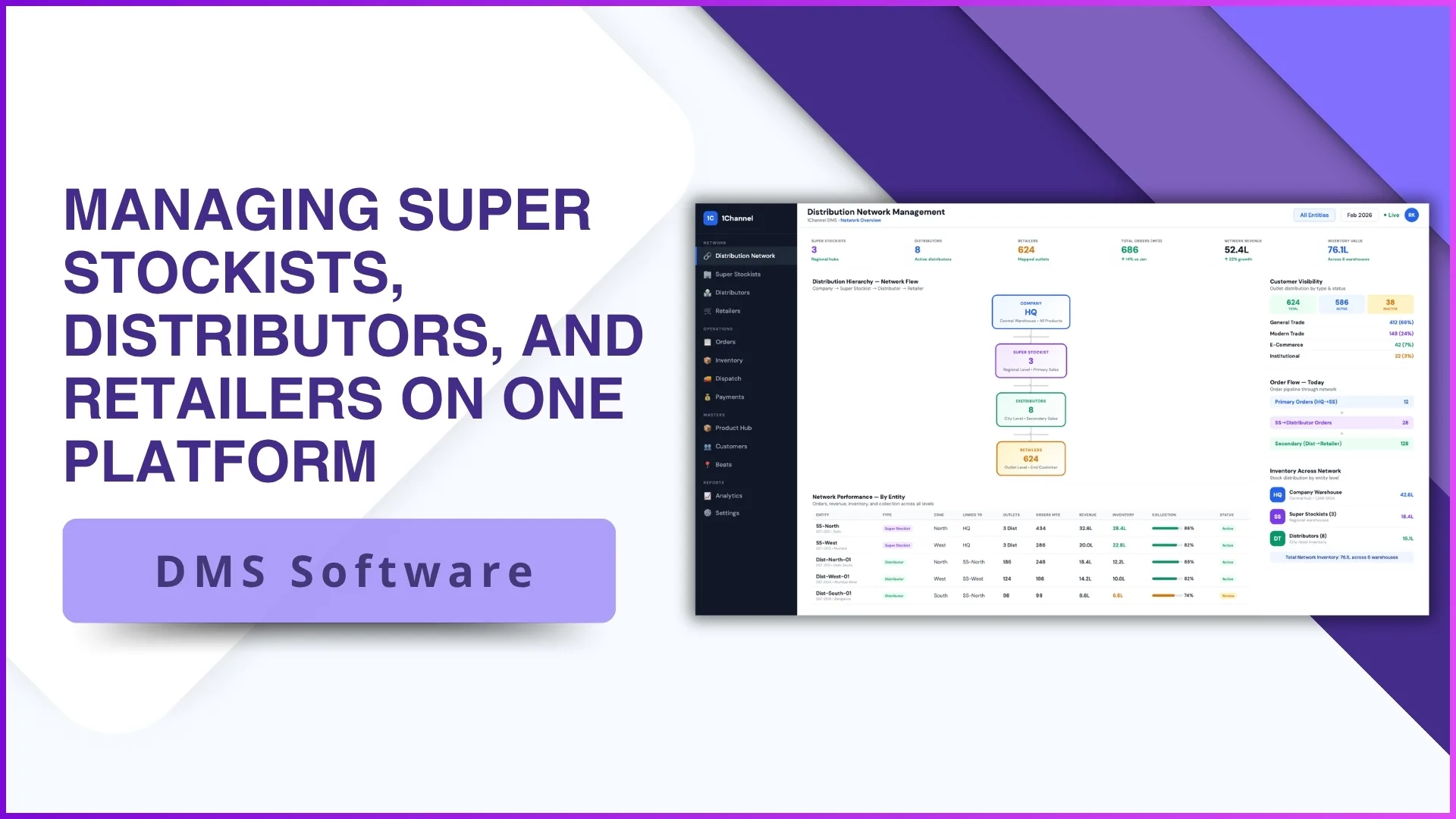
Why Businesses Need One Platform to Manage Their Distribution Network
A distribution ecosystem involves multiple users with different responsibilities:
- Super stockists managing larger inventory movement
- Distributors handling retailer orders and stock availability
- Retailers placing orders and managing product requirements
- Sales representatives managing market visits and customer relationships
- Admin teams monitoring operations and performance
Managing these activities separately can make it difficult to understand what is happening across the entire network.
A centralized platform allows businesses to:
- Manage all users from one system
- Maintain customer and distributor records
- Track product movement
- Monitor inventory levels
- Manage orders from creation to delivery
- Configure pricing and schemes
- Generate reports and insights
For example, if a distributor has low stock of a specific product, the system can identify the stock situation, support replenishment workflows, and help maintain product availability without manual tracking.
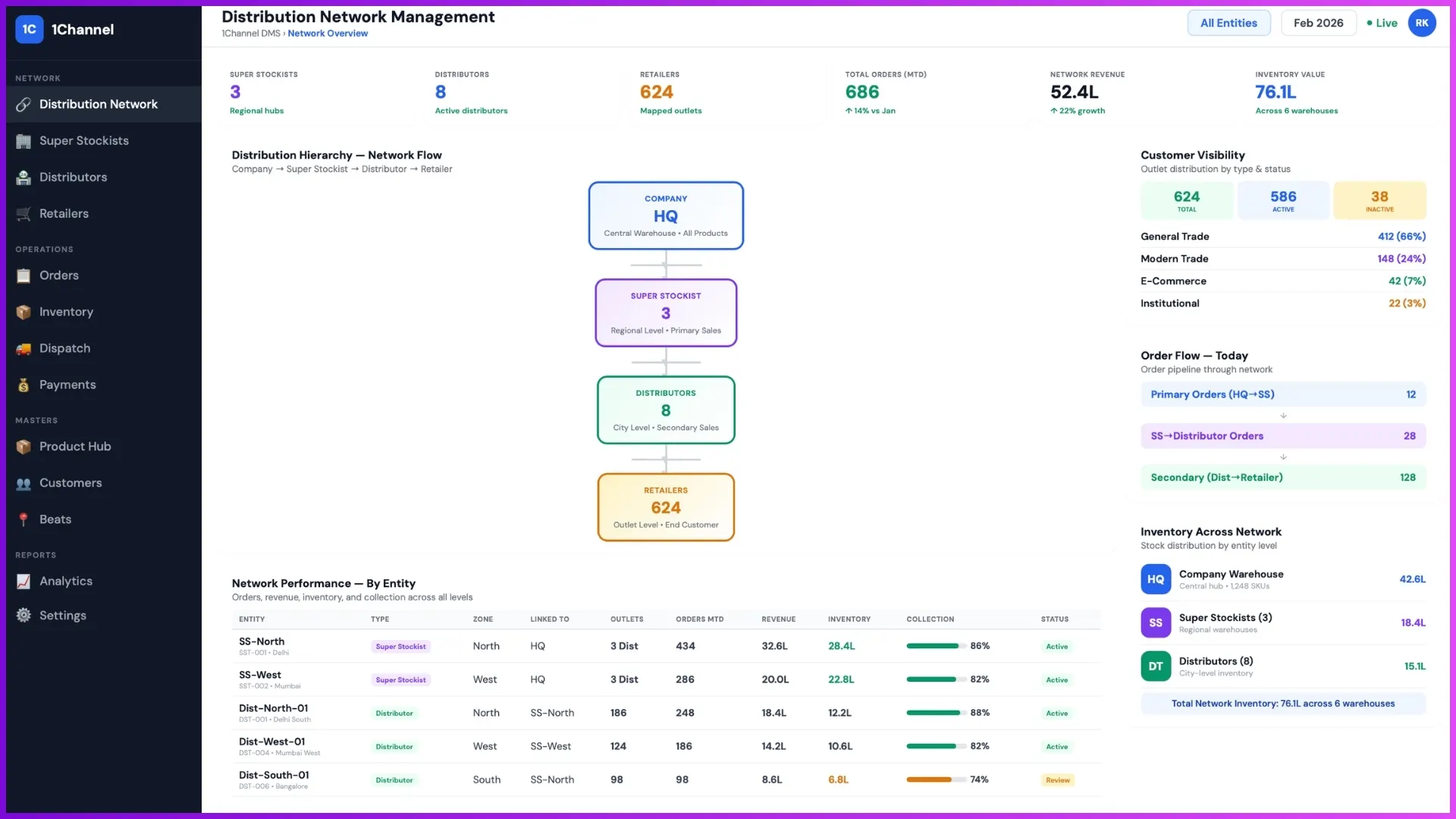
Managing Super Stockists Through a Centralized System
Super stockists play an important role in maintaining inventory availability and ensuring smooth product movement across different locations.
A distribution platform helps manage super stockists by connecting their activities with inventory, warehouses, orders, and customer operations.
Super Stockist Inventory Management
The system provides visibility into:
- Available stock
- Reserved stock
- Damaged stock
- Quality hold stock
- In-transit stock
- Stock movement history
For example, if a super stockist manages multiple warehouses, the system can show stock availability warehouse-wise and help track where products are stored.
Businesses can also manage warehouse transfers.
Example:
A product is available in Warehouse A, but an order needs fulfillment from another location. The system can record stock transfer between warehouses to maintain accurate inventory records.
Batch and Expiry Management for Super Stockists
For businesses handling products with expiry dates, batch tracking becomes important.
The system supports batch-based inventory management with options like:
- FIFO (First In First Out)
- FEFO (First Expiry First Out)
- LIFO
- Manual batch selection
Example:
If multiple batches of a product exist, the system can help allocate the batch with the earliest expiry date first to reduce expiry-related losses.
Managing Distributors and Their Daily Operations
Distributors handle multiple activities every day, including retailer orders, inventory management, payments, and deliveries.
A centralized platform helps distributors manage these operations efficiently.
Distributor Order Management
Distributors can:
- Create orders manually
- Receive retailer orders
- Check product availability
- Apply pricing rules
- Apply available schemes
- Generate delivery notes
- Process dispatch
- Generate invoices
Example:
A retailer places an order for multiple products. During order processing, the system checks:
- Available stock
- Applicable schemes
- Customer pricing
- Credit limit
Based on configured settings, stock allocation and further processing can happen automatically.
Managing Distributor Customers
The customer master helps manage different customer types such as:
- Retailers
- Distributors
- Super stockists
- Other customer users
Businesses can maintain details like:
- Customer type
- Location
- Credit limit
- Status
- Contact details
Example:
A distributor can quickly view retailer details, check outstanding balances, and understand order history from the same platform.
Retailer Management and Customer Visibility
Retailers are an important part of the distribution network because they drive market demand.
A unified system helps businesses maintain better retailer relationships by providing:
- Customer profiles
- Order history
- Outstanding information
- Product availability
- Visit details
- Communication records
Retailer Order Processing
Retailer orders can move through a structured process:
- Retailer order creation
- Stock availability check
- Pricing and scheme application
- Order approval (if configured)
- Dispatch processing
- Invoice generation
Example:
If a retailer places an order beyond their available credit limit, the system can identify the situation and follow configured credit approval workflows.
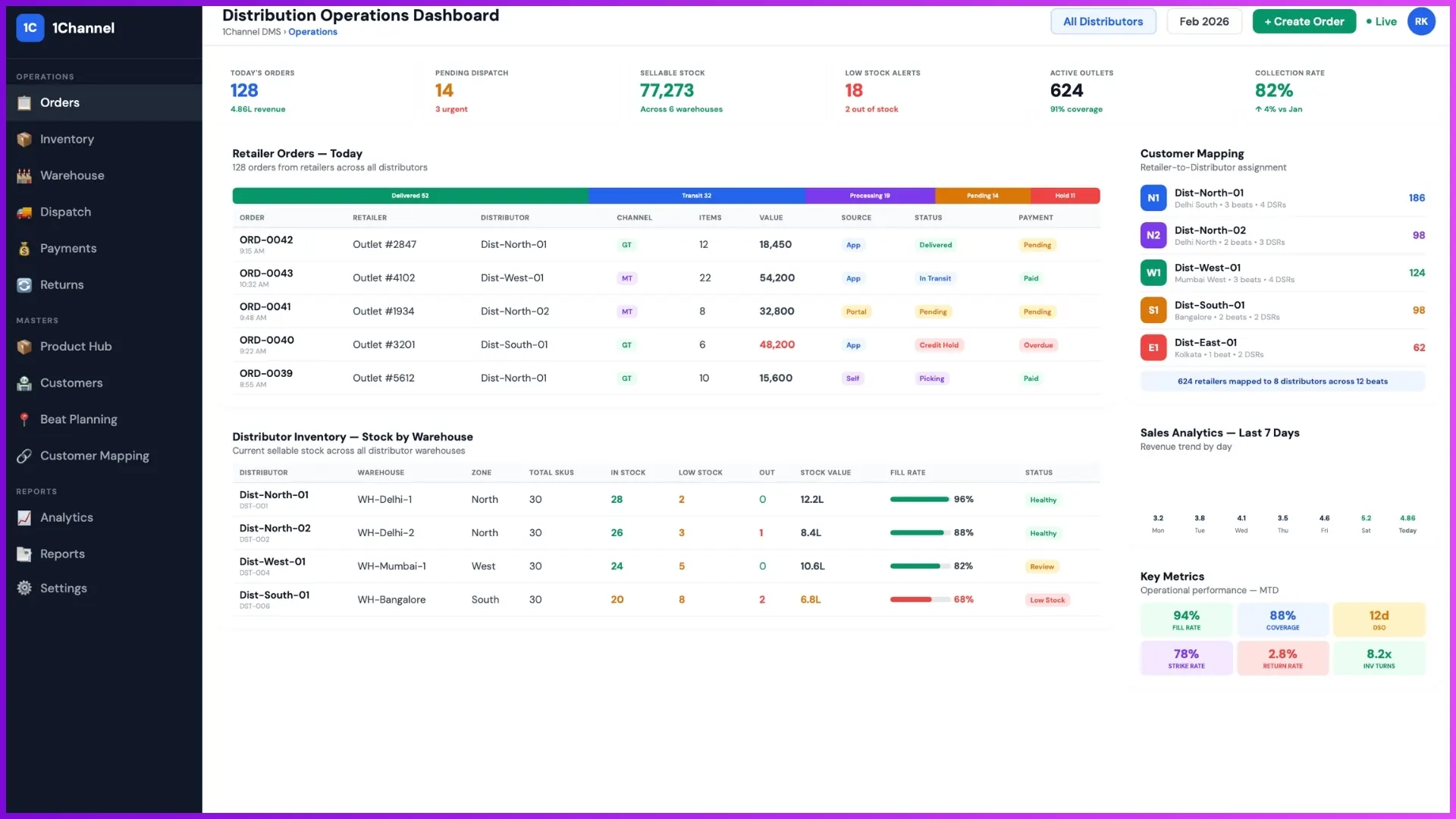
Managing Users, Roles, and Access Across the Distribution Network
Different users require different access levels in a distribution system.
The platform allows businesses to configure roles such as:
- Company administrators
- Sales representatives
- Distributors
- Retailers
- Warehouse managers
- Super stockists
Permissions can be managed at screen level.
For example:
A warehouse manager may access inventory operations, while a sales representative may only access customer visits and order-related activities.
Businesses can configure permissions like:
- View
- Create
- Edit
- Delete
- Approve
- Export
This ensures every user gets access according to their responsibilities.
Product and Pricing Management Across Distribution Channels
Managing thousands of products becomes easier through structured product management.
The system maintains product hierarchy:
Brand → Category → Product → SKU
Example:
A business can configure:
- Brand level
- Product category
- Individual products
- Multiple SKU variants
Each SKU can include details such as:
- Product code
- Pricing
- GST details
- Barcode
- Tracking information
- Shelf life
Flexible Pricing Management
Different customers may require different pricing structures.
The platform supports:
- Customer-specific pricing
- Customer-type pricing
- Geography-based pricing
Example:
A distributor in one region may have different pricing compared to another region. The system can apply the correct price list based on configured rules.
If no special pricing applies, the system uses the configured fallback pricing.
Managing Schemes for Distributors and Retailers
Promotional schemes can be configured based on business requirements.
Supported scheme types include:
- Value-based schemes
- Volume-based schemes
- Free goods schemes
Example:
A business can configure:
Buy 10 units and get 2 units free.
Schemes can be applied based on:
- Products
- Categories
- Customers
- Geography
This helps businesses manage promotional activities across different distribution levels.
Field Team and Beat Management for Better Market Coverage
Sales teams play an important role in maintaining retailer relationships.
The platform supports:
- Beat planning
- Outlet mapping
- Visit scheduling
- Customer location tracking
Example:
A salesperson can have a planned route containing multiple outlets. The system helps track:
- Assigned beats
- Customer visits
- Completed visits
- Pending activities
Recurring schedules can also be created for repeated customer visits.
Analytics and Reports for Distribution Performance
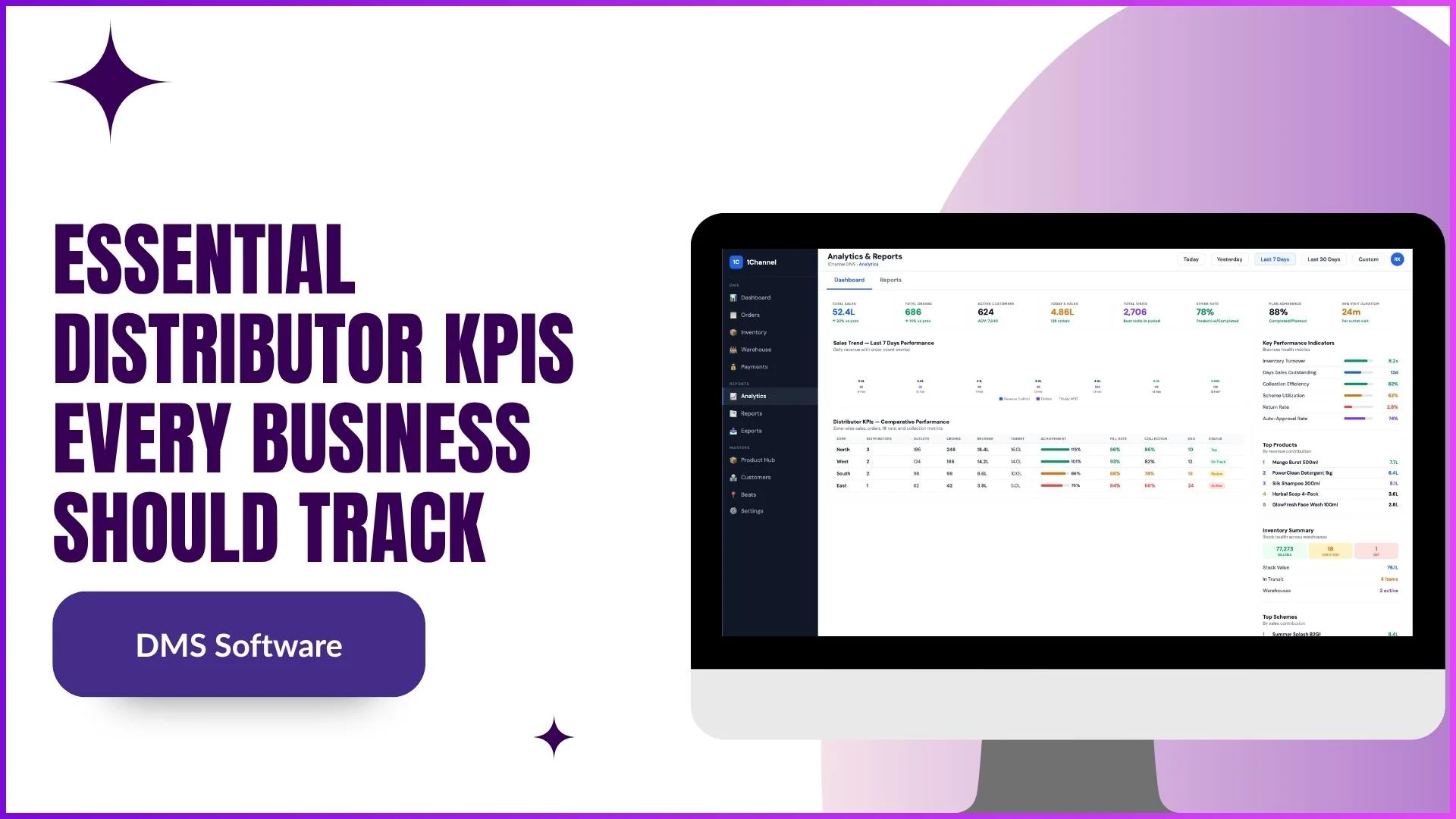
A centralized platform provides visibility into business performance through dashboards and reports.
Users can monitor:
- Total sales
- Orders
- Active customers
- Visits
- Target achievement
- Product performance
- Scheme performance
Reports include:
Inventory Reports
Examples:
- Stock summary
- Warehouse stock
- Stock ledger
- Stock aging
- Stock traceability
Sales Reports
Examples:
- Customer sales
- Sales reports
- Scheme performance
Operational Reports
Examples:
- Pending orders
- Low stock alerts
- Return analysis
Example:
A business can filter a stock report by warehouse, category, brand, or stock status and export the required information.
AI Assistant for Faster Business Insights
The integrated AI assistant helps users get information directly through conversation.
Instead of manually searching through multiple reports, users can ask questions and receive relevant information.
Examples:
- “Show my pending orders”
- “Show orders for a specific area”
- “How to place an order?”
This makes accessing business information faster for users across different roles.
Managing Payments, Credit, and Returns
Financial operations become easier when connected with orders and customer records.
The system helps manage:
- Invoices
- Payments
- Credit limits
- Credit notes
- Returns
Example:
If a retailer exceeds the defined credit limit, the system can identify the issue and trigger approval workflows based on configured rules.
Returns can also be processed by selecting:
- Order details
- Return reason
- Resolution
- Notes
How a Unified Distribution Platform Improves Business Operations
Managing super stockists, distributors, and retailers on one platform helps businesses achieve:
- Better inventory visibility
- Faster order processing
- Improved customer management
- Accurate reporting
- Better control over pricing and schemes
- Easier field team coordination
- Improved decision-making
Instead of managing separate systems for different distribution activities, businesses can manage their complete network through one connected platform.
Manage Your Distribution Network Better with 1Channel
1Channel DMS helps businesses manage their complete distribution ecosystem through a unified distribution management platform.
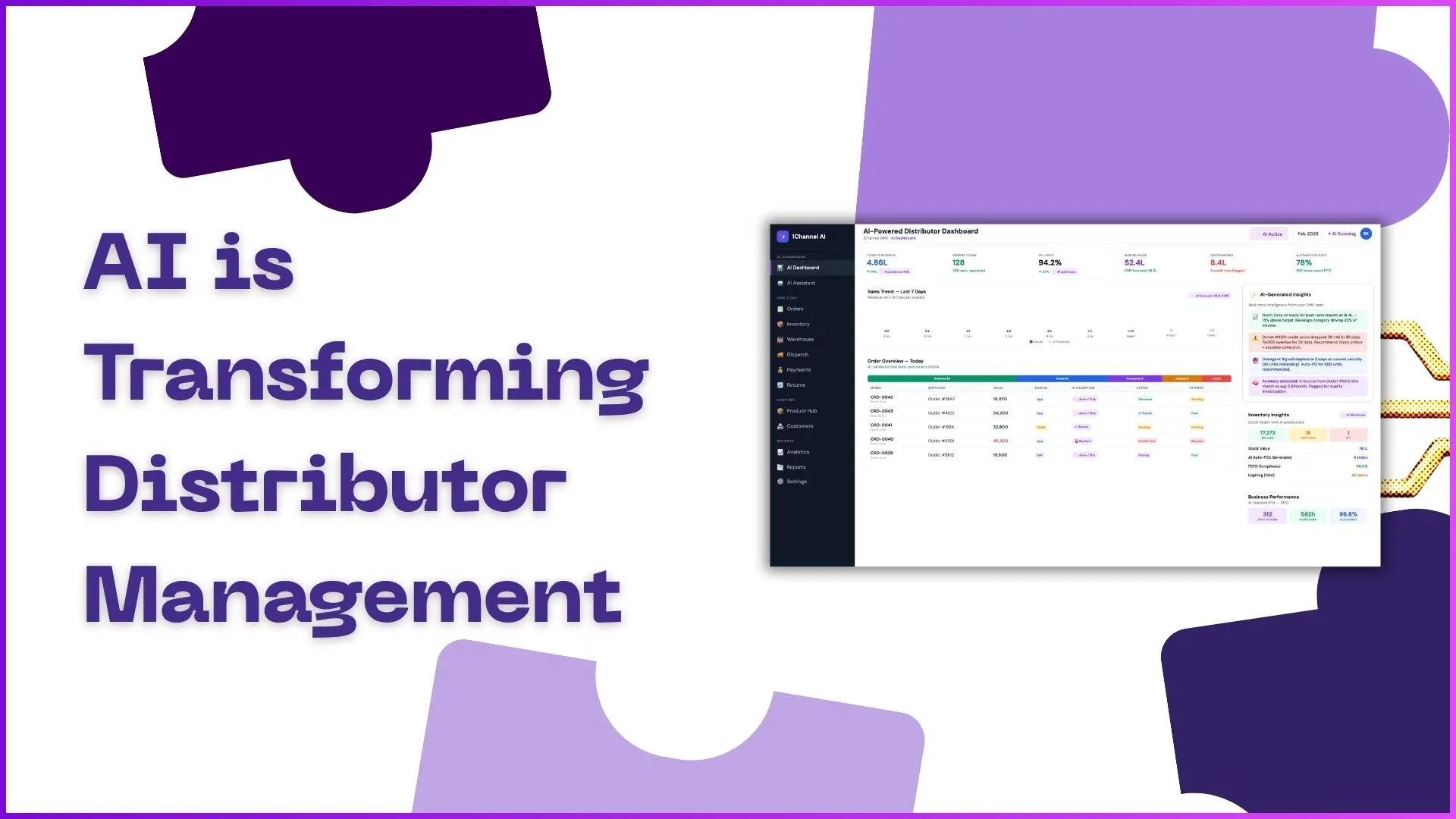
The platform brings together important operations like customer management, inventory tracking, order processing, analytics, workflow automation, reporting, and AI-based assistance.
With features designed for managing super stockists, distributors, retailers, and field teams, businesses can improve visibility and control across their entire distribution network.
Explore 1Channel AI-Powered DMS
Explore AI-Powered DMS →Frequently Asked Questions (FAQs)
1. How can a distribution platform help manage super stockists and distributors?
A distribution platform helps manage super stockists and distributors by connecting inventory, orders, warehouses, customers, pricing, schemes, and reports in one system.
2. Can businesses manage retailer orders through the same platform?
Yes, retailer orders can be created, tracked, processed, and connected with inventory, delivery notes, and invoices through the platform.
3. How does the system manage distributor inventory?
The system provides inventory visibility including available stock, reserved stock, damaged stock, stock movements, and warehouse-level stock details.
4. Can different users get different access permissions?
Yes, businesses can configure roles and permissions based on user responsibilities and provide access to specific screens and actions.
5. Can the platform manage different pricing for different customers?
Yes, pricing can be configured based on customers, customer types, or geographical locations.
6. How are schemes managed for retailers and distributors?
Businesses can create schemes based on product, category, customer, or geography with different conditions like volume-based, value-based, or free goods offers.
7. Can businesses track sales team visits?
Yes, the platform supports beat planning, outlet mapping, visit scheduling, and productivity tracking.
8. Does the system provide reports for inventory and sales analysis?
Yes, businesses can access different reports related to inventory, orders, customers, sales, operations, finance, and field activities.
9. Can users get reports using AI assistance?
Yes, users can ask questions through the AI assistant to quickly access information related to system operations and reports.
10. Can the platform support multiple warehouses and locations?
Yes, businesses can manage multiple warehouses, stock transfers, and location-based operations through the system.