Managing a distribution business requires visibility across sales, inventory, customer performance, field activities, collections, and operations. Without the right performance indicators, distributors may struggle to understand where sales are improving, where stock issues are occurring, and which areas need immediate attention.
Distributor KPIs (Key Performance Indicators) help businesses measure important activities and make better operational decisions. With a distributor management system, businesses can monitor these metrics through dashboards, reports, analytics, and real-time data tracking.
From order performance and inventory movement to customer activity and financial health, tracking the right KPIs helps distributors improve efficiency and maintain better control over their operations.
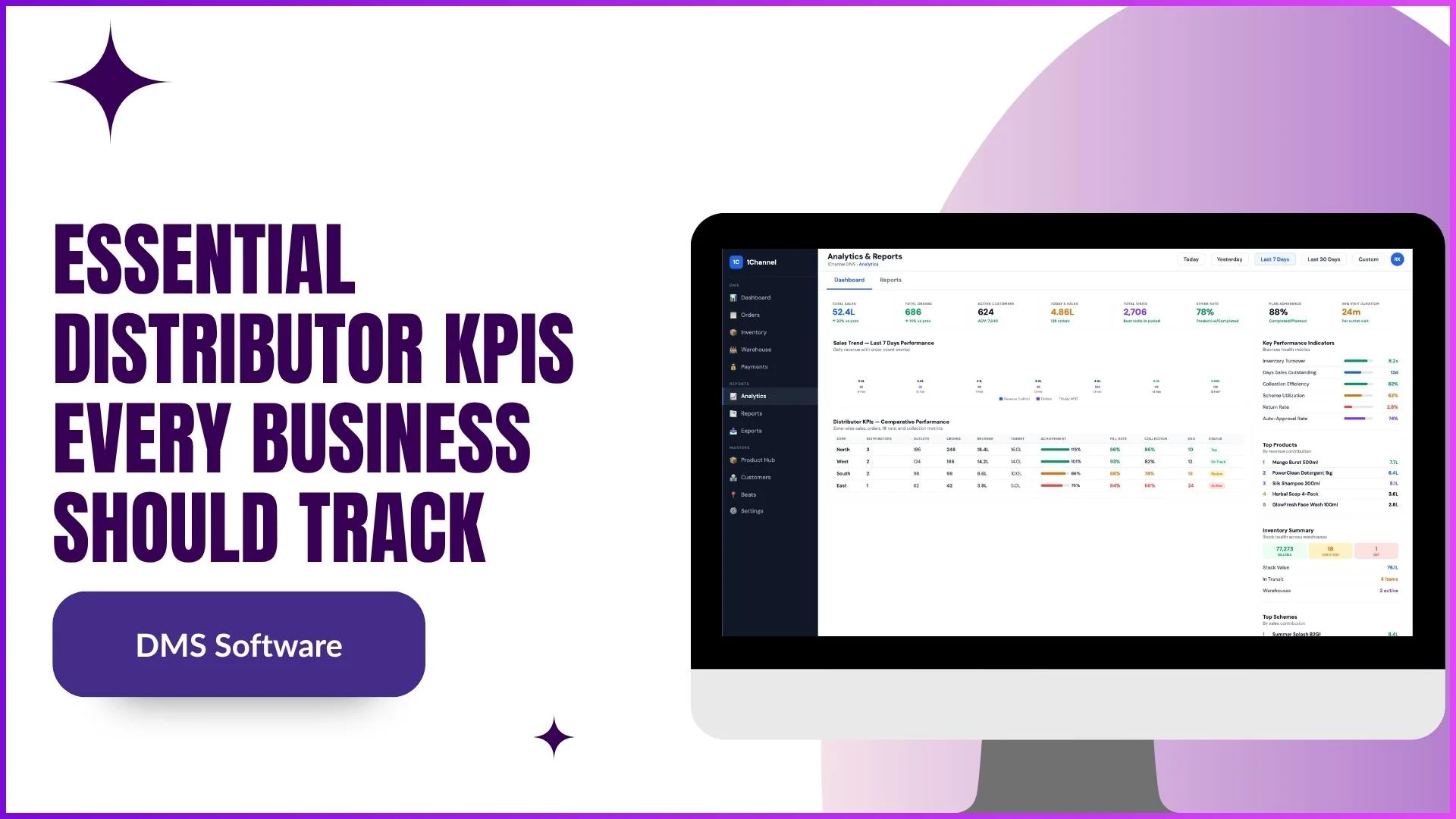
Why Tracking Distributor KPIs Is Important
A distribution network involves multiple activities happening together:
- Customer orders
- Stock availability
- Warehouse movement
- Sales team performance
- Customer payments
- Product demand
- Field visits
- Returns management
Without proper tracking, businesses may face challenges such as:
- Delayed order processing
- Low stock situations
- Poor visibility of sales performance
- Unmanaged outstanding payments
- Difficulty measuring field productivity
A centralized dashboard allows businesses to view important metrics together and identify areas requiring action.
Example:
If a distributor notices increasing overdue payments through financial KPIs, they can review customer outstanding balances and take action before credit limits become a bigger issue.
Key Distributor KPIs Every Business Should Track
1. Sales Performance KPI
Sales performance is one of the most important indicators for understanding business growth. It helps businesses track revenue generation, order volume, and sales trends over a selected period.
Important sales metrics include:
- Total sales
- Today's sales
- Revenue trends
- Total orders
- Average order value
- Sales contribution by products
A sales dashboard can show comparisons between different periods to understand whether sales are increasing or decreasing.
Example:
A distributor can review the last 30 days' sales performance and compare it with the previous period to identify whether revenue growth is improving.
2. Order Management KPI
Order-related KPIs help distributors understand order flow and operational efficiency.
Important order indicators include:
- Total orders
- Pending orders
- Processing orders
- Delivered orders
- Cancelled orders
- Overdue orders
Tracking order status helps businesses understand where delays are happening.
Example:
If multiple orders remain pending, a distributor can check whether the reason is stock availability, approval requirements, or dispatch delays.
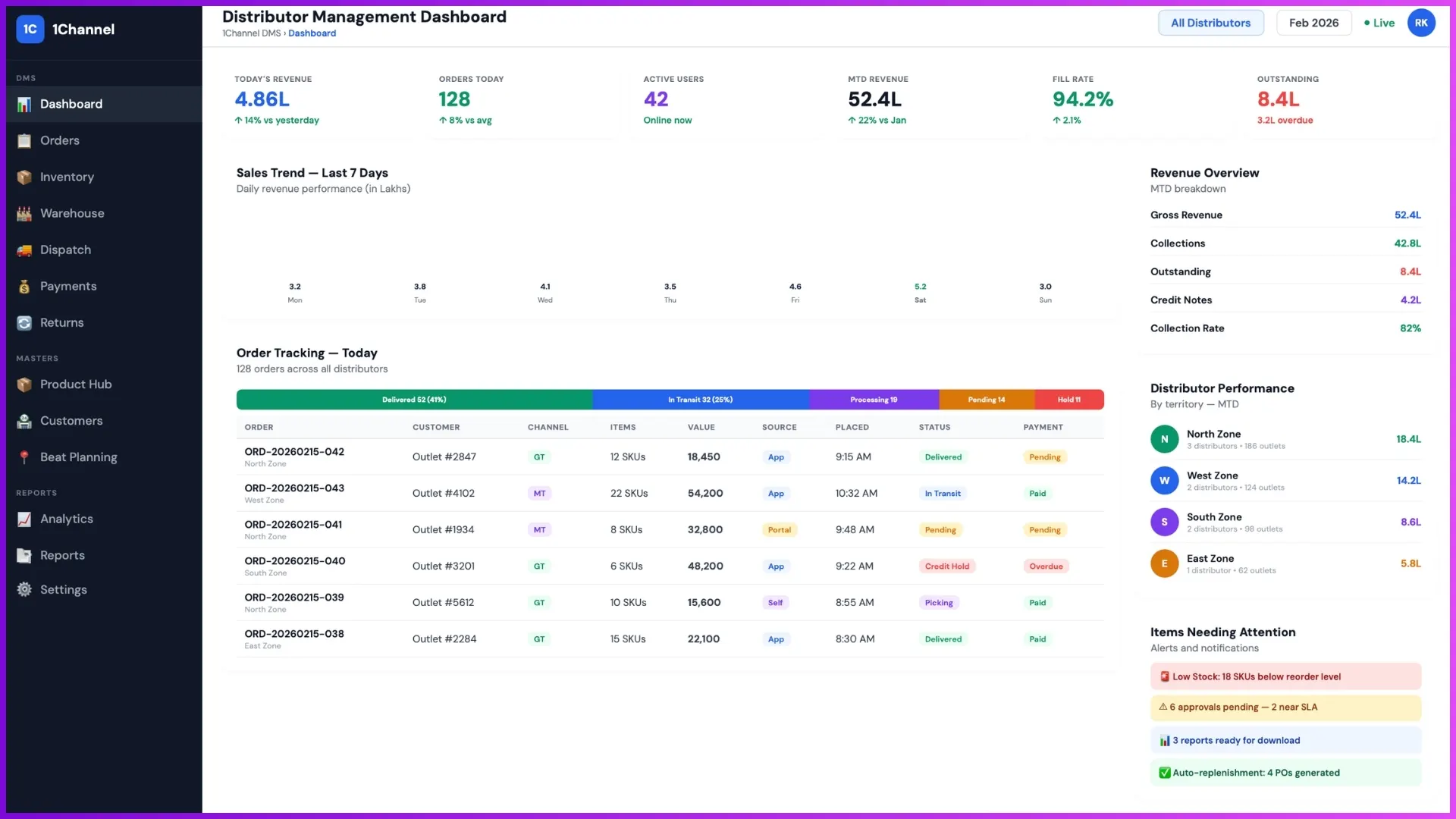
Explore 1Channel Distributor Order Management
Explore Distributor Order Management →3. Inventory Management KPI
Inventory visibility is critical for distributors because stock availability directly impacts order fulfillment.
Important inventory KPIs include:
- Total available stock
- Stock value
- Low stock items
- Out-of-stock products
- In-transit stock
- Stock movement
A distributor management system provides inventory visibility across warehouses and products.
Example:
If a product reaches a low-stock level, the business can identify it through stock alerts and plan replenishment before customer orders are affected.
4. Stock Movement KPI
Stock movement tracking helps businesses understand how inventory is moving across locations.
Businesses can monitor:
- Stock inward
- Stock transfers
- Stock adjustments
- Stock outward movement
- Warehouse-wise stock position
Example:
If one warehouse has excess inventory while another warehouse has shortages, stock transfer reports help businesses move inventory between locations.
5. Product Performance KPI
Product-level performance helps businesses identify which products contribute most to revenue and demand.
Businesses can track:
- Top-performing products
- Product sales contribution
- SKU performance
- Category performance
- Brand-level performance
Example:
A distributor can identify that one product category is generating higher sales and focus inventory planning around those products.
6. Customer Performance KPI
Customer KPIs help distributors understand customer activity and business relationships.
Important customer metrics include:
- Total customers
- Active customers
- Customer orders
- Customer sales
- Customer outstanding
- Credit utilization
Customer information can be managed through customer master data and sales reports.
Example:
A distributor can identify customers with frequent orders and customers with pending payments to plan follow-ups accordingly.
7. Field Sales & Beat Performance KPI
Field teams play an important role in distributor operations. Tracking field activities helps businesses understand market coverage.
Important field KPIs include:
- Total visits
- Completed visits
- Planned visits
- Plan adherence
- Outlet coverage
- Visit duration
Beat planning helps businesses organize customer visits based on assigned locations.
Example:
If a salesperson has planned visits for a specific area, the business can check whether those visits were completed and how many customer interactions happened.
8. Target Achievement KPI
Target tracking helps businesses measure progress against planned goals.
Targets can be created based on:
- Product sales
- Category sales
- Visit targets
- Volume targets
- Value targets
Businesses can define whether achievement should be counted when:
- Order is placed
- Order is dispatched
- Invoice is generated
Example:
A business can create a monthly product sales target and track which orders contributed toward achieving that target.
9. Inventory Expiry & Batch KPI
For businesses handling batch-based products, expiry tracking is important for reducing inventory risks.
Important metrics include:
- Expiring stock
- Expired stock
- Batch availability
- Expiry timelines
Batch selection can be managed using methods such as:
- FIFO
- FEFO
- LIFO
- Manual selection
Example:
If products have different expiry dates, the system can help allocate the batch with the earliest expiry first to reduce wastage.
10. Payment & Collection KPI
Financial KPIs help businesses monitor payment realization and customer credit status.
Important financial indicators include:
- Pending payments
- Collected amount
- Outstanding amount
- Overdue payments
- Credit utilization
- Days sales outstanding
Example:
If a customer exceeds their credit limit, the business can review outstanding payments and decide whether approval is required before processing further orders.
11. Returns Management KPI
Returns tracking helps businesses understand product return patterns and operational issues.
Important return metrics include:
- Total returns
- Open returns
- Resolved returns
- Return reasons
- Returned quantity
- Return value
Example:
If a specific product has repeated returns due to damage, the business can analyze the issue and take corrective action.
12. Scheme Performance KPI
Schemes help businesses improve sales performance, and tracking their effectiveness helps understand their impact.
Businesses can monitor:
- Scheme usage
- Sales contribution
- Scheme adoption
- Product-wise scheme performance
Example:
A business can analyze whether a quantity-based scheme increased product movement compared to regular sales.
13. Report-Based KPI Tracking
Reports provide detailed insights for different business areas.
Important distributor reports include:
Inventory Reports
- Stock summary
- Warehouse stock
- Stock ledger
- Stock aging
- Stock traceability
Sales Reports
- Customer sales
- Sales performance
- Product contribution
- Scheme performance
Operational Reports
- Pending orders
- Low stock alerts
- Return analysis
Financial Reports
- Order-to-cash tracking
- Overdue aging reports
Example:
A distributor can export a stock summary report, filter it by warehouse or product category, and review current inventory conditions.
How Distributor Dashboards Help Track KPIs
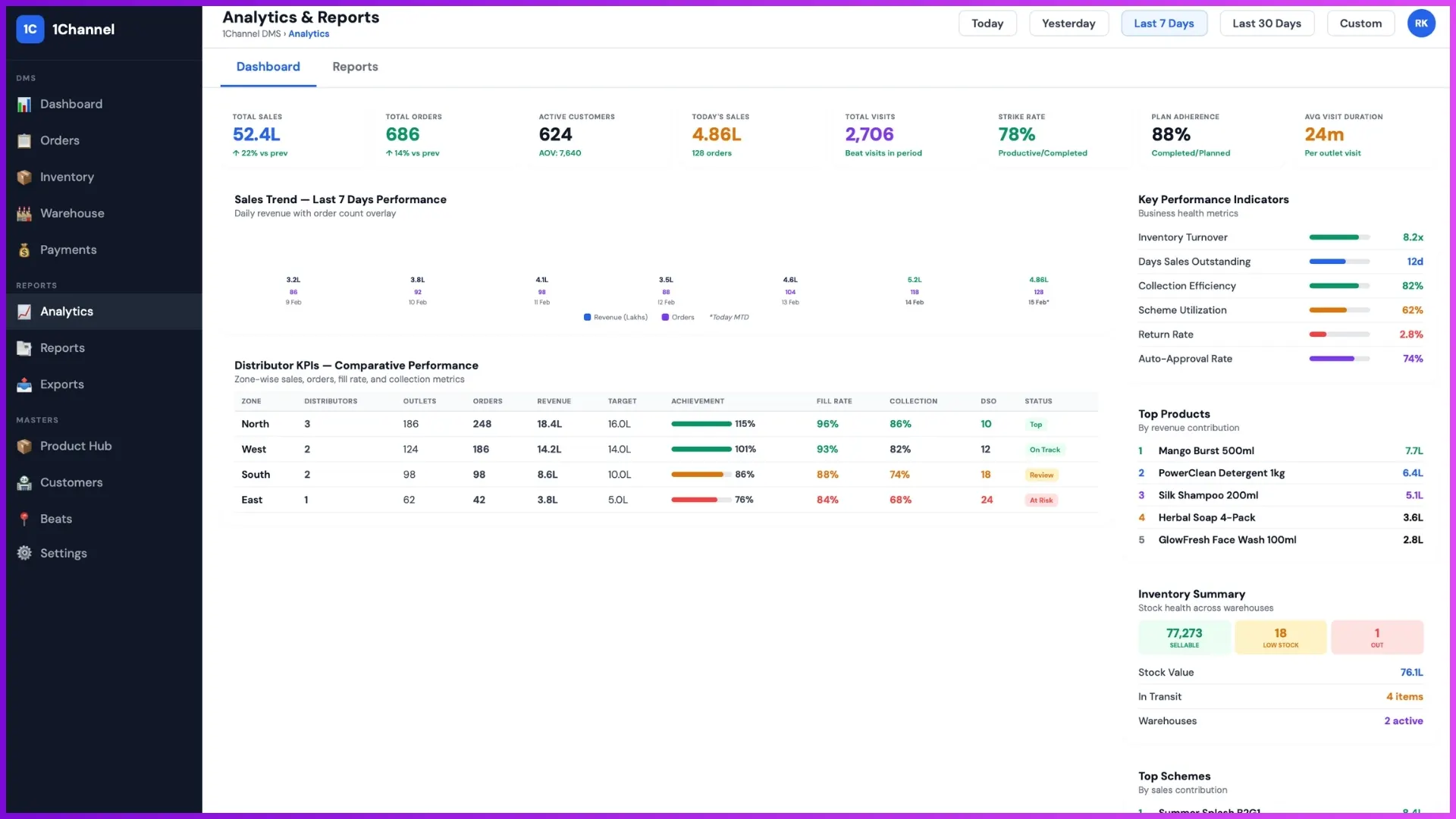
A distributor dashboard brings multiple business indicators into one place.
Common dashboard sections include:
- Revenue summary
- Order overview
- Sales trends
- Inventory status
- Customer activity
- Performance indicators
- Reports and analytics
With integrated reporting, users can quickly access business insights without manually collecting data from different sources.
Using AI Assistance for Faster KPI Insights
Modern distributor management systems can include AI assistance that helps users access information quickly through simple queries.
Users can ask questions related to business data and reports.
Examples:
- “Show my pending orders”
- “Show orders for a specific area”
- “How to place an order?”
- “Show sales performance”
This reduces the time required to manually search through multiple reports.
How 1Channel Helps Businesses Track Distributor KPIs
1Channel Distributor Analytics & Reporting Software helps businesses manage distributor operations through centralized dashboards, analytics, inventory tracking, order management, reporting, and operational workflows.
Businesses can monitor important distributor KPIs related to:
- Sales performance
- Orders
- Inventory
- Customer activity
- Field productivity
- Targets
- Payments
- Reports
The platform provides visibility across different operational areas so businesses can identify trends, monitor performance, and make informed decisions using structured data.
Explore 1Channel Distributor Analytics
Explore Distributor Analytics →Frequently Asked Questions (FAQs)
1. What are distributor KPIs?
Distributor KPIs are performance indicators used to measure important business activities such as sales, inventory, orders, customers, payments, and operational efficiency.
2. Which sales KPIs should distributors track?
Distributors should track metrics such as total sales, revenue trends, total orders, product performance, and customer sales contribution.
3. How do inventory KPIs help distributors?
Inventory KPIs help distributors monitor stock availability, low-stock products, stock movement, warehouse position, and replenishment requirements.
4. Why should distributors track order performance?
Order KPIs help businesses understand order status, processing delays, pending orders, and delivery performance.
5. How can distributors monitor customer performance?
Customer KPIs allow businesses to track customer activity, order history, sales contribution, outstanding amounts, and credit status.
6. What KPIs are useful for field sales teams?
Field sales KPIs include planned visits, completed visits, outlet coverage, productivity, and target achievement.
7. How do distributor dashboards improve decision-making?
Dashboards provide centralized visibility of sales, inventory, orders, and business performance, helping users identify issues faster.
8. Why is batch and expiry tracking important?
Batch and expiry KPIs help businesses monitor aging inventory and reduce risks related to expired products.
9. Can distributor reports be exported?
Yes, distributor reports can be filtered and exported for further analysis and business review.
10. How can businesses improve distributor performance tracking?
Businesses can improve tracking by using centralized systems that connect sales, inventory, orders, customer data, and analytics in one place.