In field merchandising, planning a path is only half the battle; ensuring your team adheres to that path is where true operational efficiency lies.
Permanent Journey Plan (PJP) compliance acts as the foundation for structured market coverage.
When field forces execute audits, staying aligned with pre-mapped routes and timelines determines the accuracy of the data collected and the productivity of the entire retail network.

1. What is PJP Adherence in Field Audits?
PJP adherence measures how closely Field Force Executives stick to their scheduled store visits on any given day. A high adherence score ensures that designated retail counters receive consistent attention, stocks are evaluated reliably, and visual guidelines are actively verified.
When field executives deviate from their planned routes, it triggers data gaps that distort performance analytics. System dashboards track these metrics in real-time to maintain operational discipline.
Key Metric Spotlight
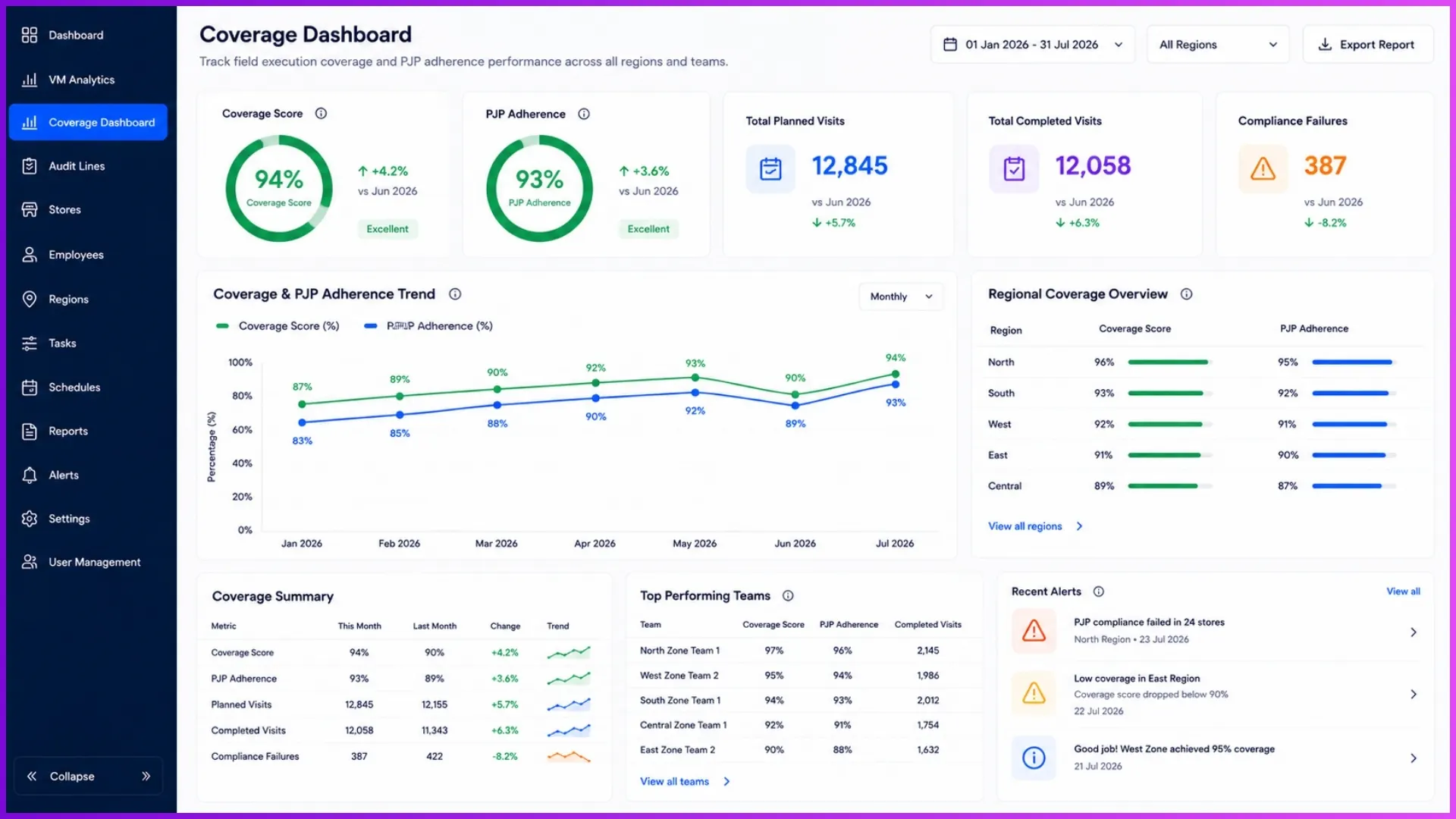
Advanced field dashboards keep a strict eye on field operations by tracking a dedicated Coverage Score, PJP Adherence %, and overall Visit Score to evaluate standard execution quality.
2. PJP Non-Compliance and Store Productivity
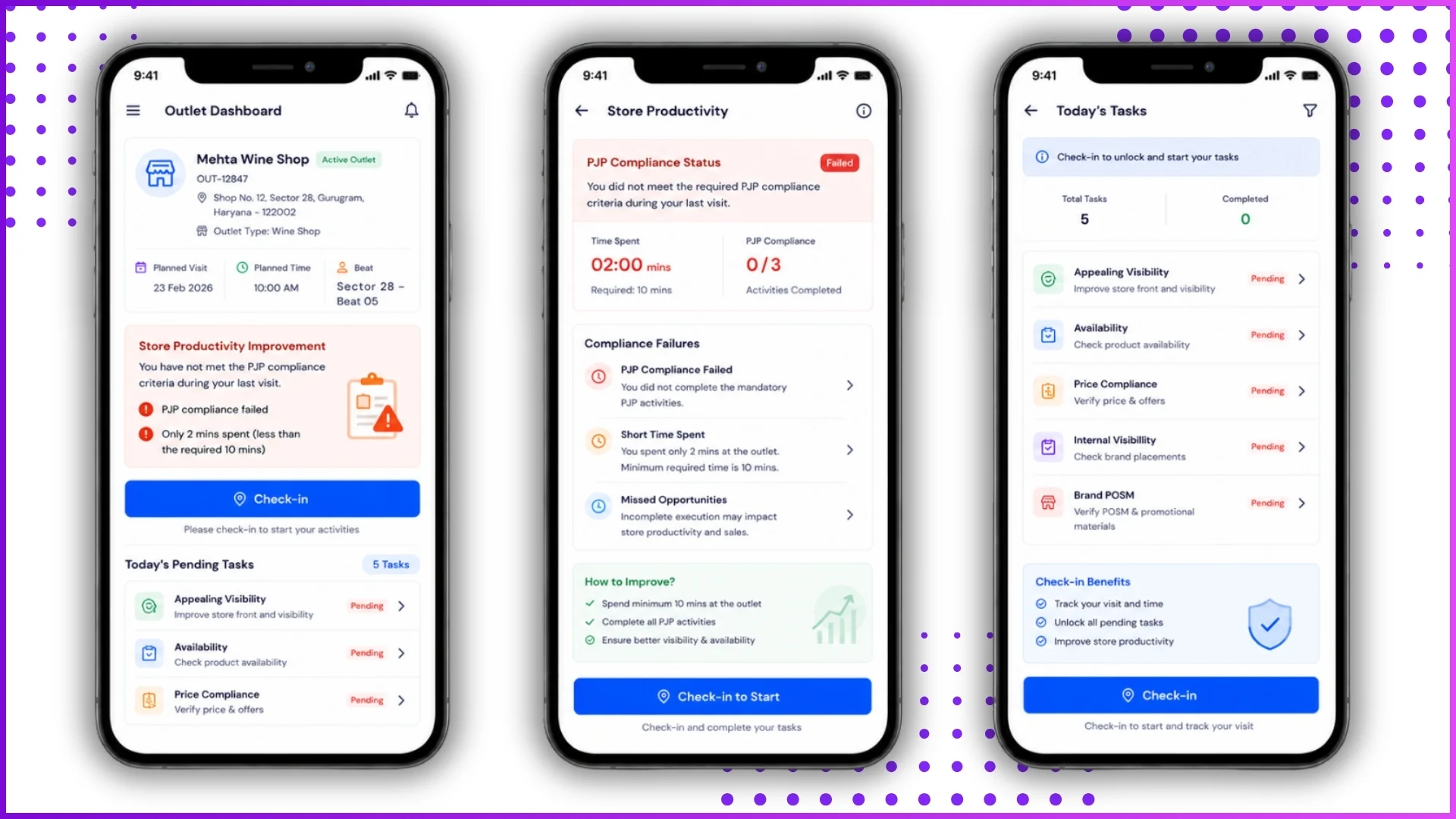
PJP compliance directly impacts store performance insights. When field visits are skipped or executed poorly, the system flags these gaps under store productivity analysis.
Identifying Field Execution Gaps
A store productivity tracking system closely monitors two critical infractions during field visits:
- Missed Compliance: Outlets where standard field journey compliance guidelines were completely ignored during the visit.
- Time-Compromised Visits: Audits where the field representative spent less than the optimum required time inside the retail outlet.
Example: The Analytics Impact
Consider a scenario at Mehta Wine Shop in Sector 28. If a Field Force Executive conducts an audit too quickly or skips required protocols, the portal registers data entries like:
- 1.25% of visits where PJP compliance was not done.
- 50% of visits where time spent was less than the optimum threshold.
Such flags immediately inform managers that the audit quality at that specific counter might be compromised.
3. The Logic of Ad-Hoc and Unplanned Visits
While adhering to the monthly structured plan is the priority, real-world market dynamics demand flexibility. Field execution systems distinguish between carefully mapped routes and spontaneous market actions.
- Planned Merchandising Visits: Routine, scheduled stops allocated to field reps at the beginning of the month to maintain steady benchmark tracking.
- Unplanned/Ad-Hoc Actions: Spontaneous visits triggered by sudden market gaps, seasonality, or competitive pressures.
Even when field reps conduct extra, unplanned visits to capture immediate market data, the system seamlessly captures the execution scores.
For instance, national performance charts often show cases where actual completed visits exceed original targets (e.g., reaching a 104% Visit Score) because field forces smartly capitalized on unexpected retail opportunities while maintaining their baseline coverage.
4. Operational Exceptions: The Negative Workflow
A crucial rule of PJP compliance is acknowledging that field reps will occasionally face structural blockers.
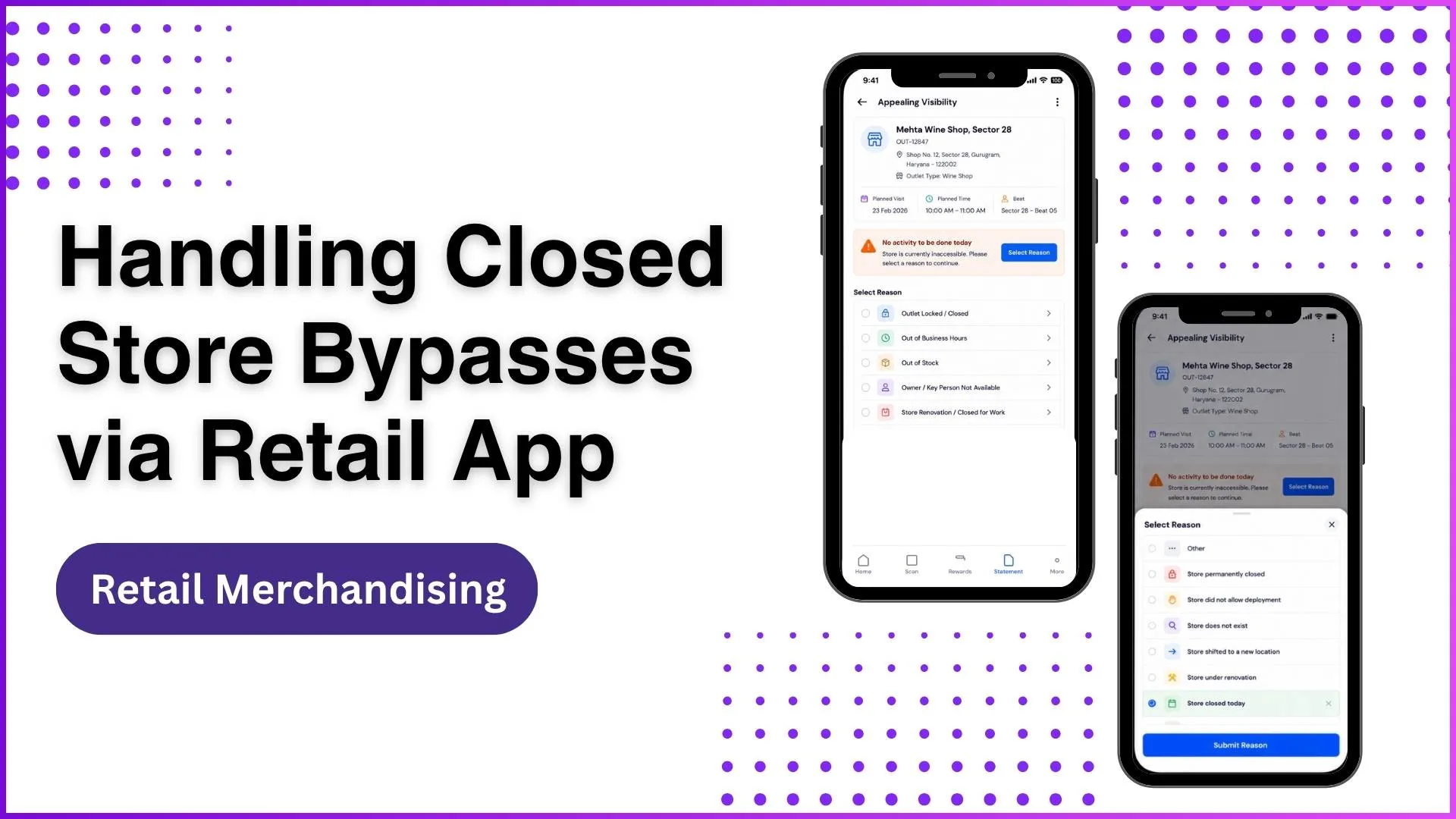
When an outlet on the journey plan cannot be evaluated, executives must utilize the system's Reasoning Bypass Workflow. Instead of leaving a scheduled visit blank, the representative submits a valid negative reason.
Standardized compliance exceptions allowed in the system include:
- Store permanently closed or shifted to a new location.
- Store closed today or undergoing active renovation.
- Store did not allow deployment, or the counter does not exist.
Submitting these reasons logs a formal explanation, protecting the representative's performance score from being penalized for unpreventable route deviations.
Streamlining Field Efficiency with 1Channel
To successfully implement these rigorous compliance rules, brands require an advanced, automated framework.
The 1Channel retail merchandising platform optimizes field operations by eliminating manual scheduling dependencies.
Through features like automated route adherence tracking, self-service campaign management, and multi-tier supervisor audit dashboards, 1Channel empowers organizations to drive real-time visibility and maintain an exceptional monthly quality score across thousands of retail outlets.
Explore 1Channel Retail Merchandising Software
See how 1Channel's Retail Merchandising Software tracks PJP adherence, store productivity, and structured bypass workflows to keep field audit data accurate across every outlet.
Explore Retail Merchandising Software →Conclusion
Enforcing clear PJP compliance rules ensures your field audit data remains pristine and actionable.
By closely monitoring adherence percentages, tracking time spent in stores, and providing structured bypass options for real-world exceptions, companies can maximize their field force investments and secure an undeniable edge at the retail shelf.
Frequently Asked Questions
1. What is PJP adherence?
It measures how closely field executives follow their pre-scheduled store routes and visit timelines.
2. What happens if a store visit is too short?
The system flags it as a time-compromised visit, indicating the audit quality may be low because minimum time thresholds weren't met.
3. Can field executives make unplanned visits?
Yes. Spontaneous or ad-hoc visits are tracked separately to capture sudden market opportunities without disrupting baseline targets.
4. What should a rep do if a store is permanently closed?
They must submit a reasoning bypass workflow with a valid negative reason to prevent their performance score from being penalized.
5. How do managers track route compliance in real time?
Managers use automated retail merchandising platforms, like 1Channel, which feature live coverage scorecards and supervisor audit dashboards.