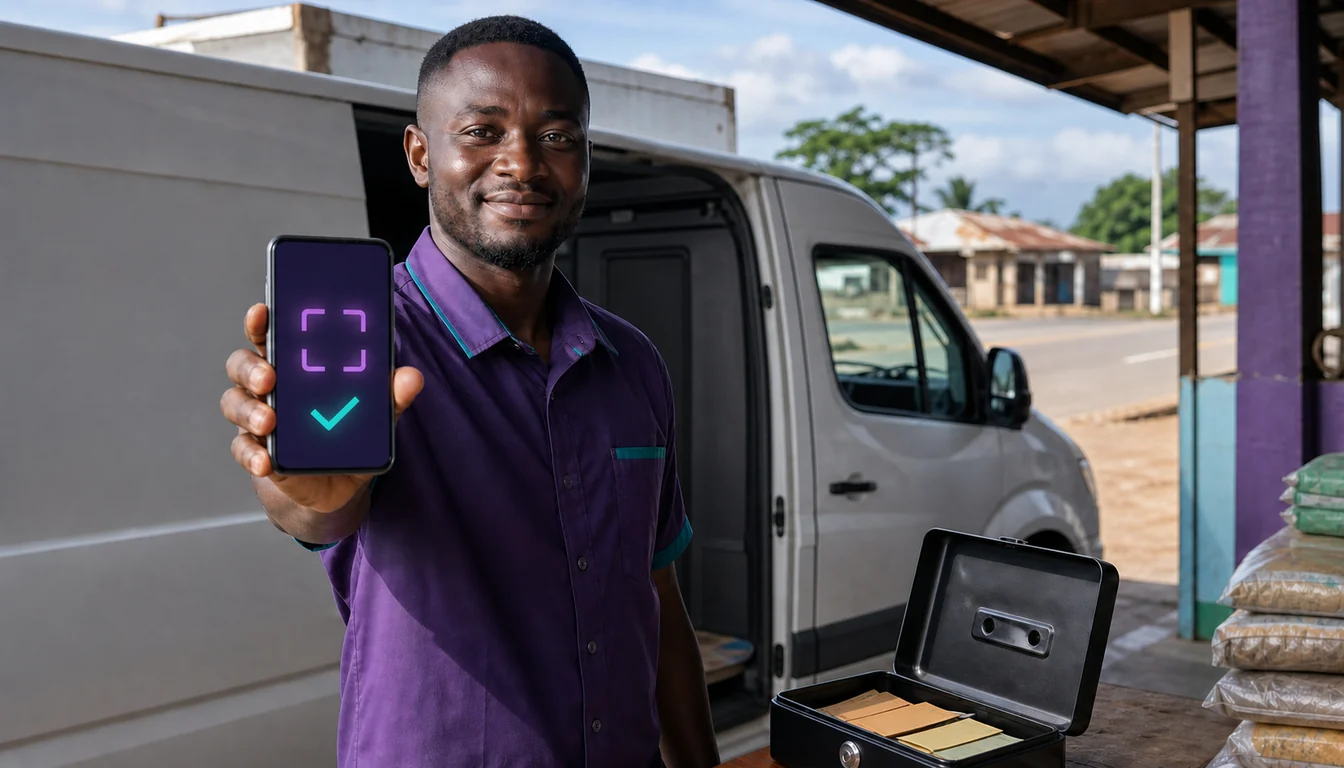
Financial Services Field Software for Ghana's Agent Networks and Branches
Reach in Ghanaian financial services depends on people, not premises: mobile money agents, agency banking outlets, insurance intermediaries and loan officers. One platform recruits and certifies them, records what they do each day, and settles their commission in GHS. Capture keeps running where northern network coverage runs out.
In Ghana, Financial Distribution Is an Agent Management Problem
A wallet float top-up in Tamale, a policy renewal in Kumasi and a group loan repayment in Techiman all pass through an intermediary the institution does not employ and rarely sees. Recruitment, certification, daily activity and GHS settlement for that network end up spread across spreadsheets, chat threads and three unconnected back-office systems.
Onboarding an Agent Takes Weeks
Ghana Card capture, National Identification Authority verification, a photograph of the shopfront, a signed agreement and a float arrangement all travel separately. By the time the approval clears, the applicant has signed with whoever asked second.
Nobody Can Prove the Visit Happened
Supervisors sign off on route reports written after the fact. Without a geo-tagged check-in and a photograph taken on the spot, an institution cannot separate a genuine outlet visit in Bolgatanga from a monthly claim typed up in Accra.
Commission Disputes Eat the Relationship
Volume sits in one system, tier rules sit in a policy document, and somebody rebuilds the GHS calculation by hand every month. Agents query the figure, payment slips late, and confidence in the network erodes faster than any scheme rebuilds it.
Applications Stall Where Nobody Is Watching
A lending file, a motor quote or an account opening pack moves as a chat message and an email attachment. Ageing is invisible, so the first signal of a stalled case is a customer who has already opened elsewhere or quietly let cover lapse.
Training Never Reaches the Last Agent
Product changes, Bank of Ghana directives and updated data-handling duties under Act 843 get announced at a regional meeting. Whether the agent in Wa took any of it in stays unknown until a mis-sale or an audit finding answers the question.
Every Channel Reports Separately
Branch teams, insurance intermediaries, bancassurance counters, mobile money agents and microfinance loan officers each keep their own numbers. Leadership assembles the picture at month end, by which point nothing about that month can still be changed.
Apps that Run the System
The Two Apps Your Field Teams Actually Open
Relationship managers, agent supervisors and loan officers work from these on Android and iOS. Both hold data on the handset when coverage drops, and both write to the cloud backend the head-office portal reads.
1Channel SFA & DMS
Google Play
1Channel SFA & DMS
Apple App Store
1Channel CRM
Google Play
1Channel CRM
Apple App Store
BFSI Solutions in Detail
Explore Each BFSI Module
Three modules, a page each, written for Ghanaian institutions and the intermediaries they sell through.
Running Branch, Agent and Loan Officer Activity in Ghana
Field work in this sector is a coverage problem before it is a sales problem. A cloud sales force automation platform hands every role its own day plan, records where a visit actually happened rather than where it was claimed, and carries each application through to disbursement or policy issue. Reps on northern and rural beats keep working when the signal drops.
Journey Plans by Role, relationship managers on business accounts, supervisors on agent territories, loan officers on group meetings, each with its own cadence
Proof of Presence, geo-tagged check-ins that store the GhanaPostGPS code alongside a landmark description, because the digital address alone will not get anyone to the door
Agent Network Oversight, float health, service quality and downtime logged per agency banking or mobile money outlet during the supervisor's round
Application Ageing, enquiry, Ghana Card and know-your-customer checks, appraisal, approval and disbursement, with a stall alert on any stage that overruns
1Voice AI Assistant, ask which Upper East outlets went unvisited last week and read the answer, instead of commissioning a report
Commission, Tiers and GHS Settlement for Ghana's Intermediaries
An intermediary paid late, or paid a figure nobody can explain, stops selling. A cloud loyalty platform reads volume straight from source, applies the tier rules you published, and settles in GHS on whichever rail the agent prefers. Ghana's rails interoperate through GhIPSS, so a bank account, a GhanaPay account and a wallet are all one instruction away.
Rules That Calculate Themselves, monthly GHS slabs on accounts sourced, premium collected, loan book grown or wallet transactions handled, with the working shown to the agent
Settlement on the Agent's Rail, GhIPSS Instant Pay into a bank or GhanaPay account, or a transfer to MTN MoMo, Telecel Cash or AT Money, on a published cycle
Tier Progression, movement earned on persistency and quality rather than gross volume alone, so business that churns stops paying twice
Messaging in the Right Language, scheme rules, tier changes and settlement confirmations by SMS and WhatsApp, in English, Twi, Ga, Ewe or Dagbani
Nobody in this network sits in a classroom. A structured cloud sales team LMS pushes short modules to the handset, tests understanding before activation, and records who passed what and when. The field app reads that record, so an agent without current accreditation on a product simply cannot pitch it.
Activation Gates, a new deposit product, cover type or wallet service unlocks only once the quiz has been cleared
Regulatory Refreshers, Bank of Ghana directives, anti-money-laundering practice, Ghana Card verification, and the customer-data duties set by the Data Protection Act, 2012 (Act 843)
Agent Onboarding Paths, float handling, fraud red flags, complaint routing and service standards for agency banking and mobile money outlets
Coaching in Local Languages, material in English with Twi, Ga, Ewe and Dagbani support, for teams who sell in one language and report in another
Field-team reading on collecting across mobile money and cash, holding credit exposure in cedis, and capture that survives a rural beat with no signal.
What the platform brings to an institution whose reach depends on people it does not employ.
Three Modules, One Record
Activity, settlement and certification write to the same cloud store. A supervisor's visit note, an agent's GHS earning and that agent's training status are three views of one record, not three exports.
Built for Mixed Networks
Branch staff, tied intermediaries, brokers, bancassurance counters, microfinance loan officers and agency banking outlets each get their own screens, targets and commission rules without a separate deployment.
AI Applied Narrowly
Face matching on the check-in photograph, scoring that ranks which open applications are worth chasing today, duplicate-sourcing detection before any GHS settlement is released, and plain-language questions answered by 1Voice.
Works Where Coverage Thins
Beats through the Savannah, Upper East, Upper West and rural agricultural districts run past the edge of usable data. Forms, photographs and timestamps queue on the device and post themselves once the handset finds signal again.
Aligned With Ghanaian Obligations
Learning content tracks Bank of Ghana directives and anti-money-laundering practice, Ghana Card checks are captured during onboarding, and role-based access, encryption and audit trails support the duties Act 843 places on personal data. The platform holds no licence or approval of its own.
Connects to the Systems of Record
REST APIs and scheduled SFTP exchanges move data between the field app and core banking, policy administration and agent-management systems, so pipeline value and commission are computed from booked figures.
Start Small, Widen Later
One module in one region is a normal first phase. Agent commission can go live while branch relationship management is still being configured, with nothing disturbed mid-cycle in a scheme already running.
White-Labelled Apps
Supervisor, intermediary and loan officer apps ship under your own brand on Google Play and the App Store, so the network sees one identity from onboarding through to settlement.
Put Your Ghanaian Agent Network on One Platform
Tell us how your branches, intermediaries and agency outlets are organised today and we will map the rollout that fits. Cloud, AI and automation throughout, with capture that holds when the network does not.
They share one cloud record per person. The field module logs what a relationship manager, a supervisor or an agency outlet did today. The loyalty module turns the resulting volume into a GHS entitlement. The learning module decides what that person is currently allowed to sell. Because all three read the same identity, a lapsed certification blocks a pitch, and a disputed commission traces back to the visit that created it.
Which roles does the field app cover?▼
Relationship managers working business and high-value accounts, supervisors responsible for agency banking and mobile money outlets, insurance intermediaries, bancassurance officers and microfinance loan officers. Each opens a different home screen, a different target set and a different form. The install is the same one, and so is the behaviour when the signal goes.
How is an application tracked from enquiry to payout?▼
Stages are configured per product. A lending file typically runs enquiry, Ghana Card and know-your-customer verification, appraisal, approval and disbursement; a cover proposal runs enquiry, quote, underwriting and issue. Every stage carries a maximum age. When a file overruns it surfaces on the owner's screen and on the branch manager's, with the GHS value still at stake attached to it.
How is agent commission calculated and settled in GHS?▼
Volume arrives from the field app and the systems of record, so nobody rekeys it. The published slab and tier rules run against it on a fixed cycle and produce a GHS figure the agent can open and inspect line by line. Settlement then goes out over GhIPSS Instant Pay into a bank or GhanaPay account, or as a transfer to an MTN MoMo, Telecel Cash or AT Money wallet, with a confirmation message and a full approval trail behind it.
What does the learning module cover for a Ghanaian financial field force?▼
Product and service modules for anything the network sells, onboarding for new agency banking and mobile money outlets, anti-money-laundering and fraud practice, Ghana Card verification, and the handling duties the Data Protection Act, 2012 (Act 843) places on customer information gathered in the field. A pass is recorded against the person, and the field app checks that record before it allows a pitch. Material runs in English with Twi, Ga, Ewe and Dagbani support.
Does the app work where network coverage is weak?▼
Yes, and that is the normal case on beats through the Savannah, North East, Upper East, Upper West and rural agricultural districts. Visits, documents, photographs, notes and application updates are written to the handset, timestamped there, and posted to the cloud the moment it next finds data. A supervisor with no bars still ends the day with a complete route record.
What does the platform connect to?▼
Core banking, policy administration and agent-management systems, over REST APIs where live exchange is wanted and scheduled SFTP where a platform prefers files. Booked disbursements, issued policies and settled transactions flow back, so pipeline value and commission are computed from confirmed figures rather than from field claims. Webhooks push events onward to whatever else needs to know.
Where does AI actually do something useful here?▼
In four places. It matches the check-in photograph against the registered person. It ranks open applications so the day starts with the ones most likely to close. It flags sourcing patterns that look duplicated before any GHS settlement leaves the system. And 1Voice takes a typed question, such as which Ashanti outlets have gone unvisited this month, and answers it directly.
What do branch and regional leaders see?▼
A branch view carrying pipeline value, application ageing, verification turnaround and who is certified on what. A channel view carrying intermediary conversion, tier movement and GHS entitlements as they accrue. Above both, roll-ups by region and district assembly, each drillable down to one supervisor, one outlet or one file. Anything not already on a dashboard can be put to 1Voice.
Which other industries does the same cloud platform serve?▼
The same backend runs FMCG, food and beverage, dairy, home care, retail and modern trade, pharma, healthcare, consumer durables, cosmetics, automotive spares, building materials, agriculture, agro-chemicals and industrial products. Configuration is what differs. A beat through provision shops and market stalls and a supervisor's round of agency outlets are the same journey-planning engine pointed at different masters.