Why Offline Capability Belongs in a Ghana Field Sales Brief
Offline capability appears on every field sales requirement list and gets ticked without much argument. In Ghana it deserves a harder look, because the honest answer changes depending on which part of the country a team is selling in.
Across the southern urban belt, connectivity is genuinely usable. 4G is broadly available around Accra, Tema, Kumasi and Sekondi-Takoradi and along the main corridors, so a Field Sales Representative working provision shops, kiosks and market stalls in a dense city beat stays connected for most of the day. Newer capacity arrives gradually: Next Gen InfraCo's shared wholesale network only switched its commercial 5G backbone on in March 2026, in parts of Accra, Kumasi and Tamale, leaving 5G a nascent layer over an established 4G base.
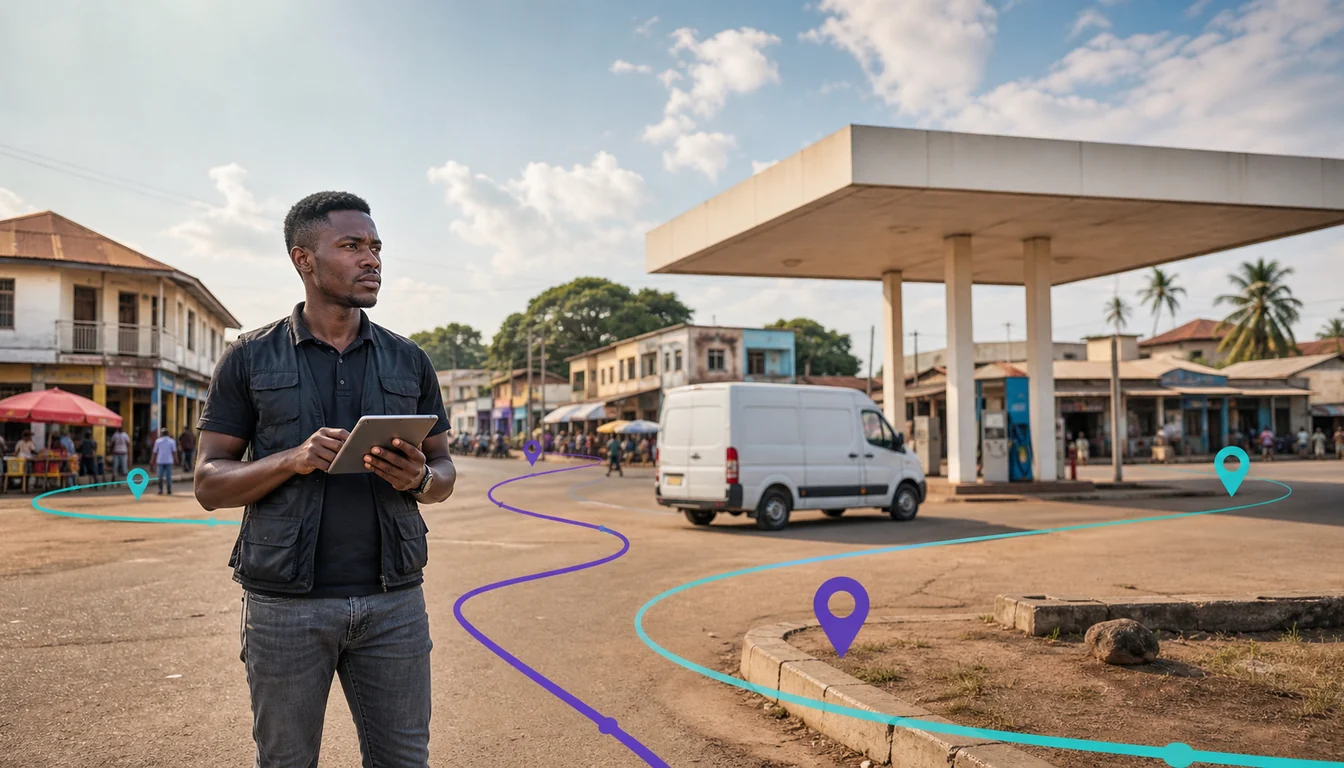
Move north and away from the trunk roads and the picture changes for real. Coverage thins across the Savannah, North East, Upper East, Upper West, Oti and Bono East regions, and along rural cocoa and agro routes elsewhere. A representative working out of Wa or Bolgatanga, or calling on farming communities between market towns, will lose signal during the day. Not as an occasional annoyance, but as a predictable feature of the route.
That is the case for offline capability in Ghana: a coverage argument tied to a definable set of routes rather than a blanket claim about the country, and measurable because of it.
Two Beats, One Application
The clearest way to size the requirement is to put two working days side by side.
A dense southern beat
A representative on a high-density urban beat may make a long list of calls inside a few square kilometres: provision shops along a residential stretch, kiosks and container shops around a junction, table-top sellers outside a lorry station, then a cluster of market stalls. Drive time is short and the constraint is call quality rather than travel. Connectivity holds through most of the day, so orders, credit checks and stock availability resolve live. Offline behaviour here is a safety net for a basement stockroom or a dead patch behind a market shed, not the design centre.
A sparse northern beat
A northern or rural agricultural beat inverts those assumptions. Outlets sit further apart, the journey between calls is the dominant cost, and a single day may cover several district assemblies. Smaller communities trade on traditional market-day cycles rather than daily, so the beat has to reach the right town on the right day or the call is wasted. Signal comes and goes with terrain and distance from the nearest site, and a representative may complete a run of calls with no connection at all, then pass back through a covered town on the return leg.
The same tablet, application and field force policy have to serve both. That is a design requirement rather than a configuration preference, and worth testing in a pilot.
What Actually Breaks When the Signal Drops
"Works offline" is not one feature. It is a set of separate behaviours, each failing in its own way, and vendors are rarely equally strong across all of them.
Order capture
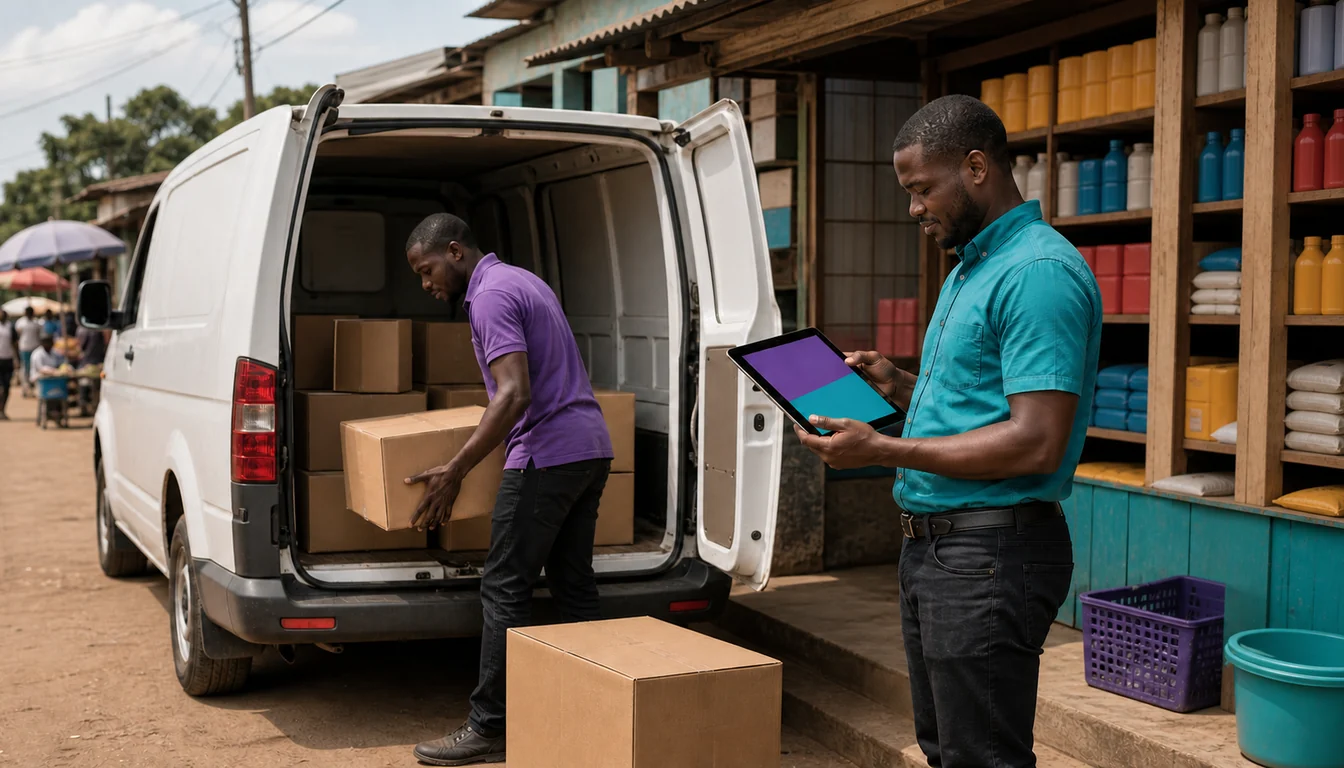
Taking the order is the call. If the order screen will not open without a connection, the visit becomes a note on paper that someone who was not there re-keys at the depot that evening. Re-keying is where quantities drift, where a substitution is lost, and where the order arrives too late for the next loading cycle. Offline capture therefore has to be the full experience, including catalogue, pack conversions, scheme logic and the running order value in GHS, so what the representative confirms with the shopkeeper is what the order management system eventually receives.
Outlet check-in and geo-tagging
Ghana's outlet masters are built on coordinates rather than addresses. GhanaPostGPS gives the country an official digital address standard, but day-to-day navigation is still landmark-led, so a geo-tagged outlet record is what makes a beat repeatable for a covering colleague. Check-in has to work from the device's own location fix, cache the stamp with its real timestamp, and upload later without losing accuracy. A system that records a visit only when the server confirms it will show a northern beat as half-worked, which is unfair to the representative and useless to the Sales Supervisor. The same applies to outlets added on the road, tying offline capture to beat planning built on landmarks rather than street addresses.
Stock, price and scheme lookups
Representatives need answers at the counter: the current price, what the key distributor holds in the warehouse, which pack carries a scheme this cycle, and whether the outlet sits inside its credit limit. Offline, the device has to serve the last synchronised version and be honest about it, showing when the data was refreshed rather than presenting stale figures as current. A good application lets a representative quote confidently from cached prices while flagging what needs confirmation, instead of blocking the call or promising stock that is not there.
Photo evidence for merchandising
Photographs are the heaviest thing a field application handles and the thing a weak offline design discards soonest. A Merchandiser working a shelf, a display or a point-of-sale placement needs the picture attached to the right outlet, visit and task. Compression should happen on the device, uploads should queue separately from transactional data so a slow photo does not hold back an order, and the queue should survive the tablet restarting. Anything less and the merchandising evidence trail quietly becomes a southern-region-only dataset, which makes national execution scoring meaningless.
How Queued Work Reconciles When Signal Returns
Capturing offline is the easy half. The hard half is what happens when the device finds a network again, hours later and after a full day of calls. Sequence matters: transactions have to replay in the order they were created rather than the order they happen to upload, or a return raised before an order will land after it and the outlet's ledger stops making sense. Uploads have to be idempotent, so a connection dropping mid-sync does not produce two copies of the same order on retry. The queue also needs to be visible to the person carrying it, so a representative sees what is still waiting instead of discovering at month end that it never arrived.
Conflicts need a stated rule rather than a silent guess. If a price changed centrally while the device was offline, if a scheme closed, or if promised stock went to another route, the system has to decide, record the decision and surface it. The safest pattern treats the field record as the truth about the outlet visit, then flags any commercial difference for the Sales Supervisor or Area Sales Manager to clear before loading.
Collections have their own timing. Mobile money is Ghana's dominant rail and is fully interoperable through GhIPSS, so a payment taken at the counter over MTN MoMo, Telecel Cash or AT Money settles quickly even though the field application may not learn of it until the device syncs. Cash is still real at the table-top and market-stall tier, and cash receipts queue like any other record. That gap between money moving and the system seeing it is normal on a rural beat, as our post on order-to-cash with mobile money and cash for Ghana distributors sets out.
Planning Northern Routes Around Sync Windows
Once you accept that a northern beat runs disconnected for stretches, the route itself becomes part of the answer. Sequencing a beat so it passes through a covered town at midday, or ends there, gives the queue two chances to clear instead of one. Depot arrival is a natural sync point, with a supervisor's check that every device has drained its queue before the team stands down. Unplanned local outages at a depot can delay an evening upload, one more reason not to make the depot the day's only sync opportunity.
Seasonality shapes this too. Harmattan from December makes northern journeys slower, festive demand around Christmas and Easter lifts volumes nationally, and Damba and Eid matter to trading rhythm in the north in a way they do not further south. Long beats become longer in those windows, so building the patterns into route planning works better than asking representatives to absorb them. The route model itself deserves revisiting for sparse territory, since van sales and pre-selling behave differently when a call cannot be confirmed live, which is the subject of our comparison of van sales and pre-selling route models for Ghana.
Questions Worth Asking Before You Buy
Most field sales platforms claim offline support. These questions separate the ones that mean it from the ones that cache a login screen.
- Can a representative complete an entire day of calls in aeroplane mode, including new outlet creation?
- How long before cached catalogue, price and credit data are treated as too stale to quote from, and what does the representative see then?
- What happens to a sync interrupted halfway, and what proves no order was duplicated?
- Do photographs queue independently of transactions, and survive a device reboot?
- Can a supervisor see, per representative, exactly what is still unsynchronised right now?
How 1Channel Helps Field Teams Work Offline in Ghana
1Channel is built for field forces that cannot assume a connection. The mobile application holds the working set on the device, captures the full call offline, and synchronises in the background whenever a usable network appears, so a northern beat and an Accra beat produce the same quality of record. Running from a single cloud back end, it behaves the same whether the call is a provision shop, a kiosk, a container shop, a market stall or a minimart, and whether the selling team belongs to the brand or to the key distributor.
- Full offline call completion. Order capture in GHS with catalogue, pack conversions, scheme logic and credit status served from the device, so no visit is reduced to a paper note.
- Geo-tagged check-in that queues. Visit stamps, outlet coordinates and new-outlet creation recorded locally with their real timestamps and uploaded intact, keeping coverage reporting honest across all 16 regions and the MMDAs beneath them.
- Independent photo queues. Merchandising and point-of-sale images compressed on the device and uploaded on their own channel, so evidence never blocks an order.
- Ordered, idempotent synchronisation. Transactions replay in the sequence they were created, interrupted syncs resume without duplicating records, and unresolved differences go to a supervisor rather than being silently applied.
- Collections that reconcile both ways. Mobile money receipts over the interoperable GhIPSS rails and cash taken at the smallest outlets are captured in the field and matched against the distributor ledger on sync.
- Compliance-ready records. Field transactions flow into distributor invoicing that aligns with E-VAT invoicing through a Certified Invoicing System connected to the Ghana Revenue Authority, in force for all VAT-registered businesses since January 2026.
Keep Every Call Complete, Even Without Signal
See how 1Channel's sales force automation keeps northern and rural beats productive offline and reconciles cleanly the moment a network returns.
Explore Sales Force Automation →Key Takeaways
Offline capability earns its place in a Ghanaian field sales brief for one specific, checkable reason, and the implementation details decide whether it delivers.
- Coverage is the reason, not habit. 4G serves the southern belt well and 5G is still nascent after NGIC's commercial backbone went live in March 2026, while coverage thins across the Savannah, North East, Upper East, Upper West, Oti and Bono East regions.
- One application, two very different beats. A dense southern round and a sparse northern round differ in call spacing, travel cost, market-day timing and connectivity.
- Four things must survive a lost signal. Order capture, geo-tagged check-in, cached stock and price lookups, and merchandising photo evidence each fail differently.
- Reconciliation is where offline is judged. Ordered replay, idempotent uploads, a visible queue and a stated conflict rule stop a disconnected day producing duplicated or missing records.
- Route design reduces the exposure. Passing through covered towns, allowing more than one sync opportunity a day, and planning for harmattan and festive peaks all shorten the unsynchronised window.
- Collections lag is normal. Mobile money over the GhIPSS rails and cash at the smallest outlets both reconcile against the distributor ledger after the fact.
Test the claim before you buy it. Put a device in aeroplane mode, work a full simulated day on a northern route, and look at what reaches the back office when it reconnects. That tells you more about a platform's fitness for Ghana than any feature list.