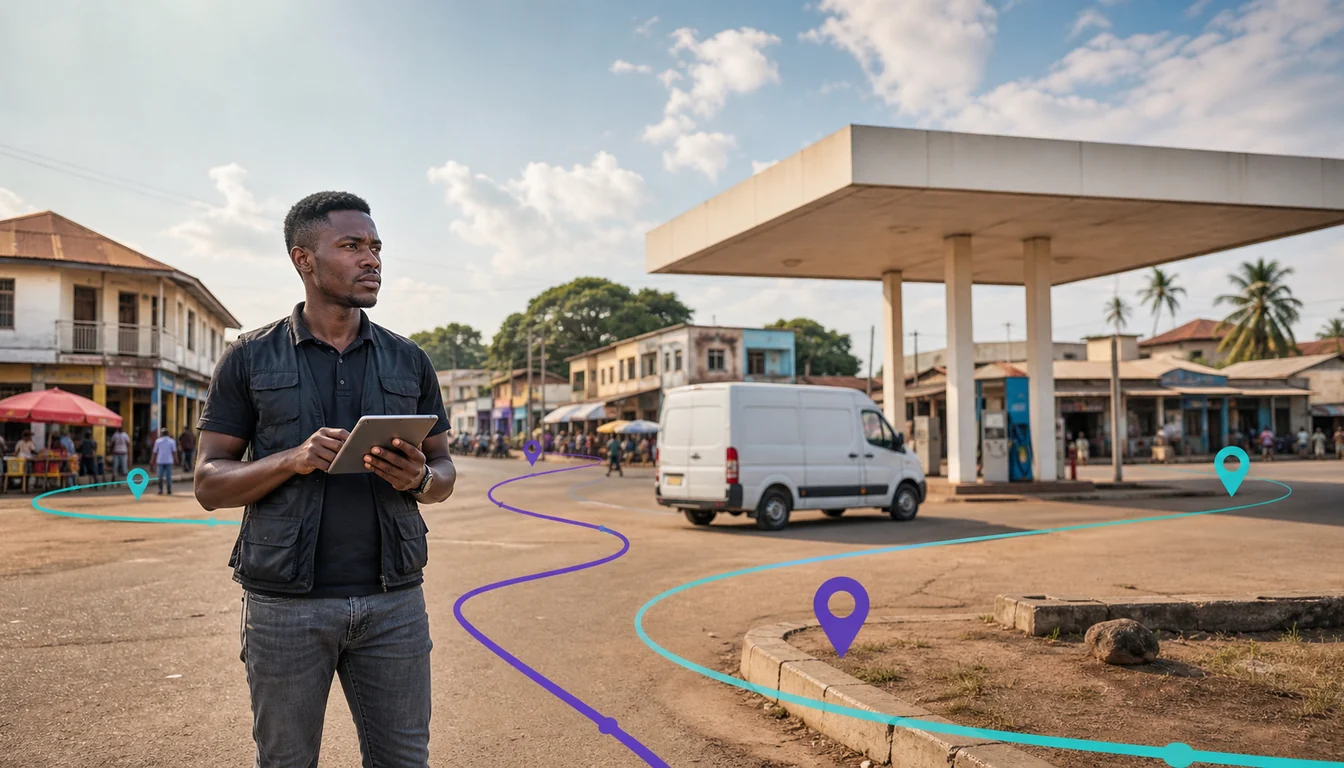
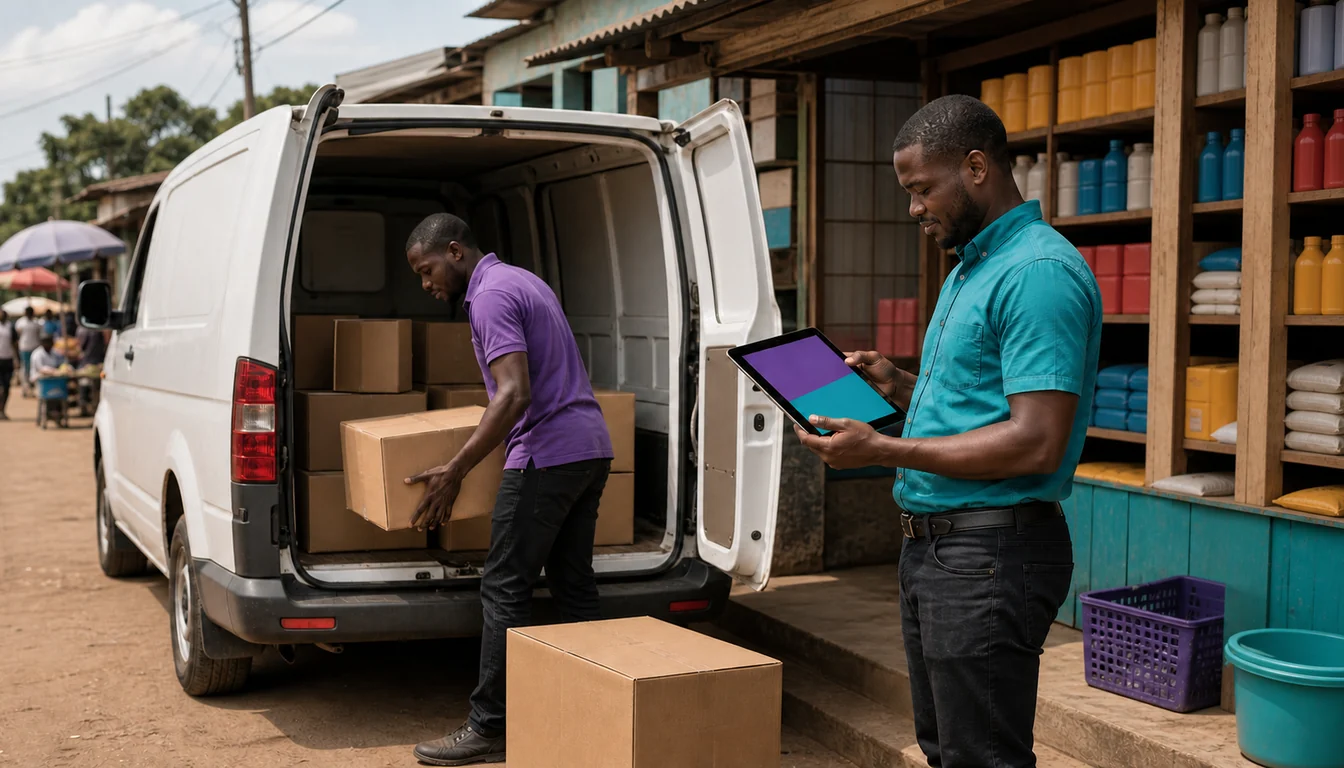
Ghanaian distributors rarely have a payments problem. They have a matching problem. Money moves fast here: a transfer between one network's wallet, another network's wallet, a bank account or a GhanaPay account settles in seconds, because GhIPSS makes the domestic schemes interoperable. What does not move at that speed is the record behind the money. An order taken at a provision shop on Monday can still sit unapplied in the receipts ledger on Friday, not because the retailer has not paid, but because nobody can prove which invoice the payment belongs to.
What Makes Collections in Ghana Different
Most markets push a distributor towards one dominant collection method and treat the rest as exceptions. Ghana does not. Mobile money is genuinely dominant, with MTN MoMo the largest wallet alongside Telecel Cash and AT Money, and because GhIPSS makes those schemes interoperable, a retailer on one network can pay a distributor who banks with another and the value arrives immediately. GhQR gives merchants a single QR standard, and GhIPSS Instant Pay handles account-to-account movement.
Cash, meanwhile, has not gone anywhere at the bottom of the channel. A table-top seller at a junction, a kiosk owner working a morning trade, a market stall in a traditional market: these outlets still hand notes to a van sales representative. So a key distributor collects on three rails at once, on the same route, often in the same week from the same outlet.
That matters more here than in a single-rail market, because Ghanaian distribution already puts distance between the brand and the money. The key distributor employs the selling team; the brand employs the supervisory layer above it. Visibility thins at exactly the handover point where cash and wallet receipts are taken, which is the same reason secondary sales go dark below the KD.
Order Capture at the Outlet
Everything downstream inherits the quality of the order. If it is written on a paper pad and keyed in at the depot that evening, the invoice is late, the delivery is guessed, and the payment has nothing clean to match against. Capturing the order digitally at the counter is a control, not a convenience feature.
The Formats a Representative Actually Sells Into
A Ghanaian beat is not a uniform list of outlets. In one morning a representative might serve a provision shop with a full grocery range, a container shop stocking fast movers, several kiosks, a few table-top sellers and a market stall buying in bulk for onward sale. Each buys and pays differently. A supermarket account needs listing-level discipline and a purchase-order reference; a kiosk needs three taps and a total. A single distributor order management layer has to serve both without forcing the small outlet through the large account's workflow.
Capturing Orders Where the Signal Thins
Across the dense southern belt, connectivity is reliable enough that this barely arises. It arises quickly once a route runs into the Savannah, North East, Upper East, Upper West, Oti or Bono East regions, where coverage genuinely thins. An order form that needs a live connection to save is a form that loses orders. The device has to accept the order, hold it and sync when signal returns, with pricing and scheme logic evaluated locally so the retailer sees the correct amount at the counter. This is why offline capability is an honest requirement on Ghana's northern routes rather than a marketing line.
Invoicing That Matches What the Buyer Pays Against
Ghana's invoicing environment is already strict, and distributors sometimes underestimate how settled it is. The Ghana Revenue Authority's E-VAT regime requires VAT-registered businesses to invoice through a Certified Invoicing System connected to the GRA platform, with no revenue threshold. This is not a mandate to prepare for. It is in force, and a system that cannot produce a compliant invoice at the point of sale is already a problem.
The VAT reform in force from 1 January 2026 under the Value Added Tax Act, 2025 changed the calculation too: the flat rate scheme was scrapped for a unified system, the health and education levies became creditable as input tax, and the registration threshold was raised. The practical consequence is that the invoice a retailer receives, the invoice the GRA sees and the receivable in the ledger must be the same document with the same reference. Where they are not, the reconciliation work below cannot be automated. The detail is worth a separate read on Ghana's E-VAT invoicing requirements.
Payment Capture Across Wallet, Bank and Cash
Delivery closes the physical side of the loop. Payment capture closes the financial side, across three routes that behave nothing like each other.
Mobile Money and GhQR
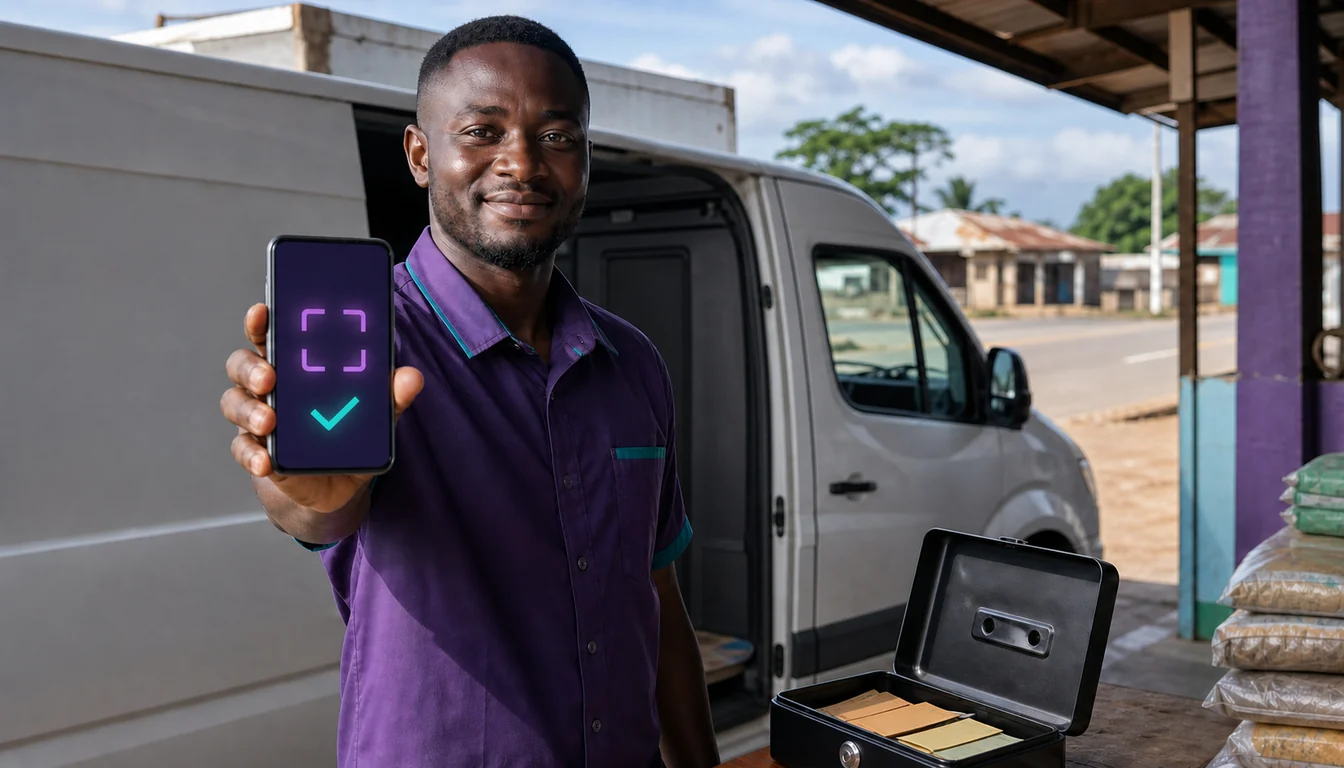
Wallet payment is the default for most independent retailers, who either send to the distributor's merchant wallet or scan a GhQR code shown on the representative's device. Settlement is effectively instant and interoperable, so receipt can be confirmed before leaving the outlet. That is the rail's most valuable property for collections: confirmation and visit happen at the same moment, so the receipt can be tagged to the invoice at the counter. A system that only learns of the payment when a statement is imported next morning throws that away.
Bank Transfer and GhIPSS Instant Pay
Wholesalers, sub-distributors and modern-trade accounts settle through their banks, typically over GhIPSS Instant Pay. These payments are larger, often cover several invoices at once, and frequently arrive without a usable reference. A wholesaler clearing four weeks of purchases in one transfer creates a real allocation decision, and if it is made informally by whoever opens the statement, the ageing report stops meaning anything.
Cash at the Smallest Tier
Cash remains normal at the kiosk, table-top and market-stall tier, and on van sales routes generally. It is also the rail with the most exposure, because between collection and remittance the value sits with a person rather than in a system. Cash collections need a receipt at the outlet, a running declaration on the device, and a depot remittance that reconciles the declared total against what is banked. How large that exposure gets depends on the route model, part of the wider van sales or pre-selling decision.
Three Rails, One Ledger
This is where most Ghanaian distributors lose time. Three rails have to be reconciled into one receivables ledger in GHS, and each fails differently.
Wallet payments arrive under the name registered to the phone, often a family member, a shop assistant or a trading name that does not match the outlet master. Bank transfers arrive as lump sums with a reference field left blank or filled with something meaningful only to the payer. Cash arrives in aggregate at the depot, one representative at a time, hours after the visits it relates to. Then there are part payments: a retailer settles most of an invoice by wallet and the balance in cash the following week, and neither entry closes the invoice on its own.
The symptom is a receivables report nobody trusts. Unapplied receipts sit in suspense while the invoices they should have cleared keep ageing, so outlets that have paid look overdue. Credit control blocks orders it should be releasing, sales override those blocks to protect the week, and credit discipline quietly disappears. Anyone tracking days outstanding will recognise the pattern from the wider problem of managing distributor credit and collections in cedis. The fix is not more reconciliation effort. It is removing the ambiguity at the point of collection, so there is nothing to reconstruct afterwards.
Closing the Loop the Same Day
A loop that closes the same day is built out of a handful of unglamorous controls, applied consistently.
Payment is captured against a specific invoice on the device, at the outlet, at the moment of collection, with the rail recorded as wallet, bank or cash. Every collection produces a receipt the retailer can keep. Cash carried by a representative is declared continuously and cleared against a depot remittance at the end of the route, so a shortfall surfaces within hours rather than at month end. Wallet and bank statements are imported and matched automatically wherever a reference exists, with only genuine exceptions queued for a human. Credit limits release or hold the next order from the applied ledger, not a supervisor's memory.
Timing matters too. Trade and distribution commonly work Saturdays here, and smaller towns run on traditional market-day cycles, so a routine built around a Monday to Friday office week leaves busy collection days unposted. Seasonality compounds it: Christmas and Easter peaks push order volume and credit exposure up together, festivals such as Homowo, Odwira and Damba lift demand regionally, and harmattan slows northern routes from December when volumes are highest. The loop has to close daily in those weeks.
Coverage design sits underneath all of it. Ghana's 16 regions and the MMDAs below them differ enormously in outlet density, and a beat supporting a daily cash remittance in Greater Accra may be impossible in Upper West. Collection frequency, route model and credit terms belong in one plan, which is why route planning and receivables management belong in one conversation.
How 1Channel Helps Close the Order-to-Cash Loop in Ghana
1Channel runs the order-to-cash loop as one connected process rather than four disconnected ones. Orders are captured on the representative's device at the outlet, invoices are raised against that order, deliveries are confirmed against that invoice, and payments are applied to it at the point of collection, whichever rail the retailer uses. Because the platform is built for markets where traditional trade carries most of the volume, it handles a provision shop, a kiosk, a container shop, a table-top seller and a supermarket account in one deployment, across the key distributor, wholesaler and sub-distributor tiers.
- Order capture at provision shops, kiosks, container shops, table-top sellers and market stalls alongside modern-trade accounts, with prices and schemes applied on the device.
- Offline order and collection capture on northern and rural beats where coverage thins, syncing when signal returns.
- Payment capture across mobile money, bank transfer and cash, recorded in GHS against a specific invoice with the rail identified.
- Cash accountability on van sales routes, from receipt at the outlet to declared float to depot remittance, with variances raised the same day.
- Automated matching of imported wallet and bank statements, with an exception queue for part payments and unmatched references.
- Credit limits and ageing that release or hold orders from the applied ledger, visible to the brand across the key distributor tier through the distributor portal.
- Invoicing that supports the GRA's E-VAT requirements and the VAT structure in force from January 2026.
Collect on every rail, reconcile to one ledger
See how 1Channel's payment management module captures mobile money, bank and cash collections against the right invoice and keeps your receivables in GHS accurate day by day.
Explore Payment Management →Key Takeaways
Ghana's collections environment is fast and interoperable, so the constraint sits in the record rather than the rail.
- Three rails run side by side. Mobile money dominates, bank transfer serves larger accounts, and cash is still normal at the kiosk, table-top and market-stall tier, so all three must be routine.
- Interoperability is worth using. Because GhIPSS links wallets, bank accounts and GhanaPay, confirmation arrives while the representative is still at the outlet, which is the moment to tag the receipt to the invoice.
- Ambiguity is created at collection, not at reconciliation. Missing references, lump-sum transfers and undeclared cash are what turn an ageing report into guesswork later.
- Invoicing is already regulated. E-VAT through a Certified Invoicing System connected to the GRA applies with no threshold, and the January 2026 VAT reform changed how levies flow through input tax.
- Coverage shapes collection. A daily remittance cycle that works across Greater Accra and Ashanti has to be rethought for the sparse northern regions, where offline capture is a genuine requirement.
- Season decides the cadence. Christmas and Easter peaks, regional festivals and Saturday trading push the loop towards daily closing rather than weekly.
Distributors who get this right stop treating collections as an accounting exercise performed after the fact and start treating it as the last step of the sales visit. The result is a receivables ledger the credit team trusts, order releases that follow the real position rather than a negotiation, and a clearer view of what is happening below the key distributor tier through distributor analytics.