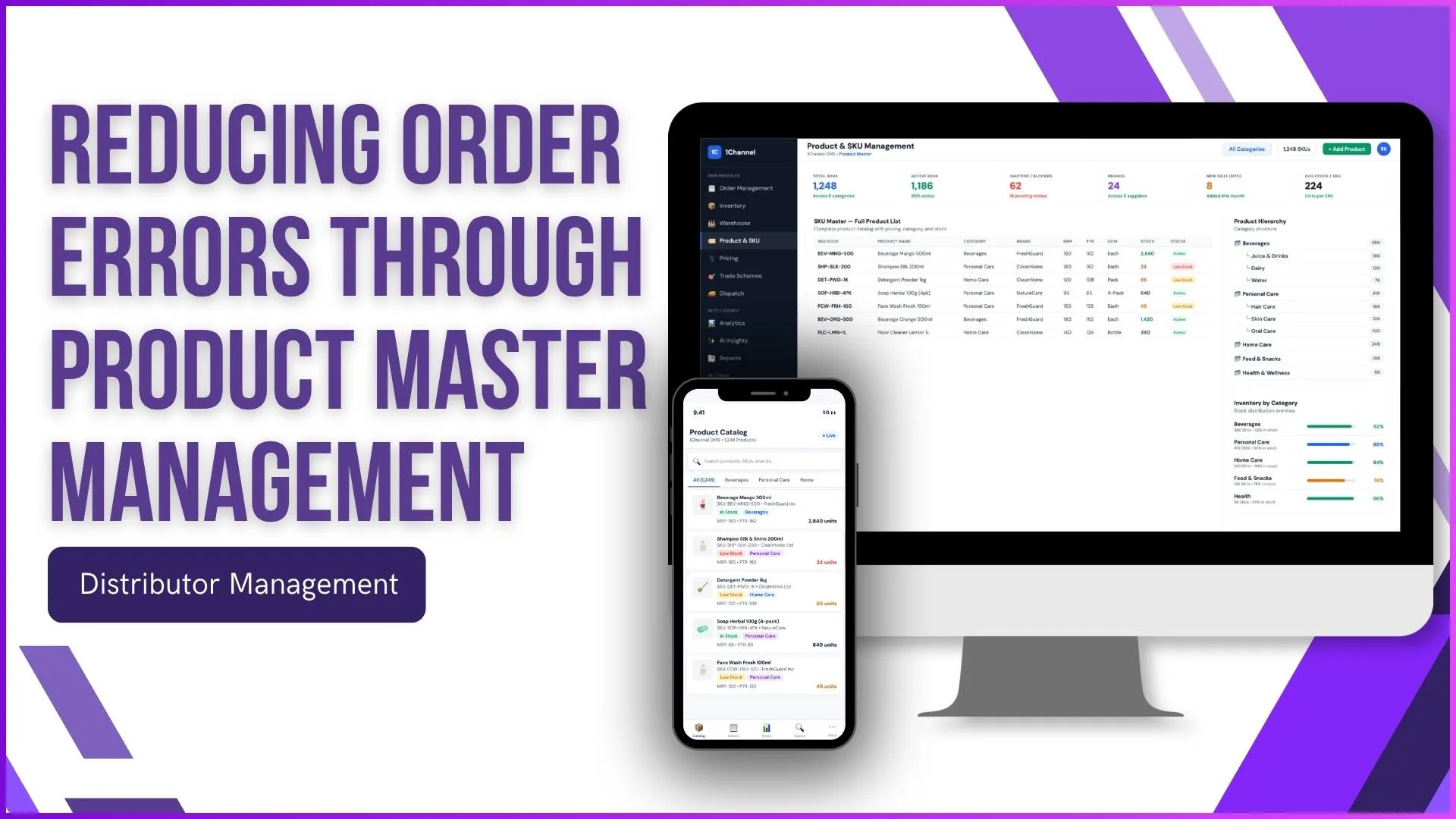
Most distribution businesses run product master management as a back-office task: someone adds new SKUs to Excel, someone else maintains pricing in a separate sheet, finance maintains a third sheet for tax categories.
By the time the rep books an order, the distributor fulfils it, the brand reports on it, and finance invoices it, the product data has passed through five different sources. The reconciliation cost is hidden inside every report.
Product master management is the discipline of running every system off the same canonical record. The boring foundation that decides whether the operation scales cleanly or grinds to a halt at 5000 SKUs.
Table of Contents
What "Product Master Management" Actually Solves
Product master management is the cloud workflow that holds the single source of truth for every product the distributor handles.
Every system that touches a SKU, from the rep's app to the distributor's order screen to the warehouse pick list to the analytics dashboard to the finance invoice, reads from the same master.
When the master is clean, the systems agree. When it drifts, each system tells a slightly different story and the operations team spends the day reconciling instead of selling.
Why It Sits at the Core of a Distribution Operation
Three operational realities make product master the foundation for distribution: data accuracy, inventory visibility, and order processing speed.
Each fails without a clean master. Each scales linearly when the master is locked. A distributor without a disciplined master adds operations cost with every new SKU; one with discipline scales with marginal cost.
Five Components That Make Up the Master
Five components make up most well-built product masters:
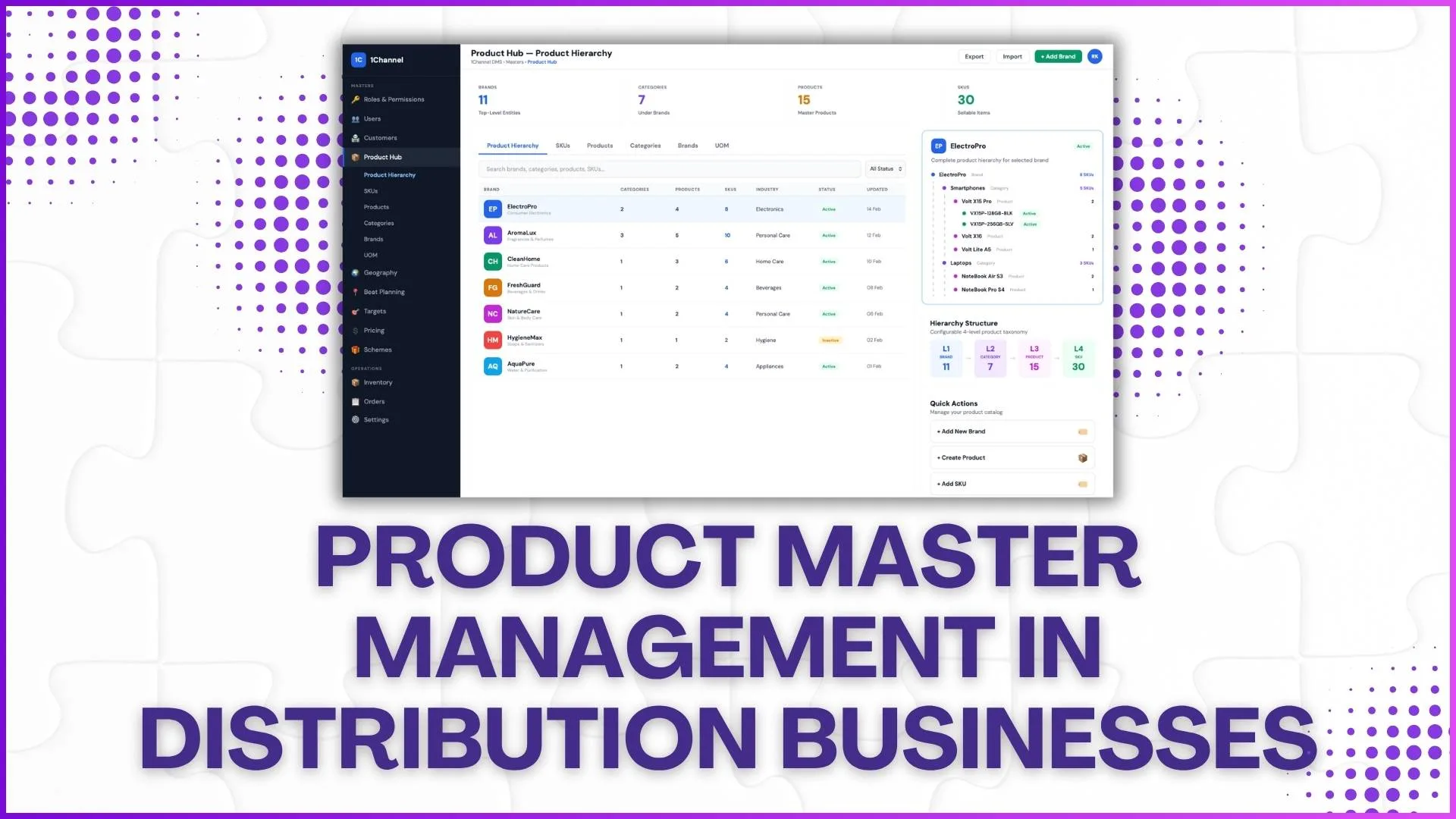
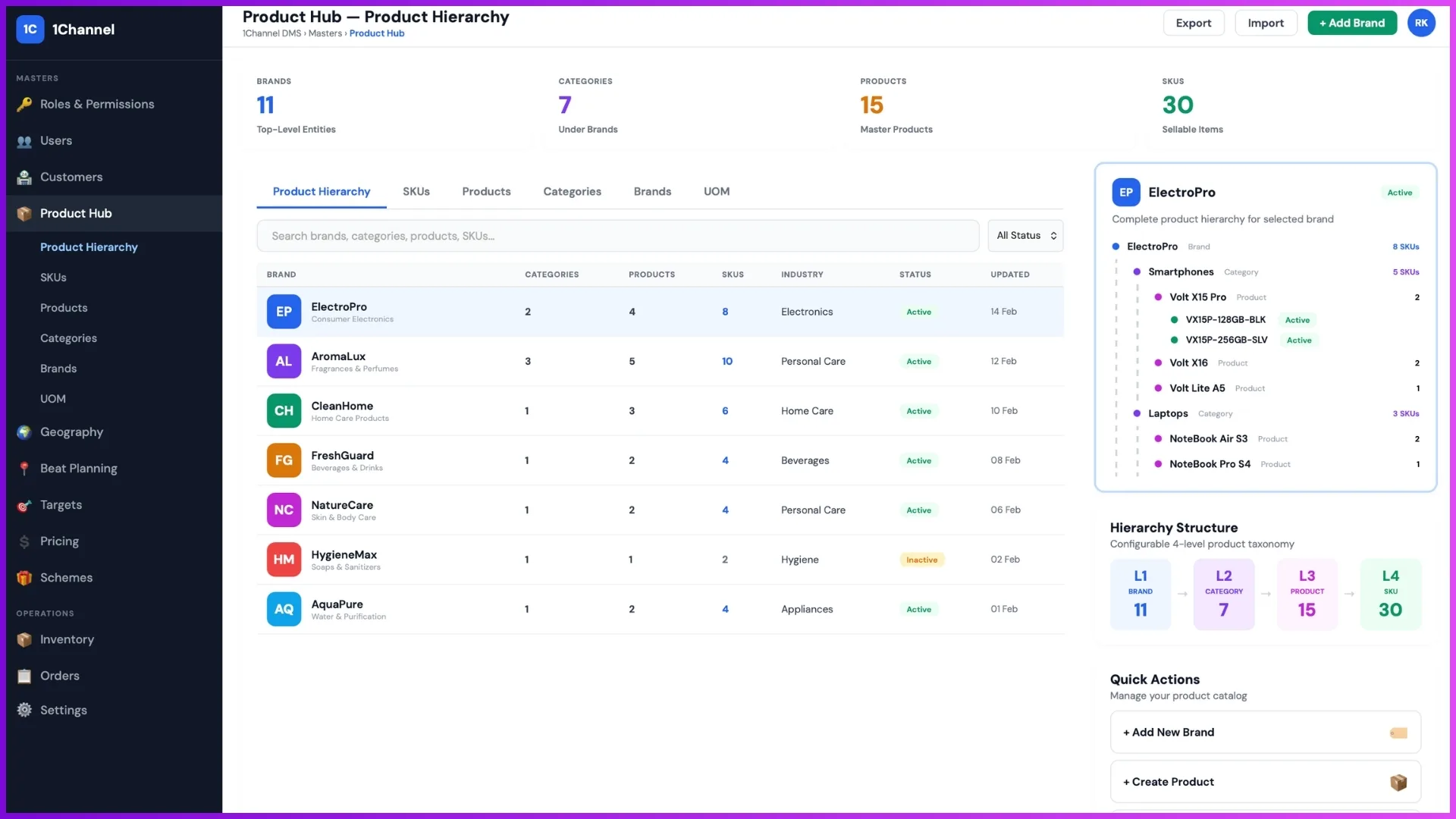
Product Hierarchy Management
Categories, sub-categories, and product families live in one tree structure. New SKUs slot into the existing hierarchy automatically; reports roll up naturally.
SKU Management
Every SKU has a single record with code, name, attributes, pricing, packaging, tax, and distribution rights. The record is the contract every other system reads.
Brand and Category Management
When the distributor handles multiple brands, the master keeps brand boundaries clean and category overlaps resolved. Reports per brand and per category roll up without manual joining.
Unit of Measurement Management
Cases, pieces, kilograms, and litres reconcile through one conversion table. Orders captured in one unit fulfil in another without translation errors.
Product Tracking Configuration
Batch numbers, serial codes, expiry dates, and warranty markers all live on the same record. The compliance and traceability requirements get answered automatically.
How It Supports Day-to-Day Operations
A clean master shows up at three operational moments: order entry, inventory reconciliation, and reporting roll-up.
Order entry runs on validated SKU codes, current prices, and applicable tax rules. Inventory reconciliation matches the master against actual stock without manual cleanup. Reporting roll-up runs against a stable structure that does not change shape every quarter.
How Different Teams Read the Same Master
Sales teams read the master for product availability and price. Inventory teams read it for stock levels and reorder points. Distribution teams read it for delivery configuration. Finance teams read it for tax and pricing logic.
Each team sees the slice that matters to its role. The master sits underneath, holding everything together.
How 1Channel Runs Product Master Management for Malaysian Distribution
1Channel runs product master management through its cloud SFA, DMS, and analytics suite. Every system reads from the same master.
1Channel's AI engine watches the master for inconsistencies. SKUs added without pricing, categories with orphan products, or distributor mappings missing for live SKUs: all surface as soft alerts before they corrupt the order flow.
New SKU additions, hierarchy changes, price updates, and mapping rules go live the same day they are approved, with an automated dry-run preview against existing operations data.
Explore SKU Management Software
1Channel's cloud SKU management platform anchors product master discipline with AI-driven consistency checks and automated propagation for Malaysian distribution.
Explore SKU Management Software →Implementation Snapshot for a 60-Day Rollout
Four phases cover a typical product master rollout for a Malaysian distribution business:
Phase 1 — Master Definition
Brand teams lock the hierarchy, naming conventions, unit-of-measure table, and tax categories. The structural decisions go in first.
Phase 2 — Data Migration
Existing SKU data migrates from Excel and legacy systems into the cloud master with validation and deduplication.
Phase 3 — System Connection
SFA, DMS, finance, and analytics layers all connect to the master. Read-only first, then write-through after stability proves.
Phase 4 — Operations Cutover
Daily order entry, pricing updates, and reporting all move to the master. The legacy spreadsheets get retired.