Brand teams reading a retail dashboard see averages: average compliance, average POSM placement, average shelf share. The store itself sees specifics: this shelf was empty, this planogram was wrong, this banner was missing.
The gap between the average and the specific is where retail execution programs lose their grip. Headquarters thinks the campaign is working at 78 percent compliance. The competitor's rep walking the same beat sees the 22 percent holes.
A retail execution platform exists to close that gap. It pulls shelf reality out of the store and onto the brand team's screen, so the average and the specific stop being two different views of the same business.
Table of Contents
Why Store Visibility Is the Hardest Thing to Get Right
Store visibility is hard because the data is distributed, fragile, and time-sensitive. Every shelf, every POSM placement, every audit happens in a different store on a different day, captured by a rep who may or may not file the right details.
The traditional approach was to roll the field's reports up into a monthly slide. By the time the slide hit the brand team's screen, the campaign was already over. The platform's job is to compress that lag from a month to the same day.
Five Visibility Dimensions a Retail Execution Platform Surfaces
Five dimensions of store visibility cover most of what brand teams need to see in real time:
1. Campaign Compliance
Which outlets are running the campaign correctly: banners up, schemes active, samples placed. Surfaces the gap between the campaign brief and the shelf reality.
2. POSM Deployment
Where the standees, wobblers, gondola wraps, and shelf strips actually landed against the plan. Photo-verified entries make the answer auditable rather than self-reported.
3. Shelf Share and Facings
How much linear shelf space the brand holds versus the competition. Norms vs actuals at the SKU level surface the drift early.
4. Hot Zone Placement
Whether the brand's premium SKUs sit at eye-level or at floor-level. Hot zones are the highest-value visibility metric in most categories.
5. Audit Compliance Across Levels
Self-audit by the rep, peer-audit by the supervisor, and surprise audit by the regional manager all flow into the same view. Discrepancies stand out automatically.
How Photo-Verified Audits Replace Honor-System Reporting
Photo audits are the single biggest upgrade most retail execution programs make. The rep captures the shelf, the cloud platform timestamps and geo-stamps the image, and the brand team sees the actual store rather than the rep's description of it.
AI-driven image analysis adds a second layer: planogram compliance, facings count, competitor visibility, and POSM detection all run on the photo automatically. The supervisor reviews exceptions, not every entry.
Why Coverage Dashboards Beat the End-of-Month PowerPoint
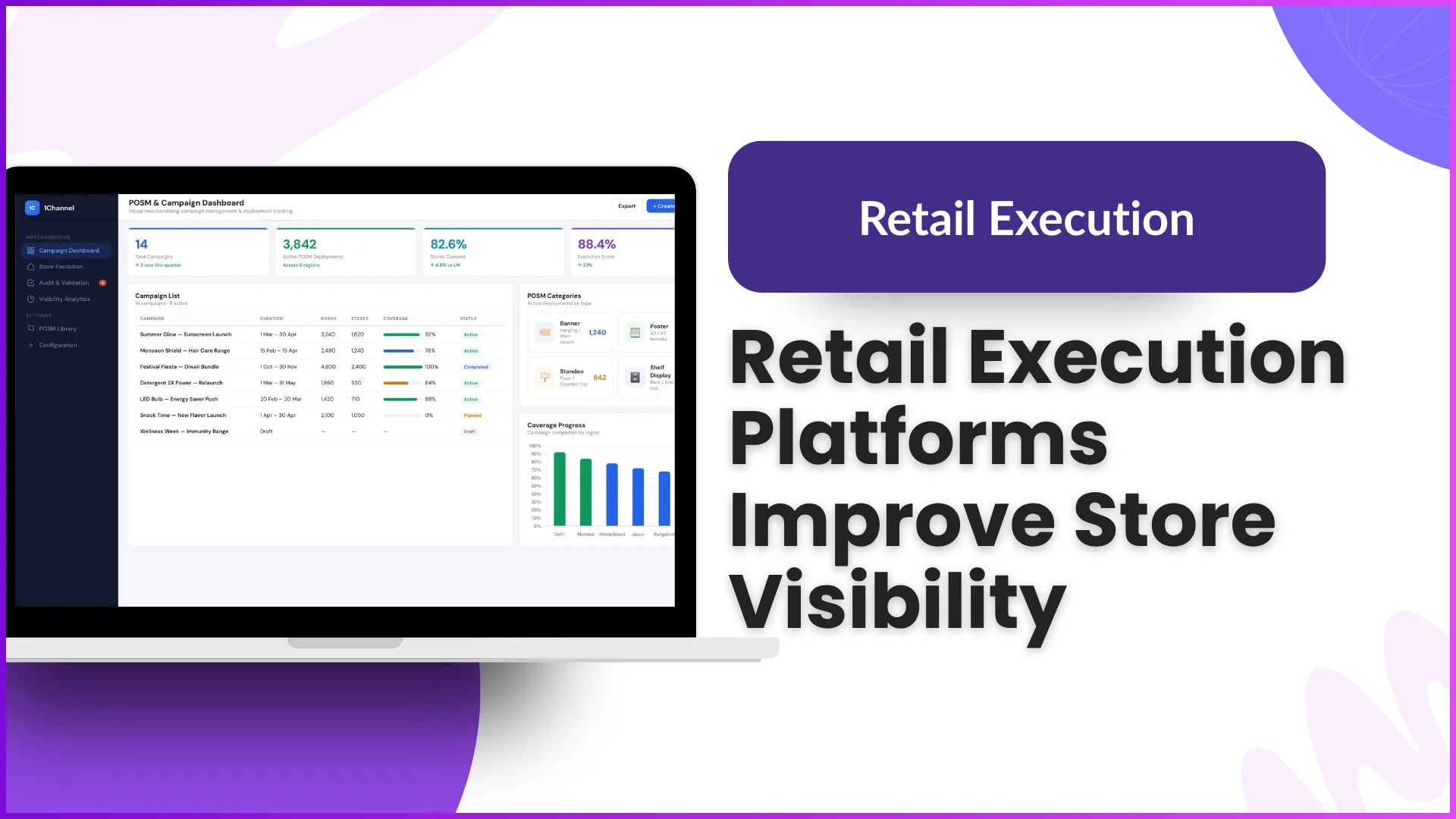
A coverage dashboard pairs every visible execution metric against the planned outlet base. The brand team reads who got covered, who got skipped, and where the gaps are concentrated, all by region, channel format, and tier.
Compared with the monthly roll-up slide, the dashboard surfaces the same information in days rather than weeks. The campaign team has time to redirect attention to under-covered outlets while the campaign is still running.
How 1Channel Runs Retail Execution for Malaysian Brands
1Channel runs retail execution through its cloud Retail Execution, Field Activity, and POSM modules. Every store visit posts a structured capture to the central ledger, and the visibility dashboard refreshes against new data automatically.
1Channel's AI engine reads photos at scale. Planogram compliance scoring, competitor signage detection, POSM placement verification, and shelf-share estimation all run on the captured image before it reaches the brand team's queue.
Configuration runs through the admin console. New campaigns, audit checklists, POSM types, and norms go live the same day they are approved, with an automated dry-run preview against the last 30 days of field data.
Explore Cloud Retail Execution Software
1Channel's cloud retail execution platform pulls shelf reality into the brand team's screen with AI photo analysis and automated coverage dashboards.
Explore Retail Execution Software →Outcomes Brands Watch For After Rollout
Programs that move from spreadsheet visibility to a retail execution platform see five operational shifts within the first cycle:
- Time-to-signal compresses from weeks to hours. A shelf that goes empty in the morning surfaces on the brand team's dashboard by lunch, not at month-close.
- Campaign compliance lifts measurably. Reps know the platform reads every visit, and the compliance number stops being a self-reported aspiration.
- POSM ROI becomes calculable. Each deployment ties to a verifiable outlet, a verifiable date, and a verifiable photo. Wastage drops without confrontation.
- Field coaching gets sharper. Supervisors read the same data the rep filed, and the conversation moves from "did you visit" to "what did you find."
- Decisions speed up at headquarters. Brand teams stop waiting for the monthly slide and start acting on the live signal as it lands.