Every Oman distribution plan eventually reaches the same question, and it is not which outlet a rep visits on Tuesday. It is where the network itself should sit: where a depot goes, which governorate one distributor owns, and whether a shipment reaches the interior faster out of a Muscat warehouse or a stocking point built closer to Sohar or Salalah. These are decisions revisited once a year or once a quarter, not once a day, and getting them wrong costs far more than a single missed visit ever could.
This sits above beat planning and route sequencing, covered separately in beat planning across Oman's governorates. Here the unit of decision is the territory itself: how a country with eleven governorates, three distinct ports and a national logistics strategy built around diversifying away from any single hub gets carved into a distribution network a business can actually run and defend.
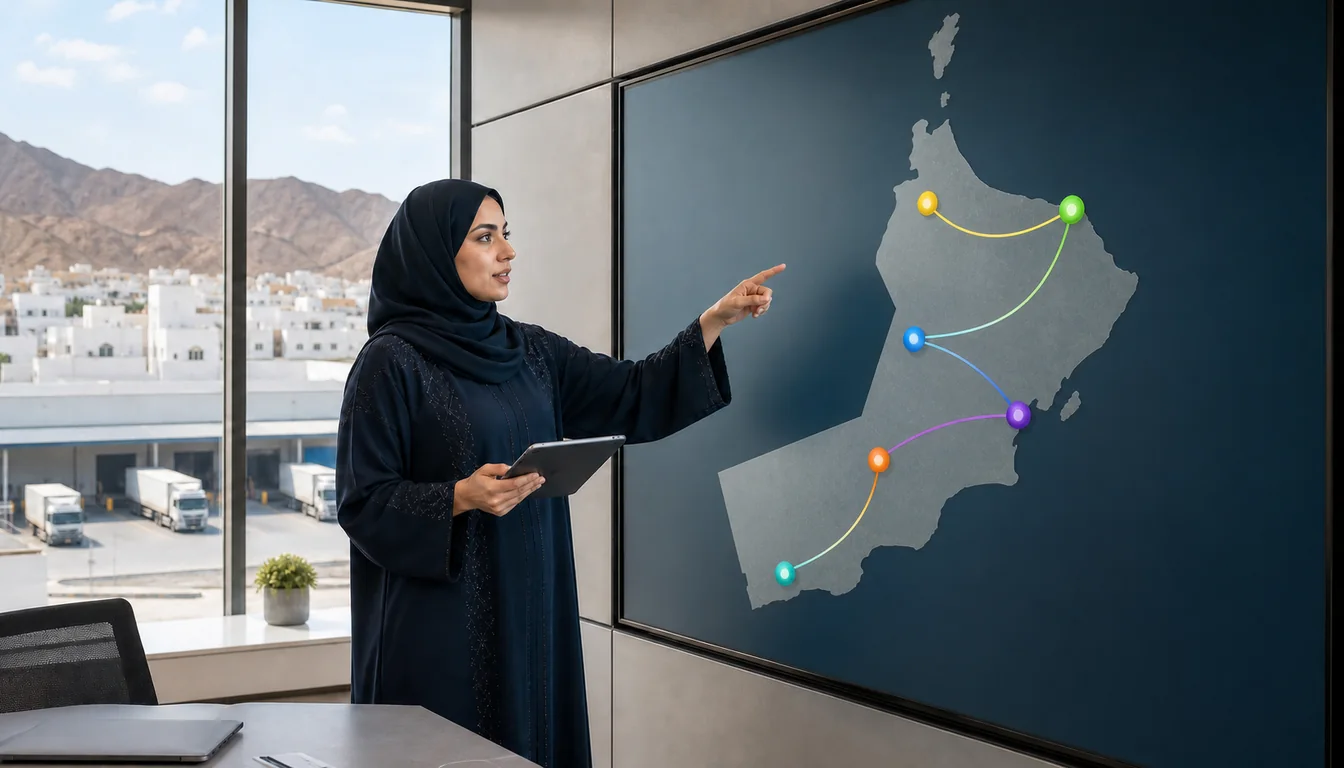
Territory Design Is a Network Decision, Not a Map
It is tempting to draw territory boundaries the way a governorate map already draws them, one line per administrative border, and call the job done. That produces a tidy diagram, not a network that actually matches how goods, distributors and demand move.
A better starting point treats territory design as three linked decisions: where stock physically sits, who is accountable for selling it into which governorate, and how that accountability is structured, direct, through an appointed distributor, or through a sub-distributor working under one. Get those three right and beat-level routing becomes a much simpler problem to solve on top. Get them wrong and no amount of route optimisation at the beat level fixes a depot in the wrong place or a territory nobody was formally appointed to cover.
Reading the 11 Governorates as Commercial Zones
Oman's eleven governorates do not carry equal weight in a distribution network, and a plan that treats them as interchangeable units on a spreadsheet will misallocate resources from day one. Grouping them into commercial clusters, based on how outlets sit and how far a delivery van can reasonably travel, is a more useful starting map than the administrative one.
| Cluster | Governorate(s) | Role in the network |
|---|---|---|
| Muscat core | Muscat | Head office, primary warehouse and the tightest, highest-frequency coverage; usually served direct |
| Northern coastal corridor | Al Batinah North, Al Batinah South | A natural extension of the Muscat network, strengthened by Sohar's port and industrial cluster |
| Interior | Ad Dakhiliyah, Al Dhahirah | Lower outlet density and longer distances; usually an appointed-distributor territory rather than a direct route |
| Eastern coast | Ash Sharqiyah North, Ash Sharqiyah South | A largely self-contained coastal territory, often one appointed distributor covering both |
| Dhofar south | Dhofar | Distant enough from Muscat, and busy enough during Khareef, to justify its own depot and its own distributor rather than a route stretched from the capital |
| Emerging Duqm cluster | Al Wusta | Low current density, but worth planning ahead of the population and workforce growth building around the Duqm Special Economic Zone |
| Border and exclave | Al Buraimi, Musandam | Small, distinct territories; Musandam in particular runs its own logistics corridor as a geographic exclave |
None of these clusters need the same coverage model, the same visit cadence or the same depot investment, and treating them that way is where a network design earns its keep over a flat, one-size territory grid.
Anchoring the Network to Sohar, Salalah and Duqm
Oman's Vision 2040 names logistics as a primary growth pillar, and the plan behind it is deliberately built around three ports rather than one. Sohar Port and Freezone, in Al Batinah North, anchors a metals, petrochemicals and logistics cluster on the northern coast. Salalah Port is one of the world's major transshipment hubs, well placed for onward routing across Asia, Europe and Africa, and it sits at the doorstep of Dhofar's own consumer market. The Port of Duqm, in Al Wusta, is an emerging special economic zone for heavy industry and offshore energy, still building toward the scale of the other two. This is not an established, single-hub picture the way some larger Gulf logistics markets present themselves; it is a genuinely diversifying, multi-port identity, and a distribution network built for Oman should diversify along with it rather than assume everything still radiates from Muscat.
For a territory planner, that becomes a simple question for each cluster: is it realistically served from a Muscat-anchored network, or does its own port make a local anchor point worth the investment. The Batinah coast's proximity to Sohar and Dhofar's own port both argue for treating the north and the south as their own catchments rather than long spokes off a single Muscat hub.
Placing Depots Near Each Anchor
A depot earns its place on the network when it measurably shortens the distance between stock and the outlets it serves, not because a governorate looks underserved on a spreadsheet. Three anchor points cover most of Oman's commercial geography reasonably: a primary warehouse in or near Muscat for the capital and the near Batinah, a secondary stocking point along the Sohar corridor once northern volume justifies it, and a standalone depot in or near Salalah, which sits far enough from Muscat by road, and busy enough during Khareef, that routing everything through the capital adds unnecessary transit time. Duqm does not yet carry the volume to justify its own warehouse for most distributors, but it belongs on the plan as a future node, tracked deliberately rather than ignored, as the SEZ builds out.
Choosing a Coverage Model for Each Corridor
Once the anchor points are set, the next decision is who actually covers each cluster: a distributor's own sales team, an appointed distributor, or a further layer of sub-distributors working under one. Oman's governorates do not all deserve the same answer, and running a low-density interior route on the same model as the Muscat core wastes a direct sales team's time on distances a local partner would cover more cheaply.
Direct Coverage From Muscat
The Muscat core, and often the near Batinah stretch toward Sohar, carries enough outlet density and modern trade concentration to justify a direct sales team, whether that means a dedicated field sales route through hypermarkets and supermarkets or systematic baqala coverage street by street. Short drive times keep visit frequency high without a distributor's margin sitting between the brand and the shelf.
Appointed Distributors for the Middle Distance
The interior around Nizwa, the eastern coast toward Sur, and the border governorates of Al Buraimi and Al Dhahirah are usually better served by an appointed distributor running its own local warehouse and delivery fleet than by a direct route stretched out from the capital. A distributor already working that ground generally knows its own baqala network, its own credit risk and its own delivery rhythm better than a route planned from a head office several hours away.
Sub-Distributor Networks for the Outer Governorates
Dhofar, Duqm and the more remote stretches of any governorate often need a further layer beneath the appointed distributor itself, a sub-distributor or wholesaler carrying stock the final distance into a baqala the primary warehouse cannot reach economically. We go through how to bring that layer onto a shared order and stock system in digitising sub-distributors and wholesalers in Oman. The point for network design is simpler: decide upfront which clusters genuinely need a sub-tier and appoint it deliberately, rather than letting an informal wholesaler fill the gap and only discovering the arrangement once a claim or a pricing dispute forces it into view.
Structuring Distributor Territories Without Overlap or Gaps
A territory boundary that looks clean on a map, drawn along governorate lines, still has to survive contact with how outlets actually cluster and how far a delivery van can reasonably travel in a working day. Two distributors quietly selling into the same baqala on the Batinah coast is not a coverage problem, it is a pricing and credit dispute waiting to surface. A stretch of Al Dhahirah nobody has been formally appointed to cover is the opposite failure, invisible until a competitor's product turns up on a shelf nobody was watching.
Setting boundaries at the outlet level, not only the governorate level, is what prevents both. Every outlet should sit under exactly one distributor or sub-distributor of record, even where two appointed territories border each other inside the same governorate. Managed this way, reassigning a stretch of coverage after a distributor change or a network expansion becomes a matter of moving outlets between accounts in a territory management system, not redrawing the map from scratch and hoping the field catches up.
Building Seasonal Flex Into Fixed Boundaries
Fixed territory lines still need to flex for Oman's two sharpest demand seasons. The Khareef monsoon transforms Dhofar's retail rhythm for several weeks each year, drawing a sharp, geographically concentrated spike in seasonal goods, produce and hospitality demand around Salalah, and Ramadan lifts demand across every governorate at once. Neither event is a reason to redraw territory boundaries. It is a reason to plan temporary capacity, extra delivery runs, a short-term stock buffer at the Salalah depot, a tighter visit cycle for the season, against a network design that otherwise stays fixed. We cover the promotional side of that planning in trade schemes and promotions planning for Ramadan and the Khareef season.
Measuring Whether the Network Design Is Working
A network design is a hypothesis until the numbers confirm it. A handful of measures, read at the territory level rather than as one national figure, show whether the boundaries, the depots and the coverage model chosen for each cluster are actually earning their cost.
- Cost to serve per territory. Delivery, distributor margin and depot overhead measured against the revenue a territory generates, so a quietly expensive interior route does not hide inside a healthy national average.
- Outlet coverage by governorate. How many mapped outlets in each territory are actually being reached against how many exist, reviewed the way we describe in retail execution and merchandising audits across Oman.
- Distributor and sub-distributor performance side by side. Secondary sales, fill rate and claim ageing compared across territories with a similar profile, not just against a territory's own number from a year earlier.
- Depot utilisation and transit time. Whether stock genuinely moves faster once a Sohar or Salalah stocking point is in place, or whether the depot adds cost without shortening the road to the shelf.
- Territory revenue per outlet. A simple check on whether a territory is over-resourced relative to what it can realistically sell, or under-resourced relative to its real potential.
Read together, and through a distributor analytics view that breaks figures down by territory rather than blending them into one number, these measures turn network design from a decision made once at launch into one revisited deliberately as Duqm grows, as Sohar's cluster expands, and as Dhofar's Khareef season proves out year after year.
How 1Channel Helps Territory and Distribution Network Design Across Oman
Designing a distribution network across eleven governorates and three ports takes more than a good map. It takes a system that can hold territory boundaries, distributor and sub-distributor relationships, and depot-level stock in one place, and report on all three at the territory level rather than as one blended national figure.
For distributors and FMCG brands planning coverage across Oman, the platform helps you:
- Assign every outlet to exactly one distributor or sub-distributor of record, with territory boundaries that hold even where two appointed areas border inside the same governorate.
- Model direct, distributor-led and sub-distributor coverage side by side, and reassign outlets between them as the network grows.
- Track depot and warehouse stock by location, so a Muscat, Sohar or Salalah stocking point shows its own sellable and in-transit position.
- Roll up cost to serve, outlet coverage and secondary sales by territory, governorate and cluster rather than as one national average.
- Flex capacity for Khareef and Ramadan without redrawing fixed territory lines each season.
- Compare distributor and sub-distributor performance on the same metrics, territory by territory.
Design a Network Built for Oman's Own Geography
See how 1Channel's territory management software assigns every outlet to one distributor of record, models coverage across Muscat, Sohar, Salalah and Duqm, and reports cost to serve by territory rather than as one national number.
Explore Territory Management Software →Key Takeaways
Territory and network design in Oman is a decision made at the level of depots, distributor appointments and port anchors, ahead of and separate from how any single rep's day is routed.
- Design the network before the route. Where depots sit and who covers which governorate has to be settled before a single beat gets planned.
- Treat the 11 governorates as commercial clusters. Muscat, the Batinah coast, the interior, the eastern coast, Dhofar and the emerging Duqm cluster each call for a different coverage model, not one national template.
- Anchor the network to Sohar, Salalah and Duqm. Oman's genuinely diversifying, multi-port logistics identity under Vision 2040 is a reason to build local depots in the north and the south, not route everything through Muscat.
- Match the coverage model to the corridor. Direct coverage near Muscat, appointed distributors for the middle distance, and sub-distributor networks for the outer governorates each earn their place differently.
- Set boundaries at the outlet level. Governorate lines are a starting point, not a substitute for assigning every outlet to exactly one distributor of record.
- Measure by territory, not by country. Cost to serve, coverage and depot utilisation all hide real problems when blended into a single national average.
Get the network right first, anchored to Oman's own geography and its own diversifying port system, and every route, beat and visit plan built on top of it has a foundation worth trusting.