Two Ways to Move the Same Case
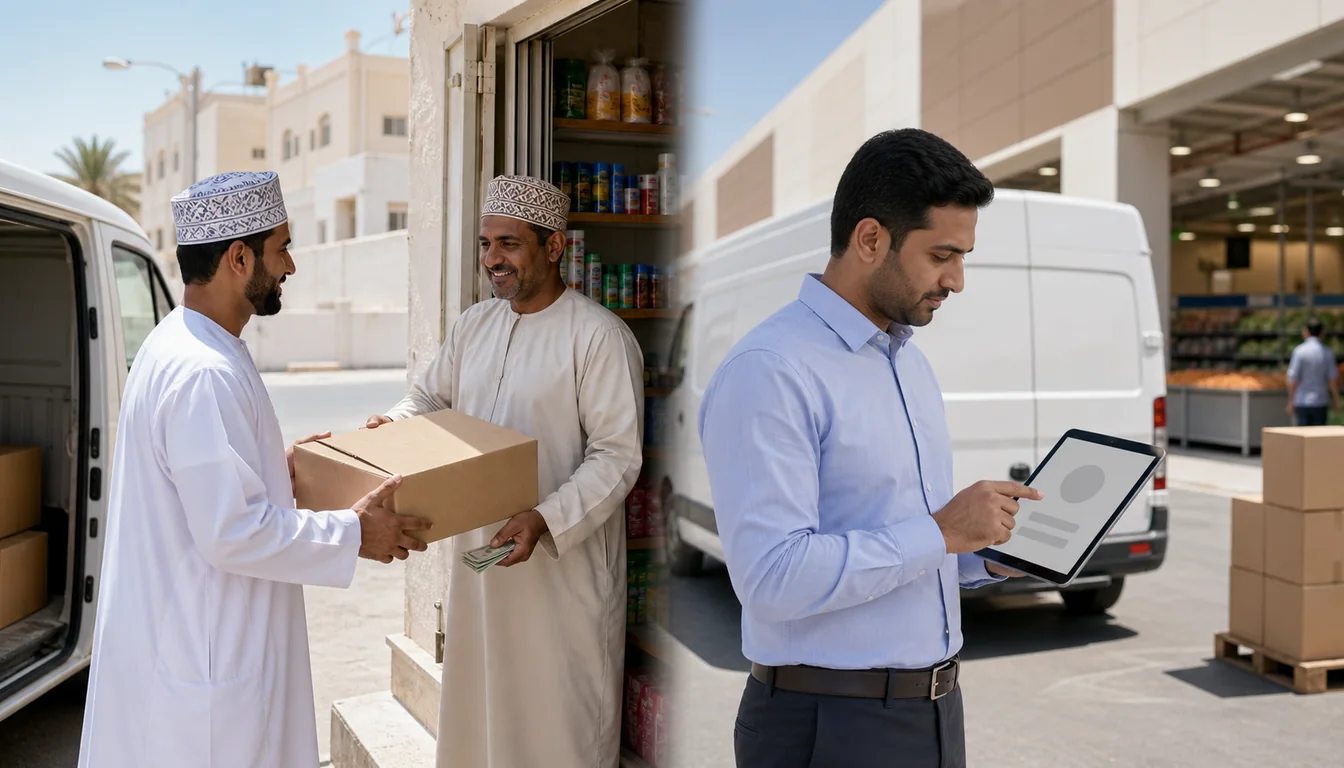
An Oman FMCG distributor deciding how stock reaches an outlet is really choosing between two different route-to-market models, or building a working blend of both. One puts the stock, the sale and the invoice into a single visit. The other splits that visit into an order taken today and a delivery that follows on a separate run. Neither approach is universally right. Each solves a different coverage problem, and most distributors selling into Oman's dual-channel market of baqalas, mini-markets and modern trade end up running both, often through the same field team.
Van Sales: Sell and Deliver in the Same Visit
A Van Sales Representative loads a vehicle in the morning, works an assigned route, and sells directly from the stock carried on board. The outlet owner decides on the spot what to take, and the rep hands over the goods and settles payment there and then, whether in cash, by card or increasingly through Maal. Nothing is ordered in advance and no separate delivery leg follows. What the van carries and what the outlet buys are settled in the same few minutes.
Pre-Sales: Order First, Deliver on a Planned Run
Pre-sales separates the selling step from the delivery step. A Field Sales Representative visits an outlet, checks shelf stock, and takes an order against an agreed price list, leaving without any goods changing hands. A separate delivery run, planned for the next day or a fixed delivery slot, fulfils that order against a picking list drawn from the warehouse. Because the order is planned rather than decided at the doorstep, routing, vehicle loading, invoicing and delivery scheduling all change with it.
Why Oman's Dual-Channel Market Needs Both Models
Oman's retail landscape is a genuine dual-channel market, not tilted heavily toward a single format the way some markets in the region are. A real, growing modern trade sector, chains such as Lulu Hypermarket, Carrefour, Sultan Center, Nesto Hypermarket and SPAR, sits alongside an extensive baqala network that reaches well beyond Muscat's own retail corridor. Both tiers are large enough, and different enough in how they buy, that a distributor cannot default to a single model across an entire territory without leaving volume on the table somewhere.
That is the practical reason van sales versus pre-sales matters here. A hypermarket buyer and a baqala owner are not making the same kind of purchase decision on the same timeline, so a single rigid route-to-market model rarely serves both well. Choosing which model fits which outlet, rather than running one approach everywhere out of habit, is where most of the coverage gains sit for a distributor operating across Oman's channel mix.
Where Van Sales Earns Its Keep: Baqalas and Mini-Markets
Van sales suits outlets that buy on impulse and reorder often, in small quantities. A baqala owner is not negotiating a listing or working from a category plan; they are deciding, in the moment, whether to top up a shelf from whatever a rep has loaded that week. Categories with a genuine impulse element, soft drinks, snacks, confectionery, single-serve packs, sell well through this model because the decision and the transaction happen together, and a baqala or mini-market rarely has the storage space or working capital to hold much more than a small, frequent drop.
Making that immediacy pay off depends on route density. A van earns its keep only if it can call on enough baqalas and mini-markets in a working day to justify the vehicle and the rep's time, which is as much a route planning question as a sales one. Take a simple illustration: a route calling on thirty to forty baqalas a day, each buying a modest OMR 10 to OMR 20 basket, can turn over several hundred rials by day's end, but only if the stops sit close enough together that drive time does not eat the margin. A beat built around realistic call frequency and genuine drive time between stops, not a fixed list carried over unchanged as a territory grows, is what keeps a van sales route paying for itself.
Where Pre-Sales Fits: Hypermarket and Supermarket Accounts
Pre-sales suits the opposite kind of buyer. A hypermarket or supermarket chain orders against a listing agreement and a category plan, typically negotiated at head-office level rather than branch by branch, and expects delivery, invoicing and returns to reconcile cleanly across every store under that account. Nobody at branch level is deciding on the spot whether to buy; that decision was made when the listing was agreed, and what follows is a planned quantity against it, not an impulse purchase from a passing van.
Separating the order from the delivery also fits how a larger account wants to be served. A Field Sales Representative capturing an order on a mobile distributor management app, with visibility into current stock, agreed pricing and any outstanding balance, can build an order that reflects what a branch genuinely needs, rather than what happens to be loaded on a van that day. The delivery run that follows can then be planned around the picking list and the account's own receiving window, one modern trade order worth OMR 2,000 or more being worth the extra planning step in a way forty small baqala drops individually are not.
Running a Hybrid Route Across a Single Territory
Few Oman distributors run one model everywhere. A territory stretching from Muscat's retail corridor out towards Sohar, Nizwa or Sur typically mixes a handful of modern trade accounts with a genuinely large number of baqalas and mini-markets, and the practical answer is usually two coordinated routes rather than one compromise route trying to serve both. A territory management view that separates modern trade coverage from general trade coverage, even where the same depot or the same distributor serves both, keeps the two from being planned as though they were the same problem.
Assigning the model by outlet type, rather than by rep or by day of the week, is what keeps a hybrid approach coherent. A van sales rep whose beat is built entirely from baqalas and mini-markets, and a pre-sales rep whose account list is entirely modern trade, are each working with a consistent set of decisions and a consistent load plan. Blending the two roles into one undifferentiated route, a few impulse drops mixed in with a couple of planned chain orders, tends to produce a route that does neither job particularly well.
Khareef, Payments and the Back Office Behind the Choice
The Khareef season transforms demand around Salalah for a sharp, predictable window each year, and it is a genuine case for leaning further into van sales for that period specifically. A baqala or mini-market near the monsoon crowds benefits from a rep who can restock on the spot as shelves empty faster than usual, rather than waiting on a pre-sales order cycle built for calmer weeks. Ramadan brings a similar, if less geographically concentrated, case for flexible on-the-spot restocking across both channels.
The two models also hand different things to the back office. A van sales settlement, cash, card or Maal, closes at the point of sale and needs to be reconciled against the invoice the same day it is collected. A pre-sales order carries a longer trail, from order to picking to delivery to invoice, that has to stay consistent all the way through, which matters more as Oman's OTA e-invoicing rollout moves through its phased 2026 and 2027 timeline. Neither model is harder to run correctly, but each demands a slightly different discipline from finance.
Common Mistakes Distributors Make Choosing Between the Two
A few patterns show up repeatedly once a distributor tries to run both models across the same territory.
- Running one model everywhere out of habit. A van sales default undersells a modern trade account's real order size; a pre-sales default leaves baqalas waiting on a delivery cycle built for a different kind of buyer.
- Building the van route on a fixed list instead of realistic density. A beat that was efficient a year ago can quietly stop paying for itself as a territory's outlet mix shifts, unless call frequency and drive time are revisited.
- Treating sub-distributors and wholesalers as an afterthought. Many Oman distributors route part of their volume through sub-distributors and wholesalers, and that layer needs the same model discipline as direct accounts, not a looser, undocumented arrangement.
- Losing visibility once an order leaves the depot. A distributor that cannot see, in one place, which stops were served by van and which by planned delivery is reconciling two separate businesses by memory.
- Letting the same rep juggle both without a clear split. A route that mixes on-the-spot drops with planned chain orders, without a defined line between the two, tends to serve neither well.
How 1Channel Helps Oman Distributors Run Van Sales and Pre-Sales
Running both models well depends on treating them as genuinely different workflows rather than variations of the same route. 1Channel supports van sales and pre-sales as distinct field processes within a single platform, so a distributor is not stitching together two separate systems to cover baqala routes and modern trade accounts.
The platform gives a van sales rep an on-the-spot billing and stock-on-hand view for immediate delivery, and gives a pre-sales rep an order-capture flow built around live pricing, stock and outstanding balance, with the resulting orders flowing straight into a planned delivery run.
On this topic, the platform helps distributors:
- Run van sales billing and stock-on-hand tracking for immediate, on-the-spot delivery.
- Capture pre-sales orders against live pricing and stock, ready for a planned delivery run.
- Assign the right model by outlet type across baqala, mini-market and modern trade accounts.
- Plan van sales beats around realistic call density and drive time.
- Record cash, card and Maal settlements against the correct invoice at the point of collection.
- Give one territory view across both van sales and pre-sales routes, by governorate.
Run Van Sales and Pre-Sales From One Platform
See how 1Channel's sales force automation tools support both route-to-market models across Oman's baqala and modern trade channels.
Explore Sales Force Automation →Key Takeaways
Van sales and pre-sales solve different coverage problems, and most Oman distributors need both running well at once.
- Van sales fits impulse, high-frequency outlets. Baqalas and mini-markets buy on the spot, in small quantities, and reward a rep who can settle the sale there and then.
- Pre-sales fits planned, listing-based accounts. Hypermarket and supermarket chains order against agreed terms and expect delivery and invoicing to reconcile cleanly across every branch.
- Route density decides whether van sales pays for itself. A beat built on realistic call frequency and drive time beats a fixed list carried over unchanged.
- Assign the model by outlet type, not by rep or habit. Blending both into one undifferentiated route tends to serve neither well.
- Khareef and Ramadan can justify leaning further into van sales. Sharp, predictable demand windows reward on-the-spot restocking over a planned order cycle.
- The two models hand different things to finance. Van sales settlements need same-day reconciliation; pre-sales orders need a consistent trail from order to invoice.
Get the split right by outlet type, and a hybrid route stops being a compromise and starts covering Oman's dual-channel market the way each part of it actually buys.