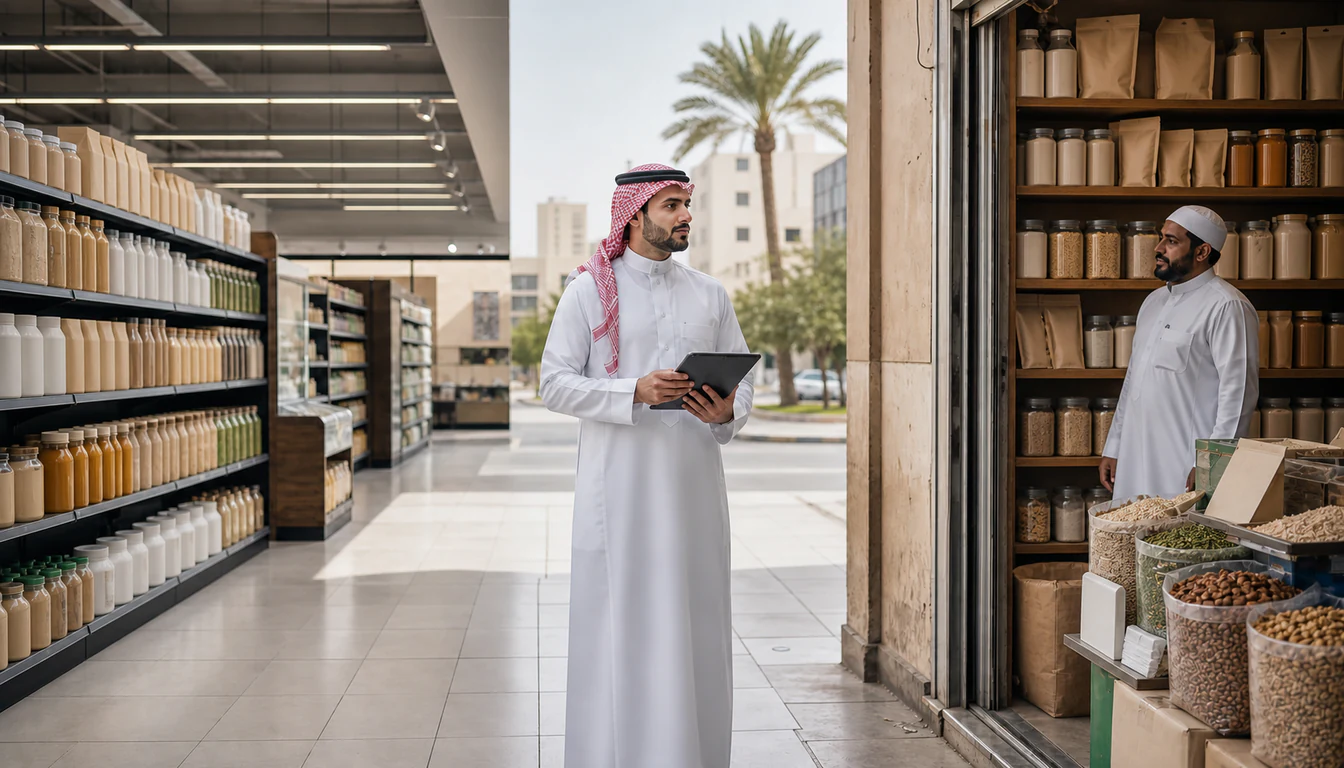
Saudi Arabian FMCG distributors are effectively running two retail businesses under one price list. Hypermarkets, supermarkets and the wider modern trade channel buy against a purchase order and a scheduled delivery window. Baqalas, mini-markets and independent grocers, spread across dense city neighbourhoods and smaller towns, restock little and often from whichever rep turns up with stock.
Van sales and pre-sales are the two established ways of serving that split. Van sales loads a vehicle at the warehouse and sells directly off it, negotiating, handing over stock and collecting payment in one visit. Pre-sales separates the steps, taking the order on one visit and fulfilling it with a dedicated delivery trip later. Both run across the Kingdom today, often on different parts of the same distributor's territory, and the mistake is treating the choice as one company-wide policy rather than a route-by-route decision.
Outlet type, route density and distance all point toward one model or the other, and the right answer can shift for a few weeks around Ramadan or Hajj-Umrah. This piece works through how to make that call and run both models without the territory falling into confusion.

How Van Sales Works on a Saudi Route
Van sales is the load-and-sell model. A rep sets out each morning with a vehicle stocked against an estimated route plan, calls on a string of outlets, and completes the transaction, negotiation, handover and payment, in a single stop. There is no separate delivery trip and no order waiting to be processed back at the warehouse. An outlet that has run low on a fast-moving line gets restocked the same day, and the distributor collects cash or a mada payment at the point of sale rather than chasing it later.
The trade-off sits in the van itself. Capacity is fixed for the day, so the rep is effectively betting on the day's mix before leaving the warehouse, and a longer route or a bigger-than-expected order can leave later stops short. Getting that load estimate right depends on real-time visibility into van stock rather than an end-of-day tally, which is where a proper mobile DMS app earns its place in the rep's hand.
How Pre-Sales Works, and Why Modern Trade Runs On It
Pre-sales splits the same transaction into two trips. A rep, or increasingly an order-taker working from a tablet, visits the outlet, checks stock and captures the order, and a separate delivery vehicle fulfils it later, often the next day or on a fixed weekly slot. This is the model modern trade expects by default: a hypermarket or supermarket chain such as Panda, Othaim or Carrefour Saudi Arabia buys against a purchase order and a negotiated delivery window, not off whatever a passing van happens to be carrying. The order management discipline behind pre-sales, matching what was ordered to what gets invoiced and delivered, is exactly what a chain buyer's own systems reconcile against.
It also lets the distributor plan delivery properly: a truck loaded against confirmed orders runs close to full capacity on a route built around known stops, rather than a van driving a full day on a guess. The cost is speed, since an outlet on pre-sales waits for the delivery trip.
Matching the Model to the Outlet Type
Once the two models are laid out plainly, the outlet-type decision mostly makes itself. It comes down to how the outlet buys and how much it can absorb in one visit.
- Baqala and mini-market. Small, frequent restocking and flexible cash or mada payment at the counter suit van sales: the volume per stop is easy to carry, and owners value stock in hand over a scheduled drop.
- Hypermarket and supermarket chains. Formal purchase orders and negotiated delivery windows suit pre-sales, since the buying process runs on an order placed in advance, not stock sold off a van at the loading dock.
- Souq and wholesale outlets. Larger, less frequent purchases closer to the pre-sales pattern, though terms vary enough to confirm route by route.
Outlet type is the first filter, not the only one. Two baqalas on opposite sides of the same city can call for different treatment once route length and distance enter the picture.
Route Length Changes the Calculation
Within a dense city route, Riyadh, Jeddah and Dammam all have neighbourhoods where dozens of baqalas and mini-markets sit within a short drive of each other, van sales is straightforward. A rep can realistically call on many outlets in a working day, and carrying a mixed load costs little because the next stop is minutes away.
Stretch that route to a long inter-city distance, a distributor covering smaller towns well outside a regional hub, and the economics flip. Carrying a full, guessed load across hours of desert distance and summer heat to serve a handful of outlets is an expensive way to find out what sells. A return delivery trip built around confirmed orders, the pre-sales pattern, uses that distance more efficiently: the rep travels once to take orders, the delivery vehicle travels once to fulfil them, and neither trip is loaded on a guess. Heat reinforces the case, since stock riding in a van across open highway for longer is exposed to summer temperatures longer than stock loaded onto a scheduled delivery run. A route planning view that separates dense urban beats from long inter-city runs makes this call repeatable rather than a judgement each rep makes alone.
Running a Hybrid Model Across a Single Territory
Very few Saudi territories are purely one pattern or the other. A single district can hold dense urban baqala streets, a couple of hypermarket accounts on negotiated terms, and a stretch of road toward a smaller town, all inside the same rep manager's patch.
Splitting by Route, Not by Policy
The distributors who handle this well assign the model route by route rather than picking one for the whole territory. A dedicated van-sales beat covers the dense baqala and mini-market streets, a separate pre-sales beat handles the modern trade accounts and the long inter-city stretch, and the same warehouse serves both from one stock pool.
Where headcount is tight, the same rep can run both models on different days, provided the stock allocation between the van float and the pre-sales order book is planned rather than improvised each morning. That planning depends on one territory view, which is what a proper territory management setup is for: assigning outlets to the right model, tracking both in parallel, and flagging when a route's outlet mix has shifted enough to warrant reassigning it.
How Ramadan and Hajj-Umrah Demand Shifts the Right Model
Saudi Arabia's demand calendar adds a seasonal wrinkle most other markets don't plan for. Ramadan produces a sharp, predictable, short-window buying surge ahead of and through the holy month, with replenishment cycles compressing hard across both channels. Hajj and Umrah layer a second, more geographically concentrated spike on top of it, felt most acutely in and around Mecca and Medina.
For baqala and mini-market routes normally served on a relaxed cycle, Ramadan's compressed reorder pattern can temporarily strengthen the case for van sales: outlets turn stock faster and want a rep who responds the same day rather than waits on the next scheduled slot. Modern trade moves the opposite way, tightening delivery windows and promotional timing rather than loosening them, so pre-sales discipline, accurate orders matched to a strict schedule, matters more during the peak. Around Mecca and Medina during Hajj and Umrah, a route that normally runs a longer pre-sales cycle because of distance can temporarily behave like a dense city route instead, rewarding a rep who responds quickly to a concentrated pocket of demand.
None of this calls for redesigning the territory each season, only a plan that can flex the model on specific routes for a defined window and flex back once the surge passes, backed by buffer stock positioned ahead of time.
Common Mistakes When Choosing Between the Two
- Applying one model to the whole territory. A single policy ignores how differently a dense city street and a long inter-city route behave.
- Ignoring route length. A route's distance and drive time can override what outlet type alone would suggest.
- Leaving van stock allocation to guesswork. A rep loading on instinct, rather than recent sell-through data, either runs short or carries dead weight.
- Losing the link between a pre-sales order and its delivery. An order is only useful if reliably matched to what actually gets delivered and invoiced.
- Treating the split as permanent. The right model can shift over time and sharply during Ramadan or Hajj-Umrah, so the plan needs reviewing, not setting once and forgetting.
How 1Channel Helps Distributors Run Van Sales and Pre-Sales in Saudi Arabia
Running van sales and pre-sales well at the same time usually breaks down because the two are managed on different tools, or none at all. 1Channel gives distributors one platform that carries both models side by side, so a route can run one, the other, or a mix, without the office losing visibility into either. For van sales, that means real-time stock visibility on each vehicle, on-the-spot invoicing, and cash or mada payment capture at the point of sale. For pre-sales, it means order capture on the visit, delivery-window scheduling, and invoice matching against what modern trade buyers actually receive, with invoicing that aligns with ZATCA e-invoicing requirements whichever model generated the sale.
On this topic specifically, the platform helps distributors:
- Track live van inventory so reps sell against real stock, not a morning guess.
- Capture pre-sales orders on a tablet and match them to scheduled delivery windows.
- Assign outlets and routes to a van-sales or pre-sales pattern, and reassign as the mix changes.
- Run both models from a single territory and stock view.
- Flex delivery frequency and buffer stock on specific routes ahead of Ramadan and Hajj-Umrah.
Run Van Sales and Pre-Sales From One Platform
See how the platform's sales force automation runs van-sales and pre-sales routes side by side, with real-time van inventory, on-the-spot invoicing and delivery-window scheduling for Saudi Arabia's dual-channel market.
Explore Sales Force Automation →Key Takeaways
Choosing between van sales and pre-sales in Saudi Arabia is a route-by-route decision, not a company-wide policy. Keep these points in front of the team when reviewing a territory:
- Van sales suits baqala and mini-market restocking. Frequent, small orders and flexible cash or mada payment at the counter favour the load-and-sell model.
- Pre-sales suits modern trade and long routes. A long inter-city route is served more efficiently by a return delivery trip than a fully-loaded van.
- Route density and distance matter as much as outlet type. A dense city street and a long desert route call for different models.
- Most territories need both. Split the model by route rather than forcing one pattern across a whole territory.
- Ramadan and Hajj-Umrah can temporarily shift the right model. Plan to flex specific routes for a defined window, then flex back once the surge passes.
- Review the split regularly. An outlet mix changes over time, so last year's right answer for a route is not guaranteed to be this year's.
Get the split right, route by route, and both channels get the service model they actually need.