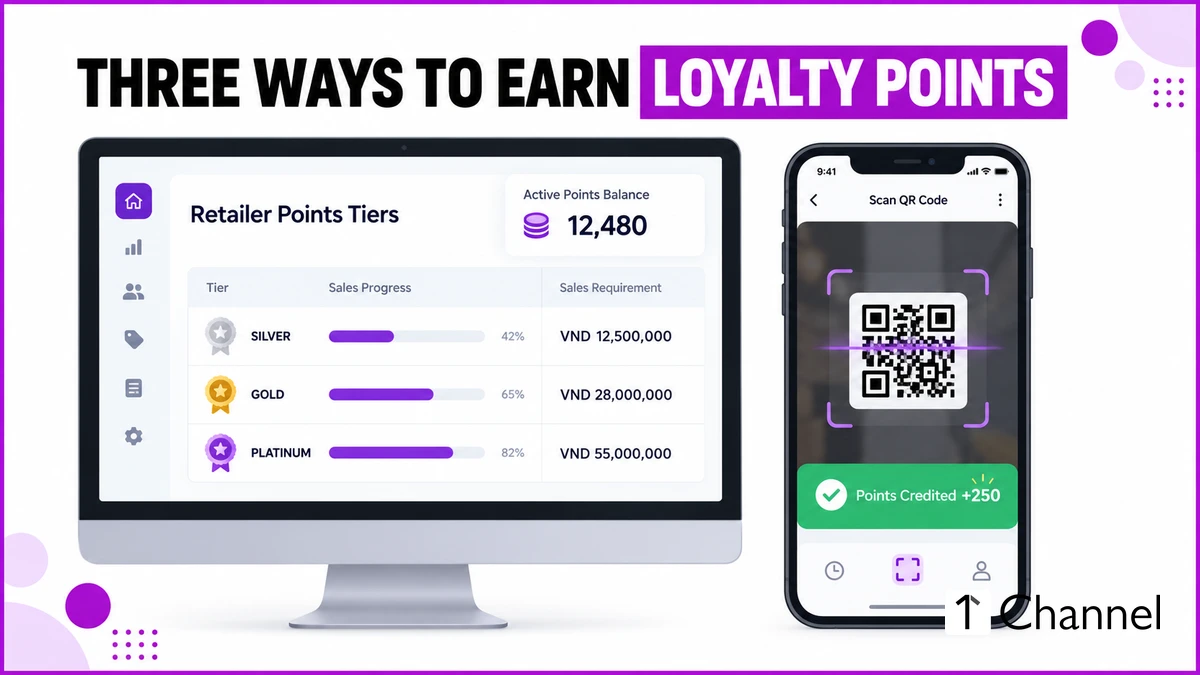
Loyalty points for a retail partner can come from three different places, and 1Channel's rules differ by exactly where that sales data actually originates.
It matters most for FMCG, Building Materials, Consumer Durables and Retail and Modern Trade partners across Vietnam, where sales data reaches the brand through very different channels.
This post covers the three point-earning mechanisms built into 1Channel's loyalty platform: automatic sales-data integration, in-app QR code scanning, and manual invoice entry with approval.
It then works through two examples showing exactly how a partner's points get credited under each setup.
Automatic Points From Sales Data Already on File
When a brand already captures partner sales through its own distributor management system, 1Channel pulls that data in automatically, with no separate entry needed from the partner.
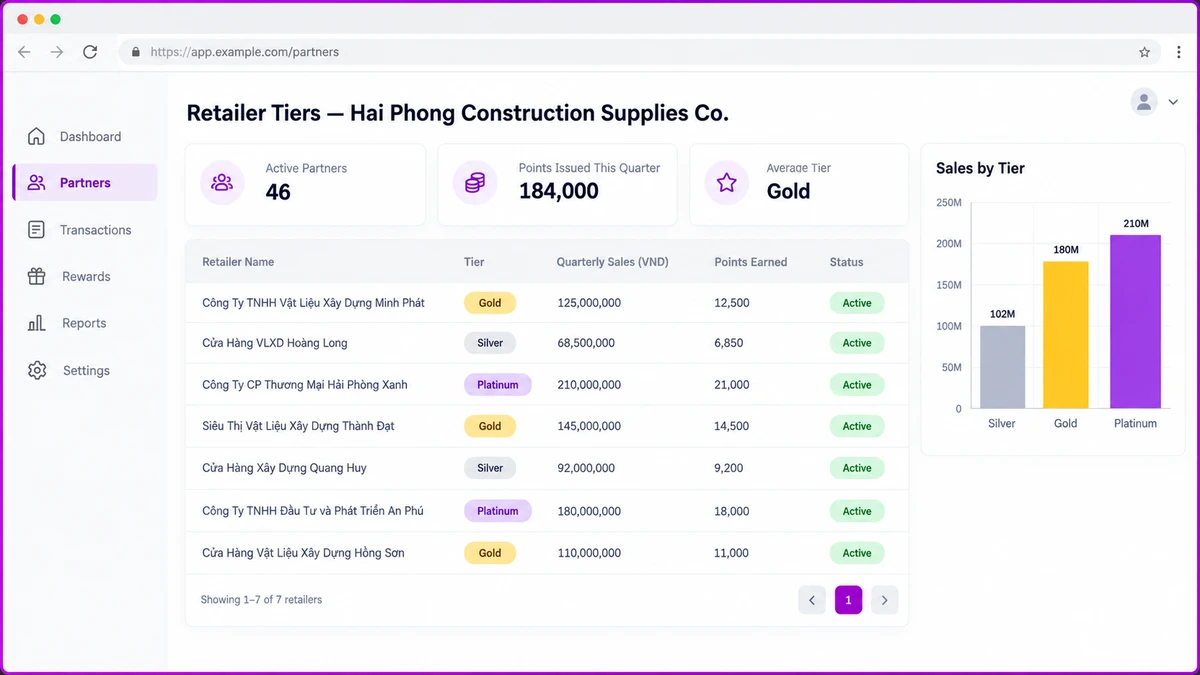
Hai Phong Construction Supplies Co., a network of 46 building-materials retailers reporting sales through one distributor's DMS, moved onto this setup in July.
Sales value for each retailer rolls up by quarter, and points get credited against a fixed slab, the same slab applied to every partner on the program.
| Tier | Quarterly sales (VND) | Point rate |
|---|---|---|
| Silver | 150,000,000 - 300,000,000 | 0.2% of sales value |
| Gold | 300,000,000 - 600,000,000 | 0.3% of sales value |
| Platinum | 600,000,000+ | 0.4% of sales value, capped at 50,000 points per quarter |
A retailer moving from Silver to Gold mid-quarter gets the higher rate applied only from that point forward, not retroactively on sales already counted.
Instant Credit From a Product QR Scan
A second mechanism works at the point a product actually reaches the retailer, not when a sales report is filed weeks later.
Each unit carries its own QR code, generated from the admin portal and applied to the product before it leaves the warehouse.
Scanning it in the partner app credits points immediately, once the system confirms the code is genuine and has not already been scanned elsewhere.
This is a product-authentication code built into 1Channel, separate from VietQR, the interbank QR transfer standard used for payments, even though both rely on the same scan-to-act idea.
Manual Entry for Purchases Outside the System
A third mechanism covers purchases that happen outside any connected system and need the partner's own submission.
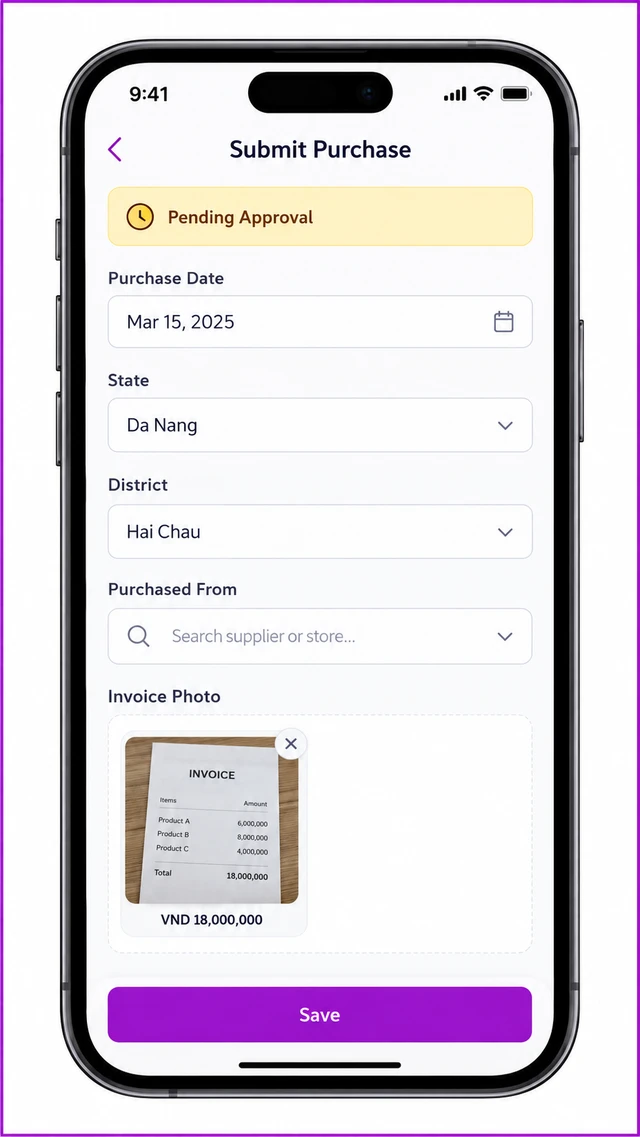
The partner enters the purchase date, location and where it was bought, then attaches a photo of the invoice as proof.
Nguyen Van An, a Consumer Durables retailer in Da Nang, submitted a VND 18 million invoice this way after buying stock from an unconnected wholesaler.
The program team reviewed the photo and approved the entry within a day, crediting points only once a reviewer confirmed the invoice was genuine.
How 1Channel Tracks Every Point Across the Program
1Channel's retailer loyalty program keeps all three mechanisms on one ledger, so a partner's balance reflects integrated sales, scanned products and approved invoices together, not three separate totals.
Each credit carries its own source and approval trail, which keeps a quarterly payout defensible even when a program mixes all three mechanisms across the same partner base.
Points That Track Back to Every Sale
Credit retail partners automatically from connected sales data, product QR scans, or approved invoice entries, all on one auditable ledger, from a cloud loyalty platform built for Vietnam's retail networks.
Explore Retailer Loyalty Program →Points to Remember
- Sales-data integration suits partners already captured in a connected DMS or ERP. No separate entry is needed once the integration is set up.
- QR scanning credits points at the product level, not the invoice level. It is a product-authentication code, not a payment instrument.
- Manual invoice entry always needs an approval step. Points move only after a reviewer confirms the submitted photo.
- Slabs, caps and rates are configured per program. The figures here are illustrative, not fixed platform defaults.
- VietQR and 1Channel's product QR serve different jobs. One moves money between banks, the other authenticates a physical unit.
- One shared ledger keeps a mixed-mechanism program auditable. Every credit still carries its own source and approval trail.
Note: Software screens may vary based on your business structure and configured workflows.