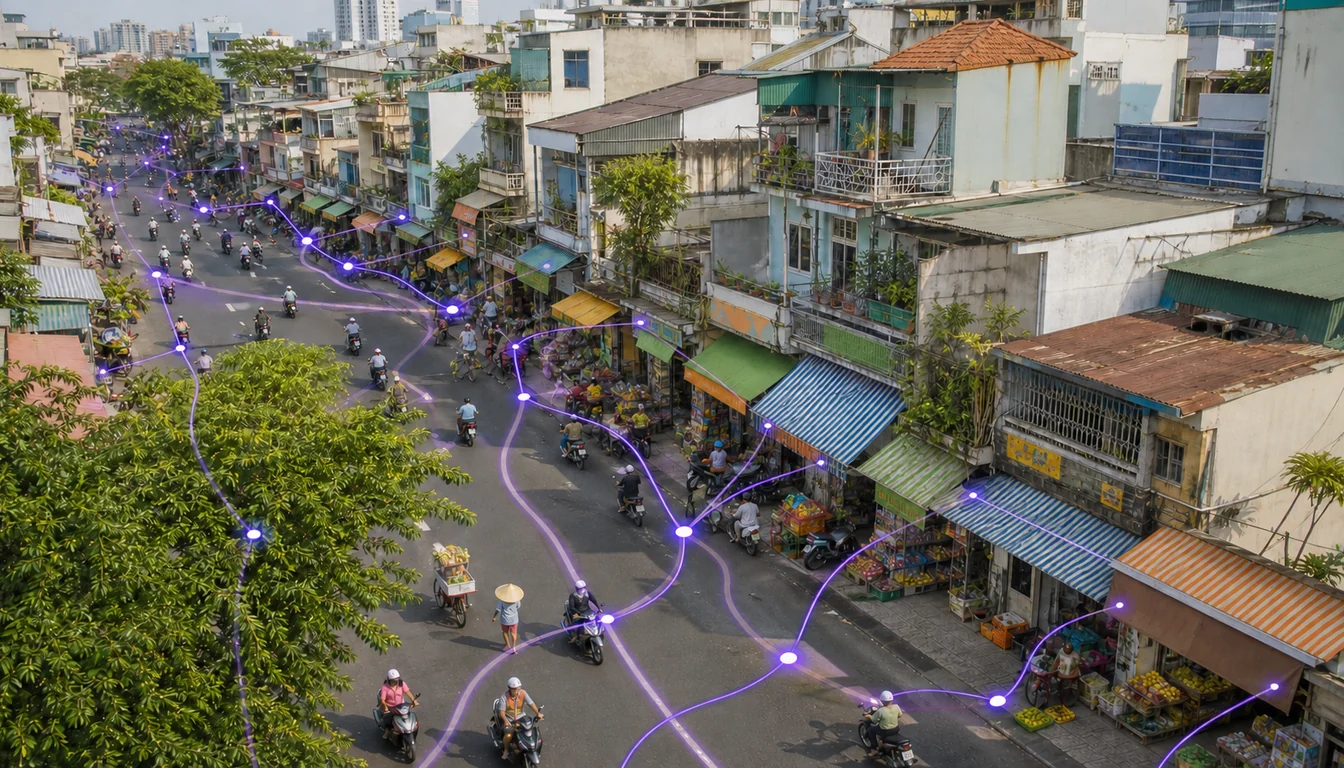
A Market That Refuses to Pick a Side
Most FMCG markets eventually settle into one shape. Either modern trade takes over and brands rebuild around chain accounts, or general trade holds and the commercial model stays built around independent outlets. Vietnam has done neither, and shows no sign of doing so soon.
Independent tạp hóa stores and traditional markets (chợ) still carry the majority of everyday FMCG volume, from the alleys of the Red River Delta to the Mekong Delta's river towns. At the same time, the minimart format is expanding at a pace few markets in the region can match, with WinMart+, Bach Hoa Xanh and Co.op Food pushing well past the big cities into provincial towns, and convenience chains such as Circle K, GS25 and FamilyMart densifying urban centres. Supermarkets and hypermarkets including Co.opmart, GO!, Lotte Mart and AEON anchor the top of the channel.
The practical consequence for a brand team is uncomfortable. You are not running one route-to-market with a modern-trade appendix, and you are not running a modern-trade business with a legacy general-trade tail. You are running two commercial models over the same territory, at the same time, with different pricing logic, different promotion mechanics, different visit frequency and radically different data availability.
What Tạp Hóa Coverage Actually Demands
The general trade base in Vietnam is deep, fragmented and served through a multi-tier structure: brand to distributor (nhà phân phối), then on to sub-distributors and wholesalers, then to the outlet. In most territories the distributor employs the salesman team while the brand employs the Sales Supervisor and Area Sales Manager layer that manages the distributor network. That structure puts local capital and local relationships behind your coverage. It is also the reason so many brands cannot answer basic questions about their own market.
Coverage Is a Frequency Problem
A tạp hóa owner buys small, buys often, and buys on the basis of what moved last week and what the shop can afford to hold this week. Storage space is measured in shelf inches. Working capital is tight. That means a fortnightly call cycle quietly hands share to whichever brand shows up weekly, because the order that gets written is the order taken when the gap on the shelf is visible.
Getting that right is a planning discipline rather than an effort problem. Dense urban clusters need short, tightly sequenced beats, while provincial and delta territory needs longer loops that still hit the high-value outlets on schedule. Our guide to beat planning for dense tạp hóa routes covers how to design them.
The Outlet Universe Is Never Finished
Independent outlets open, close, change hands and change format constantly. A retail census that was accurate in January has decayed noticeably by Tết. Brands that treat the outlet master as a fixed asset end up paying reps to call on shops that no longer exist while missing new ones two doors down. The universe has to be maintained by the people already standing in front of it, with new outlets captured, geo-tagged and classified at the first visit.
Why Minimarts Change the Playbook
Modern trade in Vietnam is not general trade with better lighting. It runs on a different commercial contract: negotiated listings, agreed planograms, promotional calendars locked weeks in advance, centralised ordering, and performance conversations held at head office rather than at the shelf.
That changes what a field visit is for. In a tạp hóa the rep is there to sell. In a minimart or supermarket the rep or Merchandiser is largely there to verify: is the agreed range actually on shelf, is the display where the contract says it should be, has the promotional price been implemented at the till, are facings holding against the category. The value of the visit sits in the evidence it produces, which is why retail execution software and photo-based audits matter far more here than order-taking screens.
The expansion into provincial Vietnam adds a second complication. As chains open in towns that were previously pure general trade, a territory that used to need one call pattern now needs two, often served by the same distributor and sometimes by the same rep on the same morning. Territory design that predates the minimart build-out will quietly fail in exactly the provinces where the channel is growing fastest.
Pricing and Promotion Cannot Be Shared
The most expensive mistake in a dual-channel market is running one promotion architecture across both channels. The mechanics do not transfer, and when they leak into each other they destroy margin in both directions.
General trade promotions in Vietnam are typically volume-led and immediate: a free case with a quantity purchase, a slab discount at a threshold, a display allowance, a wholesaler scheme designed to shift a specific pack. They are settled quickly, often against the invoice, and they are judged on whether stock actually moved through the outlet rather than into it. Modern trade promotions are calendarised, contracted, funded from a different budget line and reconciled against agreed trading terms weeks after the event.
Run those on the same price list and the arbitrage takes care of itself. Case-level general trade deals get bought by wholesalers and resold into the modern trade catchment, retail prices in the minimart stop making sense against the shop next door, and the trade-spend report tells you nothing useful because the same VND is being claimed twice under different logic. Channel-specific price lists, scheme rules and claim validation are not administrative nicety here, they are the control that keeps both channels profitable. Our post on planning trade schemes and promotions around Tết covers the seasonal version of this problem.
The Data Gap Between the Two Channels
Modern trade gives you data, eventually, in a structured form you did not design. Chains report through their own systems, on their own cadence, in their own hierarchy, and the brand's job is reconciliation. General trade gives you almost nothing unless you build the capture yourself, because the transaction that matters most, the sale from distributor to outlet, happens inside a distributor's business rather than inside yours.
This is the classic primary versus secondary sales problem, and Vietnam's fragmented multi-tier structure makes it sharper than most. Primary dispatch tells you what you sold to your distributors. It says nothing about whether that stock reached outlets or is sitting in a depot in the Central Highlands waiting for a Tết that already passed. We unpack the mechanics of closing that gap in primary vs secondary sales visibility.
Unification is what makes this hard. A national category view is only meaningful if minimart sell-out, distributor secondary sales and traditional-market offtake land in one comparable structure, with a single product hierarchy, one outlet classification and one territory tree. Otherwise you get two dashboards that disagree and a monthly meeting spent arguing about whose number is right. Consolidated distributor analytics is what turns two channels into one picture.
One Coverage Plan That Serves Both
Brands that handle Vietnam well converge on the same operating shape. Not two organisations, and not one undifferentiated one, but a single plan with deliberate channel-specific settings inside it.
Segment Before You Schedule
Classify every outlet by format, throughput and strategic value before designing a single route. A high-turnover tạp hóa on a market approach road may deserve more attention than a quiet minimart, and the plan should be able to say so. Segment-driven call frequency beats blanket frequency every time.
Split the Visit Purpose
Give the rep a different task list by outlet type. Order capture, credit position and scheme communication in general trade; planogram compliance, share of shelf, POSM verification and stock-on-shelf checks in modern trade. Same field app, different journey. Practically, that is what a properly configured sales force automation rollout is for.
Plan the Seasonal Peak by Region
Tết is the commercial event of the Vietnamese year, and the north and south prepare for it on visibly different clocks. Northern retailers tend to build stock well ahead; southern retailers commonly compress buying into a much shorter window. A single national replenishment calendar is wrong at both ends of the country. Phase the plan by region, and phase it again by channel, because a minimart chain's festive order is placed centrally while a tạp hóa's is placed one carton at a time.
Keep the Territory Model Current
Vietnam moved to 34 provincial units and a two-tier provincial and commune or ward structure on 1 July 2025. Territory definitions, distributor boundaries and reporting rollups built on the older administrative map will not line up with how the market is now organised, and the mismatch shows up first in provinces where minimarts are opening fastest.
How 1Channel Helps FMCG Brands Win Both Channels
1Channel is a cloud platform for FMCG distribution that treats general trade and modern trade as first-class citizens of the same system rather than two disconnected tools. The outlet master, product hierarchy, territory tree and trade-spend model are shared, while the rules that sit on top of them are configured per channel.
That means a brand can run weekly tạp hóa beats and contracted minimart audits from one deployment, with one consolidated view of what is selling where, and with automation handling the reconciliation work that otherwise eats a commercial team's month.
- Channel-aware outlet classification and journey plans, so tạp hóa, traditional-market, minimart, convenience and supermarket calls each carry the right task list, call frequency and time allowance.
- Separate price lists, discount structures and scheme rules by channel and by territory, with claim validation that stops general-trade case deals from leaking into modern-trade catchments.
- Photo-based merchandising and compliance audits for modern trade, covering planogram adherence, share of shelf, POSM placement and promotional price implementation at the outlet.
- Secondary sales capture across distributors, sub-distributors and wholesalers, unified with modern-trade sell-out into a single national picture in VND.
- Order-to-cash that handles how Vietnam actually pays, spanning cash, cash on delivery, VietQR transfers and e-wallet settlement, with document flows that align with e-invoicing obligations already in force since July 2022.
- Region-phased demand and promotion planning for Tết and the Mid-Autumn Festival, reflecting the different stocking clocks of the north, the centre and the south across a 34-province territory model.
- AI-assisted suggested ordering and coverage alerts that flag declining outlets, missed calls and range gaps early.
Run General Trade and Modern Trade From One System
See how 1Channel's sales force automation platform gives Vietnamese FMCG teams channel-specific journey plans, pricing and audits on a single outlet universe.
Explore Sales Force Automation →Key Takeaways
Vietnam rewards brands that build for both channels deliberately rather than treating one as the future and the other as legacy.
- Both channels matter at once. Independent tạp hóa stores and traditional markets still carry the bulk of everyday FMCG volume while minimarts scale hard into provincial Vietnam, so a coverage plan has to serve both properly.
- The visit means different things. A general-trade call is about selling and frequency; a modern-trade call is about verifying agreed range, planogram and price, and the evidence it produces is the value.
- Never share a promotion architecture. Channel-specific price lists, scheme rules and claim validation are what stop case-level general-trade deals from leaking into minimart catchments and eroding margin in both.
- Secondary sales visibility is the real gap. Chains eventually report their own numbers, but distributor-to-outlet movement has to be captured by design or the national picture stays guesswork.
- Plan Tết by region and by channel. Northern retailers typically stock well ahead while southern retailers compress buying, and a chain's festive order is placed centrally while a tạp hóa's is placed carton by carton.
- Keep the territory model current. Territory, distributor boundaries and reporting rollups should reflect the 34 provincial units and two-tier structure in place since 1 July 2025.
Winning in Vietnam is less about choosing the right channel and more about running one disciplined operating model that behaves differently in each. Get the outlet universe, the channel rules and the data structure right, and the two channels stop competing for attention.