On 2 November, General Secretary and President To Lam told the government to stop treating logistics as a service to expand and start building national logistics capacity.
Two days later, VietnamPlus put a number on it: logistics costs across Vietnam are estimated at 16 to 17% of GDP, against a 2030 target below 12%.
The gap bites hardest on bulky, low-value goods, such as Agriculture inputs like fertiliser and crop protection, Building Materials, Consumer Durables and FMCG.
This post sums up what was said, explains why freight weighs so heavily on agri-input distributors, and lists four delivery leaks worth fixing now.
What the November Logistics Push Said
The General Secretary called for a unified, multimodal national logistics network, with network planning reviewed on a multi-centre model.
He also asked for standardised data and electronic documents, and for the main bottlenecks to be identified and resolved before 2027.
| Point raised | Who raised it |
|---|---|
| Logistics costs of 16 to 17% of GDP, with a target below 12% by 2030 | VietnamPlus report, 4 November |
| Industrial parks, raw material areas, logistics centres and seaports are not planned in step | Bui Ba Nghiem, Agency for Foreign Trade |
| Domestic logistics at about 9 to 10%, against textile margins of 3 to 5% | Truong Van Cam, Vietnam Textile and Apparel Association |
| Open API links to customs and a national logistics database | Nguyen Duy Dat, Hanoi Logistics Association |
The Ministry of Industry and Trade is drafting a decree to replace Decree 163/2017 and studying a longer-term Logistics Law.
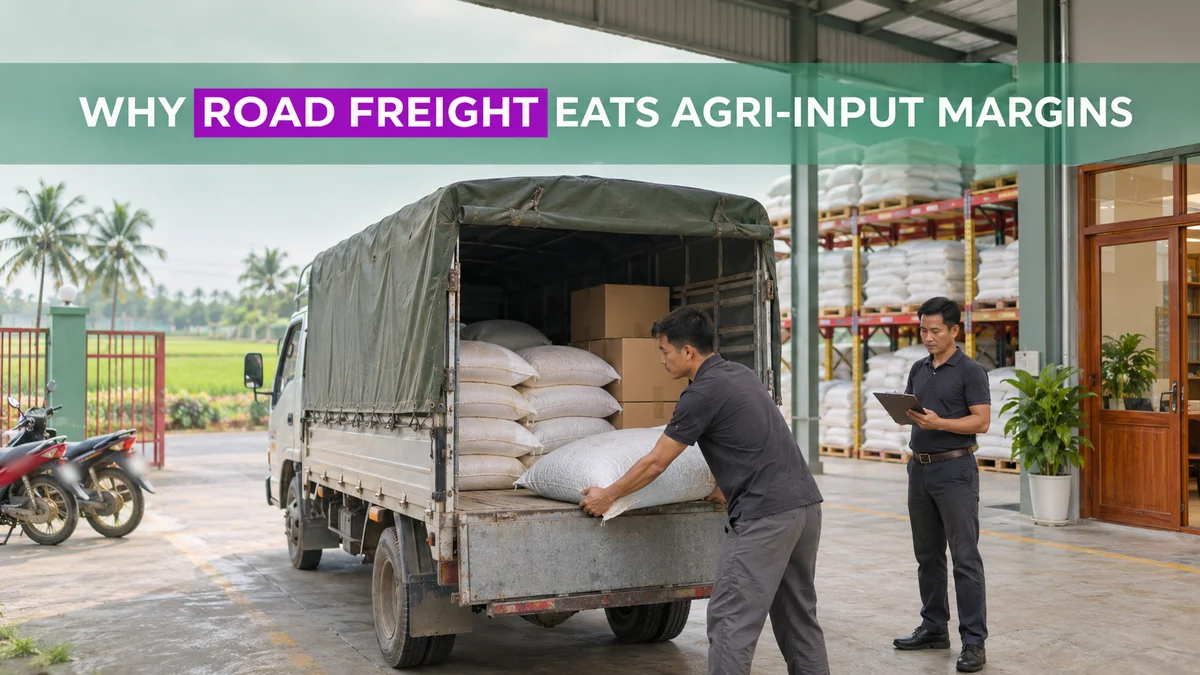
Why Freight Eats Agri-Input Margins
The textile figures show the squeeze clearly. When logistics takes around 9 to 10% and margins sit at 3 to 5%, freight decides whether a sale earns anything.
Agri-input distribution has the same shape of problem, even without published figures of its own.
Fertiliser, crop protection and seed are heavy for their value, and much of it reaches dealers in farming districts by truck.
Even in Hung Yen, which plans 14 inland container depots and 16 logistics centres, the report notes that road transport still dominates.
National fixes will take years. Until then, the freight cost a distributor controls is its own loads: how full they leave, and how often they go twice.
Four Delivery Leaks Worth Fixing Before 2027
None of these needs a new road or port. Each one needs a record of what was loaded, from where, and what actually arrived.
| Leak | How it shows up | What to record |
|---|---|---|
| Short shipments | A dealer receives fewer bags than were sent, and nobody notices for weeks | Received quantity against dispatched quantity, line by line |
| Second trips | Missing lines go out on a fresh truck to the same dealer | Remaining quantity on each order before the next dispatch |
| Wrong warehouse | Stock leaves a distant depot because a nearer one was not checked | Stock by warehouse, plus stock already in transit |
| Untraced carrier | A damaged or short load cannot be tied to a transporter | Vehicle number, driver and docket number at receipt |
Picture a Can Tho distributor sending 400 bags of fertiliser to a dealer in An Giang, and only 380 arriving.
If the shortfall is never recorded, the dealer simply reorders, and a truck drives the same route again for 20 bags.
How 1Channel Gives Every Load a Paper Trail
1Channel's distributor management system records each dispatch as a delivery note, so an order can go out in parts with the remaining quantity shown per line.
Dispatched goods sit as in-transit stock until the receiver raises a GRN. The GRN records what actually arrived and notifies the sender of any shortfall.
It also captures the vehicle number, driver name, docket number and transporter, while stock stays visible across every warehouse before dispatch.
None of this lowers fuel prices, but it shows exactly where freight money leaks between depot and dealer.
Match Every Load to What Arrived
Record what each dealer received against what left the depot, with the vehicle and transporter on file.
Explore GRN Management →Final Suggestions
- Follow the strategy review. The government wants the main logistics bottlenecks resolved before 2027, so watch for the new decree.
- Record shortfalls at receipt. A gap found at the next order has already cost a second trip.
- Check open lines first. Look at what is still undelivered on an order before booking another truck.
- Dispatch from the nearest stock. Use stock by warehouse, including goods in transit, to pick the depot.
- Keep the carrier on record. A docket number and vehicle number give every damage claim its evidence.
Source: VietnamPlus and VnEconomy