Ask two distributors in Vietnam how a route should be worked and you will get two confident, opposite answers. One will say the van goes out loaded and comes back empty, because sending a second vehicle to a provincial outlet costs more than the order is worth. The other will say nothing leaves the warehouse without an order already against it, because a representative on a motorbike in a dense ward covers several times the outlets a van can reach in a morning. Both are describing a real Vietnamese route. Neither answer survives being moved to the other one's territory.
Two Route Models, One Very Long Country
Vietnam runs roughly 1,650 km from the northern mountains to the tip of the Mekong Delta, and the retail structure changes as you travel it. Dense urban wards hold clusters of tạp hóa outlets and traditional markets (chợ) within a few hundred metres of each other, while a provincial beat may involve an hour of road between one worthwhile stop and the next. That variation is the reason the van sales versus pre-selling question does not have a national answer. It has a route-level answer, and a distributor with territory in three regions will usually need more than one.
Before comparing them properly, it is worth being precise about what each model actually commits the business to, because the labels get used loosely.
What van sales commits you to
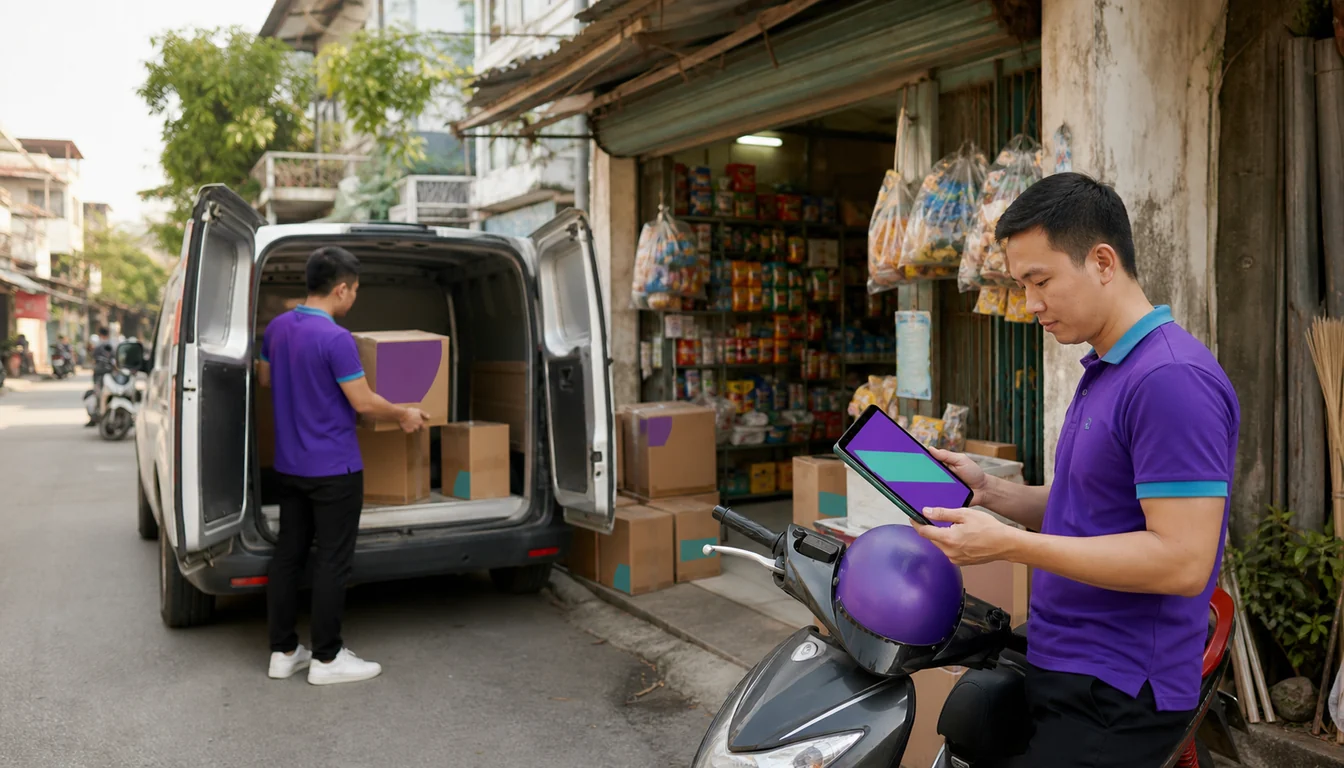
In a van sales model the Van Sales Representative leaves the depot with stock loaded, sells from that stock at the outlet, hands over goods and collects payment in the same visit. The transaction is complete before the representative moves on. The van is simultaneously a mobile warehouse, a point of sale and, quite often, a cash office. Everything good about the model and everything risky about it follows from that single fact.
What pre-selling commits you to
In a pre-selling model the Field Sales Representative visits to take the order and nothing else. Stock stays in the distributor warehouse until a picking run assembles it, and a separate delivery trip fulfils the order within an agreed window, typically the next working day. Selling and physical fulfilment are two different jobs done by two different people, which is precisely what makes the model scale and precisely what makes it slower to satisfy an outlet that wanted stock this morning.
Access Decides More Than Strategy Does
The first filter is not commercial at all. It is whether a vehicle can physically reach the outlet, and in Vietnam that question is answered very differently in a city core than on a provincial road.
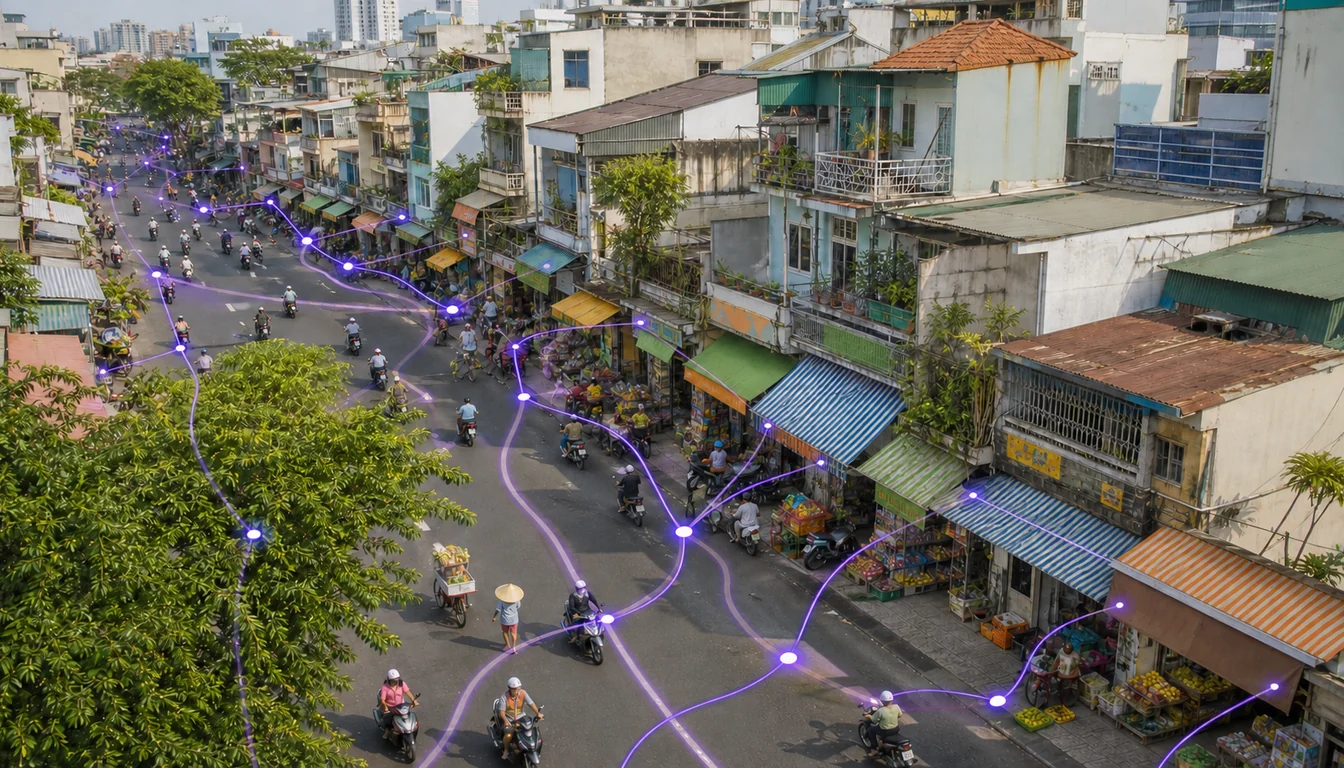
Inner-city coverage in Ho Chi Minh City and Hanoi runs through narrow alleys where a loaded van simply cannot go, or can only stop somewhere inconvenient and wait. Field teams working those clusters travel by motorbike because that is what the street layout allows, and a motorbike carries a tablet and a catalogue rather than several hundred cases of stock. Traditional markets compound this: stalls sit inside a market structure with no vehicle access to the trading floor at all. In that environment pre-selling is not a preference, it is the only model that fits, with a delivery run handling the physical goods on a schedule that suits the market's own quiet hours.
Provincial and delta territory inverts the logic. Outlets are further apart, the roads take vehicles comfortably, and a return trip to correct a missed line costs a large part of a day. A tạp hóa owner two hours out from the depot generally wants the stock now, not tomorrow, and would rather buy what is on the van than wait for exactly what was ordered. In the Mekong Delta, where routes also work around waterways and ferry crossings, that preference gets stronger still. This is where careful route planning software earns its place, because the decision is not only which model to run but how many outlets a single loaded vehicle can realistically serve before the day runs out.
Modern trade sits apart from both. Minimart chains, supermarkets and hypermarkets operate structured ordering, scheduled delivery windows and formal goods-receiving procedures at the back door. A van turning up unannounced with whatever it happens to be carrying does not fit that process. Modern-trade accounts are pre-sell accounts almost by definition, and the growth of the minimart format across Vietnamese provinces means more of the territory is moving into that category each year. Our post on beat planning for dense tạp hóa routes goes deeper into how these coverage patterns are built into a weekly schedule.
Stock, Cash and Credit Sit Differently in Each Model
Once access is settled, the real operational differences show up in custody. Who is holding the company's stock, who is holding its money, and who is carrying its risk during the working day.
Stock custody on the van
A van sales operation gives one person custody of a substantial stock value for a full day. That demands a loading sheet at dispatch, a reconciliation at return, and controls for damages, returns and unsold stock going back into the warehouse. Batch and expiry discipline gets harder too, because stock that has been riding around for several days needs to be recognised as the same batch when it comes back, not silently re-entered as fresh. Pre-selling avoids all of this by keeping goods in one controlled location until a picking list moves them, which is why regulated categories such as pharmaceutical distribution lean heavily towards it. A distributor running mixed categories often finds that inventory management software has to treat each van as its own stock location rather than as a courier.
Cash, COD and QR settlement
Vietnamese trade settles through several rails at once. Cash and cash on delivery remain genuinely common in traditional trade and in the provinces, VietQR transfers have become an everyday counter habit, and e-wallet and bank-transfer settlements arrive with references that have to be matched back to the right outlet. A van sales representative collects at the point of sale and therefore carries the day's takings, which means a same-day banking or handover routine is not optional. A pre-sell operation splits collection away from the sale, so payment may land with the delivery driver, or against an invoice later in the week, or by transfer from the outlet's own phone. Neither is simpler, they are differently complicated, and both need payment management software that can reconcile mixed rails against invoices rather than assuming one method.
Credit control
Credit is where the two models genuinely diverge on risk. Van sales is naturally a cash-and-carry style discipline: goods change hands against payment, so exposure is limited and ageing stays short. Pre-selling opens the door to credit terms, which is exactly what larger outlets and modern-trade accounts expect, but it puts a receivable on the books between order and settlement. Distributors who move a route from van to pre-sell without also introducing credit limits, ageing visibility and a blocking rule for overdue outlets usually discover the gap several weeks later, when the ledger has grown quietly on routes that used to be self-settling.
Range Carried Versus Range Sellable
A van can only sell what is on it. That sounds obvious, and it is still the most commonly underestimated cost of the model. Load capacity forces a decision about which lines travel, and the answer is almost always the fast movers. Slow-moving lines, new launches, bulky or heavy packs and anything requiring cold-chain handling tend to fall off the van and therefore fall out of the conversation at the outlet.
Pre-selling sells the full catalogue because the constraint is a picking list, not a payload. That matters most in two situations. The first is a new product introduction, where the whole point is to get distribution across a wide outlet base quickly and a van model quietly starves the launch of space. The second is Tết, when festive packs and gifting cartons are physically large, demand builds in phases across the weeks before the holiday, and northern and southern retailers build their stock on visibly different clocks. Selling those seasonal lines from a van means capping the order at whatever fits, whereas an order taken today and delivered tomorrow can be sized to what the outlet will actually shift. Keeping SKU listings and pack structures clean across both models is what stops the same product being sold under two identities.
What Each Model Reports as Secondary Sales
Both models produce secondary sales data, but they produce different data, and confusing the two is a common reporting failure inside a single distributor.
A van sale creates one record at the moment goods and money change hands, so the sale, the delivery and the invoice are the same event. Reporting is immediate and clean, but the trail says nothing about demand that was never met, because a line the outlet wanted and the van was not carrying leaves no record at all. Pre-selling separates the events, which produces a richer trail: what was ordered, what was actually delivered, what was short-supplied and what came back. That difference between ordered and delivered quantities is one of the most useful early signals a distributor has, and it exists only in the pre-sell model.
Either way, the invoice has to be a compliant e-invoice. E-invoicing has been mandatory for all businesses and traders in Vietnam since 1 July 2022, and the penalty regime around invoice violations has been restructured since, so a van issuing paper against a same-day sale is not an acceptable shortcut. Both models need order and invoice records that flow into the distributor's books properly, which is the practical case for running them through a shared distributor order management layer. For a fuller treatment of how these records roll up, see our post on primary versus secondary sales visibility.
Most Vietnamese Distributors End Up With Both
Hybrid operating models are normal here, and treating them as a compromise is a mistake. A distributor covering a city and its surrounding province will commonly pre-sell the urban wards and the modern-trade accounts, run van sales on the outlying and delta beats, and shift the balance seasonally when Tết volumes make same-day availability worth more than range. The weekly rhythm supports this: with a Monday start and Saturday mornings still worked in trade and distribution, there is room to run pre-sell order days and dedicated delivery days without either falling into the weekend.
A sensible way to decide route by route:
- Lean towards van sales when outlets are dispersed, a return trip is expensive, order values are small and frequent, the outlet expects stock the same day, and the sellable range fits comfortably on a vehicle.
- Lean towards pre-selling when outlets are dense and vehicle access is poor, the account has delivery windows and formal goods receiving, the range is broad or includes bulky and regulated lines, or credit terms are part of the trading relationship.
- Split by channel rather than by territory when a single beat mixes tạp hóa outlets with minimart and supermarket accounts, since the two need different call procedures anyway.
- Split by SKU group when a small set of fast movers accounts for most of the volume and everything else needs the catalogue.
- Review the split each season, because Tết, Mid-Autumn and new launches all change the balance between availability and range for a few weeks at a time.
How 1Channel Helps You Run Either Route Model
The practical requirement is not to pick a winner, it is to run both models properly in the same organisation without keeping two sets of books. That means one master outlet list, one product catalogue, one price and scheme engine, and reporting that reconciles a same-day van sale and a next-day pre-sell delivery into the same secondary sales picture.
1Channel supports both models on a single cloud platform, with automation handling the routine reconciliation work that otherwise falls on a Sales Supervisor at the end of every day:
- Van and pre-sell call flows in one app, so a representative working a mixed beat follows the right procedure per outlet without switching systems.
- Van as a managed stock location, with load-out, unsold-stock return, damages and batch tracking reconciled against the distributor warehouse each day.
- Mixed-rail collections covering cash, COD, QR transfers and bank settlements, matched to invoices and outlets so the day's takings tie out.
- Credit limits and ageing on pre-sell accounts, with overdue outlets flagged before the next order is accepted.
- Order, delivery and return records aligned to e-invoicing obligations, which have applied to every business in Vietnam since July 2022.
- Territory and route design across north, centre and south, so coverage plans reflect Vietnam's two-tier provincial and commune structure rather than an outdated map.
- AI-assisted analytics on ordered versus delivered lines, surfacing where van range limits are costing sales and where a route is ready to move models.
Run van sales and pre-selling on one platform
See how 1Channel's sales force automation handles mixed route models across Vietnam's traditional and modern trade without splitting your data.
Explore Sales Force Automation →Key Takeaways
The route model question in Vietnam is answered per route, not per company. These are the points that decide it:
- Access comes before commercial logic. Narrow urban alleys, motorbike-based coverage and traditional-market stalls rule out a loaded van long before anyone compares margins.
- Van sales buys same-day availability and pays for it in range. A vehicle sells only what fits, which quietly sidelines new launches, bulky festive packs and slow movers.
- Pre-selling buys range and credit and pays for it in a second trip. That is acceptable in dense territory and for modern-trade accounts with delivery windows, and expensive on a dispersed provincial beat.
- Custody is the real risk difference. Van sales puts stock and cash in one person's hands for a day; pre-selling puts a receivable on the books between order and settlement.
- The two models report differently. Only pre-selling shows the gap between what was ordered and what was delivered, and both must produce compliant e-invoices.
- Hybrid is the normal end state. Most Vietnamese distributors split by geography, channel, SKU group and season, and revisit the split around Tết.
Distributors who treat this as a permanent choice tend to defend whichever model they started with. The ones who treat it as a route-level setting, reviewed against real coverage and settlement data, end up serving dense city clusters and dispersed provincial territory well at the same time, on one system and one set of numbers.