Most brands operating in Vietnam can say precisely how much they sold last month. Far fewer can say how much the market sold. That difference, between what left the brand's warehouse and what actually reached a shelf, is where a surprising number of route-to-market decisions quietly go wrong.
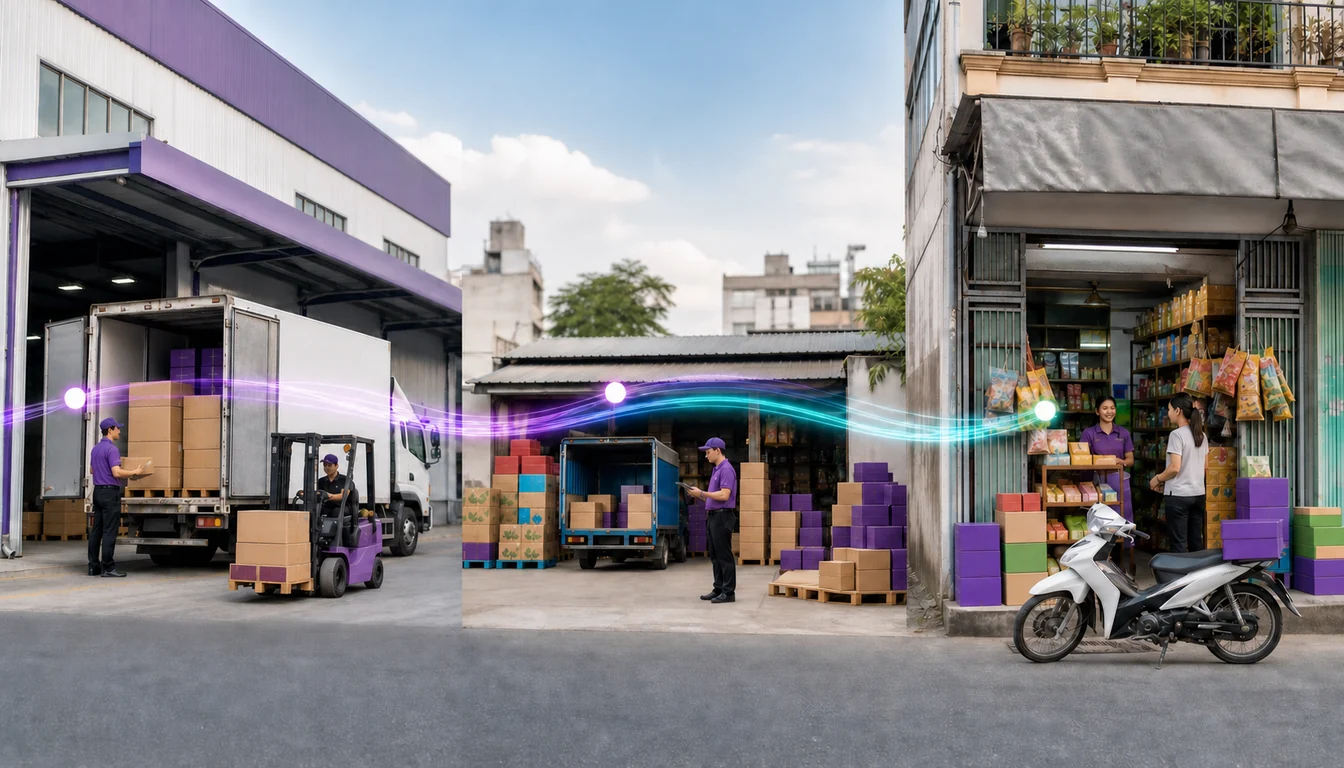
Two Different Sales, Two Different Invoices
The two terms get used loosely in planning meetings, so it is worth fixing them before discussing why they diverge. Each is a real transaction with its own invoice, owner and timing.
Primary sales: brand to distributor
Primary sales, often called sell-in, is the volume a brand or manufacturer invoices to its distributors (nhà phân phối). It is clean, well documented and easy to report, because the brand is a party to the transaction. Since e-invoicing has been mandatory for every business in Vietnam since July 2022, the primary invoice is already electronic, already numbered and already filed. If your distributor order management process is even moderately disciplined, primary sales reporting is a solved problem.
Secondary sales: distributor to outlet
Secondary sales, or sell-out, is the volume the distributor invoices onward to retail: the tạp hóa on a residential lane, the stalls inside a traditional market (chợ), the minimart on the corner, the convenience store near an office block, and the supermarket or hypermarket buying through a distributor rather than a direct account. This is the number that tells you whether consumption is real. It is also the number the brand does not own, because the brand is not a party to that transaction at all.
Both numbers matter, but they answer different questions. Primary tells you what you shipped. Secondary tells you what the market absorbed. When the two drift apart, the difference is sitting in a distributor warehouse, not in a consumer's kitchen.
Why Vietnam's Gap Is Structural, Not Administrative
In many markets, weak secondary visibility is a reporting failure that better discipline can fix. In Vietnam it is closer to an organisational fact, and understanding why changes how you go after it.
Vietnamese FMCG route-to-market typically splits employment across two organisations. The distributor employs the field sales team that calls on outlets: the people who take the order, agree the price, deliver the carton and collect the cash. The brand employs the layer above them, the Sales Supervisor who owns a geographic area and manages one or several distributors, and the Area Sales Manager who owns multiple areas. So the brand's own payroll stops exactly one level above the person who makes the secondary sale.
That single structural fact explains most of what frustrates brand teams here. You cannot mandate a reporting behaviour for people who do not work for you. You cannot performance-manage a route they did not agree with you. You cannot assume a device or an app will be used simply because head office bought it. Every mechanism for obtaining secondary data in Vietnam has to survive that reality, which means it has to be worth something to the distributor and to the representative, not just to the brand's analytics team.
The Sales Supervisor layer is where this is won or lost. Supervisors sit at the join between the two organisations and are the only brand employees with a daily working relationship with the distributor's team. A secondary-sales programme that gives them nothing useful in return tends to decay within a quarter.
Add Sub-Distributors and Wholesalers and the Picture Blurs Again
The two-step model above is the simple version. In practice, a distributor covering a wide province rarely reaches every outlet with its own vehicles. Volume moves onward to sub-distributors and wholesalers who serve the outer communes and wards, the traditional markets and the smaller tạp hóa clusters that a direct route cannot economically visit.
At that point the terminology slips. What the distributor books as a secondary sale is really stock moving to another trade partner, not a sale to a retailer. The carton is a step closer to a shelf but still not on one, and the report now shows sell-out that has not sold out. Fragmented multi-tier distribution is a named challenge of the Vietnamese market, and this is the mechanism by which it distorts reporting.
The fix is not to pretend the tier does not exist. It is to classify it honestly: mark wholesaler and sub-distributor invoices as a separate movement type so they never inflate retail sell-out, and work towards capturing the final outlet sale where the economics justify it. That is a longer programme, and it is covered in more depth in our post on digitising sub-distributors and wholesalers in Vietnam.
What Primary Loading Hides at Tết
Tết is the point in the year when the primary and secondary numbers are most likely to tell opposite stories, and when believing the wrong one is most expensive.
In the weeks before Lunar New Year, everyone stocks. Distributors take extra inventory because they expect a strong festive period and because they know the supply chain slows during the holiday. Brands are happy to ship it because the sell-in target for the quarter looks comfortably met. Retail buys heavily too, particularly in general trade, where consumer preference for the tạp hóa and the traditional market is strongest around the festival. Primary sales look excellent. It is genuinely hard, at that moment, to distinguish real demand from warehouse loading.
Vietnam adds a regional complication that a single national view cannot see. The north and the south prepare on different clocks. Retailers around Hanoi and the Red River Delta tend to build stock well in advance, while a large part of the trade in Ho Chi Minh City compresses buying into a much shorter window close to the holiday. A national primary curve blends the two into an average that describes neither region, and a national replenishment plan built on it will be early in one half of the country and late in the other.
The bill arrives afterwards. If secondary sales did not keep pace with the loading, the following weeks bring flat orders, distributors sitting on cover they cannot move, ageing stock in shelf-life sensitive categories, and pressure to discount inventory that was already sold once. Sell-in targets alone will always produce this phantom growth, because they reward stock moving into the channel and say nothing about stock moving out of it. Judging promotional mechanics on sell-out rather than sell-in is the practical antidote, and it pairs with our guidance on planning trade schemes and promotions around Tết.
Where Secondary Sales Data Realistically Comes From
Given that the brand does not employ the people making the secondary sale, there are three practical sources of data. Most Vietnamese brands end up running a combination, weighted differently by channel and region.
Orders captured at the outlet
The highest quality source is the order captured on a device by the representative standing in the shop. Because Vietnam's mobile coverage is strong across essentially the whole territory, this synchronises in near real time rather than at the end of a shift. A sales force automation app used by the distributor's team gives you the outlet, the lines ordered, the scheme applied and the visit itself, all timestamped. Adoption follows the rule above: it works when the representative gets something back, such as instant scheme calculation, a clean order that will not be short-shipped, and no evening paperwork.
Distributor system uploads and portal entry
Not every distributor will put a device in every representative's hand on day one, and not every route justifies it. The pragmatic second source is the distributor's own invoicing data, submitted through a portal or uploaded automatically on an agreed cadence. Since e-invoicing is already in force, those records exist in structured form, which makes this far less painful than it once was. You get the secondary invoice line without the visit or the shelf, and that is a reasonable trade for coverage.
Confirmation from the outlet side
The third source is the retailer confirming receipt directly, typically through a QR scan on the invoice tied to a retailer loyalty programme. It will never cover the whole universe, but it is genuinely useful as an audit signal: it independently verifies that a claimed secondary sale reached a real outlet, which matters in a market where counterfeit and grey-market movement is a named concern.
None of these three works without a clean outlet master underneath. If the same tạp hóa exists three times under three spellings, your unique-billed-outlet count is fiction, and disciplined outlet and store management is the unglamorous prerequisite for everything else in this article.
The Reporting Rhythm That Makes the Gap Visible Weekly
Secondary visibility fails most often not because the data is missing but because it arrives too late to act on. A gap discovered at quarter end is a write-off. The same gap seen in week two is a route adjustment.
Vietnam's trade week runs Monday to Friday, with Saturday mornings commonly worked in distribution, which gives a natural weekly close. A rhythm that actually changes behaviour looks roughly like this: distributor secondary data lands by Monday morning for the week just ended, the Sales Supervisor reviews area-level movement against primary shipments the same day, and the Area Sales Manager sees the regional picture before the next replenishment is released. Automated exception alerts do the heavy lifting in between, so nobody is reading a full report to find the one distributor whose cover has doubled.
Four measures carry most of the signal. Days of cover at distributor level, where loading shows up first. Unique billed outlets per week, the honest test of whether coverage is real or a handful of large accounts. Lines per invoice, which shows whether range selling is happening or representatives are riding two fast movers. And the sell-in to sell-out ratio tracked separately for the north, the centre and the south, because a national figure hides exactly the divergence you need to see. Comparing those trends across territories is what distributor analytics is for.
How 1Channel Helps Close the Primary to Secondary Gap
1Channel is built for exactly this structure, where the brand and the distributor are separate organisations with separate teams and the data has to cross between them without friction. The platform captures secondary movement at whichever level a given route can support, then presents primary and secondary side by side in one cloud view for the Supervisor and Area Sales Manager layer.
For a Vietnamese distribution network, that means:
- Secondary sales capture at the outlet through a mobile app used by the distributor's representatives, covering tạp hóa, traditional market stalls, minimarts, convenience stores and modern-trade accounts served through the distributor.
- Distributor portal submission and automated system uploads for partners not yet running devices in the field, aligned with the e-invoicing records they already produce.
- Separate classification of wholesaler and sub-distributor movement, so onward trade transfers never masquerade as retail sell-out in a regional report.
- Days-of-cover and stock-ageing visibility at distributor level, with alerts when loading runs ahead of movement, in VND and in cases, before and after Tết.
- Region-aware dashboards for the north, the centre and the south, on a Monday-based working week, so the two Tết stocking clocks are visible as two curves rather than one blended average.
- Outlet master governance and duplicate control, keeping the unique-billed-outlet count trustworthy across a two-tier commune and ward geography.
See Secondary Sales as Clearly as Primary
Give every distributor in your Vietnam network a single place to submit orders, invoices and stock positions with 1Channel's distributor portal software.
Explore Distributor Portal Software →Key Takeaways
Closing the primary to secondary gap in Vietnam is less about buying a report and more about designing around who employs whom.
- Primary is what you shipped, secondary is what the market absorbed. Only the second one tells you whether consumption is real, and it is the one you do not own.
- The gap here is structural. The distributor employs the field sales team while the brand employs the Sales Supervisor and Area Sales Manager layer, so secondary data has to be worth something to the distributor, not just to head office.
- Classify the wholesale tier honestly. Sub-distributor and wholesaler movement is stock changing hands, not a retail sale, and counting it as sell-out flatters every report it touches.
- Tết is when loading looks like growth. With the north and the south stocking on different clocks, a single national primary curve describes neither region accurately.
- Run all three data sources. Device-captured orders where routes justify it, portal or system submission everywhere else, and outlet-side confirmation as an audit signal, all resting on a clean outlet master.
- Weekly beats quarterly. A Monday close on a Monday to Friday trade week turns a write-off discovered at quarter end into a route correction made in time.
Brands that get this right stop arguing about whose number is correct and start discussing the same number. The reward is not a better dashboard, it is replenishment sized to what outlets are actually selling, promotions judged on movement rather than shipment, and a Tết plan that reflects how each region really buys.