For expanding businesses managing complex supply chains, selecting the right technology is the ultimate fork in the road.
As transaction volumes climb, leaders often find themselves debating between a dedicated Distribution Management System (DMS) and an Enterprise Resource Planning (ERP) platform.
While both systems aim to streamline business operations, they approach growth from entirely different angles.
Choosing the wrong tool can lead to operational bottlenecks or unnecessary expenditures. Here is a breakdown of how a DMS and an ERP differ, and how to choose the right one for your business expansion.
Understanding the Core Focus: Internal vs. External Logistics
The fundamental difference between a DMS and an ERP lies in their operational boundaries.
An ERP is an all-encompassing software designed to manage internal enterprise functions. It links back-office operations like HR, finance, and manufacturing under one unified roof.
Conversely, a DMS is laser-focused on external logistics and the downstream supply chain. It bridges the gap between the manufacturer, super stockists, distributors, and frontline retailers.
Key Capabilities of a Dedicated DMS
A robust DMS is built specifically to optimize field sales and distribution channels. The application provides dedicated modules to handle real-world channel complexities:
- Granular Hierarchy Masters: It allows businesses to map out complex product setups (Brand → Category → Product → SKU) and geographical layers (Zone → State → City → Pin Code). For example, a business can track a specific 100 ml variant under a particular fragrance brand across custom sales regions.
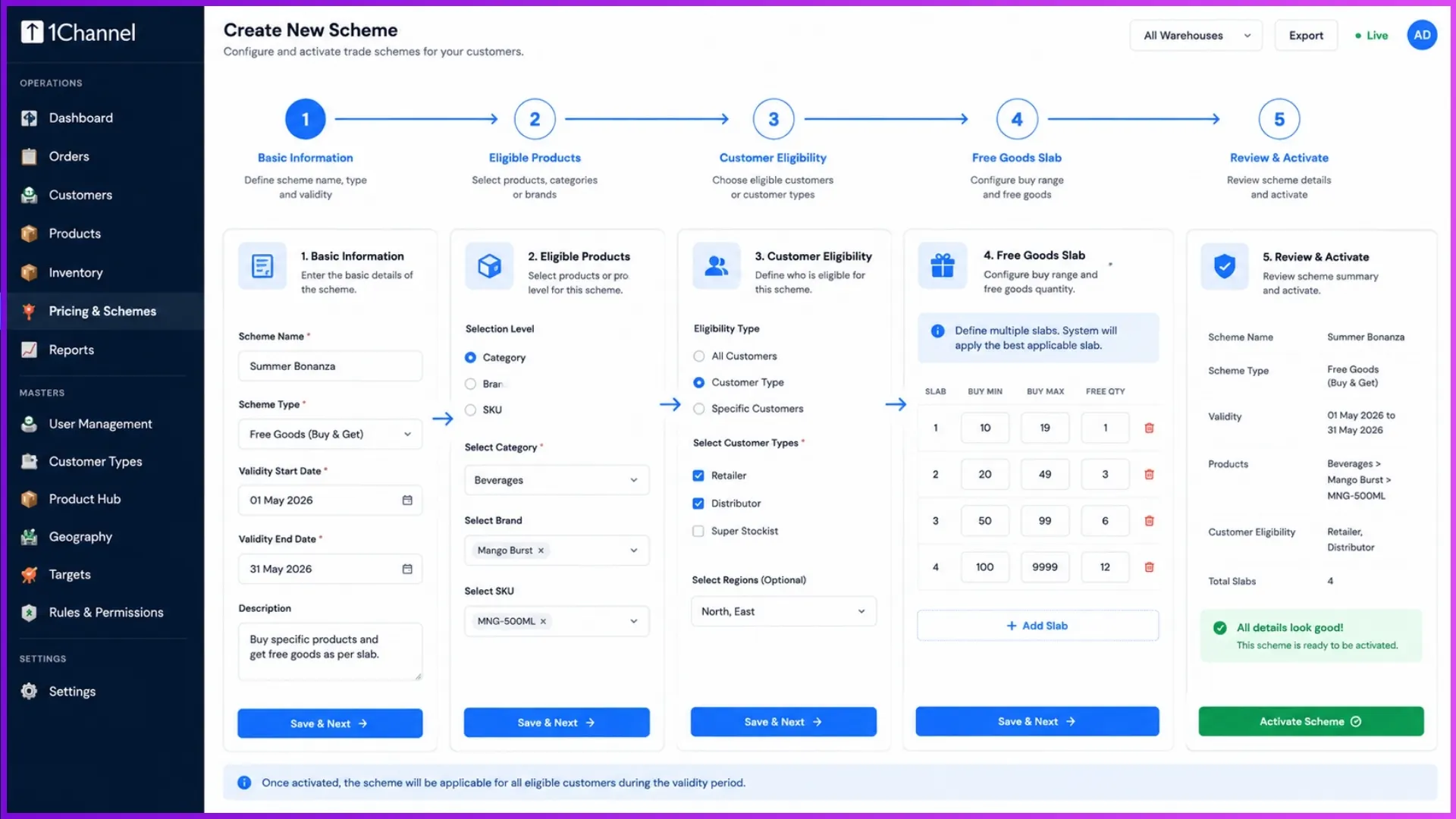
- Dynamic Scheme & Price Management: Distribution networks rely heavily on targeted promotions. A DMS natively handles value-based, volume-based, or free goods schemes (such as a "Buy 10, Get 2 Free" slab) and allows customer-specific, customer-type, or geography-based pricing.
- Automated Field Force Operations: Field execution requires specialized tools. A DMS features automated beat planning, permanent journey plans (PJP), and mobile-app-driven market visits featuring geofenced attendance tracking (e.g., requiring representatives to be within 300 meters of an outlet to check in).
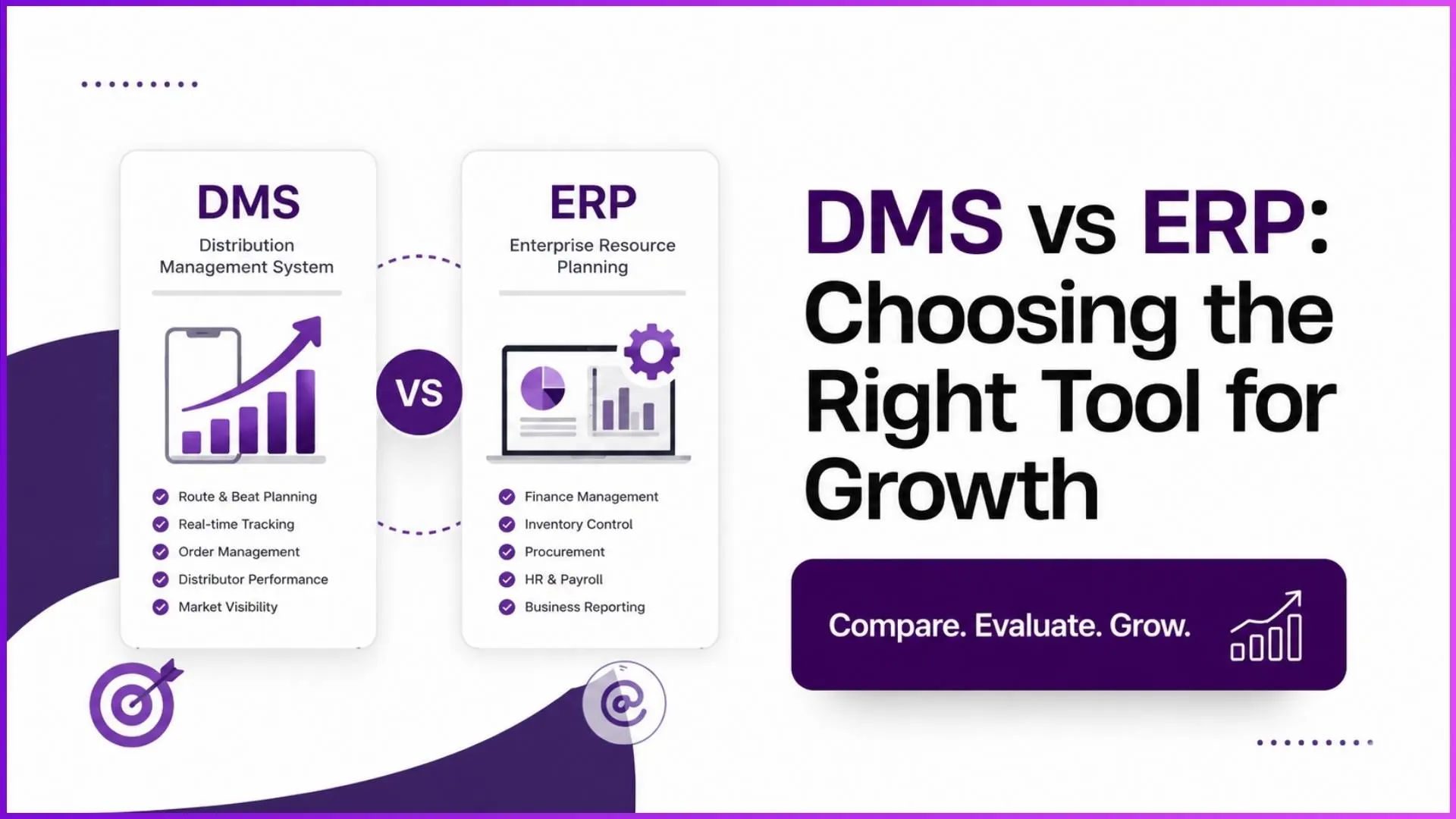
Feature Comparison: DMS vs. ERP
Identifying Your Growth Bottleneck
To choose the right tool, you must diagnose where your business is experiencing growing pains.
When to Choose an ERP
If your primary bottlenecks are internal such as: delayed financial consolidation, disorganized manufacturing schedules, or messy payroll across multiple business units, an ERP is the correct investment. It establishes a strong internal operational baseline.
When to Choose a DMS
If your bottlenecks are external such as: lack of visibility into distributor stock levels, slow secondary order processing from retailers, uncoordinated field sales visits, or leaked margins due to poorly tracked trade schemes, a DMS is essential.
A DMS ensures that orders placed through a field application automatically trigger credit limit checks, verify real-time stock availability, and apply active promotional discounts seamlessly before moving to dispatch and invoicing.
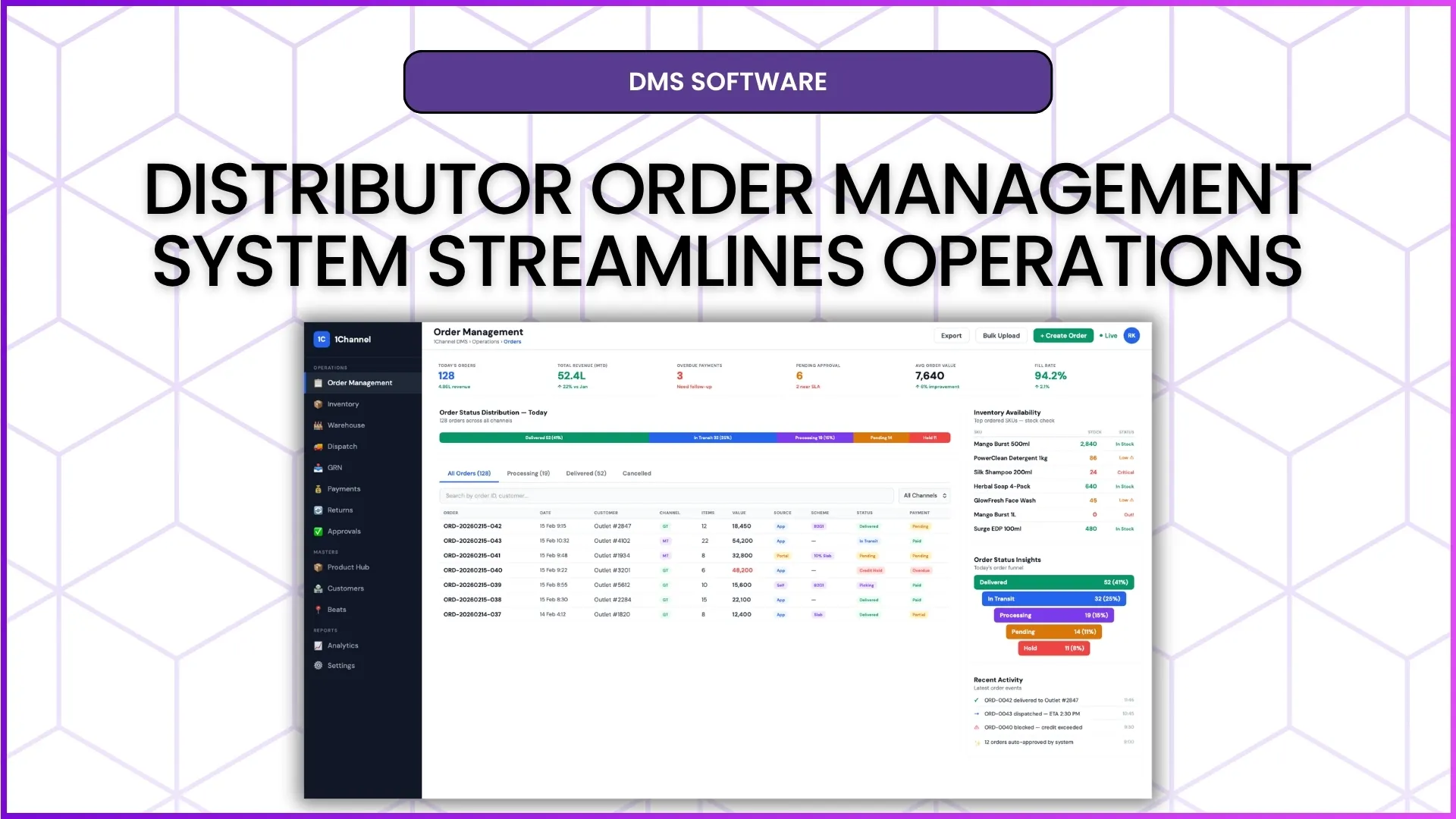
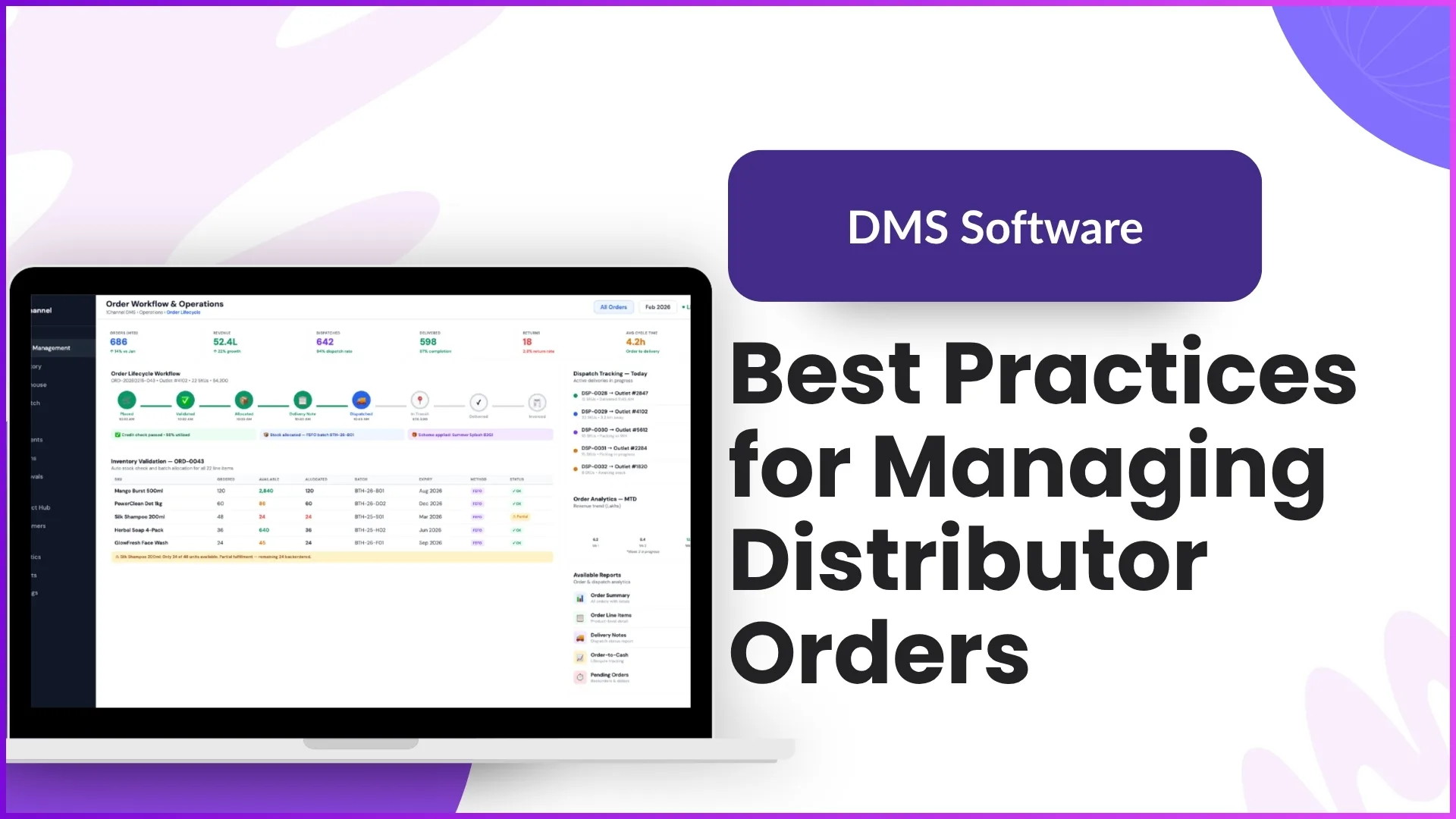
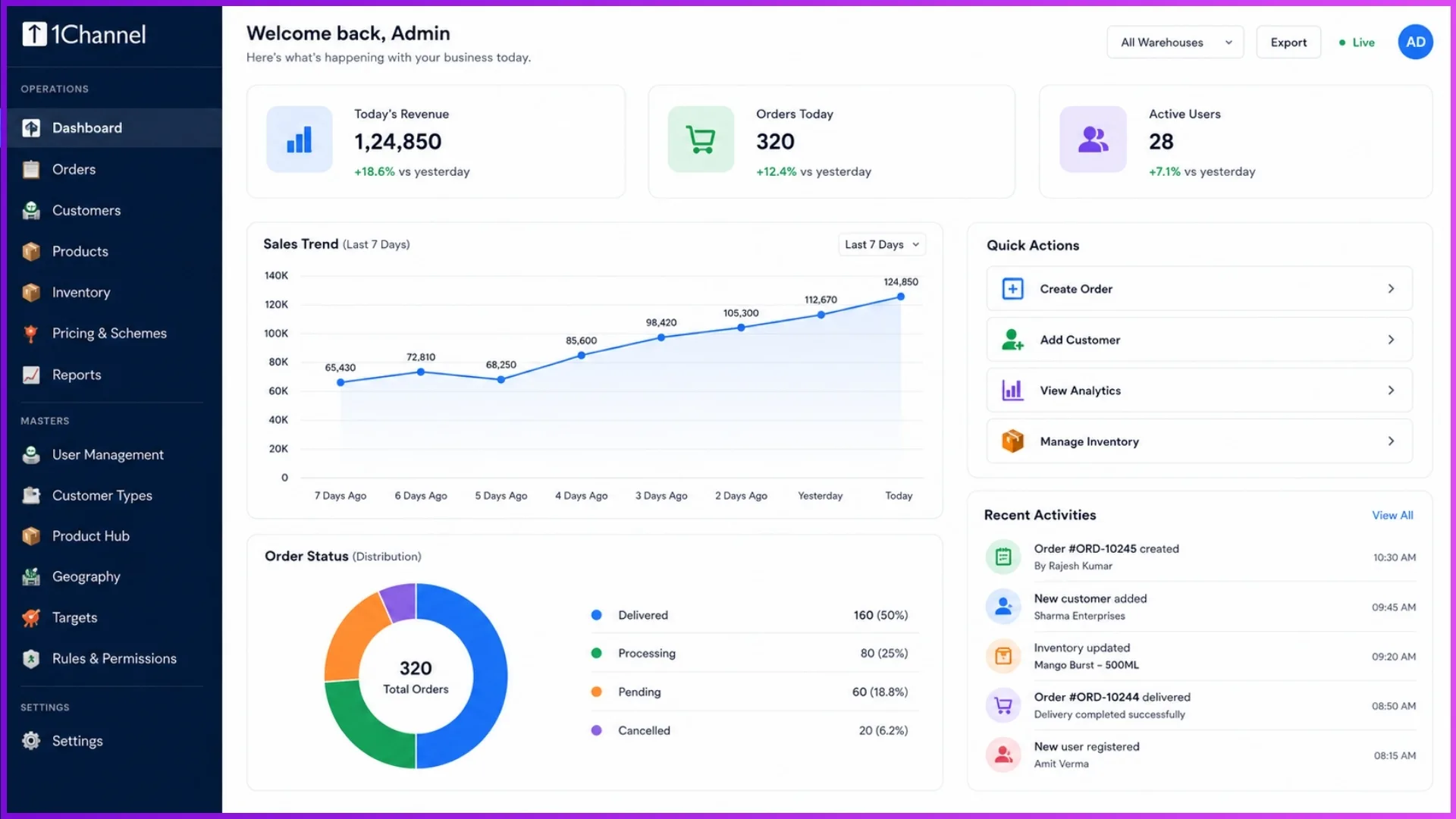
Visualizing the Software Application
Note: Software interfaces may vary depending on the client version.
Supercharging Your Distribution Strategy
For consumer goods and manufacturing brands expanding their retail footprint, general enterprise software often falls short in field-level execution. This is where a dedicated distribution engine transforms operations.
Experience Advanced Distribution with 1Channel
The 1Channel solution is a specialized platform built to address these distribution challenges directly.
It features an advanced workspace that equips teams with comprehensive Master Data Controls, robust Finance tracking, multi-layered Approvals, and deep Analytics.
By deploying 1Channel, businesses can manage everything from automated batch-selection logics (FIFO/FEFO) to mobile field attendance with GPS verification.
Furthermore, the platform integrates an AI assistant within the system. This tool allows users to quickly pull operational insights, view pending transactions, or search location-based orders simply by interacting with a chat window, eliminating the need to manually compile complex reports.
Explore 1Channel Distributor Order Management Software
See how 1Channel's distributor order management software brings hierarchy masters, trade schemes, field force automation, and AI-powered insights together on one connected platform.
Explore Distributor Order Management →Conclusion
An ERP builds a firm internal foundation, but a DMS drives external revenue and channel efficiency. If your growth path relies on a highly responsive, visible, and aggressive distribution network, implementing a dedicated Distribution Management System is the strategic move that will keep your pipeline moving smoothly.
Frequently Asked Questions
1. Can a DMS replace an ERP, or vice versa?
No, they serve different purposes. An ERP is designed to manage internal enterprise resources like finance, HR, and manufacturing setups. A DMS is tailored specifically for outward-facing supply chain execution, managing distributors, retailers, and field force performance. They work best when integrated together rather than replacing one another.
2. How does a DMS handle pricing flexibility differently than a standard ERP?
While an ERP typically applies static or broad contract pricing, a DMS allows dynamic, multi-layered price resolution. It automatically resolves pricing based on specific tiers: Customer-specific pricing, Customer Type pricing (e.g., separating distributor rates from retailer rates), or Geography-based pricing (e.g., different rates for different regions).
3. We struggle with expired inventory at the distributor level. Which system fixes this?
A DMS resolves this directly through batch-enabled inventory tracking and automated allocation logics. It supports FEFO (First Expiry First Out) and FIFO (First In First Out) automated batch allocation during order creation, ensuring that items expiring the earliest are automatically pushed out first.
4. How does a DMS improve field sales accountability compared to an ERP?
An ERP does not track field movement. A DMS includes built-in field force tools like Beat Planning and Permanent Journey Plans (PJP) with GPS geofencing. For example, field sales representatives are restricted from checking in unless they are within a configured radius (e.g., 300 meters) of the verified retail outlet.
5. When is the right time for a growing brand to transition from spreadsheets to a DMS?
The transition becomes critical when you lose visibility of secondary sales (what distributors sell to retailers) and stock levels. If you cannot instantly track real-time stock shortages, handle complex volume-based trade schemes, or manage manual approval chains for credit limit breaches, you have outgrown manual tracking and need a DMS.
Growth-Focused Use Cases
Use Case 1: Automated Distributor Stock Replenishment
The Challenge: A growing consumer brand frequently suffers from stockouts at major distributor locations because distributors delay placing reorders.
The DMS Solution: Using a DMS, the brand configures minimum stock thresholds at the SKU level. When a distributor's inventory drops below 5 units, the system automatically triggers a replenishment order. Depending on rules, it either moves straight to dispatch or routes into an automated approval workflow for the sales manager to review.
Use Case 2: Managing Multi-Tiered Promotional Schemes Without Margin Leakage
The Challenge: A manufacturer wants to launch an aggressive volume-based campaign (e.g., Buy 10–12 pieces get 2 free, Buy 13–15 pieces get 3 free) across specific cities, but manual invoicing leads to calculated errors and margin loss.
The DMS Solution: The company builds a multi-step scheme wizard specifying the eligible products, target locations, and strict free-goods slabs. When a field rep or distributor inputs the order quantity into the application, the system automatically cross-references stock availability and applies the correct promotional items instantly.
Explore 1Channel AI-Powered DMS Software
See how 1Channel's AI-powered DMS applies trade schemes, stock checks, and credit limit rules automatically during order placement.
Explore AI-Powered DMS →Use Case 3: Resolving Credit Limit Breaches in Real-Time
The Challenge: A high-performing retailer wants to place an order that exceeds their approved credit limit, causing field reps to wait hours for manual phone-call approvals from head office while the order hangs in limbo.
The DMS Solution: The DMS utilizes integrated workflow automation. When an order triggers a credit breach, it immediately fires a real-time notification node up to 7 levels deep in the management hierarchy. The manager can view the customer outstanding balance on their dashboard and instantly approve a temporary credit override, allowing the order to proceed to the warehouse without delay.
Note: Software/App screens may vary based on your business structure and configured workflows.