Order accuracy plays a critical role in retail execution, field sales operations, and inventory management. Even a small mistake in product selection, SKU pricing, product mapping, or store-level stock updates can lead to incorrect orders, stock mismatches, delayed fulfilment, and revenue loss.
One of the most effective ways to reduce such errors is through strong Product Master Management. When product information is centrally managed, standardized, and linked with sales, stock, pricing, distributor, and store data, businesses can ensure that field teams work with accurate information at every stage of the order process.
This article explores how Product Master Management helps reduce order errors and how various system capabilities work together to improve order accuracy.
What is Product Master Management?
Product Master Management is the centralized process of managing product-related information such as:
- Brands
- Product Categories
- Products
- SKUs
- SKU Prices
- Product Hierarchies
- Product Classifications
- Availability Norms
- Facing Norms
Instead of maintaining product information across multiple spreadsheets or disconnected systems, all product data is managed from a single location and made available to users across the organization.
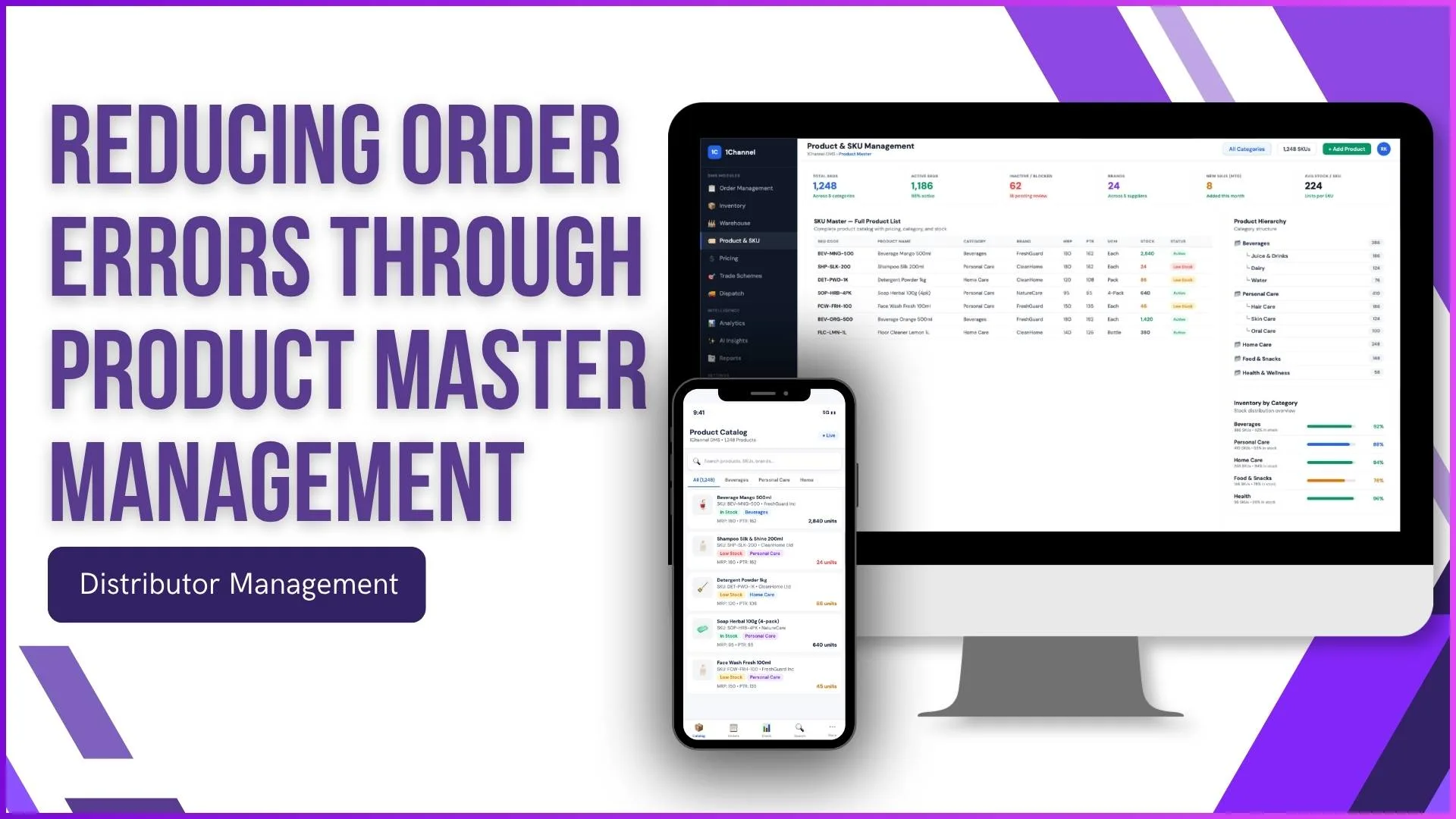
According to the software workflow, products are structured in a hierarchy:
Brand → Product Category → Product → SKU
This ensures that every product and SKU is properly organized before being used for sales, stock reporting, order capture, or distributor management.
Why Order Errors Happen
Order errors often occur when:
- Field teams use outdated product information.
- SKU pricing is incorrect.
- Products are mapped inconsistently across stores.
- Multiple versions of product lists exist.
- New products are not updated across all users.
- Stock information is inaccurate.
- Manual entry mistakes occur during order capture.
Without a centralized product master, different users may work with different versions of the same product information.
1. Creating a Standardized Product Structure
The foundation of error-free ordering starts with a well-defined product hierarchy.
The system allows administrators to create:
- Brands
- Product Categories
- Products
- Individual SKUs
Example
A consumer electronics company may organize products as:
Brand: Acer
Product Category: Laptops
Product: Aspire Series
SKU: Aspire 5 i5 16GB 512GB
By creating a clear hierarchy, field users can select products from predefined structures rather than manually entering product names.
This reduces:
- Wrong product selection
- Duplicate product entries
- Product naming inconsistencies
2. Centralized SKU Management
Every order ultimately depends on SKU accuracy.
The Product Management section enables administrators to manage:
- SKU creation
- SKU hierarchy
- SKU classification
- SKU pricing
- Product serials
Because every SKU is maintained centrally, sales representatives always work with approved products.
Example
If a new SKU is launched, administrators can add it to the product master.
Once updated:
- The SKU becomes available across the system.
- Sales teams can select the correct SKU.
- Stock tracking remains consistent.
- Reporting reflects the new product correctly.
This eliminates confusion caused by manually shared product lists.
3. Bulk Product Master Uploads Reduce Manual Errors
Manual data entry increases the risk of mistakes.
The system provides:
- Product Master Upload
- SKU Price Upload
- Bulk Product Creation
Example
A company launches 200 new SKUs for a seasonal campaign.
Instead of creating each SKU individually:
- Product data is uploaded in bulk.
- Pricing is uploaded through predefined formats.
- All records follow the same structure.
This reduces:
- Typing errors
- Missing product records
- Duplicate SKU creation
4. Accurate SKU Pricing Prevents Order Mistakes
Incorrect pricing is one of the most common causes of order disputes.
The system provides dedicated options for:
- SKU Price Management
- Upload SKU Price
- Price Master Settings
- Price Master Upload
Example
A distributor places an order for a product.
If the SKU price has already been updated in the central price master:
- The field user sees the correct price.
- Orders are captured using approved pricing.
- Pricing disputes are minimized.
This ensures pricing consistency across stores, distributors, and field teams.
5. Better Stock Visibility Improves Order Accuracy
Order errors often happen when users do not know actual stock levels.
The platform supports:
- Stock Reports
- Current Stock Reports
- Upload Sale from Stock
- Stock Data Uploads
Example
A field representative visits a store.
Before suggesting an order, they can review available stock information.
If a product already has sufficient stock, unnecessary orders can be avoided.
This helps reduce:
- Overstocking
- Duplicate ordering
- Inventory mismatches
6. Store Mapping Ensures Products Reach the Right Location
Product information becomes more accurate when stores are properly mapped.
The system provides:
- Store Management
- Store Classification
- Assign Stores
- Store Master
- Territory Mapping
Example
A promoter works with a specific store.
Because the store is already mapped within the system:
- Product information is linked correctly.
- Orders are associated with the right outlet.
- Sales records remain accurate.
This prevents order allocation errors between locations.
7. Distributor Mapping Improves Fulfilment Accuracy
Distributor relationships directly affect order fulfilment.
The platform supports:
- Distributor Master
- Distributor Store Mapping
- User Distributor Mapping
- Distributor Stock Upload
Example
A store is mapped to Distributor A.
When orders are captured:
- The correct distributor relationship is already defined.
- Fulfilment follows the approved distribution structure.
- Routing mistakes are minimized.
This reduces delays caused by incorrect distributor assignments.
8. Availability Norms Help Prevent Missing Products
Availability Norms define which products should be present in stores.
The system includes:
- Availability Norm Management
- Upload Availability Norm
- Secondary Sales Availability Norm
- Tertiary Sales Availability Norm
Example
A retail chain expects five core SKUs to be available in every outlet.
Availability norms help teams verify whether those products are present.
If a SKU is missing:
- The field team can identify the gap.
- Corrective action can be taken.
- Future orders become more accurate.
9. Sales and Stock Reporting Creates a Single Source of Truth
The platform provides multiple reports including:
- Sales Report
- Secondary Sales Report
- Stock Report
- Sales Productivity Reports
- Current Stock Reports
Example
Managers reviewing store performance can compare:
- Sales data
- Stock data
- SKU performance
Because all information comes from the same product master structure, reporting inconsistencies are reduced.
This improves confidence in order-related decisions.
10. Role-Based Access Maintains Product Data Integrity
Not every user should be allowed to edit product information.
The system allows administrators to define:
- User Roles
- Access Permissions
- Module Visibility
Example
A promoter may only view products and record sales.
Product creation and pricing updates remain restricted to authorized users.
This prevents unauthorized changes that could create order inaccuracies.
Explore 1Channel SKU Management Software
1Channel SKU Management Software helps businesses centralize product hierarchies, SKU data, pricing structures, and stock visibility to reduce order errors and improve sales execution accuracy.
Explore SKU Management Software →How Product Master Management Supports Order Fulfilment
Accurate product data does not only improve ordering, it also improves fulfilment.
The platform includes an Order Fulfilment section where businesses can review fulfilment activities based on selected date ranges.
When product masters, pricing, store mappings, and distributor information are maintained correctly:
- Orders are processed faster.
- Fulfilment accuracy improves.
- Reporting becomes more reliable.
- Customer satisfaction increases.
Key Benefits of Product Master Management
Organizations can reduce order errors by:
- Standardizing product information.
- Centralizing SKU management.
- Maintaining accurate pricing.
- Improving stock visibility.
- Mapping stores correctly.
- Aligning distributors with stores.
- Enforcing role-based controls.
- Using consistent reporting structures.
Together, these capabilities create a reliable foundation for accurate order capture and execution.
How 1Channel Helps Businesses Manage Product Data Effectively
1Channel provides comprehensive Product Master Management capabilities that help businesses maintain accurate product hierarchies, SKU information, pricing structures, store mappings, distributor relationships, and stock visibility from a centralized platform.
By connecting product data with sales operations, reporting, field execution, and order fulfilment workflows, businesses can significantly reduce manual errors and improve overall order accuracy across their retail and distribution networks.
Explore 1Channel Sales Force Automation
1Channel Sales Force Automation delivers centralized product master management, SKU tracking, pricing control, stock visibility, and field sales automation to help businesses reduce order errors and improve execution accuracy.
Explore Sales Force Automation →FAQs
1. What is Product Master Management?
Product Master Management is the centralized management of product information including brands, categories, products, SKUs, pricing, classifications, and related product data.
2. How does Product Master Management reduce order errors?
It ensures all users work with standardized and approved product information, reducing mistakes caused by outdated or inconsistent product data.
3. Why is SKU management important for order accuracy?
SKUs are the actual units used in ordering and sales. Proper SKU management ensures users select the correct products during order capture.
4. How do bulk uploads help reduce errors?
Bulk uploads eliminate repetitive manual entry, reducing typing mistakes, missing records, and duplicate product creation.
5. How does pricing management improve order accuracy?
Centralized pricing ensures all users see approved product prices, preventing pricing discrepancies during ordering.
6. Can Product Master Management help with inventory control?
Yes. Product master data works alongside stock reports and stock management features to provide accurate visibility into product availability.
7. Why are store and distributor mappings important?
They ensure products, orders, and fulfilment activities are linked to the correct locations and distribution channels.
8. How do product hierarchies improve order management?
Product hierarchies organize information in a structured format, making product selection easier and reducing the likelihood of choosing incorrect items.