Sales Force Automation (SFA) helps businesses manage field sales activities, track employee performance, monitor store visits, and analyze sales data. However, finding specific information often requires navigating dashboards, applying filters, or downloading reports.
Conversational AI simplifies this process.
Instead of opening multiple reports, a sales manager can ask, "Who were my top five sales performers last month?" and receive an answer directly through an AI Assistant.
For field representatives, AI can also provide step-by-step guidance for everyday activities such as marking attendance, recording orders, or completing store visits.
By combining AI with Sales Force Automation, businesses can make sales information easier to access, understand, and act on.
What Is Conversational AI in Sales Force Automation?
Conversational AI in Sales Force Automation allows users to interact with sales software through natural-language questions instead of relying entirely on traditional menus, dashboards, and reports.
It acts as an intelligent interface between sales teams and their business data.
For example, a regional sales manager may need to identify the highest-selling product category in a particular month.
Traditional SFA: Open the sales report, select the reporting period, apply product-category filters, and compare the results.
Conversational SFA: Ask the AI Assistant:
Sales Manager: "What were the top five product categories by units sold in September?"
The assistant retrieves the relevant information and presents a ranking.
This makes SFA more accessible to managers and field employees who need information without manually analyzing multiple reports.
How Does AI Make Sales Force Automation Conversational?
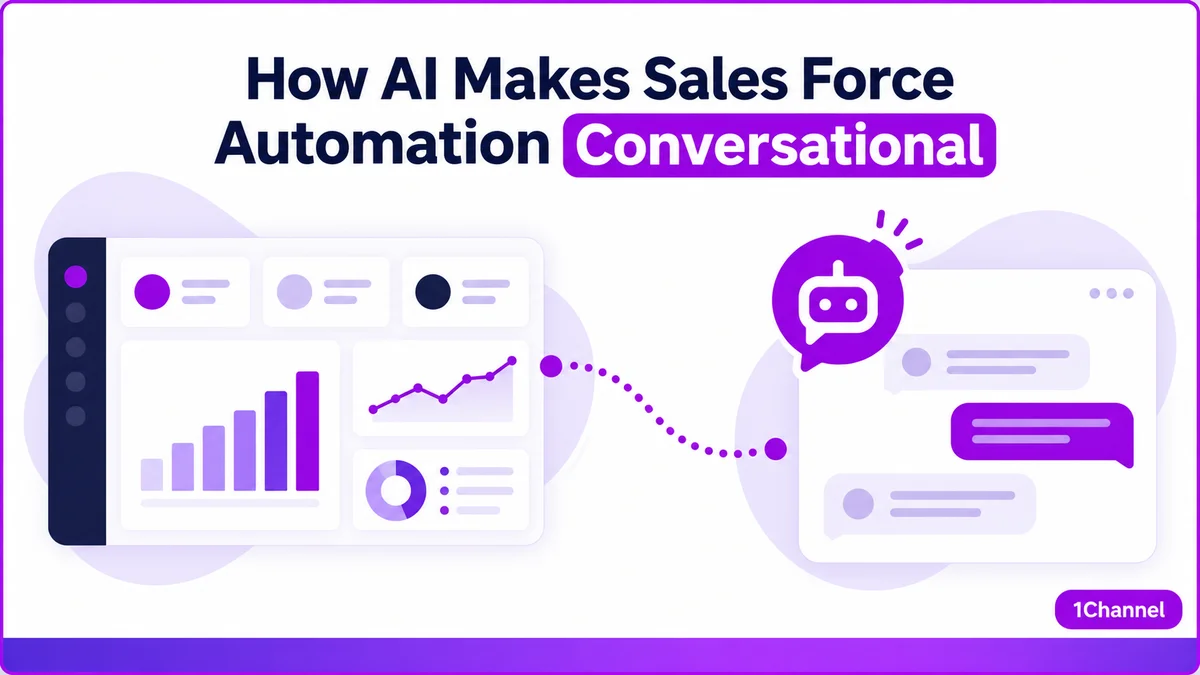
Conversational AI works by connecting natural-language questions with the operational information captured through an SFA platform.
How conversational SFA works
- Field Data Collection — Sales, attendance, store visits, stock and retail activities
- SFA Platform — Operational data is organized and available for reporting
- Conversational AI Assistant — User asks a question in everyday language
- Relevant Business Answer — Sales rankings, stock information, execution status or task guidance
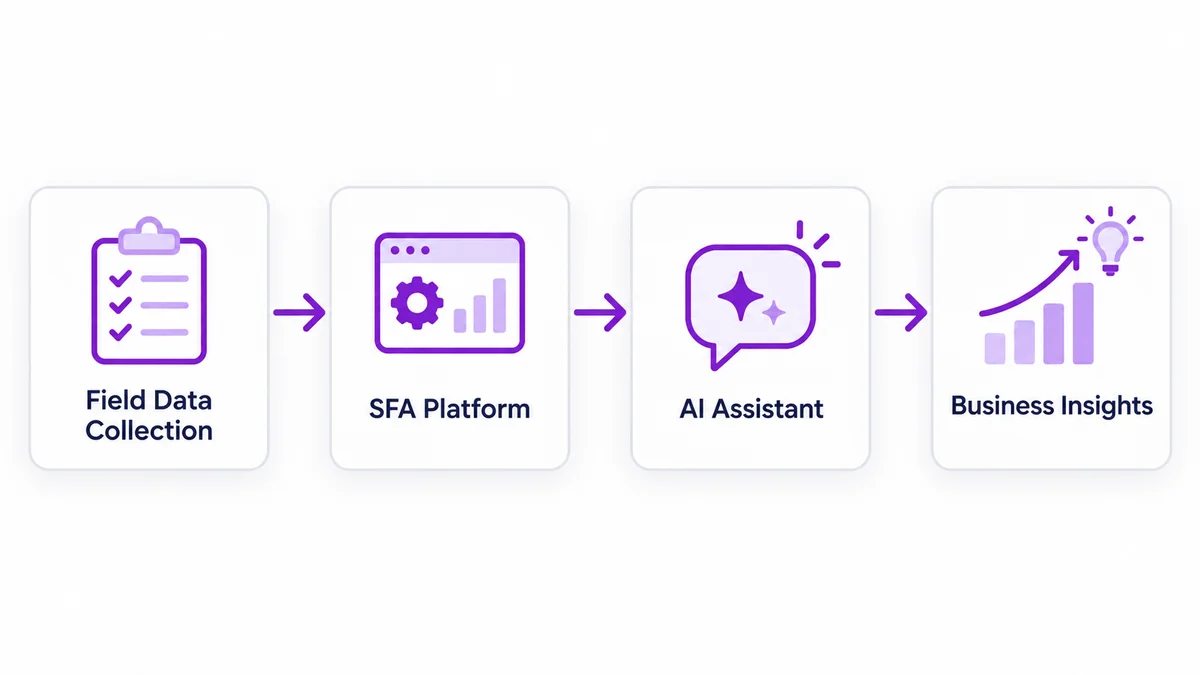
For example, an SFA system may already contain daily sales information, product-wise performance, employee records, and merchandising reports. Conversational AI provides a simpler way to access supported information through questions.
The major change is not necessarily how field data is collected, but how quickly users can obtain useful answers from it.
6 Ways Conversational AI Improves Sales Force Automation
1. Get Sales Performance Insights Without Opening Reports
Sales managers regularly compare sales across products, categories, employees, and reporting periods.
Traditionally, this involves report filters, spreadsheets, and manual comparisons.
With conversational AI, managers can request performance information directly.
Sales Manager: "What were our top five product categories by units sold in September?"
AI Assistant: Top product categories:
| Category | Units Sold |
|---|---|
| Multi Grooming | 164 units |
| Trimmer | 124 units |
| Dryer | 120 units |
| One Blade | 96 units |
| Straightener | 46 units |
Illustrative product-page example; not live business data.
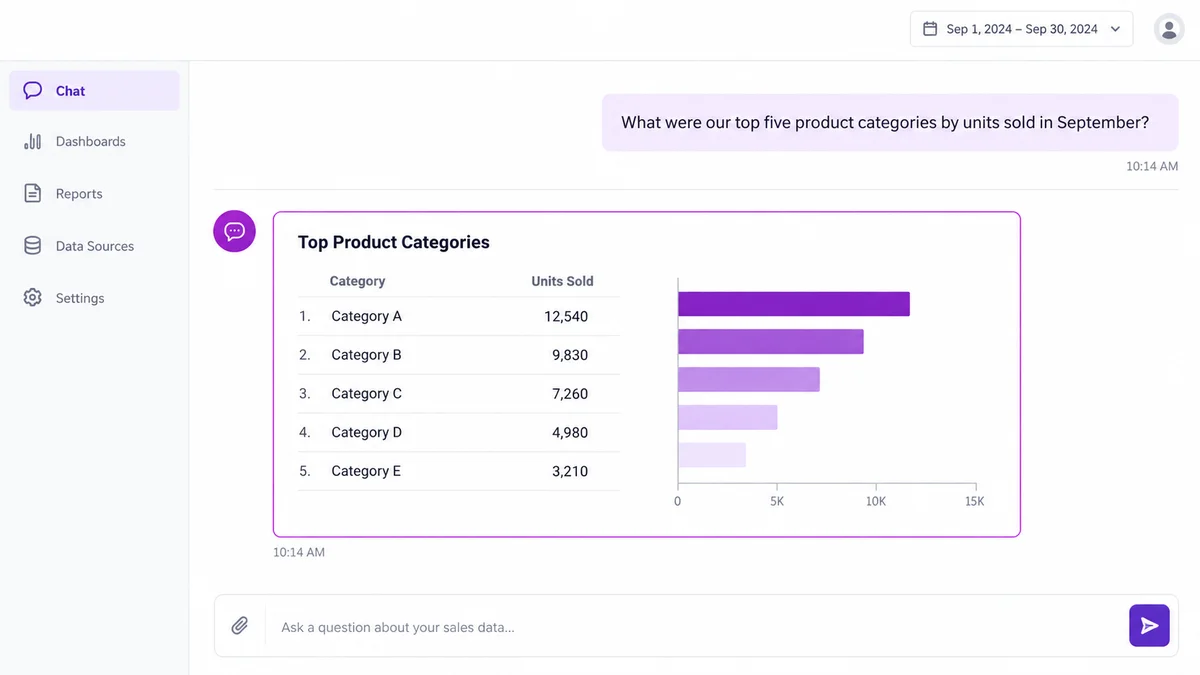
Business benefit: Managers can identify product performance trends without repeatedly preparing reports.
2. Track Sales Representative Performance Through Simple Questions
Monitoring individual sales performance helps managers recognize strong performers and identify where coaching may be required.
An AI Assistant can make this information easier to retrieve.
Manager: "Who was the top sales performer in September?"
AI Assistant: "Suraj Singh, with 67 units sold."
The manager can use this information to review individual performance and discuss sales opportunities with the team.
This is particularly useful for organizations managing representatives across multiple regions and outlets.
Business benefit: Faster performance reviews and more informed coaching conversations.
3. Access Stock and Outlet Information Instantly
Field representatives frequently need information about stock availability, outlet history, or promotional schemes.
Instead of navigating separate screens, they can request supported information through the AI Assistant.
Example questions:
- "What is the current stock level for this outlet?"
- "Show the previous sales activity for this store."
- "Which schemes are available for this outlet?"
For example, before visiting a retailer, a sales representative could check stock information to prepare for an order discussion.
The 1Channel AI Assistant supports stock-level, outlet-history, and scheme-detail lookups.
Business benefit: Better preparation for store visits and less time spent searching for operational information.
4. Identify POSM and Retail Execution Gaps
Sales Force Automation often works alongside retail execution activities such as promotional display tracking, merchandising visits, and Point-of-Sale Material (POSM) monitoring.
Conversational AI allows managers to check retail execution information through natural-language questions.
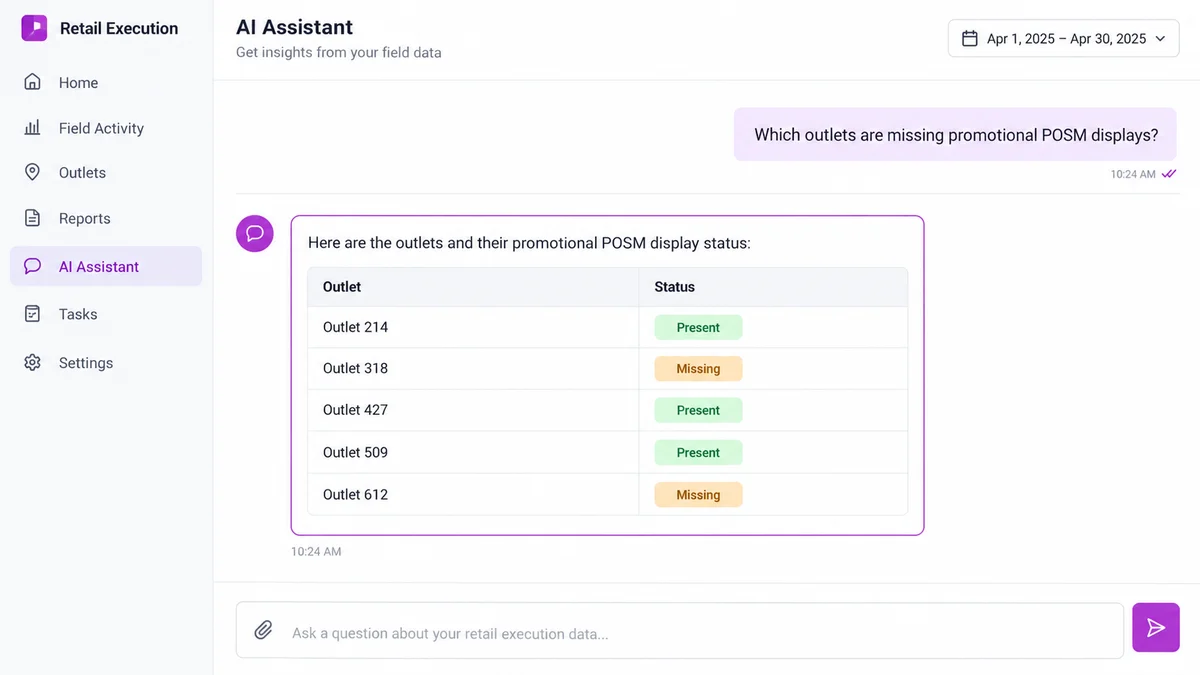
Manager: "Which Bangalore outlets have the MOD Consumer Offer POSM present or missing in September?"
AI Assistant:
| Outlet | POSM Status |
|---|---|
| Bangalore – J P Nagar | Present |
| Market City Bnglr | Not present |
Illustrative example from the 1Channel AI Assistant product walkthrough.
Rather than manually reviewing individual store records, managers can identify outlets requiring further attention.
Business benefit: Quicker identification of merchandising gaps and better prioritization of corrective activities.
5. Monitor Branding and Store Compliance
Retail brands need to ensure that promotional materials, in-store branding, and merchandising activities meet execution standards.
Conversational AI helps managers retrieve branding observations captured by field teams.
Manager: "Which Mumbai outlets reported branding placement issues in September?"
The assistant can return outlet-level observations, highlighting locations where branding is unavailable or where execution conditions are satisfactory.
Managers can then prioritize which locations require review or corrective action.
Business benefit: Improved visibility into retail execution without manually checking every outlet report.
6. Guide Field Representatives Through Daily Activities
Conversational AI is not limited to reporting. It can also help employees understand how to complete routine SFA tasks.
For example, a newly onboarded field representative may be unfamiliar with attendance or order-booking steps.
Instead of contacting a supervisor for basic instructions, the representative can ask:
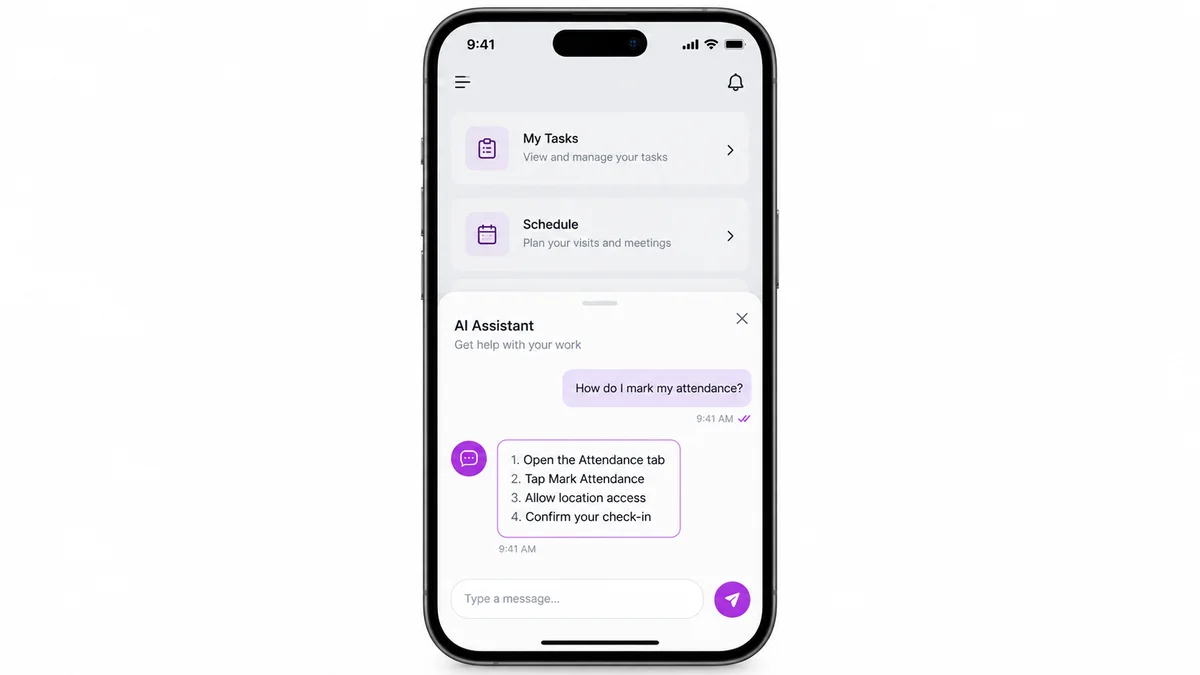
Field Representative: "How do I mark my attendance in the mobile app?"
The AI Assistant can guide the user through the appropriate workflow.
The same approach supports order booking and store-visit activities.
This is particularly valuable for businesses with large field teams, frequent employee onboarding, or multiple operational processes.
Business benefit: Easier onboarding, less dependence on supervisors for routine guidance, and more consistent use of the SFA application.
Traditional SFA vs. Conversational AI-Powered SFA
Traditional SFA and conversational AI are not competing technologies. Conversational AI adds a more accessible interface to existing sales automation capabilities.
| Business Activity | Traditional SFA | Conversational AI-Powered SFA |
|---|---|---|
| Sales performance | Open dashboard and apply filters | Ask for a sales ranking |
| Employee performance | Review individual reports | Ask for top performers |
| Stock information | Navigate inventory screens | Request stock details in chat |
| POSM monitoring | Review merchandising reports | Ask which outlets have missing POSM |
| Branding compliance | Check audit observations | Ask for outlet-level compliance information |
| Employee assistance | Follow manuals or contact supervisors | Receive guided instructions |
Traditional dashboards remain important for visual analysis, detailed reporting, administration, and data verification.
Conversational AI improves the experience by giving users another way to interact with the same operational information.
Key Business Benefits of Conversational AI in SFA
Conversational AI creates value by reducing the effort required to access sales and field execution information.
- Faster decision-making: Managers can check sales rankings, employee performance, and retail execution gaps when they need them instead of waiting for separate reports.
- Reduced manual reporting: Natural-language questions reduce repetitive filtering, spreadsheet analysis, and report requests for straightforward information.
- Improved field productivity: Sales representatives can access stock details, outlet information, and task guidance through the same application used for their daily work.
- Better retail execution visibility: Managers can identify stores with missing promotional materials or branding issues and prioritize corrective actions.
- Simpler employee onboarding: AI-guided workflows help new representatives understand routine activities without repeatedly asking supervisors for assistance.
These are potential operational benefits; actual time savings and productivity improvements depend on data quality, system configuration, and user adoption.
How 1Channel Makes Sales Force Automation Conversational
1Channel combines its Sales Force Automation platform with an AI Assistant designed for sales and retail execution operations.
The 1Channel AI Assistant is available within the mobile field application and admin web portal, allowing field representatives and managers to interact with relevant business information through natural-language questions.
Its capabilities include:
- Conversational sales insights: Retrieve product-category rankings and employee sales performance.
- Operational data lookups: Access supported stock, outlet-history, and scheme information.
- Retail execution intelligence: Check POSM presence and branding placement issues across outlets.
- Guided workflows: Receive step-by-step assistance for attendance, order booking, and store-visit activities.
- Mobile and web access: Use the assistant within existing SFA workflows instead of relying on a separate tool.
For example, a regional manager could begin by checking the best-performing sales representative, then investigate product-category performance or ask about merchandising execution in a particular city.
This brings sales intelligence and retail execution information into a more accessible conversational experience.
Why Choose 1Channel for Conversational Sales Force Automation?
1Channel brings together field sales management, employee attendance, beat planning, sales reporting, store management, and retail execution capabilities within its SFA platform. By integrating conversational AI, 1Channel helps businesses move beyond traditional reporting workflows and access supported operational insights through simple questions. This enables sales managers and field representatives to spend less time searching for information and more time acting on it.
Explore 1Channel Sales Force Automation and the 1Channel AI solutions to understand how these capabilities work together.
Frequently Asked Questions
1. What is conversational AI in Sales Force Automation?
Conversational AI in SFA allows sales representatives and managers to ask questions in natural language to retrieve information about sales performance, stock, retail execution, and other supported business activities.
2. How does an AI Assistant improve sales reporting?
An AI Assistant reduces the need to manually navigate reports for common questions. Managers can ask for product rankings, sales performance, or other available insights and receive relevant answers directly.
3. Can conversational AI help field sales representatives?
Yes. It can help representatives retrieve operational information and follow guided workflows for tasks such as attendance, order booking, and store visits.
4. Can AI-powered SFA help with retail merchandising?
Yes. Where the relevant data is available, conversational AI can identify outlets with missing POSM, branding placement concerns, or other retail execution issues captured by the system.
5. Does conversational AI replace traditional SFA dashboards?
No. Conversational AI complements dashboards by simplifying access to information. Dashboards and detailed reports remain useful for visual analysis, administration, and in-depth reviews.
Conclusion
Conversational AI is changing how businesses interact with Sales Force Automation software.
Instead of depending entirely on dashboards, filters, and manually generated reports, sales teams can ask questions, retrieve information, and receive guidance within their existing workflows.
From identifying top-performing employees to checking stock levels and retail execution gaps, conversational AI makes SFA information more accessible and useful for everyday decisions.
With 1Channel's AI Assistant, businesses can bring conversational capabilities into field sales and retail operations without replacing their core SFA workflows.
Explore the 1Channel AI Assistant to see how conversational intelligence can support your sales teams.
Note: Software screens may vary based on your business structure and configured workflows.