In FMCG retail, getting products into stores is only half the challenge. Brands must also ensure their products are visible, properly positioned, and competing effectively for shelf space.
When competing brands occupy more shelf space or receive better placement, it can weaken product visibility at the point of purchase.
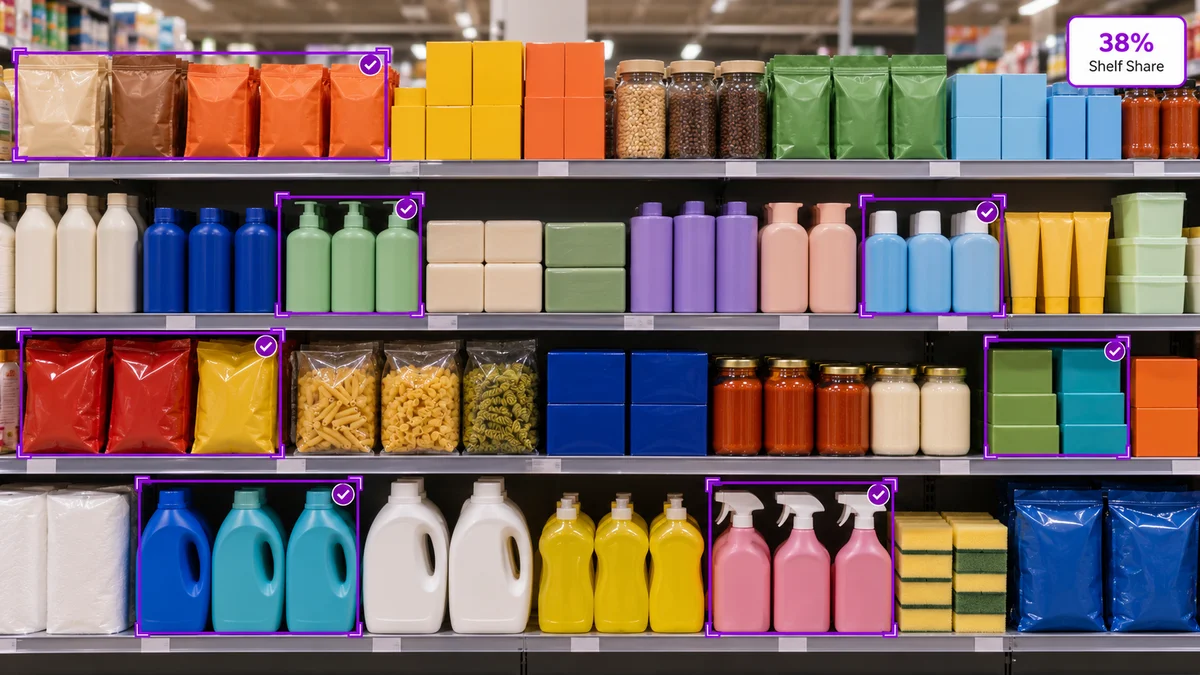
Traditional shelf audits rely on field representatives manually counting products, recording observations, and submitting reports. AI-powered share of shelf tracking changes this process by using computer vision to analyze shelf photographs, identify competing products, and measure brand visibility.
For FMCG companies managing hundreds or thousands of outlets, this makes competitor shelf monitoring more consistent, measurable, and actionable.
What Is Share of Shelf in FMCG Retail?
Share of shelf (SoS) measures the proportion of shelf visibility occupied by a brand compared with other brands in the same product category.
It helps FMCG companies understand whether their products receive adequate visibility relative to competing products.
A common method calculates share of shelf using product facings:
Share of Shelf (%) = (Brand Facings ÷ Total Category Facings) × 100
For example, suppose a retail shelf contains:
- Brand A: 30 facings
- Brand B: 25 facings
- Brand C: 20 facings
- Brand D: 25 facings
With 100 total facings, Brand A holds a 30% share of shelf.
Tracking this metric across outlets helps brands identify competitive gaps, monitor merchandising performance, and understand changes in shelf visibility.
Importantly, share of shelf measures physical display presence, not sales-based market share.
Why Traditional Shelf Share Tracking Falls Short
Manual shelf monitoring becomes difficult when FMCG brands operate across multiple territories, store formats, and product categories.
Common challenges include:
- Manual counting errors: Field representatives may miss facings or record inconsistent numbers.
- Delayed reporting: Shelf observations often require manual consolidation before managers can review them.
- Limited competitor visibility: Reports may focus on the company's products without measuring competing brands.
- Inconsistent audits: Different field executives may evaluate shelf placement differently.
- Difficult trend tracking: Comparing photographs and spreadsheets across multiple visits takes additional effort.
These challenges make it harder for retail managers to identify where competitors are gaining shelf visibility.
How AI Tracks Shelf Share Against Competitors
AI-powered shelf monitoring uses image recognition and computer vision to turn retail shelf photographs into measurable data.
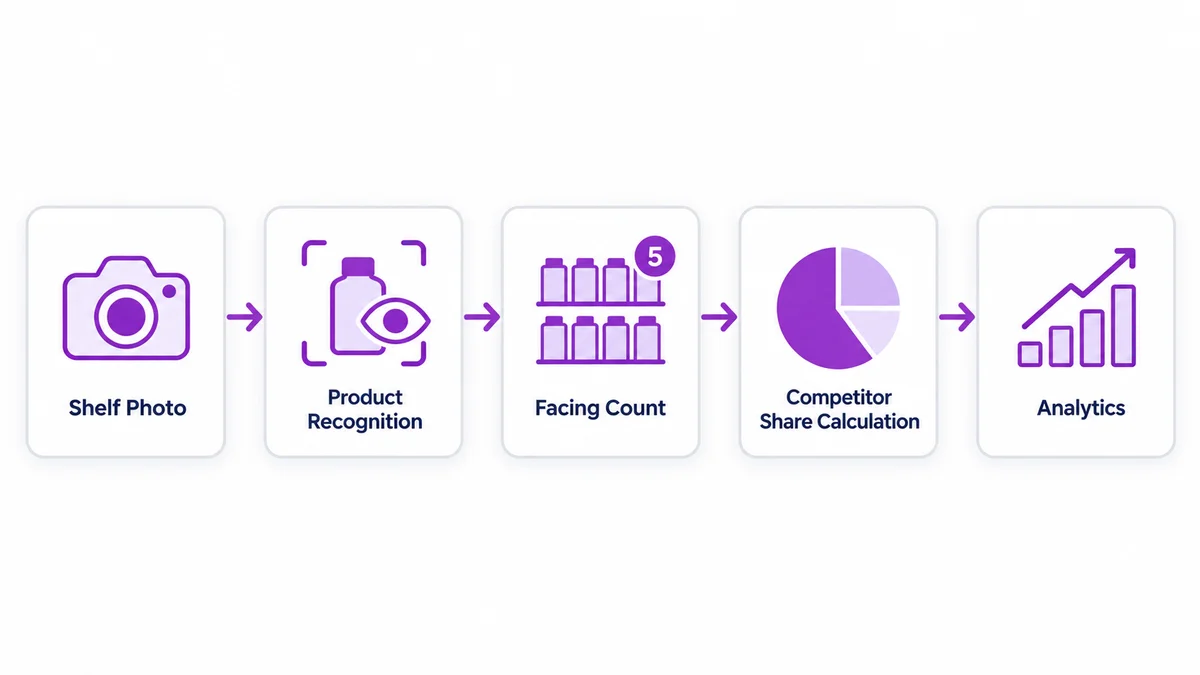
The process typically follows five steps.
1. Capture Shelf Images During Store Visits
Field representatives capture photographs of store shelves using a mobile application.
Multiple images can cover different shelf sections and viewing angles, helping the system analyze the complete display rather than relying on a single photograph.
2. Identify Brand and Competitor Products
Computer vision analyzes the images to identify visible products and their associated brands.
This allows the system to recognize both the company's products and competing SKUs displayed in the same category.
3. Count Product Facings Automatically
The system counts visible product facings and groups them by brand.
This reduces the need for representatives to manually enter product quantities or facing counts.
4. Calculate Competitor Shelf Share
AI compares the brand's facing count with the total facings identified within the measured category.
The resulting percentage shows how much visible shelf presence each brand holds.
For example, a brand holding 35% of the identified facings can be compared with competitors holding the remaining 65%.
5. Track Results Across Store Visits
Shelf-share measurements are recorded against the outlet and visit.
Managers can compare current and previous results to identify changes in visibility and determine where additional merchandising attention may be required.
Manual vs. AI-Powered Shelf Share Tracking
| Parameter | Manual Shelf Audits | AI-Powered Shelf Tracking |
|---|---|---|
| Data collection | Manual product counting | Shelf photographs |
| Facing measurement | Counted by field staff | AI-based recognition |
| Competitor analysis | Separate manual observations | Competitor products identified from images |
| Accuracy consistency | Depends on individual auditors | Standardized recognition and validation |
| Reporting | Requires manual consolidation | Automated shelf metrics |
| Historical comparison | Manual report comparison | Store-wise tracking across visits |
| Scalability | More audit effort as outlets increase | Repeatable digital audit workflow |
AI does not eliminate the need for good photographs or data validation, but it can substantially reduce repetitive measurement and reporting work.
Key Shelf Share Metrics FMCG Brands Should Monitor
Tracking shelf share alone does not provide a complete picture of retail execution. FMCG brands should evaluate several related indicators.
- Brand Share of Shelf: The percentage of category facings occupied by the brand.
- Competitor Facings: The visible facing counts of competing brands.
- SKU Visibility: Whether important products are present and visible on the shelf.
- Minimum Stock List (MSL) Adherence: Whether the required assortment of SKUs is present.
- Facing Compliance: Whether products meet the defined minimum display-facing norms.
- Shelf Placement: Whether products occupy the intended display positions.
- Shelf Share Trends: How a brand's visibility changes across repeat store visits.
Monitoring these metrics together helps managers distinguish between competitor gains, missing products, and merchandising execution gaps.
How 1Channel Helps FMCG Brands Track Competitor Shelf Share
1Channel Share of Shelf AI combines computer vision with retail execution workflows to measure brand visibility directly from store photographs.
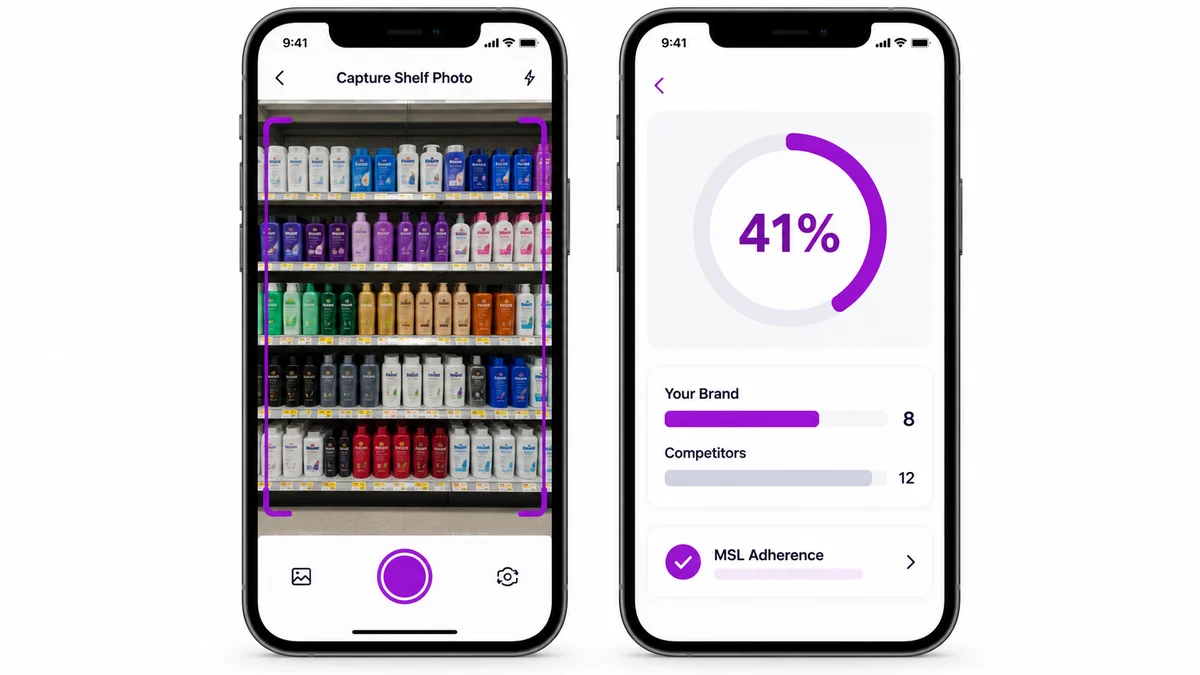
Instead of relying on manual facing counts, field representatives capture shelf images during regular outlet visits, and the software generates shelf-share measurements.
AI-Powered Competitor Shelf Analysis
1Channel identifies own-brand and competitor SKUs from shelf images to calculate their respective facing counts.
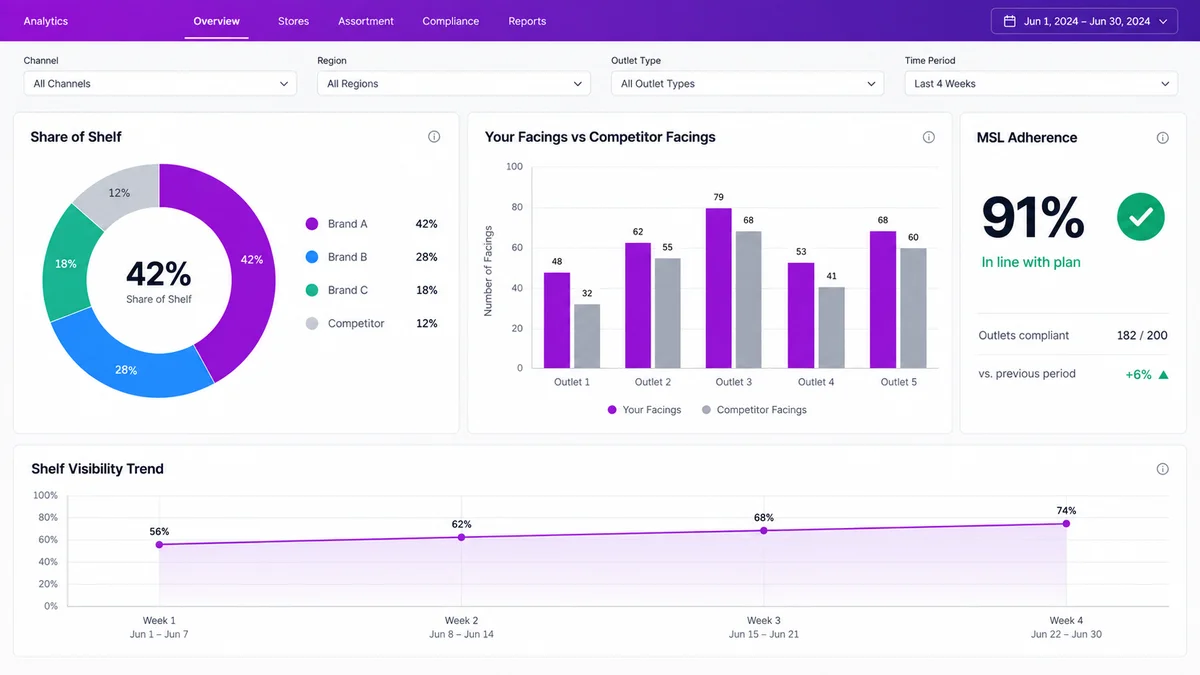
The resulting scorecard shows:
- Brand-wise product facings
- Overall share of shelf percentage
- Competitor shelf visibility
- MSL adherence
- Outlet-level historical results
This helps managers understand the competitive shelf situation without manually consolidating observations from multiple stores.
Image Recognition and Shelf Compliance
1Channel Image Recognition supports guided photo capture, product-facing checks, and comparison against defined shelf-display norms.
The system can detect missing facings, assess promotional display compliance, and request another photograph when image quality is insufficient.
This creates a more consistent process for shelf and merchandising audits.
Store-Level Tracking and Retail Analytics
1Channel records shelf-share results against individual outlet visits, allowing teams to review historical measurements.
Its retail execution capabilities also support visual merchandising audits, outlet-specific norms, campaign tracking, and compliance reporting.
Together, these records help brands evaluate where shelf execution meets expectations and where improvements are required.
Connected AI for Field Execution
Other capabilities within the 1Channel AI platform support related sales and retail operations:
- AI Assistant: Provides natural-language access to sales information, outlet data, POSM presence, and retail execution checks.
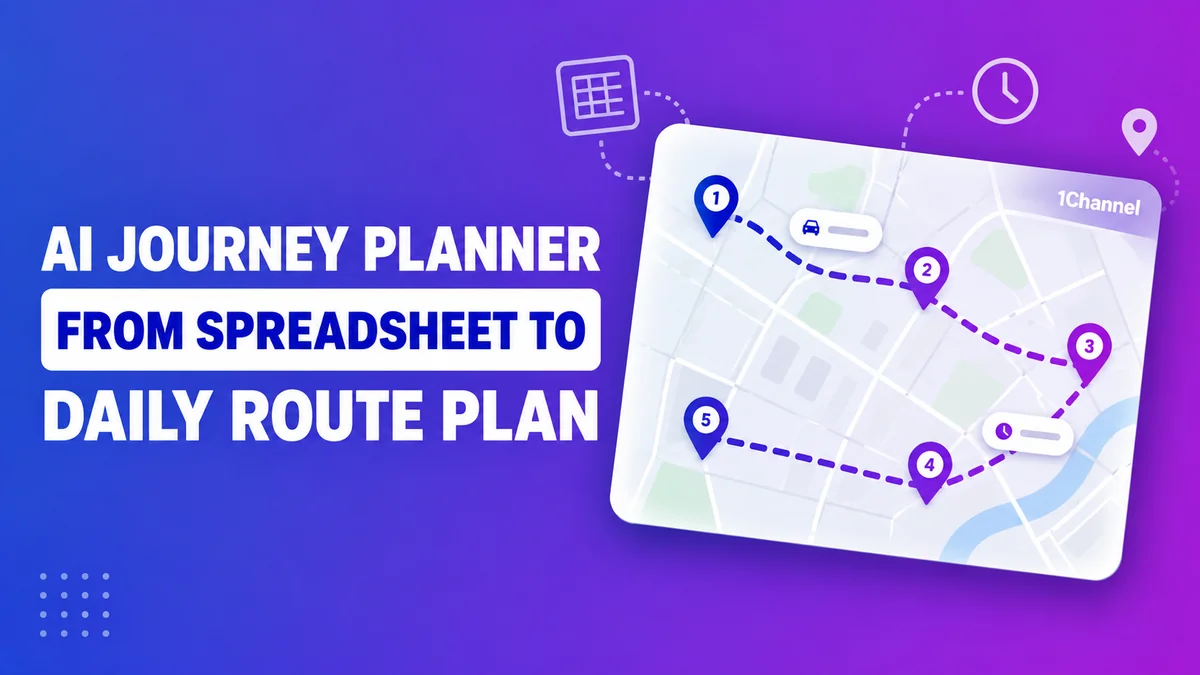
- AI Journey Planner: Plans feasible field visit routes using outlet locations, travel time, and working-hour constraints.
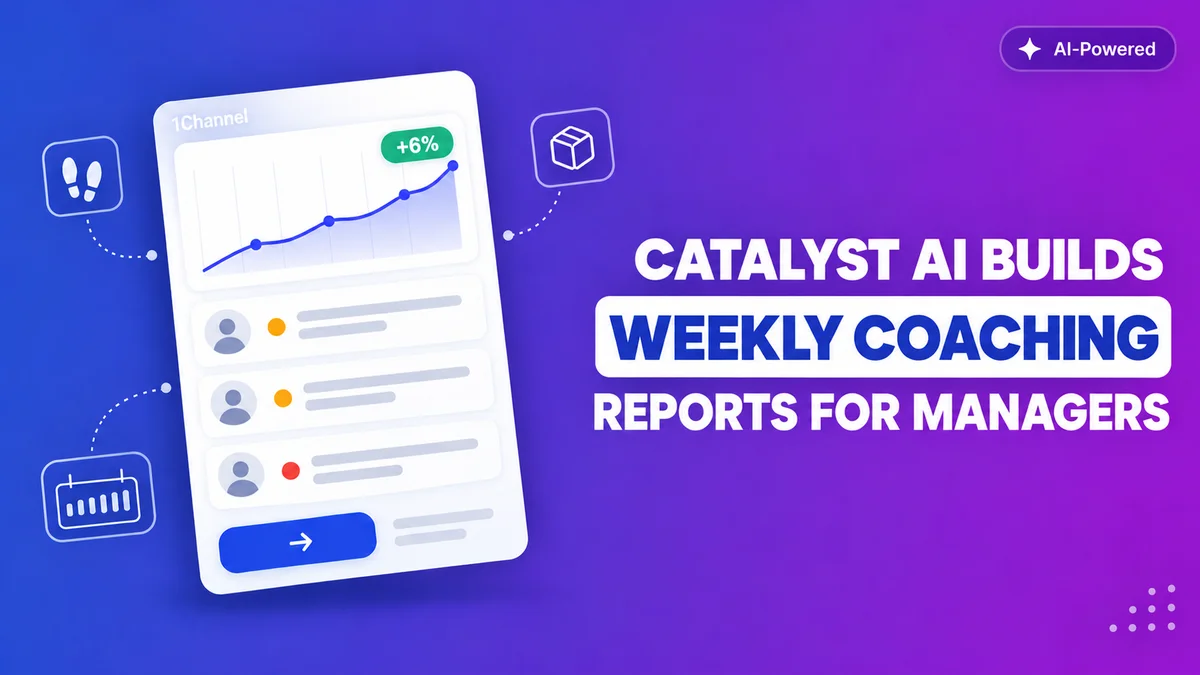
- Catalyst: Analyzes sales, visit, and stock performance to identify risks and recommend follow-up actions.
These capabilities support the wider retail execution process alongside shelf-share measurement.
Benefits of AI-Based Competitor Shelf Monitoring
AI-powered shelf analytics can help FMCG brands improve retail execution in several ways.
- Faster shelf audits: Automated facing counts reduce manual recording efforts.
- Better competitor visibility: Teams can measure competing brands within the same shelf category.
- Consistent execution checks: Standardized image analysis reduces differences between individual assessments.
- Earlier visibility-gap detection: Managers can identify missing facings and declining shelf presence from repeat audits.
- Improved merchandising decisions: Outlet-level insights help teams prioritize shelf corrections and merchandising follow-ups.
- Scalable retail monitoring: A common digital process supports consistent measurement across large outlet networks.
The outcome is a more reliable view of in-store brand visibility and the competitive environment.
Why Choose 1Channel for AI-Powered Shelf Monitoring?
1Channel connects AI-powered Share of Shelf tracking, Image Recognition, and Retail Execution Management within a unified platform. FMCG brands can measure competitor visibility, verify product facings, monitor shelf compliance, and review outlet-level results without relying entirely on manual counting. By connecting shelf intelligence with field visits and merchandising analytics, 1Channel helps teams make more informed retail execution decisions.
Frequently Asked Questions
1. How does AI calculate share of shelf in FMCG stores?
AI uses computer vision to identify visible products in shelf photographs, count facings for each brand, and calculate the brand's share against total category facings.
2. Can AI track competitor products on retail shelves?
Yes. AI-based shelf recognition can identify supported competitor SKUs alongside a brand's own products, enabling brand-wise facing counts and competitive shelf-share comparisons.
3. What is the difference between share of shelf and market share?
Share of shelf measures a brand's physical visibility on retail shelves, while market share measures its portion of sales within a defined market. A higher share of shelf does not automatically mean higher market share.
4. Can AI detect missing products and shelf compliance issues?
Yes. AI image recognition can compare visible products against defined display or assortment requirements and identify missing facings, absent SKUs, and other supported shelf-compliance gaps.
5. How does 1Channel help FMCG brands monitor shelf share?
1Channel uses AI-powered image recognition to count brand and competitor facings, calculate shelf-share percentages, monitor MSL adherence, and maintain outlet-level records for comparison across visits.
Conclusion
Tracking competitor shelf share is essential for FMCG brands that want to maintain strong in-store visibility.
AI-powered shelf monitoring replaces much of the repetitive manual counting process with image-based measurement, helping brands understand their shelf position, identify visibility gaps, and monitor changes over time.
With 1Channel Share of Shelf AI, FMCG businesses can connect competitor shelf analysis with their broader retail execution activities.
Explore 1Channel AI-powered shelf monitoring to improve visibility and strengthen retail execution across your outlets.
Note: Software screens may vary based on your business structure and configured workflows.