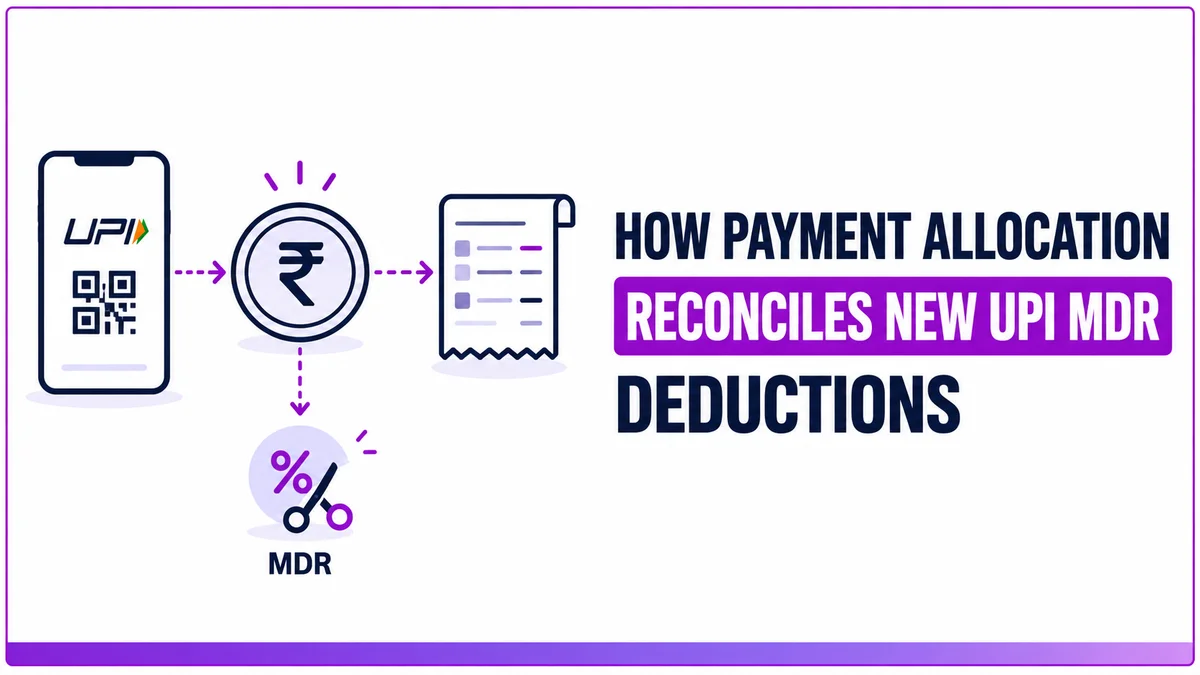
From October 15, 2026, UPI payments above ₹2,000 to a merchant carry a new 0.4% Merchant Discount Rate, capped at ₹300 for payments of ₹75,000 and above, confirmed by the Department of Financial Services' official FAQ. Customers pay nothing extra. Merchants, the party receiving the money, absorb the deduction and cannot pass it on as a surcharge.
For a distributor, that changes what actually lands in the bank account every time a retailer pays over UPI. A ₹50,000 collection nets ₹49,800, not ₹50,000, and the official guidance is direct about what happens next: merchants must update reconciliation processes to account for the deduction. 1Channel's DMS logs every payment against a customer's outstanding orders, exactly where that reconciliation happens.
What Changes on October 15
- 0.4% MDR on UPI person-to-merchant payments above ₹2,000
- Capped at ₹300 for payments of ₹75,000 and above
- Merchants under ₹1 lakh a month in UPI QR receipts are exempt
- The customer's side of the payment is unaffected; only the receiving merchant absorbs the deduction
- Merchants cannot recover the fee by adding a surcharge
Where the Gap Shows Up in a Distributor's Ledger
Take a retailer paying a distributor ₹50,000 against an order on 16 October. The bank credits ₹49,800. If the payment gets logged as ₹50,000 received against the order, the order looks fully settled, but the distributor's own account is short by ₹200 that nobody actually still owes anyone.
1Channel's Record Payment screen logs a payment's customer, amount, mode, and reference number, and can auto-allocate that amount across a customer's outstanding orders, or let the amount be allocated manually. Recording the ₹49,800 that actually arrived, not the ₹50,000 invoiced, keeps the allocation accurate against what the order still owes.
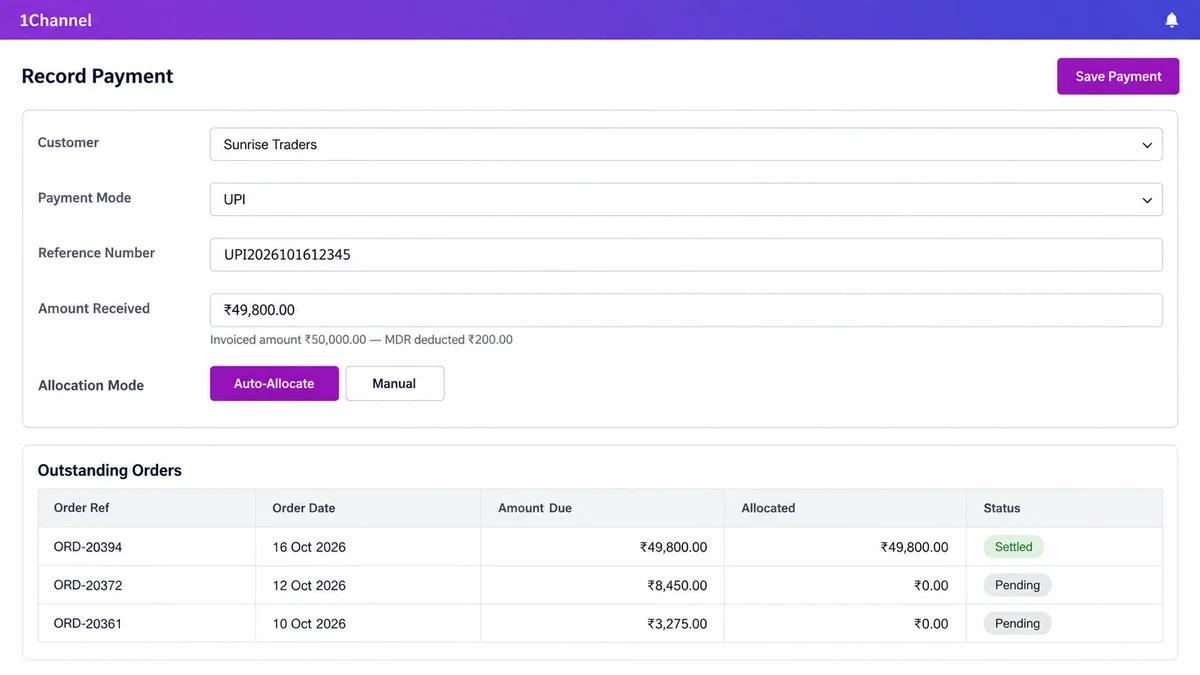
Why a Single Deduction Adds Up Across a Ledger
A distributor's Credit Management dashboard tracks Total Credit Limit, Utilized Credit, Total Overdue, and DSO (Days Sales Outstanding) per customer. If UPI collections consistently settle a few hundred rupees short and the gap isn't recorded against the right order, a customer's Outstanding balance never quite clears to zero, even though every payment they made was, from their side, in full.
Over a full month of UPI collections across many retailers, that "few hundred rupees" per transaction stops being trivial.
Key Takeaways
- 0.4% MDR applies to UPI collections above ₹2,000 from 15 October 2026, capped at ₹300
- The deduction is invisible to the payer and absorbed entirely by the receiving distributor or retailer
- A payment logged at the invoiced amount instead of the settled amount leaves a permanent, small gap in the ledger
- Recording the actual amount received, and allocating it against the right order, keeps Outstanding balances accurate
- The gap is small per transaction but compounds across a month of UPI collections
How 1Channel DMS Handles Payment Allocation
1Channel's DMS logs every payment against a customer, order, and outstanding balance, and lets that amount be auto-allocated across pending orders or allocated manually, so a distributor's ledger reflects what was actually collected, not just what was invoiced.
Explore 1Channel DMS →Note: Software screens may vary based on your business structure and configured workflows.