In distribution businesses, managing product information accurately is important for smooth operations, better inventory control, and efficient order processing. As businesses handle multiple brands, categories, products, variants, and SKUs, maintaining a structured product master becomes necessary.
Product Master Management helps businesses organize product-related information in a centralized system. It allows teams to manage product hierarchy, SKU details, categories, brands, units of measurement, pricing information, and product-related configurations from one place.
A well-managed product master ensures that every department works with accurate product data, from inventory teams and sales representatives to distributors and reporting teams.
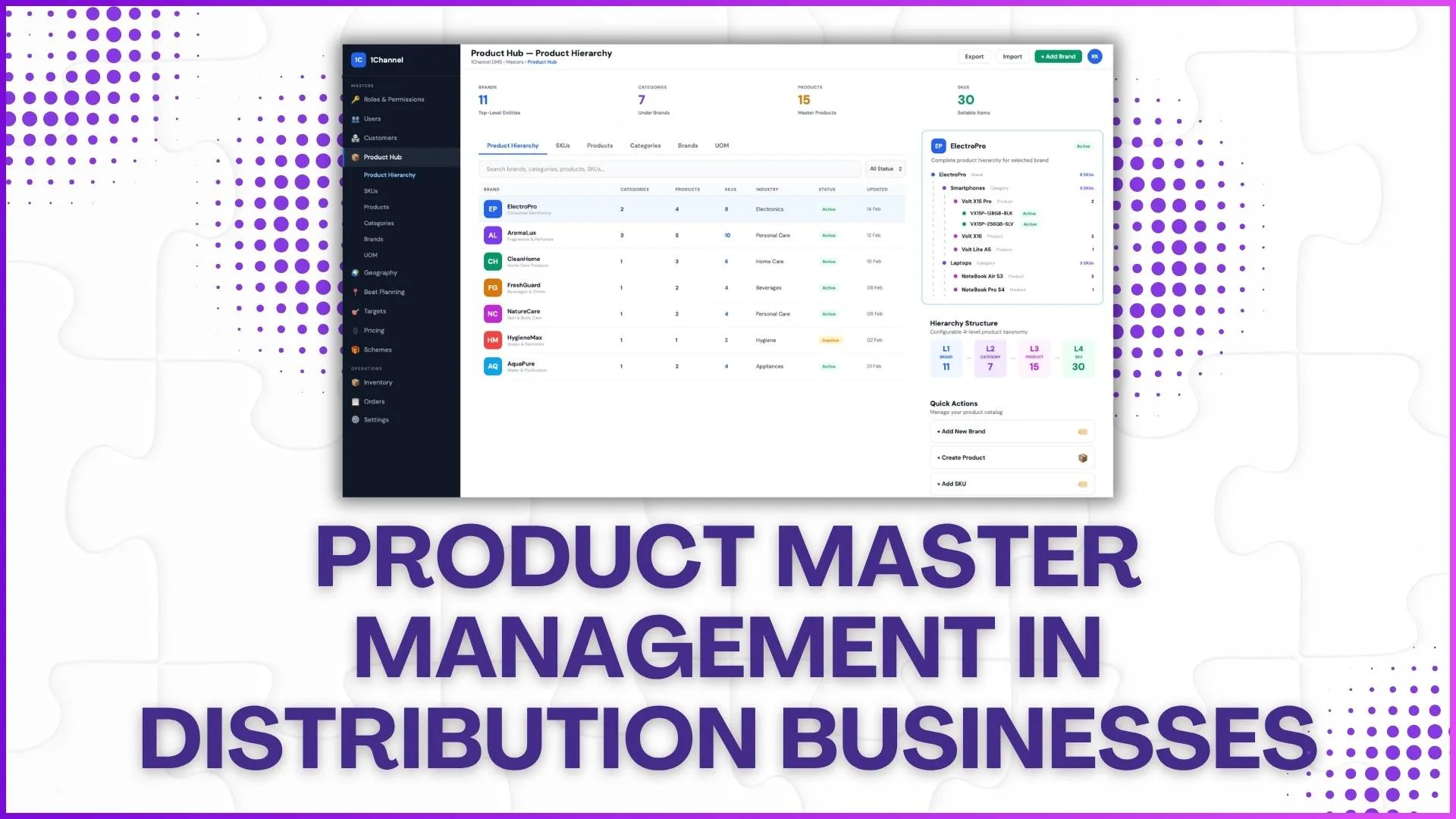
What is Product Master Management?
Product Master Management is the process of creating, organizing, and maintaining complete product information within a distribution system.
It includes managing:
- Brands
- Categories
- Products
- SKUs
- Product variants
- Units of measurement
- Pricing details
- Product tracking information
Instead of maintaining separate product records across different teams, businesses can manage all product-related data through a single structured system.
For example, a business selling multiple product lines can organize data as:
Brand → Category → Product → SKU
This structure helps users quickly identify products, manage inventory, process orders, and generate accurate reports.
Why Product Master Management Matters in Distribution Businesses
Distribution operations depend heavily on accurate product data. Incorrect product information can impact inventory movement, order processing, pricing, and reporting.
A proper product master helps businesses:
Maintain Product Data Accuracy
All product details can be stored in a structured format, reducing duplicate entries and inconsistencies.
For example, product codes, SKU details, pricing information, and product status can be maintained together so teams always access updated information.
Improve Inventory Visibility
Product master data connects directly with inventory operations.
When products and SKUs are properly configured, businesses can track:
- Available stock
- Stock movement
- Warehouse-wise inventory
- Batch and expiry details
This helps teams understand product availability before processing orders.
Simplify Order Processing
During order creation, the system can use product information such as SKU details, pricing, and applicable configurations.
For example, when a distributor creates an order, the system can identify available products, apply configured pricing, and check related inventory information.
Key Components of Product Master Management
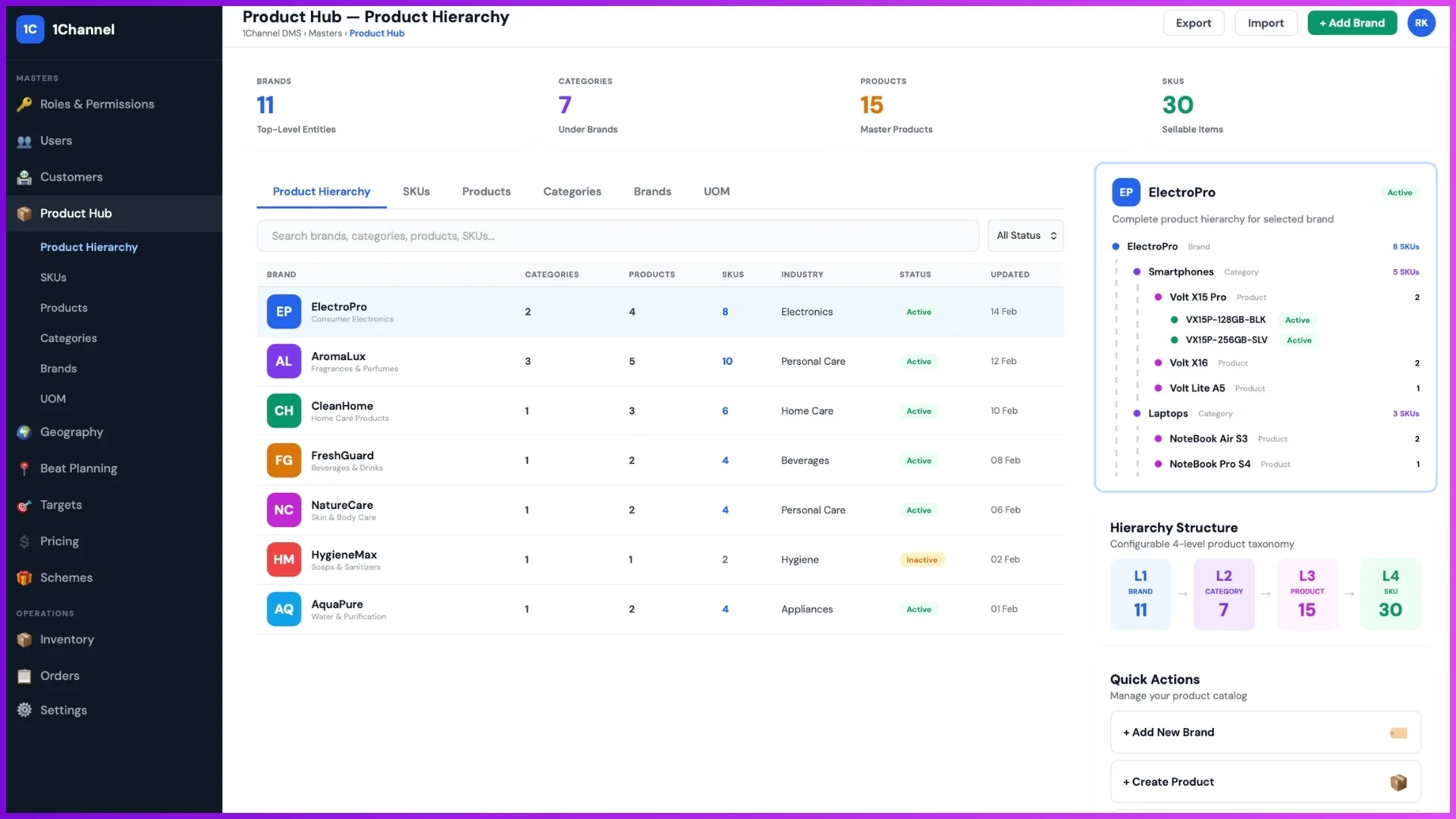
1. Product Hierarchy Management
A product hierarchy creates a structured relationship between different levels of product information.
A common hierarchy includes:
Brand → Category → Product → SKU
For example:
- Brand: A product brand
- Category: Product group under the brand
- Product: Specific product type
- SKU: Sellable item with specific size, variant, or code
This hierarchy can be configured according to business requirements because every organization follows different product structures.
For example, one business may organize products by:
- Brand → Category → Product → SKU
Another business may use different product grouping based on its operations.
2. SKU Management
SKUs represent individual sellable items in a product catalog.
A SKU contains important information such as:
- SKU Name
- SKU Code
- Product mapping
- Pricing details
- Unit of measurement
- Barcode
- Tracking settings
- Status
Businesses can manage SKU details individually or through bulk import options.
For example, a single product can have multiple SKUs based on:
- Different sizes
- Different variants
- Different packaging options
This makes product management easier for businesses handling large product catalogs.
3. Brand and Category Management
Brands and categories help organize products in a meaningful structure.
Brand management allows businesses to maintain:
- Brand name
- Brand code
- Product association
- Status
Category management helps businesses organize products into groups.
For example:
A product catalog can include multiple categories under different brands, allowing users to filter and manage products efficiently.
4. Unit of Measurement Management
Different distribution businesses handle products in different measurement formats.
Product Master Management allows businesses to configure units such as:
- Pieces
- Packs
- Boxes
- Cartons
- Liters
- Weight-based units
A conversion system helps maintain accurate quantity calculations.
For example:
If one box contains multiple pieces, the conversion factor can be configured so the system can calculate quantities correctly during orders and inventory movement.
This improves accuracy in stock calculations and order processing.
5. Product Tracking Configuration
Different products may require different tracking methods.
Product configuration can include tracking options such as:
- Batch tracking
- Expiry tracking
- Serial number tracking
For example, businesses handling products with expiry dates can configure tracking at the SKU level to maintain better inventory control.
How Product Master Management Supports Distribution Operations
Better Inventory Management
Product information directly impacts inventory accuracy.
When SKUs, categories, and product structures are properly configured, teams can easily view:
- Current stock levels
- Stock movement history
- Warehouse-wise availability
- Product-wise inventory details
This helps businesses maintain better stock visibility.
Accurate Pricing Management
Product master data works together with pricing configurations.
Businesses can manage different pricing scenarios such as:
- Customer-specific pricing
- Customer type-based pricing
- Geography-based pricing
For example, the same product can have different prices for different customer groups or locations based on configured rules.
Improved Reporting and Analytics
Accurate product data improves business reporting.
Reports can provide insights related to:
- Product performance
- Sales contribution
- Inventory status
- Stock movement
Teams can filter reports based on product-related information such as category, brand, SKU, and warehouse.
Challenges Without Proper Product Master Management
Without structured product management, businesses may face issues such as:
- Duplicate product records
- Incorrect SKU information
- Difficulty tracking inventory
- Pricing mistakes
- Delayed reporting
- Confusion between teams
A centralized product master reduces these challenges by maintaining consistent product information.
Explore 1Channel Distributor Order Management
Explore Distributor Order Management →Role of Automation in Product Master Management
Automation helps businesses reduce manual work and improve accuracy.
With automated product management, users can:
- Import product data
- Manage product records
- Configure product structures
- Update information faster
- Access reports easily
Workflow-based automation can also support approvals and controlled changes when required.
How Product Master Management Helps Different Teams
Sales Teams
Sales teams can access accurate product information while creating orders and managing customer requirements.
Inventory Teams
Inventory teams can track products, SKUs, and stock movement more effectively.
Distribution Teams
Distributors can process orders with correct product details, pricing, and availability information.
Management Teams
Managers can use reports and analytics to understand product performance.
Using a Distribution Management Platform for Product Master Management
A distribution management platform helps businesses manage product information, customer operations, inventory, orders, analytics, and reporting from a connected system.
With centralized product management capabilities, businesses can organize product hierarchy, manage SKUs, configure units, maintain pricing structures, and connect product data with daily distribution activities.
How 1Channel Helps Businesses Manage Product Information
1Channel Product and SKU Management Software provides businesses with tools to organize and manage product-related information through a structured distribution management system.
It helps users manage product hierarchy, SKUs, categories, brands, and units of measurement while connecting product data with inventory, orders, and reporting workflows.
By maintaining product information in one place, businesses can improve operational visibility and make product-related processes more efficient.
Explore 1Channel SKU Management
Explore SKU Management →Conclusion
Product Master Management plays an important role in improving distribution operations. From managing product hierarchy and SKUs to supporting inventory, pricing, and reporting activities, a structured product master helps businesses maintain accurate and reliable product information.
As distribution businesses continue to manage larger product catalogs, having a centralized approach to product management helps teams improve efficiency, reduce errors, and support better decision-making.