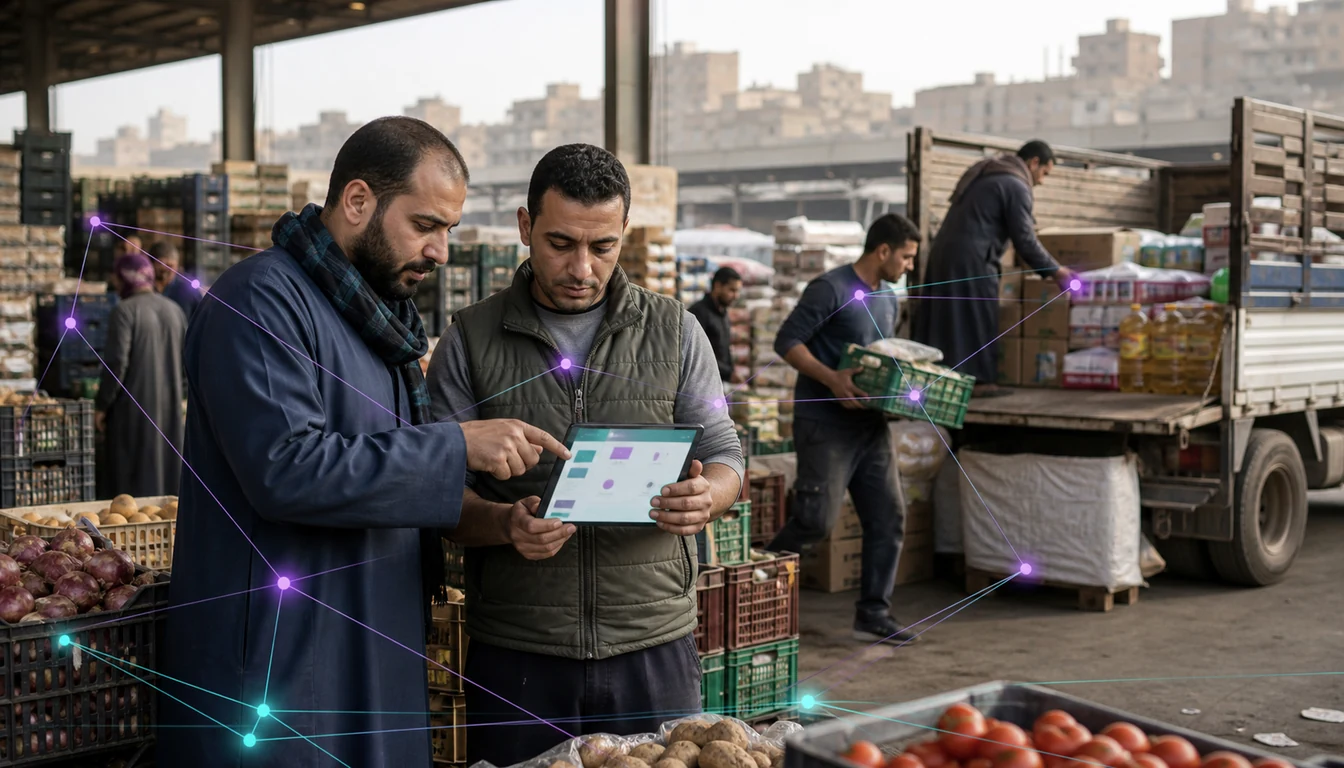
Stock-outs and leakage look like opposite problems. A stock-out is the baqala that calls in to reorder a fast-moving line and finds none available, so the sale goes to whichever competitor still has stock on the shelf. Leakage is the opposite motion, stock that quietly disappears, spoils or gets damaged before it is ever billed to anyone. Yet both trace back to the same weakness inside an Egyptian distribution warehouse, a gap between what the stock record says is there and what is actually there.
Most grocery volume in Egypt still moves through baqalas, pharmacies and small independent outlets rather than large organised chains, so the link that keeps this network stocked often runs on paper dockets, phone calls and manual counts rather than a live system. That gap between warehouse and shelf is where both failures take root, and closing it has less to do with new hardware than with trusting one number for what is genuinely sellable at any given moment.
This piece looks at why the visibility gap between warehouse and baqala shelf produces both stock-outs and leakage, how real-time stock tracking compares with periodic manual counts, what it takes to reconcile what left the warehouse against what was delivered and sold, and why leakage priced in EGP is a larger and quieter cost than most distributors assume.

The Visibility Gap Between Warehouse and Baqala Shelf
A stock-out rarely starts as a supply failure. The goods usually exist somewhere in the network, but the warehouse did not register that the sellable figure had fallen until the baqala owner rang to ask why the usual case had not turned up. The same blind spot that hides a falling stock level also hides a leaking one, because neither shows itself until somebody physically checks.
Several patterns repeat across Egyptian FMCG and pharma distribution warehouses, whether the network is anchored in Cairo, feeds Alexandria's port catchment, or reaches into Upper Egypt and the Delta:
- Reordering by memory rather than by threshold. A fast-moving line can empty days before anyone notices, because nobody is watching a number, only waiting to be told.
- No split between sellable and non-sellable stock. Damaged cases, pending returns and quality-hold stock sit in the same pile as good stock, so the quantity on hand looks healthy while the quantity that can actually be dispatched is much lower.
- Transfers counted at both ends, or at neither. A load moving between a Cairo hub and a depot further along the Suez Canal corridor gets logged as available in two places at once, or in neither, until someone reconciles it by hand.
- Manual counts that surface a gap weeks late. By the time a periodic stocktake reveals the shortfall, several reorder cycles have already run on the wrong number.
None of this needs a large project to fix, only a warehouse that sees stock as it changes rather than as it looked at the last count, and treats every handover as a moment to be recorded rather than assumed. Many distributors tackle this by first digitising the baqala network itself, so demand signals feed back into the warehouse instead of dying at the till.
Real-Time Stock Tracking versus Periodic Manual Counts
The traditional answer to "do we actually have this in stock" is a periodic count, a monthly or quarterly stocktake that pauses part of the warehouse while staff count everything by hand. It is thorough, but slow, and slow is a weakness a fast-moving distribution business cannot carry.
Why the Periodic Count Falls Behind
Between counts, the book figure and the physical figure drift apart every day a case is picked, returned, damaged or misplaced. By the time a quarterly count catches a shortfall, the warehouse has already reordered on a wrong number and promised the wrong quantity to a baqala or hypermarket buyer. For pharma and other dated FMCG lines, that lag costs more still, because a batch that quietly overstayed its shelf life shows up as a write-off rather than a sale.
What Real-Time Capture Needs to Work in Egypt
Real-time tracking replaces the once-a-quarter event with a running total. Every inward receipt, pick, transfer and return updates the figure as it happens, so a rolling cycle count on a handful of SKUs each day catches a discrepancy within days rather than months. For that discipline to actually get used on the warehouse floor, the capture itself has to fit local conditions:
- Built on the same offline-first approach that keeps field capture usable, since a signal can drop inside a block-built warehouse or along a depot route.
- An Arabic-first interface, since many warehouse staff are considerably more comfortable working in Egyptian Arabic than in English.
- Runs on the ordinary Android handsets staff already carry, not a dedicated scanner fleet nobody wants to be responsible for.
- Timestamps and tags every entry to the person who logged it, so the record stays traceable without turning into a blame exercise.
Distributors moving off spreadsheets and paper bin cards for this usually start with a dedicated inventory and stock management system that carries SKU-level balances across every warehouse, rather than trying to bolt real-time capture onto a count sheet after the fact.
Reconciling What Left the Warehouse Against What Was Delivered and Sold
A stock figure only means something if it can be checked against what happened outside the warehouse gate. Three numbers should agree for every order: what the warehouse dispatched, what the outlet confirms it received, and what was subsequently sold or returned. Wherever those numbers disagree, that is where leakage hides.
Reconciliation has to happen at each point custody changes, not once at month-end:
- Goods inward checked against the supplier invoice at the gate, not assumed correct.
- Van loading signed off against a picking list, so what leaves the warehouse matches the order.
- Proof of delivery captured at the baqala or outlet, ideally with a signature or photo, so a short delivery is flagged the same day.
- Returns and near-expiry stock processed through a controlled route back into the warehouse, not handed back informally.
Splitting stock into clear statuses keeps the sellable number honest rather than inflated by cases that cannot actually be dispatched:
| Stock status | What it covers | Counts as sellable? |
|---|---|---|
| Available | Good stock ready to dispatch | Yes |
| Reserved | Allocated to a confirmed order | No |
| In-transit | Moving between hub and depot | No |
| Returns | Back from outlets, awaiting inspection | No |
| Quality hold | Awaiting clearance or inspection | No |
| Damaged | Not fit for sale | No |
Distributors running more than one warehouse or depot typically pair this discipline with dedicated warehouse management for bin-level putaway and picking, so the sellable figure reflects exactly where a case sits rather than just that it exists somewhere on site.
Why Leakage Costs More in EGP Than the Ledger Shows
Leakage measured only in units understates the problem. Leakage priced in EGP against a book value set months earlier understates it again, because Egypt's currency has moved enough in recent years that a cost figure entered at the start of a quarter can be materially out of date by the end of it. A distributor that only revalues stock occasionally is, in effect, under-costing every case that walks out the gate unrecorded.
That is also part of why frequent repricing has become routine for many Egyptian distributors, and why a shrinkage figure that is not refreshed alongside it can look smaller than it truly is. The safer approach tracks leakage as a rate, value unaccounted for as a share of throughput, rather than a single EGP amount that ages the moment it is calculated. Collections deserve the same discipline as stock: a case that leaves the warehouse informally is much the same kind of loss as a baqala account that is never collected. None of this needs a specific rate or threshold, only a stock value that gets revalued on a schedule, and a thinning margin treated as a prompt to check the physical count, not just the price list.
A Worked Example: One Distribution Week
Consider a food and household-goods distributor running a Greater Cairo hub with a depot serving outlets further into the Delta. On Monday, a wholesaler orders a large quantity of a fast-moving cooking-oil line, and the hub's system shows enough stock to confirm it in full. Except a transfer of the same line left for the Delta depot over the weekend and was never marked as in-transit, so both locations were effectively counting the same cases. The depot is short before the week even starts, and nobody notices until a baqala further down the route calls to ask where its order has gone.
With in-transit visibility and a sellable-stock split in place, the week plays out differently. The weekend transfer is booked as in-transit the moment it leaves, dropping the hub's sellable count immediately, so Monday's order is confirmed against the real available figure. The cooking-oil line crosses its reorder threshold that same morning, so a replenishment order goes out automatically rather than after a complaint, and once the depot confirms receipt, the in-transit figure clears and both locations show the same true total. Nothing here needed new stock, only the same stock recorded honestly as it moved.
What to Measure, and the Pitfalls to Avoid
A handful of tracked numbers do more good than a crowded dashboard nobody opens:
- Stock-out incidents on A-class SKUs, how often the fastest-moving lines hit zero sellable stock in a given week.
- Inventory accuracy, the gap between system quantity and physical count at each cycle count, tracked as a trend rather than a one-off score.
- Shrinkage rate, value unaccounted for as a share of throughput rather than a static EGP figure that ages quickly.
- Returns and expiry as a share of dispatch, a rising figure usually points to weak expiry-first dispatch discipline or a leakage point hiding behind write-offs.
- Delivery variance, quantity dispatched against quantity confirmed received and sold at the outlet.
Three pitfalls trip up most first attempts:
- Chasing perfect data before starting. Begin with the busiest depot and the top SKUs. Covering the vital few beats a plan that never launches because the master data is not spotless.
- Blaming staff instead of the process. If custody is not recorded at each handover, a gap is a system weakness, not proof that someone was dishonest, a question that sits close to the broader one of choosing a distributor management system in the first place.
- Designing only for head-office connectivity. A tool assuming a strong signal and an English-only screen gets quietly worked around on a warehouse floor in Upper Egypt or a rural Delta depot, and once staff work around a record, it stops meaning anything.
How 1Channel Helps Egyptian Distributors Cut Stock-Outs and Leakage
Getting the sellable number right, and keeping it right as goods move between a hub and its depots, is exactly the job a connected inventory system is built for. 1Channel gives distributors one live stock picture across every warehouse, denominated in EGP, with sellable stock clearly separated from returns, quality hold and damaged goods.
Because capture works offline first on ordinary Android handsets and supports an Arabic-first interface, the record survives a dropped signal inside a block-built warehouse or a depot outside Cairo, then syncs once connectivity returns. Every entry carries a timestamp and the name of whoever logged it, so the record stays traceable rather than punitive.
For this topic, the platform handles:
- Per-warehouse SKU levels in EGP, split across Available, Reserved, In-transit, Returns, Quality Hold and Damaged.
- In-transit visibility on inter-depot transfers, with confirmed receipt closing the loop automatically.
- Threshold-based auto replenishment, so reorders fire on a number rather than a phone call.
- Photo-backed goods inward, damage and returns entries for evidence at every handover.
- Batch and expiry tracking with expiry-first dispatch for dated FMCG and pharma lines.
See Your Sellable Stock in EGP, Live Across Every Depot
See how 1Channel gives Egyptian distributors per-warehouse SKU visibility, in-transit tracking and threshold-based replenishment, captured offline on the handsets warehouse staff already carry.
Explore SKU Management Software →Key Takeaways
Cutting stock-outs and leakage is less about a single tool and more about making the warehouse tell the truth about itself every day, in the conditions Egyptian distributors actually work in:
- Stock-outs and leakage share the same root cause, a gap between what the warehouse believes it holds and what is physically there, so closing that gap shrinks both together.
- Replace periodic, once-a-quarter counts with real-time capture and rolling cycle counts, so a discrepancy is caught within days rather than after several reorder cycles have already run on the wrong number.
- Reconcile three numbers for every order: what was dispatched, what the outlet confirms it received, and what was actually sold or returned.
- Separate sellable stock from returns, quality hold and damaged goods so the "available" figure can be trusted for a reorder decision.
- Track shrinkage as a rate against throughput rather than a static EGP figure, since a book value that is never refreshed will always understate the real cost of leakage.
- Build for offline, Arabic-first capture on ordinary handsets, because a system that only works with a strong signal and an English screen gets worked around, and a record staff bypass stops being a record at all.