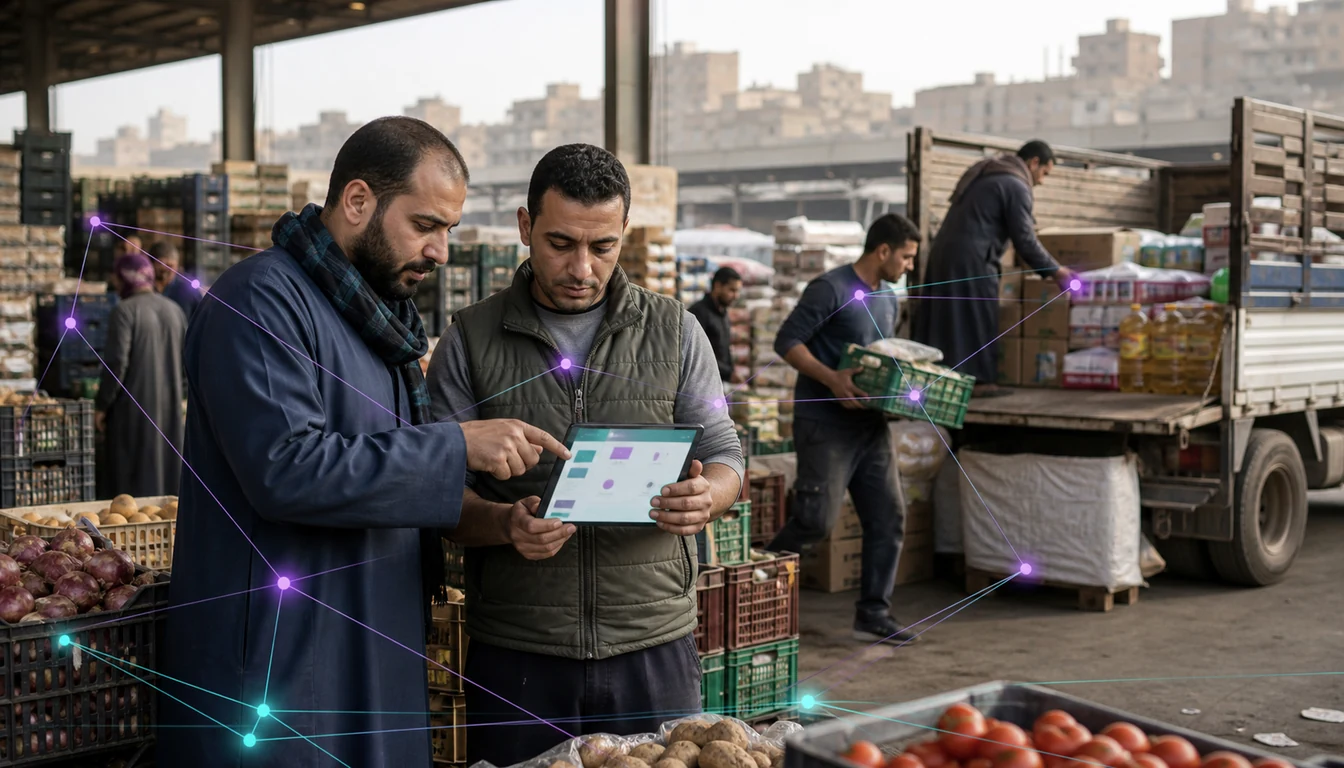
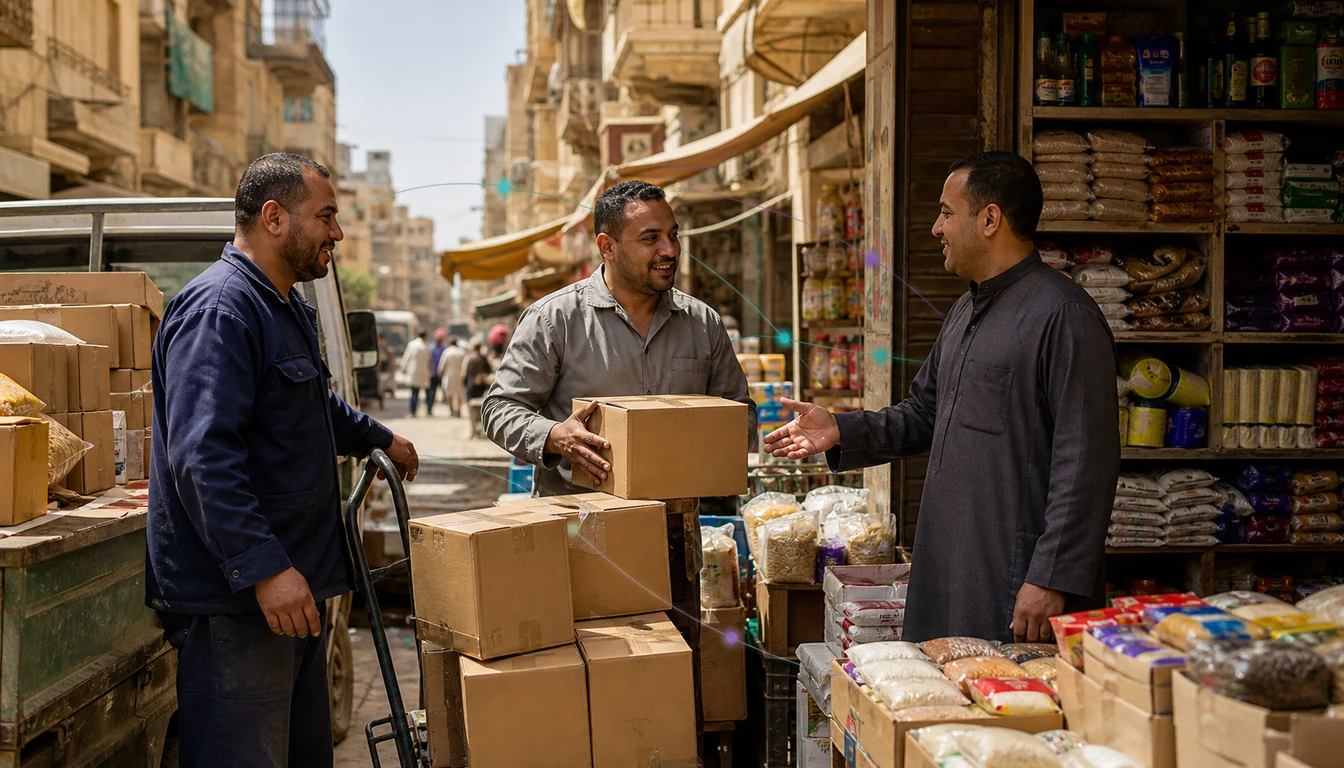
A distributor management system that looks flawless in a Cairo boardroom demo can still fall apart on a delivery route through the Delta or a baqala cluster in Upper Egypt. The gap between a polished pitch and a working rollout is where most FMCG operators here lose money, not in the contract itself.
Three forces are reshaping what "good enough" means for a DMS in this market. The ETA e-invoicing and e-receipt system is in force and widening rather than sitting as a future requirement. The pound's volatility means price lists get revised far more often than distributors in steadier currencies are used to. And collections still run heavily through cash at the baqala tier, even as InstaPay, Fawry, Meeza and telco wallets pull a growing share onto digital rails.
This guide sets out what to actually verify before signing: fit for Egypt's trade structure, genuine offline capability, e-invoicing readiness, baqala-tier collections handling, Arabic-first field usability, and the evaluation mistakes that quietly sink otherwise sound purchases.

Start by Testing Fit for Egypt's Trade, Not the Feature List
Many distributor management platforms sold into this market were designed around assumptions that do not hold here: a single retail tier, addresses that map cleanly to a delivery app, and a currency stable enough to price once and forget. Egypt's route-to-market does not work that way. Baqalas on nearly every street corner from Alexandria to Aswan still account for the overwhelming majority of grocery sales value, even as organised chains such as Carrefour Egypt and Kazyon expand.
Before comparing feature lists, put four questions to any vendor. Does the platform model your actual hierarchy, distributor down to wholesaler down to baqala, with visibility at each tier rather than a flat customer list? Can it map an outlet with no formal street address, relying on a GPS pin and a landmark note instead? Does every price, credit limit and balance display consistently in EGP with no assumptions baked in from another market? And is the data model built for how FMCG brands actually compete in Egypt's informal trade, rather than retrofitted from a modern-trade-only design?
A platform that cannot answer those cleanly will struggle regardless of how sharp its dashboards look, and outlet-level weaknesses tend to surface only after go-live, when a proper outlet management layer is already needed to hold the network together.
Offline-First Capability Across Egypt's Connectivity Split
Cairo, Alexandria and Giza carry dense, largely reliable connectivity. Move into Upper Egypt or the rural Delta governorates and coverage thins out noticeably. A DMS that assumes a live connection to book an order will quietly cost you sales on exactly the routes where competition for shelf space is weakest.
Genuine offline-first field sales behaviour is specific, not vague. Orders should book completely offline, with the rep selecting outlet, SKUs, quantities and payment method with no signal at all. Pricing, scheme eligibility and credit checks need to resolve on the device itself, not wait on a server round trip. When the device reconnects, the sync queue uploads automatically and handles the case where two people touched the same record offline. The app also needs to be light enough on battery and data that a full route does not drain either by mid-afternoon.
Ask for a demonstration in aeroplane mode. Book an order, trigger a credit check, then reconnect and watch the sync. A vendor who hesitates at that request is telling you something.
ETA E-Invoicing and E-Receipt Readiness
The Egyptian Tax Authority's e-invoicing and e-receipt system is not a future project to plan around later. It has rolled out in stages for several years and is currently pulling smaller businesses into scope, with B2C e-receipt obligations also expanding. Treat it as live and still widening, because that is what it is.
What this means for evaluation is less about a specific threshold, which has already moved once and can move again, and more about architecture. Can the platform generate invoice and receipt data in the structured format the ETA system expects, order by order, without a manual reformatting step? Does it handle a business that sits just inside today's scope but may need full compliance as the mandate reaches smaller operators next? A system built to adapt to a widening mandate is a safer buy than one patched together for a single compliance snapshot.
Getting this wrong is not a missing feature. It is a compliance gap that surfaces at the worst moment, during an audit or a registration deadline.
Baqala-Tier Collections and Multi-Rail Payments
Cash still dominates collections at the baqala tier, and that is not changing quickly. What has changed is everything sitting alongside it: InstaPay for instant bank transfers, Fawry for high-volume daily payments, Meeza for card-based collections, and telco wallets such as Vodafone Cash and Orange Cash. No single rail dominates the way one might expect from a smaller market, so a DMS needs to treat all of them as first-class payment methods, not an afterthought bolted onto a cash-only design.
The practical checklist covers four things. Can the field app capture cash, InstaPay, Fawry, Meeza and wallet payments against the same invoice without a workaround? Does the baqala owner's credit limit and balance show before the rep confirms an order, with over-limit orders routed to an approver rather than accepted or hard-blocked? Is there a clean, time-stamped audit trail for every EGP collected in cash, since that is where disputes and leakage cluster hardest? And can a manager see overdue flags by distributor credit and collections account, rather than reconstructing it from spreadsheets at month end?
Vendors who can walk you through an order-to-cash workflow spanning InstaPay and Fawry alongside cash, rather than call digital payments a roadmap item, have usually built for this market rather than adapted one built for a different one.
Arabic-First Field UX, Not a Translated Afterthought
English fluency among field staff is far from universal outside white-collar, urban business circles. A rep working a baqala route through a Cairo side street or a Delta village market needs an app built around Arabic first, not an English interface with a language toggle bolted on.
That distinction matters in practice. A genuinely Arabic-first design handles right-to-left layout properly throughout, not just in translated labels sitting inside an English-oriented screen. It leans on icons so a rep with limited reading confidence in either language can still navigate order-taking, scheme selection and collections. It also extends to how field staff are trained, since an app that is Arabic-first but onboarded in English only solves half the problem.
Ask to see the actual mobile screens a rep would use on a real route, in Arabic, not a deck with an Arabic logo pasted over English screenshots. The difference is usually obvious within a minute.
Common Evaluation Mistakes, and a Short Checklist
A handful of mistakes show up repeatedly in how distributors here choose, and later regret, a DMS. Buying on the strength of a slick demo without forcing an offline field test is the most common. Close behind is underestimating how much of the retail network sits at the baqala tier, and evaluating as if organised trade were the whole market. Treating ETA e-invoicing as "something we'll handle later" is a third, given how clearly the mandate is widening. A fourth is assuming one payment rail will dominate and building collections around it, when the reality is several rails growing at once alongside cash. A fifth is rolling a new system out across the whole network on day one instead of proving it on a single strong route first, where sync issues and Arabic UX gaps actually surface.
Before signing anything, run through a short checklist covering the ground above:
- Does it model the distributor to wholesaler to baqala hierarchy, not a flat customer list?
- Does order-taking, pricing and credit checking work fully offline, with automatic conflict-aware sync?
- Can it produce ETA-compliant invoice and receipt data without a manual reformatting step?
- Does it capture cash, InstaPay, Fawry, Meeza and wallet payments against the same invoice?
- Is the field app genuinely Arabic-first, including training materials, not just translated labels?
- Has the vendor proven it on one real route in aeroplane mode, rather than only in a boardroom?
A platform that clears all six deserves a serious commercial conversation. One that clears only three or four deserves a harder look before you commit a full network to it.
How 1Channel Helps Egyptian FMCG Buyers Decide With Confidence
1Channel pairs an offline-first mobile app with a manager portal on one synced backend, built around the conditions this guide has covered rather than retrofitted for them. Pricing, credit and collections run in EGP, and the platform is designed to keep pace with a mandate that keeps widening rather than standing still.
Buyers can run the checklist above directly against the platform, and most items resolve as standard capability. In practical terms, here is what that looks like on the ground:
- Books orders fully offline and syncs automatically, with conflict handling, once coverage returns.
- Models the distributor, wholesaler and baqala hierarchy with visibility at every tier, not a flat customer list.
- Structures invoice and receipt data to align with the ETA e-invoicing and e-receipt system as it expands.
- Captures cash, InstaPay, Fawry, Meeza and telco wallet payments against each invoice for clean reconciliation.
- Runs the mobile field app Arabic-first, with icon-led navigation suited to a mixed-literacy field force.
See a DMS Built for the Way Egypt Trades
Walk through how 1Channel's AI-powered DMS handles offline order-taking, baqala-tier credit control and multi-rail collections, built for Egypt's distribution network rather than adapted to it.
Explore AI-Powered DMS Software →FAQs
What is the single most important feature to check in an Egyptian DMS?
Genuine offline order-taking. If a rep cannot book an order, check a credit limit or apply a scheme without a live connection somewhere between Cairo and a rural governorate, the rollout will lose sales quietly and continuously, whatever the rest of the platform looks like on paper.
Does a DMS for Egypt need to support ETA e-invoicing directly?
It needs to produce invoice and receipt data structured for the ETA system, since the mandate is in force and widening, not upcoming. A platform bolted together for a single compliance snapshot will struggle as smaller businesses keep being pulled into scope.
Should I worry about which digital payment rail my DMS supports?
Worry less about picking one rail and more about whether the platform treats several as equally important. InstaPay, Fawry, Meeza and telco wallets are all growing alongside cash, so a DMS handling only one or two will force workarounds at the point of collection.
How do I evaluate whether a platform is truly Arabic-first, not just translated?
Ask to see the actual field app screens in Arabic, including right-to-left layout and icon-led navigation, rather than a demo built in English with translated labels on top. Also check whether onboarding and training materials are genuinely Arabic-first, since that is where translated-only tools usually fall short first.
What is the best way to pilot a DMS before committing to a full rollout?
Run it on one real route that includes a baqala cluster with patchy connectivity. Book orders in aeroplane mode, trigger a credit limit, collect a payment through more than one rail, then reconnect and confirm the sync and reconciliation hold up before scaling to the wider network.