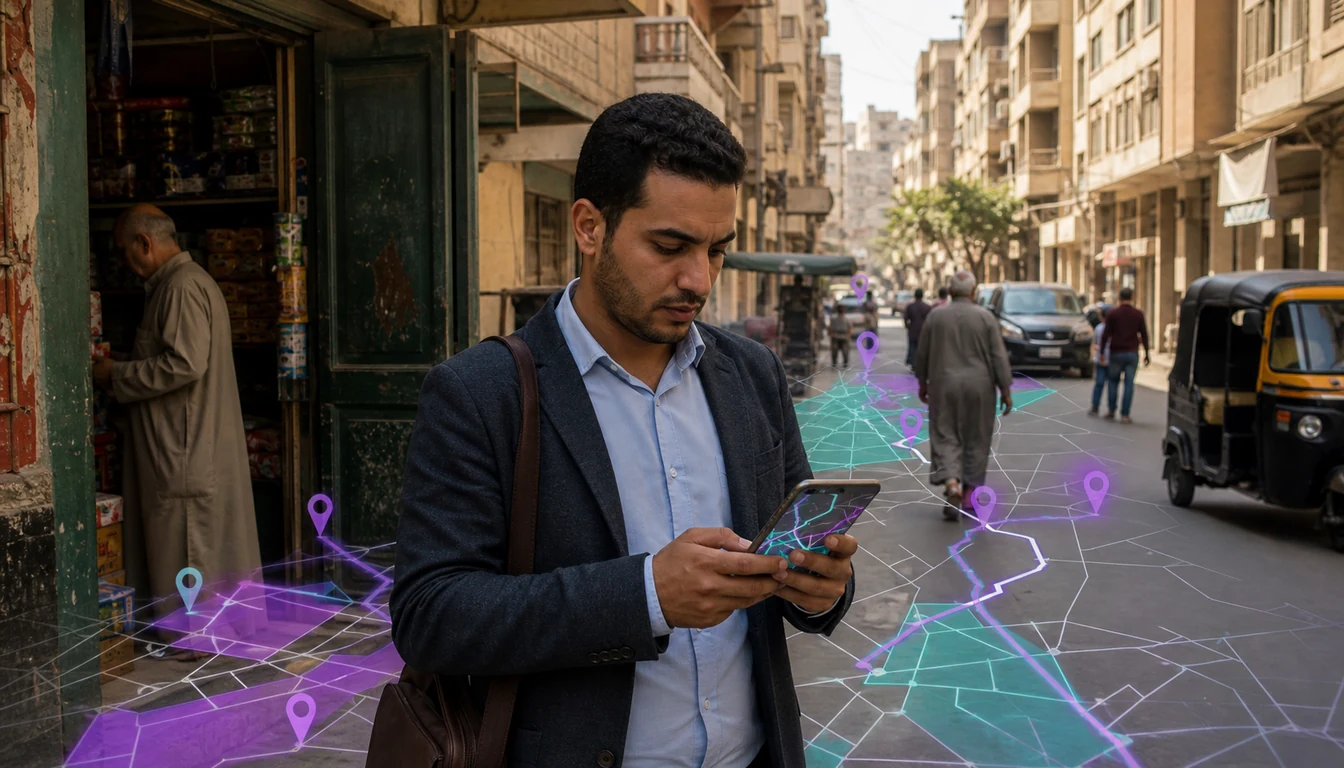
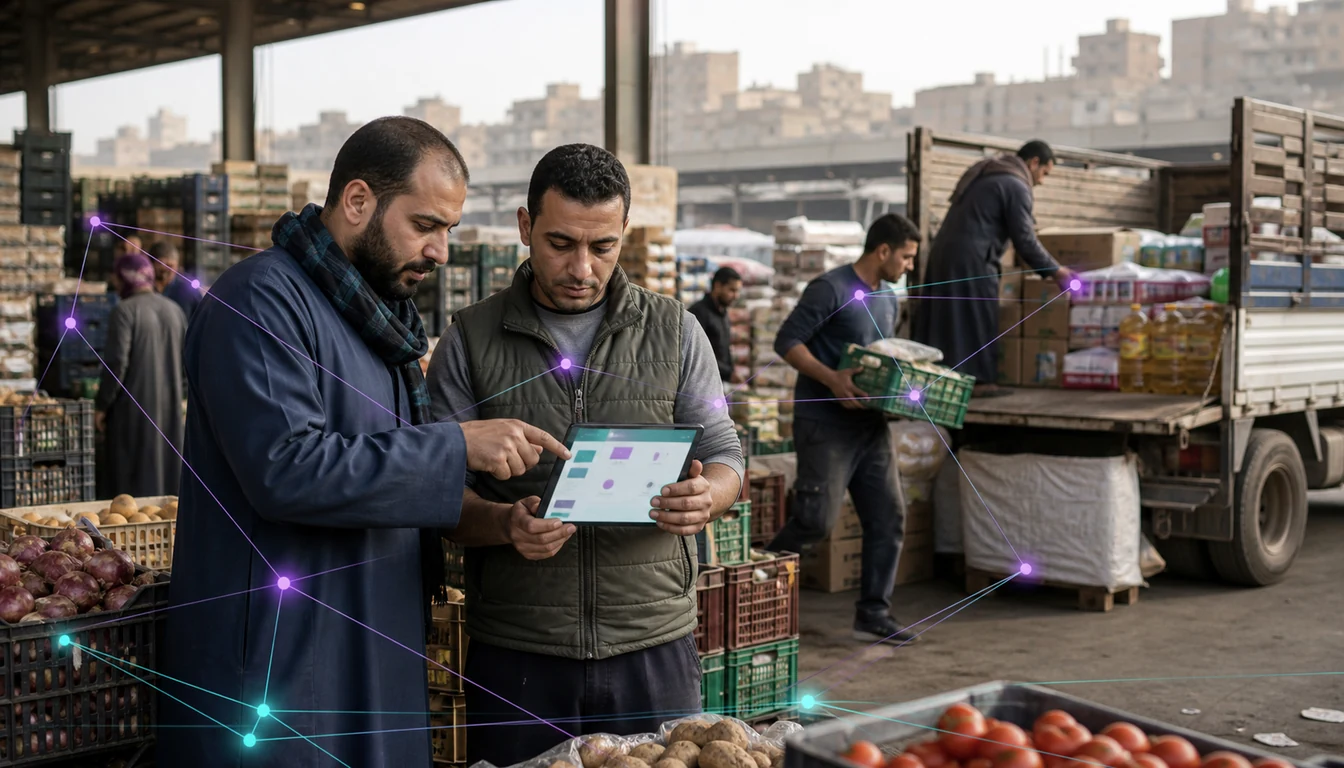
Cairo's traffic and Alexandria's coastal sprawl hide a connectivity story that most field sales software never accounts for. A rep working a beat through Giza's retail strips or downtown Cairo can expect signal outlet to outlet, one dropped bar followed by a stronger one two minutes later. A rep covering a Delta village round or a stretch of road through Upper Egypt sees that signal thin out for long stretches, sometimes for most of a working day.
That gap is not marginal. Internet penetration runs close to 84% in Egypt's cities against roughly 63% across rural areas, a real split of around 21 points that field software has to absorb rather than assume away. A distributor selling across both worlds, from a baqala on a Cairo side street to a baqala at the far end of an Upper Egypt route, cannot run one connectivity assumption for the whole team.
Offline-first is the design posture built for that split. It treats a live network as a bonus a rep sometimes gets, not a condition the software depends on. This piece covers what actually breaks when field apps assume constant connectivity, how offline capture and sync work once a system is built the right way round, and what changes operationally when visits stop getting lost to a dead signal.
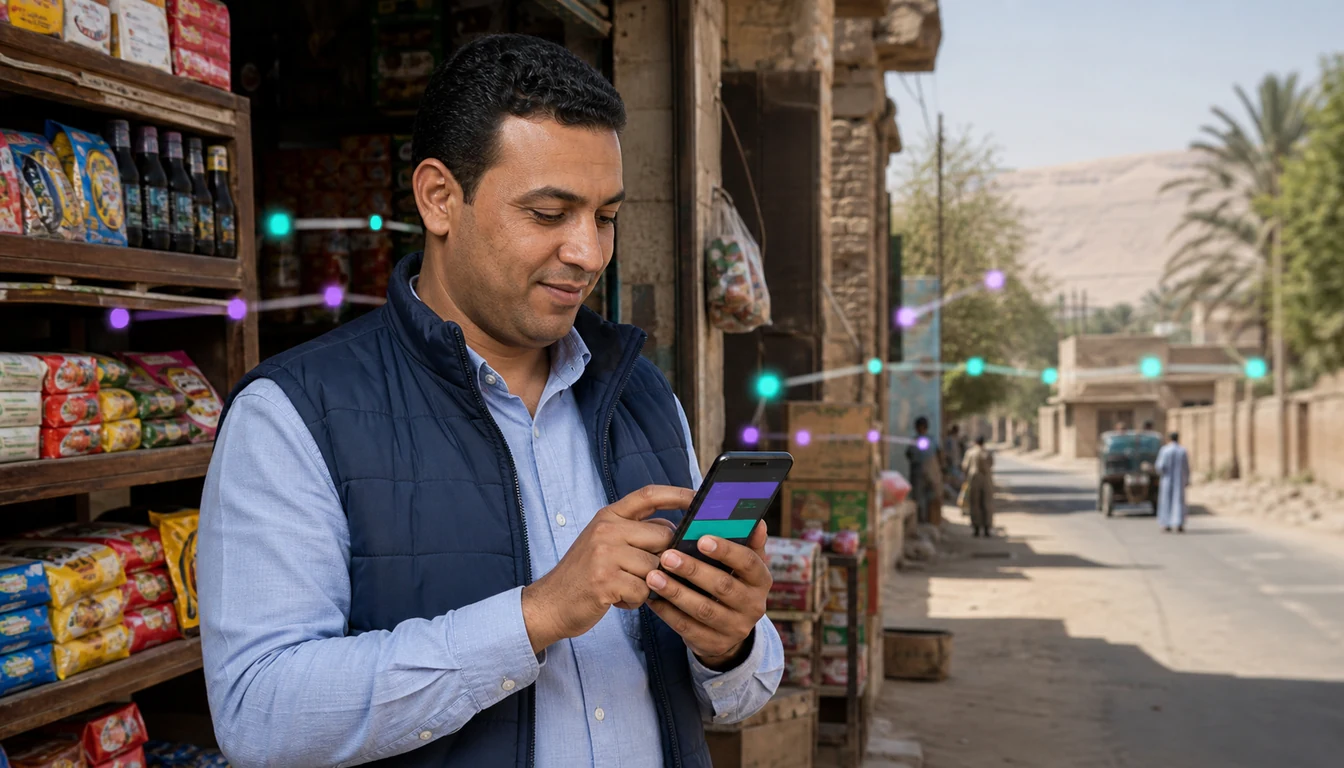
What Breaks When Field Apps Assume Constant Connectivity
Most field sales software is still built and demoed on office WiFi, which means the failure mode only shows up once reps take it into Egypt's informal trade. An app that expects a live connection to load a catalogue, check stock, or submit an order has three ways to fail in the field, and all three cost real orders.
- The screen freezes or the order will not save. A rep standing in front of a baqala owner with two or three customers waiting cannot ask the network to hurry up. If the app stalls, the order gets written on paper or not written at all.
- Cached data goes stale without warning. A rep who last synced that morning may be quoting a price list or stock position that has already moved, with no on-screen signal that the numbers are hours old.
- Visits go unrecorded rather than just late. When a check-in or an order depends on an immediate server round-trip, a dead zone does not just delay the record, it can drop it entirely if the rep moves on before signal returns.
The compounding cost sits on the data side. A distributor manager reading a coverage report the next morning cannot tell the difference between an outlet that was skipped and an outlet that was visited but never synced. Both look identical: blank. Across a full team and a full month, that ambiguity quietly erodes trust in every number the system produces.
How Offline-First Capture and Sync Actually Work
A properly built offline-first app flips the assumption. The device is the primary system of record for that rep's day, and the server is where everything eventually lands, not where everything has to start.
Before the rep leaves
- The full beat loads onto the device overnight or first thing in the morning, while a network is available: outlets, catalogue, current pricing, active schemes, and stock positions relevant to that route.
- Route order is sequenced for the terrain the rep is actually covering, using route planning built around density and travel time rather than a flat list of addresses.
- Everything above works with the device fully offline, so the rep never opens the day depending on a signal that may not show up until lunch.
At the outlet
- Attendance is geo-stamped on-device the moment the rep arrives, whether at a baqala, a pharmacy, or a modern-trade branch, and held locally until sync.
- Orders are booked against the last-synced stock and credit position, so a rep is not promising volume the warehouse cannot actually deliver.
- The payment method is logged as it happens. Cash still dominates at the baqala tier, but a growing share of collections now runs through InstaPay, Fawry, Meeza, or a telco wallet, and reconciliation depends on knowing which channel settled which order.
- A shareable order record is produced on the spot, even with no connection, so the shop owner has something to hold before any money or stock changes hands.
- New outlets can be registered inline, pinned by GPS where the surrounding streets have no clean formal address, without a separate trip back to the office to add them to the system.
None of this waits for a network. When a signal does appear, even briefly on a moving vehicle or near a village tower, the queued records sync in the background without the rep doing anything. A route across dense Giza streets and a route through the Delta end the day the same way: fully captured, fully synced, no manual reconciliation required.
Measuring Coverage When Data Arrives in Bursts
Once capture is offline-first, data does not stream in evenly through the day, it arrives in bursts as devices find a signal. Reading coverage and performance reports has to account for that pattern rather than fight it.
| Metric | What it tells you |
|---|---|
| Sync latency by rep and route | The gap between when an order was captured and when it reached the server. A wide gap on a Delta or Upper Egypt route is expected; the same gap on a Cairo route is worth asking about. |
| Beat compliance and strike rate | How many assigned outlets were actually visited against how many produced an order. Geo-stamped check-ins keep this honest where street addresses are informal or missing. |
| Coverage by density band | Splitting dense urban routes from sparse rural ones surfaces whether a drop in visits reflects a genuine access problem or a gap in how the beat was planned. |
| Order-to-cash by payment channel | With collections spread across cash, InstaPay, Fawry, Meeza, and telco wallets, tracking each channel separately shows where reconciliation delays actually sit. |
Standardising this across a full field team, rather than leaving each rep to their own habits, is what sales force automation is for: one consistent capture method that still produces clean, comparable numbers whether the route ran through a crowded Cairo market or a quiet village further south.
Designing for Cairo's Density and Upper Egypt's Distance
Offline-first is necessary but not sufficient on its own. Two further design questions decide whether the app actually holds up across Egypt's range of field conditions.
The route and device reality
A dense city round through Giza, downtown Cairo, or the streets near Al Obour Wholesale Market packs dozens of stops into a small radius, so sequencing and travel-time estimates matter more than raw distance. Careful planning for dense city streets keeps a rep from doubling back across the same block twice in a morning.
A rural round through the Delta or Upper Egypt inverts the problem: far fewer stops, much longer gaps between them, and no room for a route built on the wrong drive-time assumptions. The app also has to run well on the modest Android devices most field teams carry, with efficient local storage and a design that stays usable in strong midday sun.
The language reality
English fluency among field reps and shopkeepers is far from universal outside white-collar urban circles. An Arabic-first mobile experience, not a bolted-on translation layer, is what keeps data entry accurate at the point of capture. Getting this right at onboarding matters more than any feature added later, because offline data quality is decided in the seconds a rep spends entering an order in front of a customer, not in a training room.
Common Pitfalls to Avoid
- Treating offline mode as a fallback. Software that is online-first with an offline patch bolted on tends to lose data or create duplicate records the moment two versions of the same order try to sync.
- Skipping conflict resolution rules. If a rep edits an outlet offline while an office user edits the same record online, the system needs a clear rule for which version wins, or the master data slowly drifts.
- Trusting timestamps without location. A time-stamped visit with no matching GPS point is easy to fabricate. Pairing the two keeps beat compliance data usable for real decisions.
- Assuming one connectivity profile for the whole team. A sync frequency or cache size tuned for Cairo will not serve a rep on a Delta route well, and the reverse is just as true.
- Leaving compliance as an afterthought. As Egypt's e-invoicing and e-receipt rules under the Egyptian Tax Authority widen to cover more businesses, order records captured cleanly offline and synced with a full audit trail are far easier to reconcile than notes scattered across personal phones.
How 1Channel Helps Close the Connectivity Gap
Running field sales across Egypt's mix of dense cities and sparse rural stretches means one capture method has to work equally well on both. 1Channel's Cloud AI Mobile DMS App is built offline-first from the ground up, so a rep's day does not depend on where the nearest tower happens to be.
The app runs on the modest Android devices most field teams already carry, holds a full day's beat, catalogue, and pricing on the device, and syncs everything the moment a signal returns, whether that is seconds later on a busy Cairo street or hours later on a village round.
- Offline order capture against the last-synced stock and credit limit
- Geo-stamped attendance that works with zero signal at check-in
- On-the-spot outlet registration by GPS pin, no office visit required
- Payment-mode tracking across cash, InstaPay, Fawry, Meeza, and telco wallets
- Route sequencing tuned separately for dense urban rounds and long rural ones
Keep Every Route Selling, Signal or No Signal
See how 1Channel's Cloud AI Mobile DMS App lets Egyptian field teams capture orders, attendance, and new outlets offline, then sync cleanly the moment a signal returns, from central Cairo to the furthest stop on an Upper Egypt round.
Explore the Mobile DMS App →Key Takeaways
- The urban-rural connectivity gap is real and measurable. Roughly 84% urban internet penetration against about 63% rural means one connectivity assumption cannot serve the whole field team.
- Offline has to be the default, not a fallback. Attendance, order capture, and outlet registration should all work fully on-device before any sync happens.
- Sync-on-return should be invisible to the rep. The moment a signal appears, queued records should upload in the background with no manual step required.
- Route design has to fit the terrain. Dense city rounds and sparse rural ones need different sequencing logic, not the same template stretched across both.
- Pair every timestamp with a location. Geo-validated capture is what keeps beat compliance and coverage data trustworthy enough to act on.
- Clean offline data is also a compliance asset. As e-invoicing obligations widen, a full, synced record of every order beats scattered notes when it is time to reconcile.