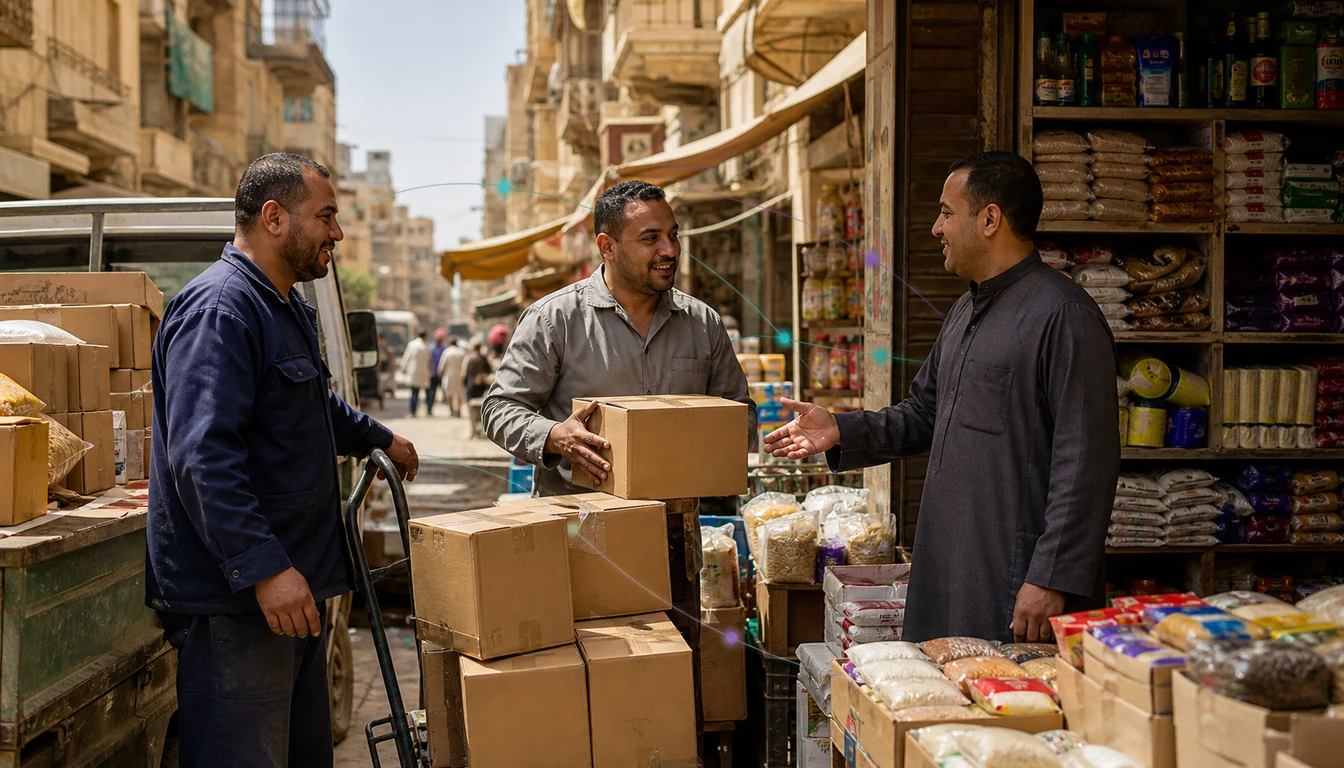
Most conversations about Egyptian FMCG distribution stop at two tiers: the brand's appointed distributor, and the baqala where a shopper actually buys the product. Everything that happens between those two points, the wholesaler tier, tends to get treated as a black box that somehow keeps working.
That box is bigger than it looks. A meaningful share of what leaves a distributor's warehouse in Cairo, Alexandria or Giza does not go straight to a baqala shelf. It goes first to a wholesaler, who breaks bulk, extends credit to dozens of smaller shops, and moves stock onward across a governorate a distributor's own van fleet cannot reach efficiently on its own.
Because this tier trades mostly on paper, phone calls and personal trust, it is also the least digitised, least visible part of the chain. Bringing it onto a shared digital portal, one where orders, stock and credit are recorded rather than remembered, changes what a brand can see and what a wholesaler can offer their own customers, without asking anyone to abandon how business has always been done.
The Layer Between the Distributor and the Baqala
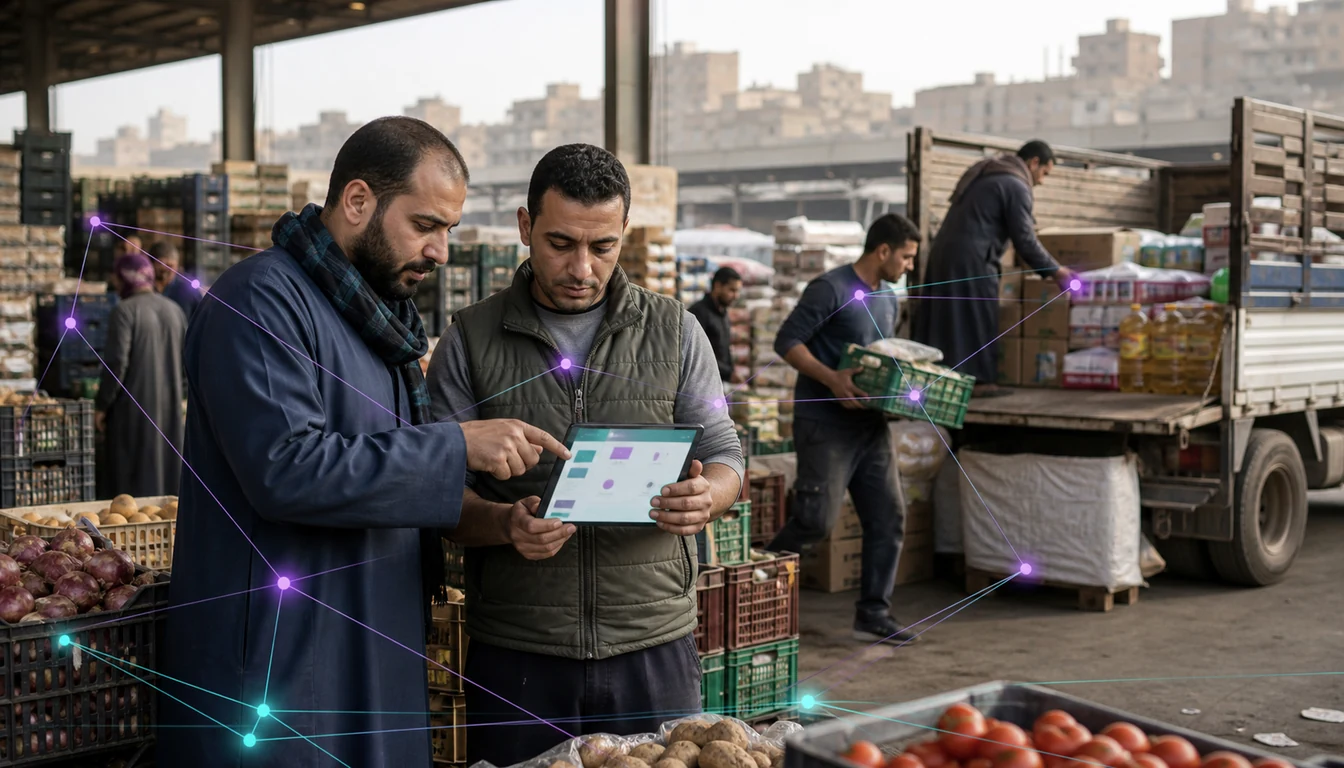
A wholesaler in Egyptian FMCG distribution rarely fits one clean definition. Some operate as informally appointed area wholesalers, buying set volumes from a single distributor and reselling within a defined patch of a city or governorate. Others work out of open wholesale markets, sometimes called gomla markets, breaking bulk bought from several sources and selling on to whoever walks in, a baqala owner or a smaller wholesaler alike.
Al Obour Wholesale Market on the edge of Greater Cairo illustrates how concentrated and physical this trade can be. Rows of traders move real volume through a single hub every day, much of it destined for baqalas that are never coded anywhere as a distributor's account. The same pattern repeats, less visibly, in smaller wholesale clusters across Alexandria, Giza and provincial towns, where a wholesaler's shopfront might be the only fixed point of contact in the whole chain below the distributor.
One wholesaler can be, on the same day, a bulk buyer, a mini-distributor to smaller wholesalers, and a credit-granting supplier to twenty baqalas, all without a single formal appointment letter. A digitisation effort that assumes tidy, one-to-one relationships will misread the trade immediately. Coding each wholesaler account properly, a real location, a real parent distributor where one exists, and an honest outlet type inside outlet and store management, is the unglamorous first step that makes everything built on top of it trustworthy.
How Wholesalers Operate Today
Strip away the terminology and most Egyptian wholesalers run on the same three tools: a paper register, a mobile phone and memory. Orders to the distributor travel by phone call or a WhatsApp voice note listing quantities against products the wholesaler already knows by heart. Confirmation, when it comes at all, is a verbal yes or a photo of a handwritten note.
Payment collection follows the same informal shape. Cash still dominates at this tier, though a growing share of transactions move through InstaPay, Fawry, Meeza or a telco wallet as wholesalers and their baqala customers both get more comfortable with digital transfers. None of these channels talk to each other, and none of them automatically produces a ledger anyone upstream can read, which is why order-to-cash across Egypt's payment rails is worth treating as its own problem.
Credit is the glue that holds the tier together. A wholesaler extends running credit to the baqalas they know personally, tracked in a notebook or simply remembered, while receiving a similar informal credit line from their own distributor. It works, until it does not, and by the time it stops working there is rarely a clean record showing where the exposure actually sits.
What Breaks Without Visibility Into This Tier
None of this is unmanageable at small scale. It becomes a genuine liability once a brand or distributor is trying to run pricing, credit and stock decisions across hundreds of wholesalers they cannot see into.
Credit Exposure Nobody Can See in Real Time
When a wholesaler's credit position exists only in someone's head and a notebook, a distributor extending terms to that wholesaler is really extending trust to an unknown number. If several baqala accounts default at once, the first sign is usually a missed payment, not an early warning. A running, shared statement of account and credit position turns that guess into a number both sides can check before it hardens into a dispute.
Price Lists That Go Stale Before They Reach the Wholesaler
Given how often EGP-denominated price lists need revisiting, a wholesaler working from a figure quoted over the phone last week may already be working from the wrong number. That mismatch surfaces as disputes at the point of resale, short payments, and a wholesaler who quietly adds a private buffer to every price just to be safe. A live, shared price list removes the guesswork on both sides of that call.
Stock and Sales Visibility Gaps at the Break-Bulk Point
The distributor knows exactly what it sold to a wholesaler. What that wholesaler then sells on to baqalas, the genuine secondary sale, is usually estimated rather than captured. That gap is precisely where primary and secondary sales visibility comes apart, and where two brands with identical primary numbers can have very different real market performance.
What a Distributor Portal Actually Gives Wholesalers and Brands
A distributor portal is not primarily a brand-side reporting tool bolted onto the trade. Done properly, it gives the wholesaler something they did not have before: a self-service way to place an order against current stock and current pricing, see a running balance instead of relying on memory, and get a confirmation that does not depend on someone answering a phone.
For the brand, the same portal produces the thing this tier has always denied it: order-level visibility. Every order a wholesaler places carries a timestamp, a product list and a price, which is a very different foundation for planning than a monthly figure the distributor reports after the fact. Aggregated across a region, that data starts to show genuine secondary movement rather than a back-calculated estimate.
The two benefits reinforce each other. A wholesaler who trusts the portal's stock and pricing keeps using it, and that continued use is exactly what generates the visibility a brand actually wants. A portal built only for head-office reporting tends to get used once and then quietly abandoned in favour of the old phone call. Working out which system fits this tier deserves its own comparison, covered in a buyer's guide to distributor management systems in Egypt.
Keeping It Simple Enough for a Wholesaler Used to Paper
None of this works if the first version a wholesaler sees demands they change everything about how they trade. A wholesaler who has run a profitable business for fifteen years on a phone and a notebook is not going to sit through a lengthy onboarding session or learn a screen full of menus just to place the same order they place every day.
Three design choices decide whether adoption sticks. First, Arabic-first screens, not an English interface with a translation layer bolted on, because the working language on the ground is Egyptian Arabic and a wholesaler's staff may not be comfortable transacting in English. Second, an interface that opens on the one task a wholesaler actually wants done, placing an order and checking a balance, before it offers anything else. Third, offline-first capture that assumes the connection will drop, particularly for wholesalers trading out of Upper Egypt and Delta governorates where connectivity is noticeably weaker than in Cairo or Alexandria. An order should save the moment it is entered and sync once the signal returns, not vanish because a page timed out.
Sequencing matters as much as design. Start with ordering alone, because that is the task with the clearest, most immediate payoff for the wholesaler. Once that habit is established, add visible stock and a running statement of account. Only once both are in daily use does it make sense to ask a wholesaler to record what they sell onward to baqalas, because that step benefits the brand more than the wholesaler, and it will fail if it is asked for too early.
What Changes Once the Wholesaler Tier Is Online
The value of any of this shows up in a short list of numbers that were simply unavailable before. How many wholesalers are actually placing orders through the portal in a given week, not just registered against it. How the gap between primary sales to the wholesaler and captured secondary sales to baqalas moves over time, a question tied directly to how a brand approaches informal trade across Egypt more broadly. How outstanding balances look in real time rather than at month-end reconciliation. And how quickly a pricing or stock dispute gets resolved once both sides see the same numbers instead of arguing from memory.
How 1Channel Helps Digitise Egypt's Wholesaler Tier
Bringing the wholesaler tier into view calls for a platform built around how this trade actually operates, not a dashboard designed for head office and handed down to the field. 1Channel gives distributors and the wholesalers who buy from them a shared, self-service login that works on a low-cost smartphone and keeps working when the connection does not.
For a business trying to bring Egypt's wholesaler and baqala network onto one system, the platform supports:
- Arabic-first, offline-capable self-service ordering against live stock and current EGP pricing
- A running statement of account so credit exposure per wholesaler is visible before it turns into a collections problem
- Real order-level capture that turns secondary sales from an estimate into an actual number, by product and region
- Outlet and wholesaler master data that reflects how the trade genuinely works, rather than a forced one-to-one hierarchy
- A phased rollout path, ordering first, then stock and statements, so adoption never outpaces what a paper-based wholesaler is ready for
See the Distributor Portal Built for Egypt's Wholesale Trade
Explore how 1Channel's Distributor Self-Service Portal gives Egyptian wholesalers a simple, offline-capable way to order, check stock and view their balance, while giving brands real visibility into what actually reaches the baqala shelf.
Explore the Distributor Portal →Key Takeaways
The wholesaler tier is not a gap to be designed around. It is where a large share of Egypt's FMCG volume genuinely changes hands, and it will keep running on paper and phone calls until something better earns its place.
- Egyptian wholesalers trade mostly on trust, not records. From hubs like Al Obour Wholesale Market to smaller gomla markets across every governorate, orders and credit move by phone call and memory rather than any recorded system.
- Invisibility turns into liability at scale. Credit exposure, stale pricing and secondary sales all become guesswork that only surfaces once something has already gone wrong.
- A portal earns adoption by helping the wholesaler first. Self-service ordering and a real balance matter more to a wholesaler than any reporting layer built for head office.
- Real secondary-sales visibility means capturing the sale, not estimating it. A number calculated after the fact is an opinion, not a fact.
- Arabic-first design and offline capture are not optional extras. They are the difference between a portal a wholesaler actually uses and one they quietly abandon.
- Sequence the rollout. Ordering first, then stock and statements, then secondary capture, so a wholesaler used to paper is never asked to change everything at once.
Get the sequencing and the design right, and the fog between the distributor and the baqala starts to clear, one order at a time.