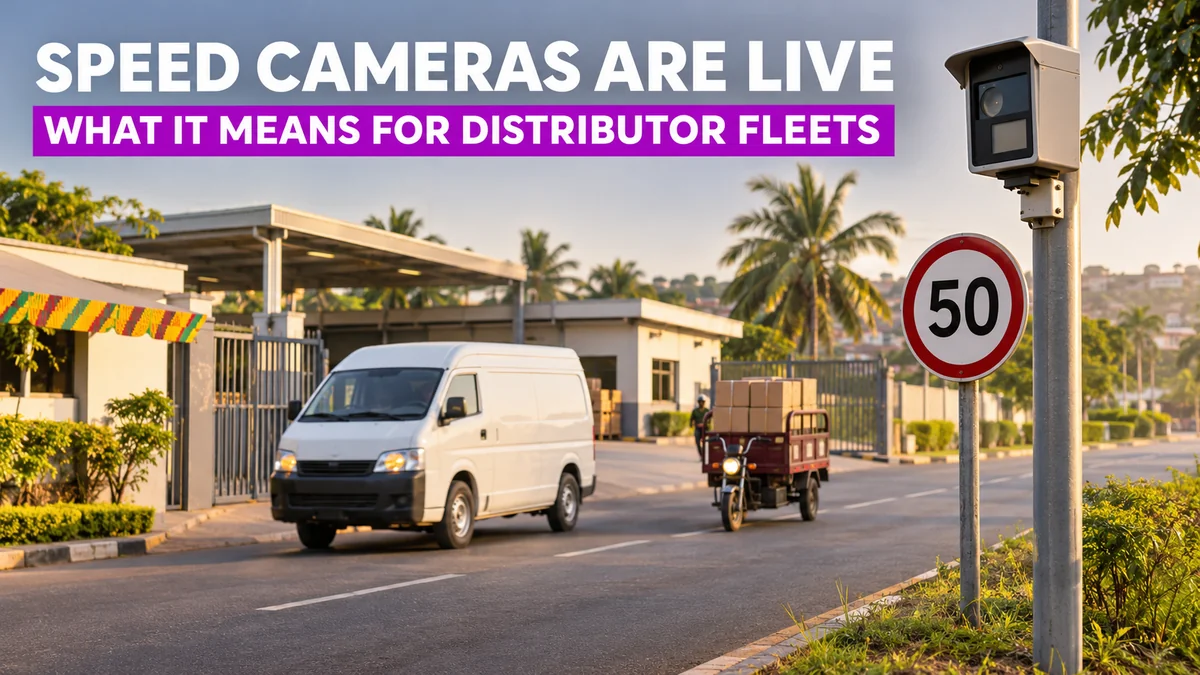
Since 1 November, a speeding van on a Ghanaian road no longer meets a police officer at the roadside. It meets a camera instead.
The vehicle's registered owner then gets an SMS. For distributors across Ghana that own their vans and tricycles, that owner is usually the business itself.
This post covers what TraffiTech-GH enforces, why the notice lands on the distributor, and how route planning eases the pressure on drivers.
The change matters most where fleets run tight daily beats: FMCG, pharma and healthcare, building materials, and logistics and field services.
What Went Live on 1 November
The Ghana Police Service switched on TraffiTech-GH on 1 November 2026, starting with speeding.
Cameras and laser speed devices capture the offence, and MTTD officers review the footage before any notice goes out.
The Electronic Notice of Violation arrives by SMS from the sender ID GPS-MTTD. The minimum fine is GH¢240, for 5 to 20 km/h over the limit.
| Road type | Speed limit |
|---|---|
| School, health and commercial zones | 30 km/h |
| Built-up urban areas | 50 km/h |
| Highways | 90 km/h |
| Motorways | 100 km/h |
Commercial zones sit at 30 km/h, which is exactly where delivery vans and sales reps spend their day.
Why the Notice Lands on the Distributor
Camera notices go to the registered owner, not the driver. Owners have 14 days to pay or contest.
After that, 1 per cent of the original fine is added for every day it stays unpaid.
Police have urged owners to make sure their drivers follow the rules. For a distributor, that means knowing who drove which vehicle, on which route, and when.
It also means checking the plan. A beat with more outlets than a working day can hold asks the driver to make up time on the road.
How 1Channel Plans Beats Around Real Travel Time
1Channel's AI journey planner builds routes on realistic road travel time, using an average city speed the admin sets.
It respects each rep's working hours and reports the visits that will not fit, rather than packing them into the day.
Reps see the day's optimised route with an ETA per stop. Managers can review distance travelled per day and between stores.
Goods received against a dispatch can also record the vehicle number and driver name, so each delivery has a dated trail.
Plan Routes Your Team Can Drive Within the Limit
See how journey plans built on real travel time, per-stop ETAs and daily distance reports work together for field teams and delivery routes.
Explore Sales Force Automation →Final Suggestions
- Check every vehicle's registration. Former owners can stay liable until the DVLA record is updated, so confirm each van and tricycle sits under the right name.
- Route notices to one person. With only 14 days to pay or contest, an SMS left on a driver's phone can quietly turn into daily penalties.
- Keep a dated driver log. Match each notice to the vehicle, driver and route of that day before deciding to pay or contest.
- Audit your heaviest beats. Any route that only works at speed needs fewer outlets or a second day.
- Brief drivers on 30 km/h zones. Markets and commercial streets are the default delivery stop, and the lowest limit on the road.
Sources: Graphic Online, Citi Newsroom, Rainbow Radio