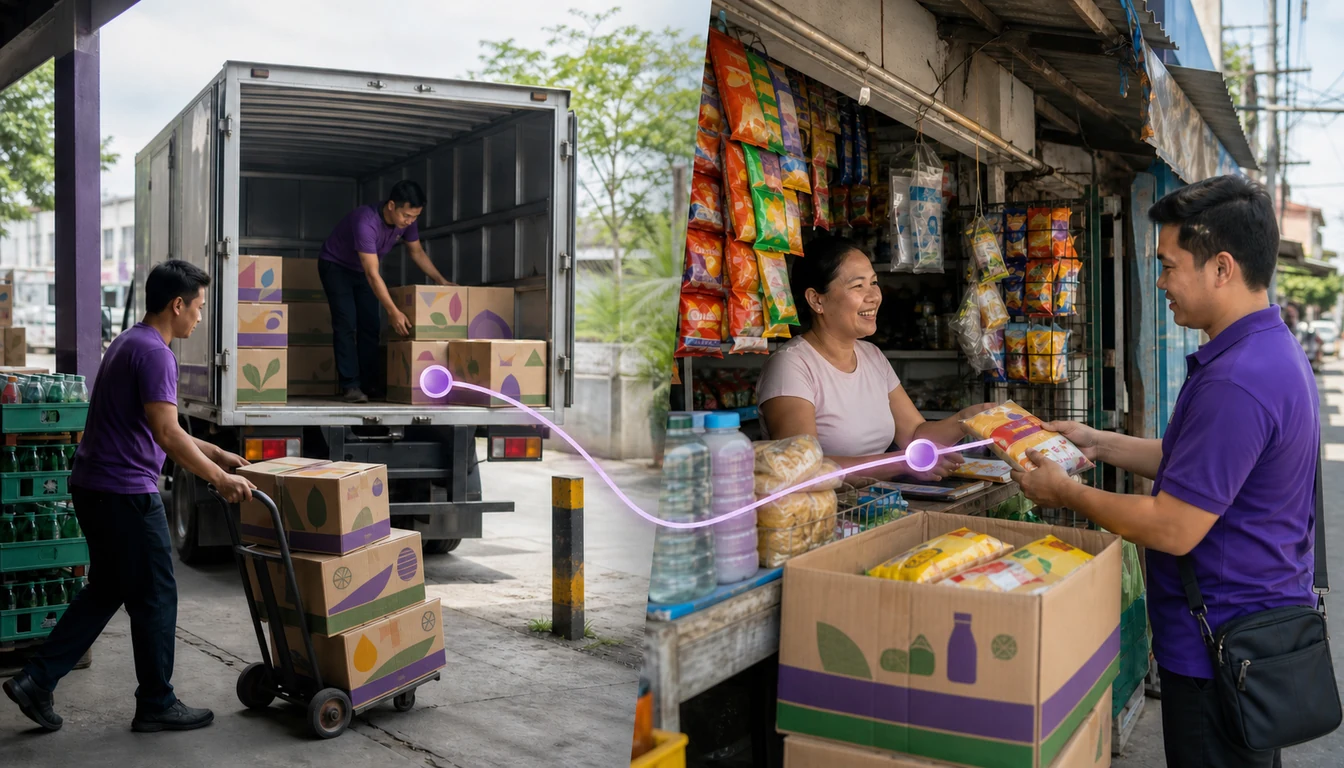
A distributor selling into a handful of large modern trade accounts can review outstanding balances in an afternoon. A distributor selling into a few hundred sari-sari stores across two or three cities cannot. Multiply that by the roughly 1.1 million sari-sari stores operating nationwide, each one a small line of credit extended on trust and a delivery schedule, and the exposure a mid-sized Philippine distributor is carrying at any given moment becomes genuinely difficult to see, let alone manage, without a system built for the job.
Most distributors did not choose to become lenders. Credit terms crept in because sari-sari owners run tight cash cycles themselves and expect a few days, sometimes a couple of weeks, between delivery and payment. Extending that grace is how a distributor wins and keeps shelf space against a competing route. The trouble starts when that informal arrangement, sound in a single relationship, is replicated across hundreds of outlets without a shared ledger, a common credit policy, or a clear view of who owes what and for how long. A paper receipt book carried on a delivery van, a notebook kept at the warehouse, and a spreadsheet updated once a week are three different truths, and none of them agree with what is actually outstanding.
This is a peso story specifically, not just a collections story. Every credit limit, every ageing bucket and every reconciled receipt in this piece is denominated in Philippine pesos (₱), because the risk a distributor is carrying is a peso number that finance has to close against actual cash in the bank, not an estimate. This guide sets out how Philippine distributors can size credit exposure per outlet, track how overdue it gets, tie every collection back to the invoice it settles, and keep cash collections at the sari-sari tier from quietly becoming unreconciled peso leakage.

Why Distributor Credit Risk Multiplies Across a Sari-Sari Network
A single overdue balance of ₱4,500 from one sari-sari store is a rounding error. The same ₱4,500 average balance carried informally across a distributor's active outlet base, many of them restocking small quantities frequently rather than large quantities occasionally, adds up to a peso exposure that most finance teams cannot see clearly until month end, if then. The tingi buying pattern that defines sari-sari retail, small, frequent, sachet-level restocking, means each outlet generates many small invoices rather than a few large ones, and small invoices are exactly the kind that slip through a manual ledger unnoticed. Urban stores that lean on company salespeople for supply and rural stores that lean more on wholesalers both carry credit risk, just on different terms, and a distributor covering both needs one consolidated view rather than two disconnected paper trails.
The real cost is not any single bad debt. It is the compounding effect of not knowing, in near real time, how much of a distributor's working capital is currently sitting in unpaid invoices across the network, and which outlets are drifting from "usually pays on time" to "usually pays late" before that drift becomes a write-off. A distributor analytics view that rolls up outstanding balances by route, by sales rep and by region turns that invisible exposure into a number finance can act on weekly instead of discovering quarterly.
Setting Credit Limits by Outlet, Not by Guesswork
A flat credit policy, the same limit for every sari-sari store regardless of order history or repayment pattern, either under-serves the reliable payers or over-exposes the distributor to the unreliable ones. Neither outcome is acceptable at scale. The fix is a credit limit set per outlet and revisited as the relationship matures, not a number fixed once at onboarding and forgotten.
Tiering limits by outlet history and order pattern
A new outlet with no payment history should start on a conservative limit, perhaps cash-on-delivery for the first few orders, before any credit is extended at all. An outlet with six months of on-time settlement earns headroom to carry a higher balance. An outlet that has slipped into late payment twice in a quarter should see its limit tightened automatically, not left unchanged until someone notices at reconciliation. Tiering by actual behaviour, rather than by a sales rep's relationship with the owner, keeps the credit decision consistent even as reps rotate between routes.
Blocking orders that would breach the limit
A credit limit that exists only as a policy document does nothing to stop a van sales rep from taking one more order from a store already over its ceiling, especially when the rep's own incentive is tied to volume, not collections. The limit has to be enforced at the point of order capture, so a rep working offline on a route with no signal still sees the outlet flagged and the order held for approval rather than delivered on trust. Tying that check into distributor order management means the block happens before the stock leaves the warehouse, not after finance discovers the breach two weeks later.
Ageing Buckets and the Real Cost of Overdue Balances
An outstanding balance that is three days old and one that is ninety days old are not the same risk, even if the peso amount is identical. Ageing the receivables ledger into standard buckets, current, 1 to 30 days, 31 to 60, 61 to 90, and beyond 90, turns a flat list of unpaid invoices into a prioritised worklist. A finance team chasing the beyond-90 bucket first is protecting the balances least likely to ever be recovered; a collections team working current and 1 to 30 first is protecting cash flow that is still genuinely collectable.
Reading the ageing ledger by route and by rep
Ageing only becomes actionable when it is sliced by more than the outlet. A distributor that can see which routes and which sales reps are consistently carrying older balances can address a training or accountability gap directly, rather than treating every overdue account as an isolated case. A route where balances routinely age past 60 days points to a collection process problem on that route specifically, not a market-wide one.
From reminder to write-off: structuring the escalation path
Left unmanaged, an overdue balance drifts from "the rep will collect it next visit" to "nobody remembers whose responsibility it was" to a write-off nobody planned for. A structured escalation path, an automatic reminder at 15 days, a supervisor alert at 45, a credit hold at 60, and a formal review before any write-off is approved, keeps the decision to absorb a loss deliberate rather than accidental. It also gives the sales rep a clear, defensible reason to hold the next order rather than an awkward conversation they would rather avoid.
Matching Every Collection to the Invoice It Settles
A payment received without a clear link to the invoice it settles is a payment finance cannot fully trust yet. This matters more in the Philippine sari-sari context than it might elsewhere, because a single outlet can easily be carrying three or four open invoices at once given how frequently tingi-driven restocking generates new orders. A collection of ₱2,000 against an account with ₱2,000, ₱1,500 and ₱800 outstanding across three invoices needs to be applied to a specific one, or split, deliberately, not guessed at.
Digital references make the match automatic
Where a payment arrives digitally, through GCash, Maya, InstaPay or PESONet, a consistent invoice or account reference on the transaction is what allows the payment to be matched to the right ledger entry without manual lookup. The mechanics of choosing the right rail for a given payment size and settlement window are covered in more depth in our companion piece on order-to-cash for Philippine distributors; the point for credit management specifically is that a well-referenced digital payment closes the exact invoice it was meant for, which is exactly what an ageing report needs to stay accurate.
Partial payments and running balances
Sari-sari owners frequently pay what they can rather than the full invoice value, particularly on a tighter week. A system that only recognises full settlement will misrepresent a genuinely partial, good-faith payment as no payment at all, which damages the accuracy of the ageing report and, over time, the relationship with an outlet that is actually trying to stay current. Recording partial payments against the specific invoice, and carrying the balance forward clearly, keeps the ledger honest.
Cash Still Rules the Sari-Sari Tier, and the System Has to Account for It
Digital collections through GCash and Maya now reach the large majority of digitally active Filipino consumers, but a sari-sari owner settling a distributor's van sales rep at the counter is still, in a great many cases, handing over physical cash. That is not a gap to be designed around; it is the reality of the tier and needs to be recorded with the same discipline as a digital receipt, not treated as an afterthought scribbled into a notebook.
Recording cash against the right outlet ledger, on the spot
A cash collection recorded at the point it happens, on the rep's device, against the specific outlet and invoice, closes the exposure immediately. A cash collection recorded later from memory, or from a paper receipt transcribed back at the warehouse days afterward, introduces both delay and error, and it is where legitimate collections quietly go missing between the field and the books. The gap between "the rep collected it" and "finance can see it" is precisely where reconciliation problems start.
Cash-in-transit accountability
A rep carrying physical cash collected across a full day's route also carries a personal accountability question that a purely digital collection avoids. Recording each cash collection individually as it happens, rather than as a single lump sum reconciled at day's end, gives both the rep and the distributor a clear, itemised trail if a discrepancy ever needs to be traced back to a specific stop on the route.
Reconciliation Discipline: Closing the Books Daily, Not Monthly
Reconciliation is the step that turns "collections happened" into "collections are proven." It means matching every peso that hit a bank account or e-wallet against a specific invoice and outlet in the ledger, identifying the ones that do not match cleanly, and resolving the discrepancy before it ages into a dispute nobody can untangle months later.
A distributor reconciling weekly or monthly is, in effect, choosing to discover problems late. A distributor reconciling daily catches a misapplied payment, a duplicate entry or a missing cash collection within a day or two of it happening, while the sales rep, the outlet owner and the delivery record are all still fresh enough to resolve the question quickly. Daily reconciliation is a habit more than a feature, but it needs a system that surfaces unmatched transactions automatically rather than requiring someone to hunt for them across spreadsheets. A distributor portal that gives finance a live, filterable view of outstanding, matched and disputed transactions turns reconciliation from a monthly fire drill into a short daily routine.
Collecting Across an Archipelago: When Typhoons Delay the Route
Credit and collections in the Philippines cannot be planned as though every route sits on a single connected road network, because it does not. Distributors serving outlets across Luzon, the Visayas and Mindanao are frequently coordinating road delivery with inter-island sea or air freight, and an average of around twenty typhoons a year, several making landfall, routinely disrupt ports and knock out mobile connectivity for days at a stretch. When a route is delayed by weather, the collection scheduled for that stop is delayed too, and an ageing report that does not distinguish "genuinely overdue" from "the delivery truck could not reach the island this week" will unfairly flag an outlet, and unfairly stress a sales rep, for a delay outside anyone's control.
Two things help here. First, route planning built for multi-modal, weather-aware scheduling, so a disrupted route reschedules the collection rather than simply missing it. Second, offline-capable field logging, so a rep who does reach a store during a signal outage can still record the collection on the device and have it sync once connectivity returns, rather than losing the transaction entirely or falling back to a paper note that may or may not make it back to the warehouse intact.
How 1Channel Brings Credit and Collections Together for Philippine Distributors
1Channel gives Philippine distributors one connected view of credit and collections instead of a paper ledger, a spreadsheet and a rep's memory pulling in three directions. Credit limits are set and enforced per outlet at the point of order capture, so a breach is blocked before stock leaves the warehouse rather than discovered afterward. Ageing runs automatically across the full outlet base, sliced by route and by rep, so overdue balances surface as a prioritised worklist rather than a once-a-month surprise. Every collection, whether it arrives through GCash, Maya, InstaPay, PESONet or physical cash handed to a rep on a sari-sari counter, is captured against the specific invoice it settles, with offline logging for routes affected by signal gaps or typhoon disruption so nothing is lost between the field and the books. The result is a peso-accurate, always-current picture of exactly what is owed, by whom, and for how long, that finance can act on daily rather than reconstruct monthly.
Turn Outstanding Balances Into a Managed Number
See how 1Channel's payment and credit management tools give Philippine distributors per-outlet credit limits, automatic ageing, and reconciled peso collections in one system.
Explore Payment Management →Key Takeaways
Distributor credit exposure in the Philippines is a scale problem before it is anything else, and the fixes below are what keep a large, dispersed sari-sari network from turning into unmanaged peso risk.
- Exposure compounds across the network. A small average balance per sari-sari outlet becomes a significant peso number once carried across hundreds or thousands of accounts, and it needs a consolidated view to be visible at all.
- Credit limits belong at the outlet level. Tiering by payment history and enforcing the limit at order capture, rather than after delivery, stops breaches before they become bad debt.
- Ageing turns overdue balances into a worklist. Standard buckets, sliced by route and by rep, let finance and collections prioritise the accounts still worth chasing before they age past recovery.
- Every collection needs to close a specific invoice. Digital payment references and disciplined partial-payment handling keep the ledger accurate even when an outlet is carrying several open invoices at once.
- Cash at the sari-sari tier needs the same rigour as digital collections. Recording it on the spot, against the right outlet and invoice, is what prevents genuine collections from going missing between the field and the books.
- Reconciliation should be a daily habit, not a monthly scramble. Matching every peso received against the ledger while the transaction is still fresh is what keeps disputes small and resolvable.