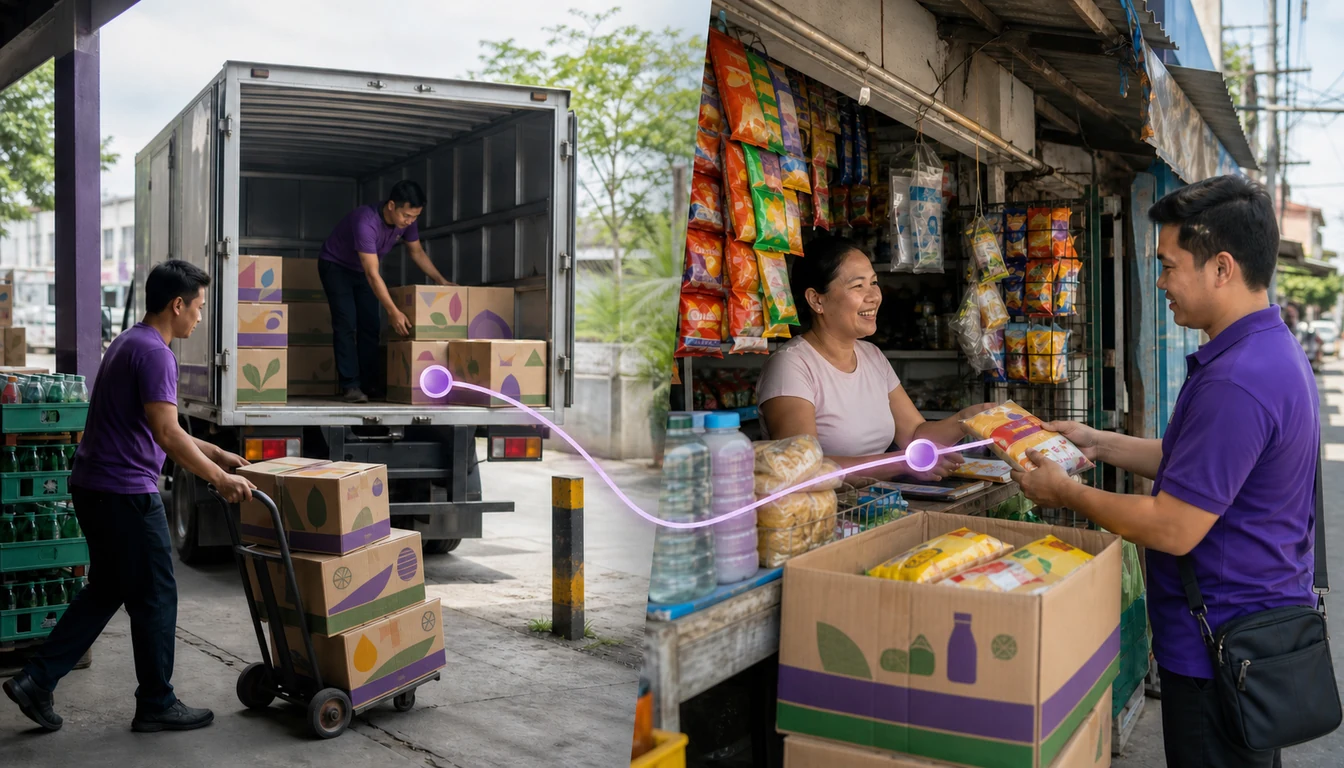
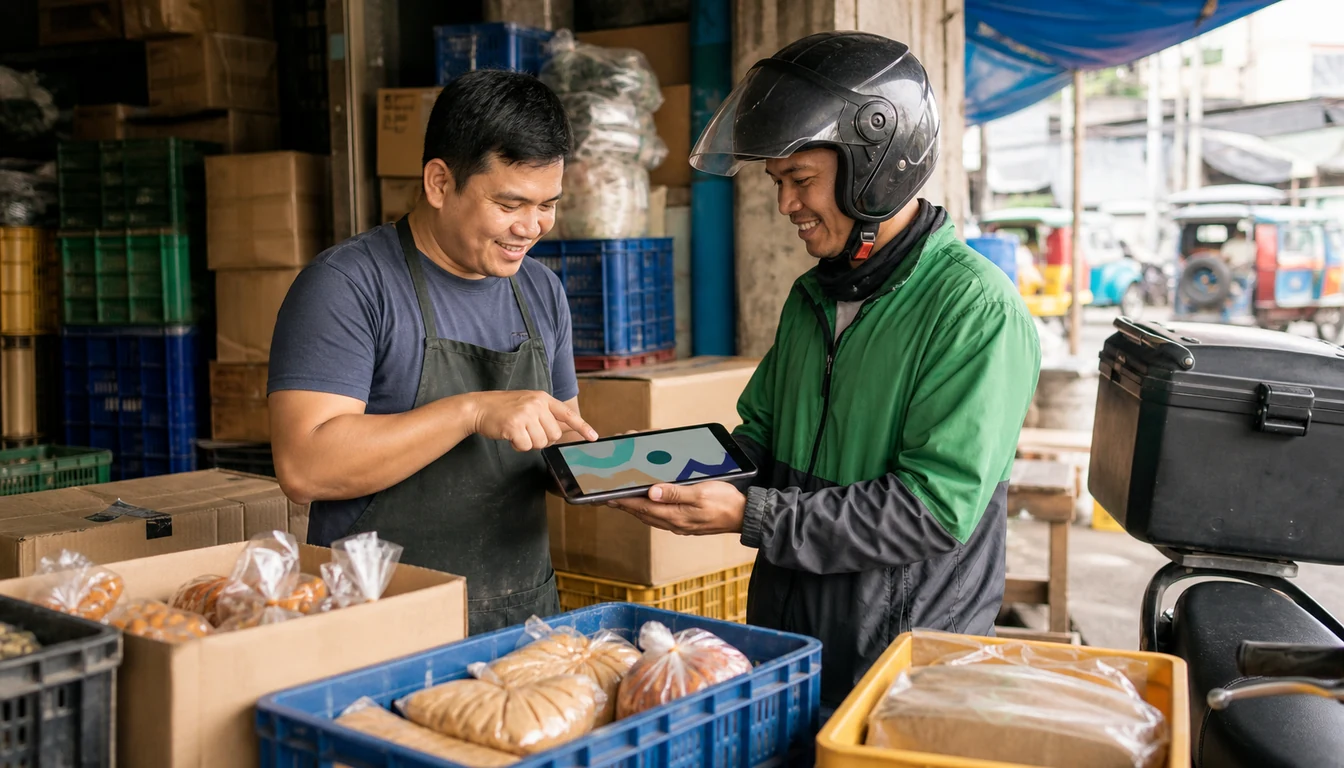
For most Philippine distributors, the order is only half the transaction. The other half happens later, when a van sales rep or pre-selling representative is standing in front of a sari-sari store owner with a stack of invoices and a canvas bag of cash, or worse, a post-dated cheque that will not clear for days. Cash goes missing on long routes, gets miscounted at the end of a shift, or simply does not make it back to the branch office on the same day it was collected. Cheques introduce their own lag: a payment is recorded as "received" on paper long before it actually clears the bank, leaving finance teams reconciling a promise rather than a settled transaction.
That collection model is changing quickly, and not because distributors are choosing to modernise for its own sake. Filipino consumers and outlet owners have already moved their everyday money onto e-wallets: GCash and Maya between them now reach an estimated 95% or more of digitally active Filipinos, from a sari-sari owner in a Visayas barangay to a modern trade buyer in Metro Manila. When the retailer on the other side of the counter already pays for groceries, mobile load and household bills through an app on their phone, asking them to keep a cash box aside for supplier settlements starts to look like the outdated step in the chain.
Behind GCash and Maya sit two interbank rails that make the shift possible at scale: InstaPay, which settles transfers in real time up to ₱50,000 per transaction, and PESONet, which handles bulk and scheduled transfers without that same per-transaction ceiling. Between them, a distributor can now collect same-day payment for a single small delivery and also receive a consolidated bulk settlement from a larger account, all without a rep touching physical cash. What most distributors have not yet solved is what happens after the money arrives: matching dozens of e-wallet payments a day back to the right outlet, the right invoice and the right sales rep.
Why cash and cheques still expose distributors to risk
Cash collection has always carried a simple, physical risk: a rep travelling a multi-stop route with a bag of collections is a target, whether the route runs through a dense barangay in Metro Manila or a rural stretch connecting one town to the next. Beyond the safety question, cash creates a chain of manual handoffs that each introduce error. A rep collects a few thousand pesos from one outlet and a smaller amount from the next, notes both in a paper logbook or a messaging thread, and only reconciles the total against the actual notes in hand once the shift ends, often a full day or more after the sale was made. Any shortfall, whether from an honest miscount or something less innocent, is discovered too late to trace back to a specific stop on the route.
Cheques solve the security problem but introduce a different one: timing. A cheque marked as collected does not represent cash in the bank. It represents a promise that clears, bounces, or sits in a drawer for days before anyone deposits it. Finance teams end up reconciling two separate ledgers, one for what reps say they collected and one for what has actually cleared, and the gap between them is where credit exposure quietly builds up on outlets that are, on paper, already "paid".
GCash and Maya: the new default for distributor collections
GCash and Maya did not need to be sold to Filipino consumers as a payment method. Both wallets were already the default way most digitally active Filipinos pay for load, bills, transport and everyday retail purchases, and sari-sari owners across Luzon, Visayas and Mindanao are as likely to have a GCash account open on their phone as they are to have a cash drawer under the counter. That existing familiarity is what makes e-wallet collection realistic for distributors: there is no new habit to teach an outlet owner, only a new payment option to offer alongside cash at the point of delivery.
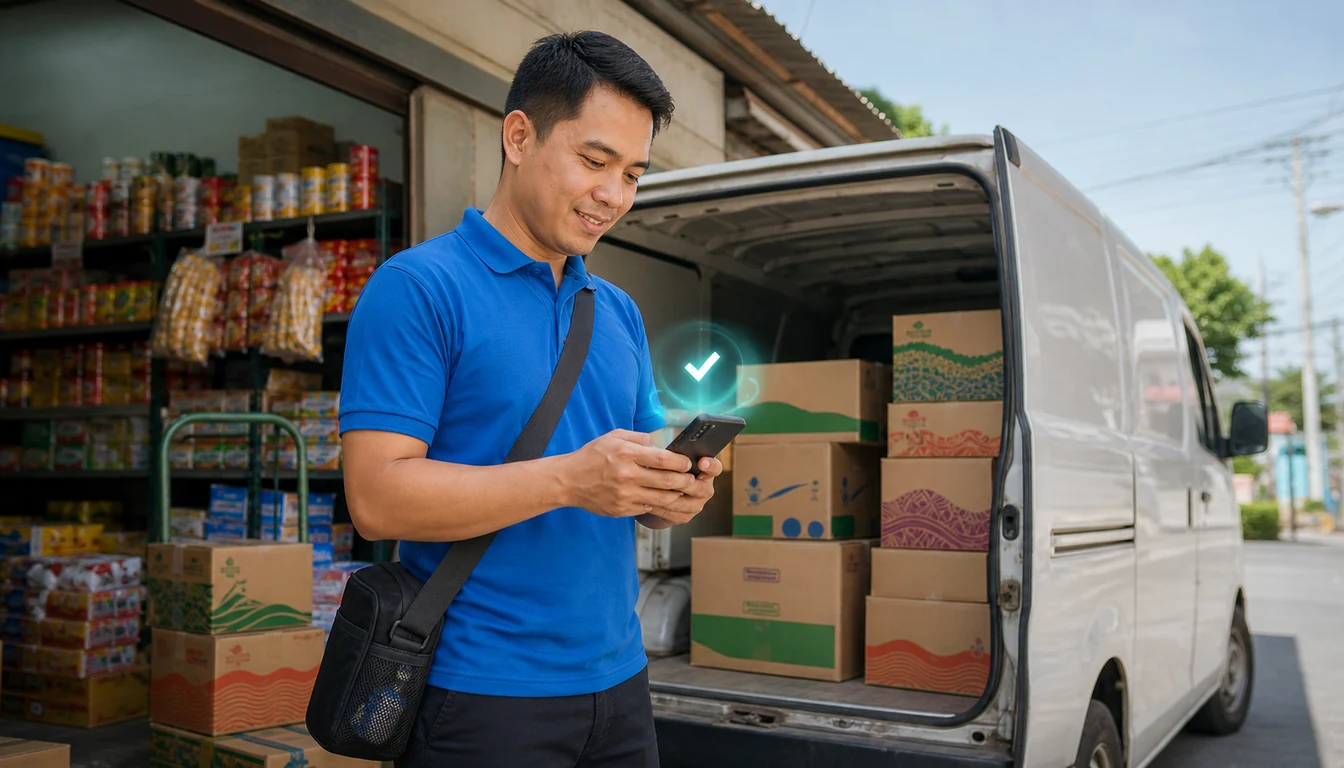
For the distributor side of the transaction, the appeal is less about consumer convenience and more about control. A payment made through GCash or Maya lands with a timestamp and a transaction reference the moment it happens, rather than sitting as an unverified note in a rep's logbook until end of day. Field teams working a route with sales force automation already logging the order, the invoice and the delivery confirmation can capture the payment in the same visit, closing the loop between "delivered" and "paid" without a separate reconciliation step days later. The result is less float sitting with reps overnight and a much shorter gap between an invoice being raised and a distributor actually having usable funds.
InstaPay and PESONet: choosing the right rail for the payment
GCash and Maya are the wallets outlets and reps interact with directly, but the settlement underneath runs on one of two interbank rails, and the difference between them matters for how a distributor structures collections across its account base.
InstaPay for real-time, per-invoice settlement
InstaPay moves money between banks and e-wallets in real time, crediting the receiving account within minutes rather than the next business day. Its ₱50,000 per-transaction limit is not a practical constraint for most single-outlet deliveries; a typical sari-sari or small retail invoice, even accounting for the high order frequency that tingi-driven restocking creates, rarely approaches that figure in one transaction. InstaPay is the natural rail for the everyday case: a rep completes a delivery, the outlet owner pays through GCash or Maya, and the distributor can see the funds settled before the rep has even left the barangay. For distributors running high call-frequency routes across many small accounts, that speed is what actually shortens the cash conversion cycle, rather than any single large payment.
PESONet for bulk and scheduled settlement
PESONet, by contrast, is built for batch and scheduled transfers rather than instant, one-off payments, and it does not carry the same per-transaction ceiling. It suits larger accounts settling on a weekly or monthly cycle rather than per delivery, such as a sub-distributor clearing several weeks of invoices in one consolidated transfer, or a modern trade buyer processing supplier payments through its own scheduled payment run. Because PESONet transfers can take longer to land, typically the same or next banking day rather than instantly, they suit accounts where the distributor already extends credit terms and is not depending on the transfer clearing within minutes. Structuring collections around both rails, InstaPay for frequent small settlements and PESONet for scheduled bulk ones, lets a distributor match the payment method to the actual credit and volume profile of each account rather than forcing every outlet through the same process.
Reconciling digital payments to the right outlet and invoice
Speed is only useful if the payment can be matched to what it was for. A distributor running tingi-driven order volumes might process dozens of small deliveries to sari-sari accounts in a single morning, several of them in the same barangay, some to the same store more than once in a week given how frequently sari-sari owners restock in small quantities rather than bulk. When a GCash or Maya payment lands with only a sender's mobile number and an amount, matching it back to a specific invoice, outlet and rep becomes a manual guessing exercise, especially when two outlets on the same route pay near-identical amounts on the same afternoon.
Payment references and QR-linked invoices
The fix is to make the invoice, not the outlet name, the thing a payment gets matched against. Generating a unique reference code or QR code at the point an invoice is raised, and asking the outlet to quote or scan that reference when paying through GCash or Maya, turns a loose bank memo field into a structured link back to a specific order. Reps working with a connected distributor order management workflow can raise that reference at the same moment the invoice is generated, so there is no separate step for anyone on the route to remember.
Matching multi-invoice accounts and running balances
The second half of the problem is accounts that do not pay invoice by invoice. Sub-distributors and wholesalers frequently run a tab across several weeks of deliveries and clear it with one bulk PESONet transfer that does not map cleanly to any single invoice number. Without a system tracking a running balance per account rather than a flat list of unpaid invoices, that kind of bulk payment either gets applied to the wrong invoices in sequence or sits unreconciled until someone manually works through the account history. Visibility into which invoices are actually outstanding, refreshed as each payment lands rather than at a manual month-end close, is what keeps that kind of account from silently drifting into an overdue balance nobody has flagged.
The sari-sari tier is still cash-heavy, and that's fine if the system accounts for it
None of this means cash disappears. Sari-sari stores, the roughly 1.1 million small, often family-run outlets that between them drive an estimated 60% of the country's FMCG sales, are not a uniform tier. Urban stores in Metro Manila or Metro Cebu increasingly lean on e-wallets because their owners already use GCash or Maya for everything else. Rural stores further from a city centre are more likely to lean on wholesalers and market stalls for supply, and are more likely still to settle in cash, whether from habit, from limited signal in the barangay, or simply because the owner is more comfortable with physical notes changing hands than with a phone screen.
Connectivity is a real constraint here, and an honest one. The Philippines is an archipelago of roughly 7,641 islands across Luzon, Visayas and Mindanao, and typhoon season, an average of around 20 storms a year with several making landfall, routinely disrupts mobile signal and even shuts ports and grounds flights for days at a stretch. A route that runs through a dead zone cannot depend on a real-time InstaPay confirmation arriving before the rep needs to move on to the next stop.
Recording every payment type in one place
A distributor does not need every outlet to pay digitally to get the benefit of digital collections. What it needs is every payment, cash, cheque, GCash or Maya alike, recorded against the same invoice in the same system, rather than digital payments living in one reconciliation process and cash living in a separate paper trail. Field teams working field activity management tools that log a cash collection with the same rigour as a digital one, amount, invoice reference, timestamp and geotag, close most of the reconciliation gap even on routes where the outlet has no realistic way to pay by wallet.
Offline-first logging for routes without signal
For the routes where connectivity itself is the obstacle, whether a rural barangay or an inter-island leg reachable only by ferry, the practical answer is offline-first capture: the rep records the collection on the device at the point of sale regardless of signal, and it syncs the moment connectivity returns. That is a genuinely different problem from an unreliable power supply; it is a signal and geography problem specific to an island nation with a seasonal storm pattern, and it is worth designing the collection workflow around rather than assuming every stop on a route has a live connection.
BIR e-invoicing readiness: a phased rollout, not a single deadline
Collections are not the only place digitisation is reaching distributors. The Bureau of Internal Revenue's Electronic Invoicing System, introduced under the EOPT Act (Republic Act 11976), is being phased in for large taxpayers, e-commerce sellers and businesses already using a computerised accounting system, with full coverage for VAT-registered taxpayers targeted from 2027. It is not, today, a requirement for every distributor or every sari-sari account in the country, and framing it that way overstates where the rollout actually stands.
What it does mean is that distributors who fall inside the current scope, or who expect to as coverage expands, benefit from having structured, invoice-level records already in place rather than retrofitting them later. A system that already generates a unique reference per invoice, tracks payment status against it and keeps that record electronically is most of the way toward EIS-ready invoicing, whether or not a given distributor is in scope this year. Distributors preparing early are not chasing a hard deadline that applies to them today; they are avoiding a scramble once the coverage does reach them.
Discipline and fraud prevention in field collections
Cash collection is also, bluntly, where the most common discipline problems in a distribution business show up. A rep under pressure on target might delay banking a collection to cover a personal shortfall, apply a discount that was never authorised to move stock faster, or simply under-report what was collected at a stop and hope nobody checks the invoice against the payment. None of that requires dishonesty on a grand scale, it just requires a gap between what happened on the road and what the back office can actually verify.
Digital collection closes most of that gap by default. A GCash or Maya payment against a specific invoice reference cannot be quietly under-reported the way a cash figure written in a logbook can, because the transaction record exists independently of what the rep chooses to report. Pairing that with approval workflows for anything unusual, an invoice discounted beyond a set threshold, a payment that does not match any outstanding balance, a collection recorded well after the delivery timestamp, gives a distributor's finance team a way to flag exceptions as they happen rather than discovering them during a monthly audit. That kind of visibility does not need to feel punitive toward reps; it also protects an honest rep from being blamed for a discrepancy they did not cause, since the record shows exactly what was collected, when, and against which invoice.
How 1Channel brings order-to-cash together for Philippine distributors
1Channel's order-to-cash workflow is built around the reality described above rather than a single "digital-only" assumption. Every invoice raised through the platform carries a unique reference that a GCash, Maya, InstaPay or PESONet payment can be matched against automatically, so reconciliation happens at the moment a payment lands rather than during a separate end-of-day or end-of-month process. Cash and cheque collections are captured with the same invoice-level rigour, geotagged and timestamped at the point of sale, so a distributor gets one collections ledger rather than a digital one and a paper one that have to be manually merged.
For routes where connectivity is not guaranteed, whether a rural barangay or an inter-island leg, the mobile app captures collections offline and syncs automatically once signal returns, so a typhoon-disrupted route does not become a reconciliation backlog. And because every invoice already carries structured, electronic records by default, distributors preparing for BIR's phased Electronic Invoicing System coverage have a system that already aligns with EIS-style invoicing rather than one that needs to be rebuilt around it later. The aim is a single, current view of what has been ordered, delivered, invoiced and collected, across every payment method an outlet actually uses.
See Every Peso Collected, in One System
Match GCash, Maya, InstaPay and PESONet payments to the right invoice automatically, and keep cash and cheque collections in the same ledger, all from one cloud-based order-to-cash workflow built for Philippine distributors.
Explore Payment Management →Key Takeaways
Digital collections are changing how Philippine distributors manage order-to-cash, but the shift only pays off when it is matched with the right reconciliation, offline coverage and compliance groundwork.
- Cash and cheques create a reconciliation lag. Cash risks security and miscounts on the road, while a cheque records a promise rather than a settled payment, leaving two ledgers that need to be manually matched.
- GCash and Maya are now the default collection method. Combined reach of an estimated 95% or more of digitally active Filipinos means offering e-wallet payment is no longer a novelty for most outlets.
- InstaPay and PESONet serve different jobs. InstaPay settles small, per-invoice payments in real time up to ₱50,000 per transaction, while PESONet handles bulk, scheduled settlements for larger accounts.
- Matching payments to invoices needs structure, not guesswork. Unique invoice references or QR codes turn a loose e-wallet payment into a reconciled transaction rather than a manual lookup.
- The sari-sari tier will stay partly cash-based. Rural connectivity gaps and habit mean cash and offline-first logging remain necessary alongside digital rails, not a stopgap to be phased out.
- BIR e-invoicing readiness is worth building toward early. EIS coverage is phased through 2027 for specified taxpayers, but structured, invoice-level records now help avoid a scramble once coverage expands.