Every SKU in a distribution system is counted in one base unit, and every box, packet or carton is simply a multiple of it.
This post explains the three settings that define a conversion, builds a two-step unit chain, and works through one counted product and one weighed product.
Unit conversions carry the most weight in FMCG, Building Materials, Agriculture and Pharma distribution.
Each of them sells one SKU as a box to a distributor, a packet to a wholesaler and a single piece to a retailer.
Three Settings Behind Every Conversion
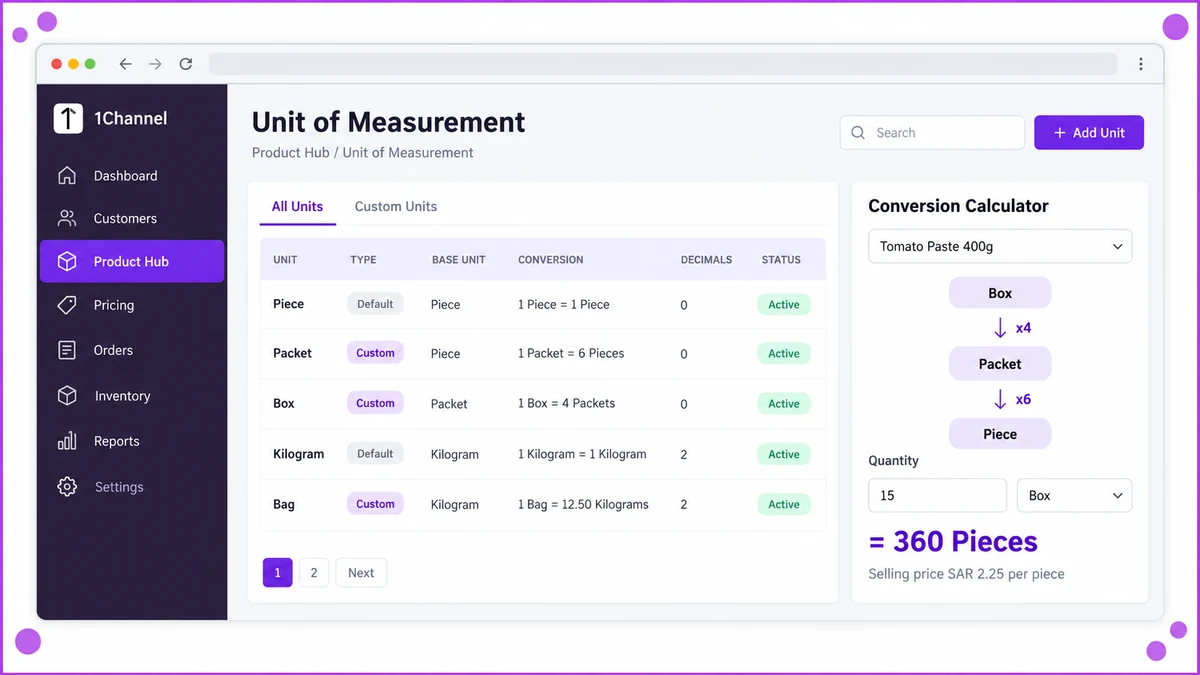
Conversions live in the Unit of Measurement master, which sits inside Product Hub alongside brands, categories, products and SKUs.
| Setting | What it controls | Example |
|---|---|---|
| Base unit | The smallest unit that cannot be split further | Piece |
| Conversion factor | How many base units make one larger unit | 1 Box = 20 Pieces |
| Decimal places | Precision for quantities measured by weight, volume or length | 12.50 kg per bag |
A pure count, such as pieces in a box, never needs decimals. The setting only matters when the base unit is measured rather than counted.
Building a Two-Step Unit Chain
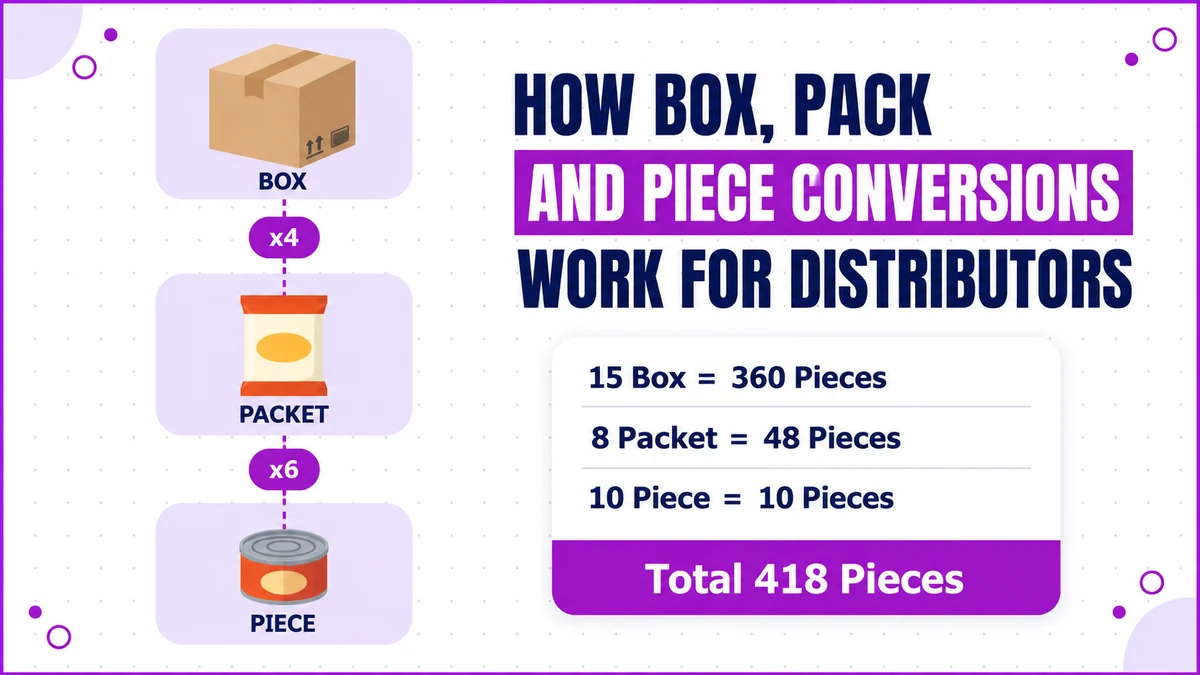
Many SKUs move through more than one pack size. The conversion calculator lets an admin chain them, so Box converts to Packet and Packet converts to Piece.
- Set Piece as the base unit for the SKU.
- Define 1 Packet = 6 Pieces.
- Define 1 Box = 4 Packets, which resolves to 24 Pieces.
- Save the chain, so order entry accepts any of the three units.
Conversions Inside Real Orders
A Counted Product Ordered Three Ways
A distributor in Jeddah orders tomato paste 400g, which uses the chain above and a selling price of SAR 2.25 per piece.
| Line entered | Base units | Line value |
|---|---|---|
| 15 Box | 360 Pieces | SAR 810.00 |
| 8 Packet | 48 Pieces | SAR 108.00 |
| 10 Piece | 10 Pieces | SAR 22.50 |
All three lines resolve to one total of 418 pieces, which is the figure checked against available stock for that SKU.
A Weighed Product With Decimals
Basmati rice is sold by weight, so its base unit is Kilogram and the conversion carries two decimal places.
One bag is configured as 12.50 kg. An order for 3 bags resolves to 37.50 kg, and 8 bags to exactly 100.00 kg.
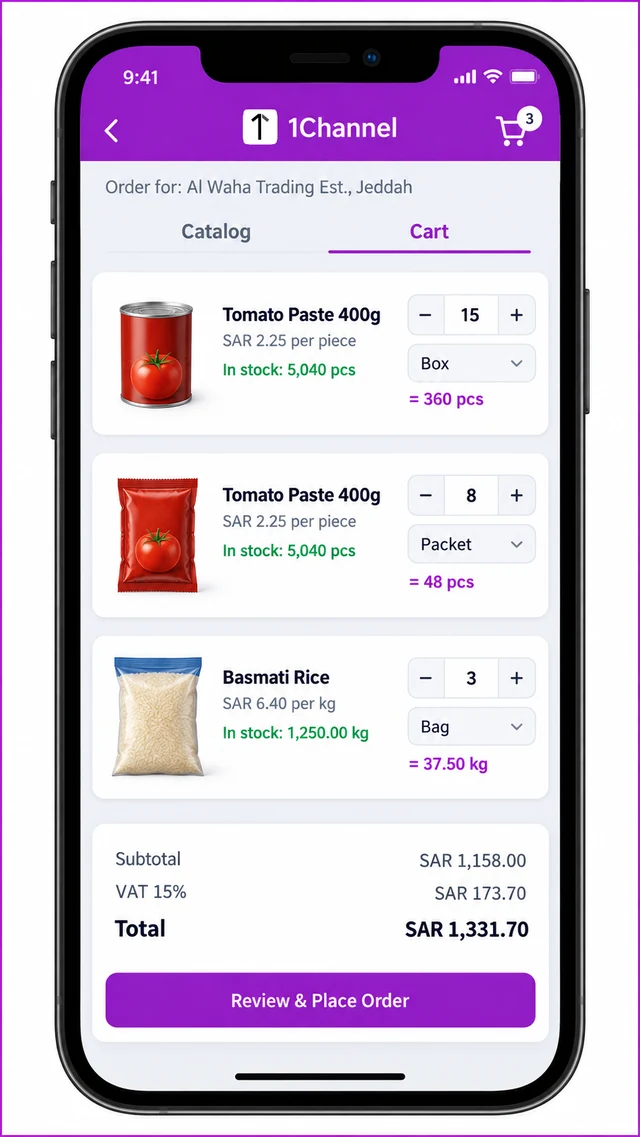
In the field app, each catalogue row shows the price per unit and live stock, so a rep can check availability before adding boxes to the cart.
Why the Base Unit Must Be the Smallest
If Packet were set as the base unit, a retailer asking for ten loose pieces could not be entered at all.
Choosing the indivisible unit first keeps every larger pack a clean multiple, and keeps every order line comparable.
How 1Channel Converts Pack Sizes at Order Entry
1Channel keeps the base unit, conversion factors and decimal rules on the SKU itself, inside one cloud product master.
Order quantities convert automatically as lines are added, so admins maintain a single stock figure for every pack size.
Sell by Box, Packet or Piece From One SKU
See how distributors in Saudi Arabia define unit chains per SKU and take orders in whichever pack size each customer buys.
Explore SKU Management Software →What This Looks Like in Practice
- A modern trade buyer orders 40 boxes, which the order records as 960 pieces.
- A wholesaler orders 12 packets of the same SKU, billed at the same per-piece rate.
- A baqala takes 18 loose pieces, with no separate SKU created for single units.
- A hardware dealer orders bagged adhesive by weight, and the decimals carry through to the invoice.
Note: Software screens may vary based on your business structure and configured workflows.