A new round of industry analysis this month puts a number on something most FMCG and retail teams already sense.
Across sub-Saharan Africa's informal channels, 40 to 90% of food sales still move through outlets no head-office dashboard was built to see.
This shows up hardest for teams selling through FMCG, cosmetics and personal care, modern trade retail, and consumer durables.
Any brand running field merchandising across many stores feels the same blind spot, whichever category it sells.
The sharper point in this month's commentary is not that number. It is a shift toward closing what analysts are calling execution gaps, the space between a system knowing something is wrong on shelf and someone actually fixing it.
This post covers what those gaps actually are, why a dashboard alone does not close them, and what a field system needs to carry the fix through.
What "Execution Gaps" Actually Cover
Recent industry commentary singles out five recurring execution gaps in African retail. Each one is a place where a brand loses revenue between knowing something and acting on it.
- Promotion compliance — whether an agreed promotion is actually live on shelf in every store, not just approved at head office.
- Price accuracy — whether the price on the shelf matches what was decided, before it costs margin.
- Fresh-food replenishment — restocking perishables against real demand, not a fixed weekly cycle.
- Fulfilment reliability — making sure stock shown as available online is actually available in the store fulfilling it.
- Inventory availability — catching a stockout before it shows up as lost sales.
Why Watching Isn't the Same as Closing
The commentary frames the fix as an autonomous enterprise model. AI agents coordinate routine decisions and act on them directly, while people keep control of strategy, policy, and risk tolerance.
It also makes a point specific to this market. African retail systems have to work with informal channels, mixed store formats, and uneven connectivity, so an AI model built for consolidated Western retail chains does not transfer as-is.
| Execution Gap | What a Dashboard Reports | What Closes It in the Field |
|---|---|---|
| Promotion compliance | Which stores ran the promo, after the fact | A rep prompted on-site, with the display checked before leaving |
| Price accuracy | A mismatch flagged once revenue is already lost | The wrong price caught during the same shelf check |
| Fresh-food replenishment | Stock-outs by SKU, reported the next morning | A reorder triggered off actual shelf depletion, same visit |
| Fulfilment reliability | Online stock shown available, store stock telling a different story | One stock number both channels actually check against |
| Inventory availability | A stockout total for the week | Which store, which SKU, flagged before the shelf empties |
How 1Channel Closes These Gaps in the Field
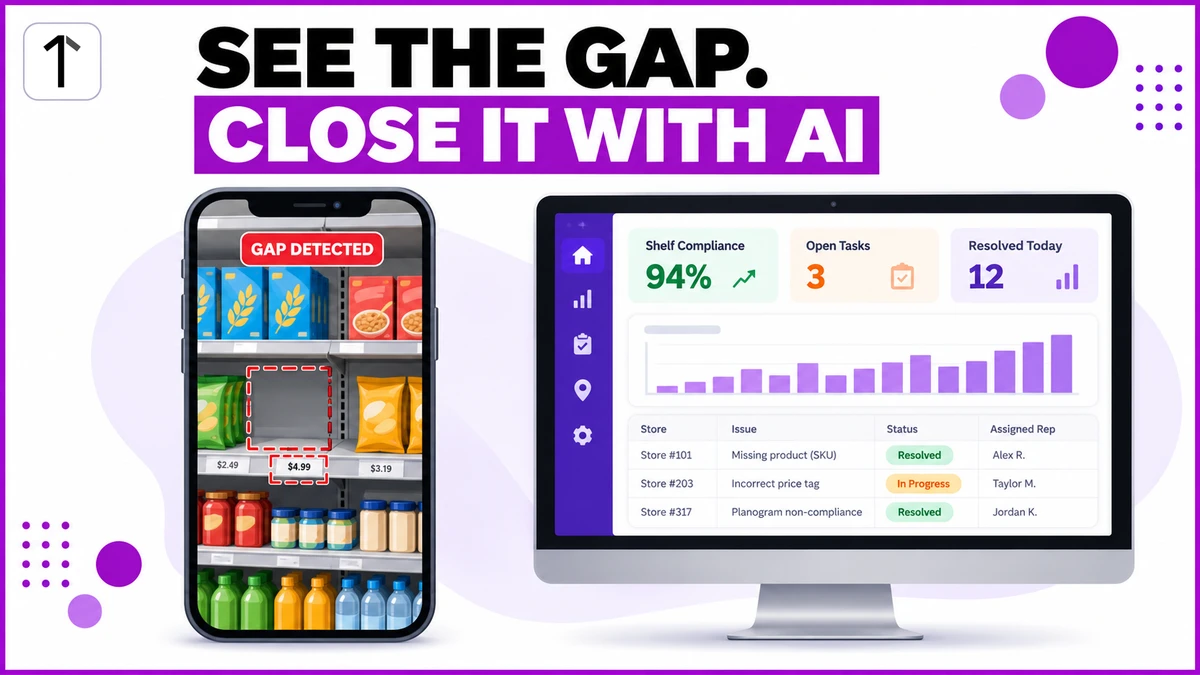
1Channel's retail execution platform already scores exactly these gaps from the same shelf photo a field rep takes on a normal store visit.
Computer vision measures a brand's actual share of shelf, checks it against competitors, and tracks compliance against the agreed must-stock list.
The same image recognition verifies product visibility, audits point-of-sale material, and scores how well a promotion or activation actually landed in-store.
None of that sits in a report a manager reads on Monday. A flagged gap becomes a task assigned to the rep standing in the aisle, the same visit.
Turn Every Shelf Photo Into a Closed-Out Task
See how 1Channel's retail execution platform scores compliance, pricing, and shelf availability from a single photo, and assigns the fix on the spot.
Explore Retail Execution Software →Common Mistakes to Avoid
- Treating a shelf audit as a report instead of a task someone is assigned to close before leaving the store.
- Checking compliance on a fixed schedule instead of every visit, so a gap sits open for days.
- Keeping online stock and in-store stock on separate numbers, so fulfilment promises what the shelf cannot deliver.
- Reviewing price accuracy after the sales report, once the margin is already gone.
- Assuming one AI model fits every store format, when a spaza shop and a modern-trade chain need different execution rules.
Source: SAP Africa News Center