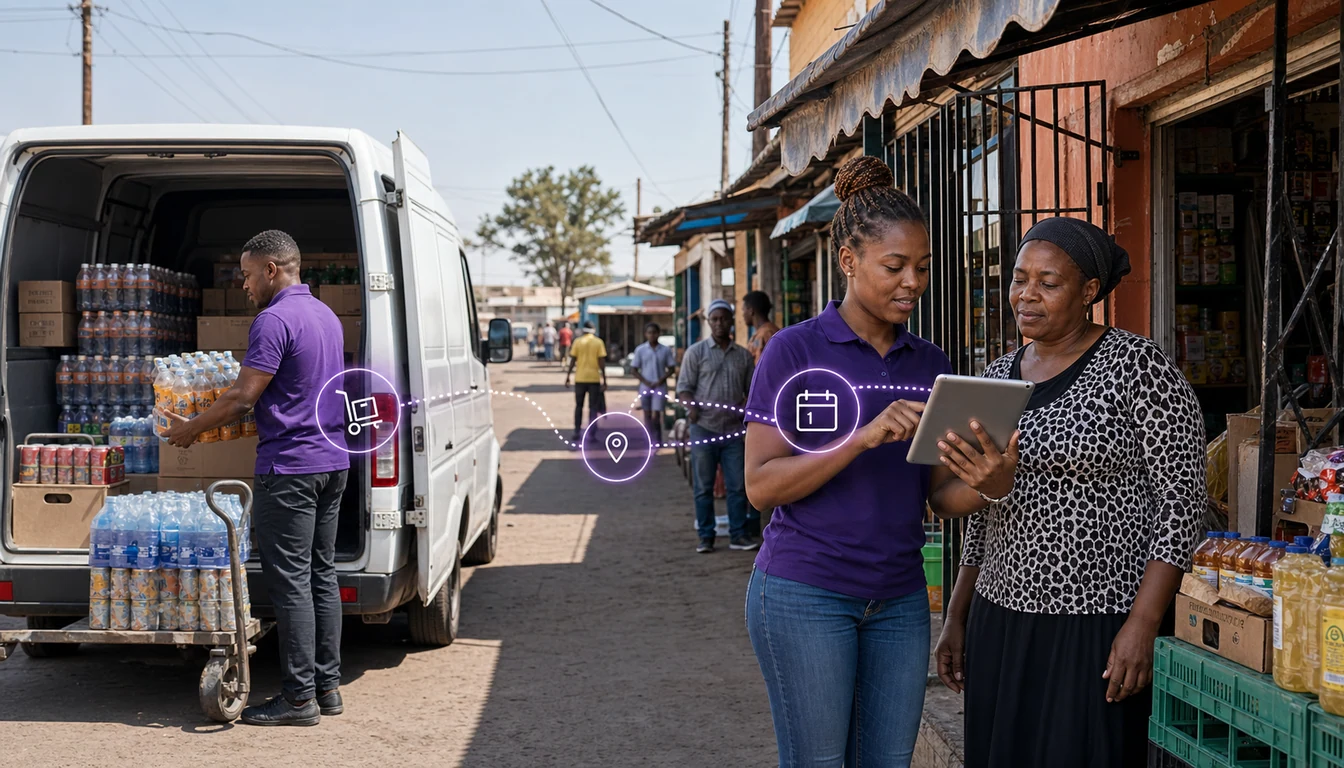
South Africa asks a brand to win twice. Volume moves through the national chains and their planograms, and it moves through the spaza shop on a Soweto corner, the tuck shop beside a school in Mdantsane and the tavern trading off a side street in Khayelitsha.
Neither channel is a rounding error here. Modern trade is mature and demanding, township trade is dense and still growing, and the formal independent stores and cash-and-carry counters in between feed both. A brand that only knows how to sell to one of them leaves the other on the table.
Winning across both is not a matter of raising trade spend and hoping the stock disappears. It is about seeing what really happens between your plant and the till in each channel, then holding the field discipline that shifts it week after week.

Map Both Halves of Your Route to Market
A South African route to market rarely runs on one track. Part of the volume goes direct to a national chain's distribution centre on agreed terms. The rest flows through a distributor, then through independent wholesalers and cash-and-carry counters, and finally out to spaza shops, tuck shops, taverns and forecourt stores.
A case can change hands three or four times before a shopper buys a single unit. Every hand-off is a point where visibility, pricing discipline and stock freshness quietly slip.
Before you spend on field teams or software, be honest about how your product actually travels in each province. The pattern is nowhere near the same everywhere:
- Gauteng (Johannesburg, Pretoria): the densest mix in the country, where chain distribution centres, high-turnover township routes through Soweto, Alexandra and Tembisa, and the trading around the Bree taxi rank and City Deep all sit within a short drive of each other.
- KwaZulu-Natal (Durban, Umlazi): port-led volume feeding the N3 corridor, with Warwick Junction working as a redistribution engine for traders right across the metro and well beyond it.
- Western and Eastern Cape (Cape Town, Gqeberha): long runs between towns along the N2, established independent wholesale serving Khayelitsha, Mitchells Plain and Mdantsane, and rural routes where a rep covers far fewer outlets in a day.
Once you can describe the route province by province, you can decide where you sell direct, where a key-account manager owns the relationship, and where you lean on a distributor's own reps. That map becomes the backbone for beat plans, targets and reporting.
Build for the Coverage You Actually Get
Anything you put in a rep's hand has to keep working where the signal does not. Mobile coverage thins out on rural routes between towns, and it falls away in pockets of dense township trade and deep inside the busiest trading halls. Mobile data costs enough that reps ration it.
If your field process assumes a live connection, it will fail in precisely the places your volume sits. Here is what offline-first has to mean on the ground:
- Capture works with no signal at all. A rep logs the call, the order, distributor stock and a shelf photo inside the market, and the app syncs later when the phone picks up a network on the main road.
- Entry-level Android is the norm. Field teams carry modest handsets with limited storage, so the app has to stay light on space, battery and data rather than assume a flagship phone.
- Outlets are mapped by GPS and landmark. Where street addressing is inconsistent, you find the spaza shop "behind the taxi rank" from a geo-tag captured on the very first call.
Get this right and your coverage data is worth trusting. Ignore it and reps mark calls from home while managers argue over figures nobody believes.
Measure Coverage and Sell-Out, Not Just Billing
Primary sales, what you invoice to distributors and chain distribution centres, is the easiest figure to see and the most misleading to run a business on. A distributor can load up to clear a scheme target and then sit on the stock for weeks, so a strong primary month happily hides a weak one at retail.
What tells you the brand is genuinely moving is secondary sales: stock leaving the distributor and landing on a chain shelf, an independent store's rack or a spaza counter. The measures worth watching across both South African channels are few and practical:
- Outlet coverage: how many mapped spaza shops, tuck shops, independent stores and chain outlets on a beat were genuinely called on this cycle.
- Productive calls and strike rate: the share of calls that ended in an order rather than a greeting.
- Range selling: how many of your lines the average outlet carries, given that a small township store will cheerfully stock your single fastest mover and nothing else.
- Primary versus secondary gap: whether stock billed out is really selling through to retail or banking up in a warehouse.
The Weekly Rhythm That Makes It Stick
Set a beat plan per rep, review coverage and strike rate every week, and work the outliers. Chase routes with plenty of calls and no orders, outlets that quietly dropped off the list, and distributors whose sell-out trails their buy-in.
That weekly loop, held to consistently, does more for growth than a quarterly promotion. To run it, the field team needs a way to capture geotagged calls, van-sales orders and secondary sales offline, and turn them into reports nobody has to rebuild by hand.
Keep Distributor Credit and Collections Tight
Order-to-cash is where margin leaks without anyone noticing. Trade runs on credit at every step: the distributor extends it to the wholesaler, and the wholesaler extends it to the shop owner.
Township trade is still largely a cash business, though card, instant EFT and PayShap are picking up quickly. Whenever a rep takes cash in a busy market, the risk of leakage, mis-posting and disputes is real.
A few practical habits cut both the leakage and the arguments:
- Match every collection to an invoice in the field. The rep records the payment and its reference against the specific outlet and invoice at the moment of collection, never from memory at the end of the day.
- Track what is outstanding by outlet and by distributor. Ageing that everyone can see stops credit drifting into bad debt.
- Reconcile electronic payments the same day. As more rand arrives by instant EFT, matching references quickly settles the "I paid it" against "we never saw it" standoff.
Win Two Very Different Shelves
In a national chain the shelf is a planogram, a share of facings and a promotion you have already paid for. In township trade it is a crowded counter, a hanging strip and whatever the shopper notices first. Both settle the sale far more often than advertising does.
That makes retail execution a daily job rather than a campaign. The right lines have to be present, priced properly and visible. Here is how execution differs by outlet type:
- Photo proof of execution: a quick in-store photo shows the strip is hung and the signage is up, which counts for most where there is no planogram to audit against.
- Share of shelf where it can be measured: in the national chains, facings and compliance against the agreed planogram give a key-account manager something concrete to act on.
- A must-stock list per outlet type: a spaza shop, an independent store and a chain outlet each carry a different realistic range, so set the target to match.
- Watch pricing down the chain: when a cash-and-carry counter undercuts, retailer margin goes with it across a whole province, so surface street pricing from the field.
The Field Force Is the Distribution Asset
Your field team is multilingual by default. Depending on the route that means English alongside isiZulu, isiXhosa, Afrikaans, Sesotho or Setswana, and many reps are early in their careers, mobile-first and easy to lose to a better offer.
The brands that win invest in honest beat plans, targets a rep can actually hit, and tools that make the day lighter instead of heavier. When the app helps a rep place an order and get paid sooner, adoption looks after itself; when it exists only to police them, the data rots.
A Gauteng Distributor Scenario
Picture a biscuit brand working through a single Johannesburg distributor covering Soweto and part of the southern suburbs. On paper the distributor buys well every month, so head office assumes coverage is healthy.
In practice three reps split several hundred outlets between the chain stores on the main road and the spaza shops behind them, and nobody can say which were skipped this cycle. A simple weekly cadence changes what you can see:
- Map every outlet once against a geo-tag and a landmark, because street numbering will not carry you.
- Give each rep a fixed beat so the same outlets come up on the same days each week.
- Capture every call offline with the order, a shelf photo and any cash or electronic payment taken.
- Review coverage and strike rate every Monday and reassign whatever was missed.
Within a few cycles the gap between what the distributor buys and what actually lands at retail becomes visible, and the brand can work on it instead of guessing.
Where Dual-Channel Programmes Come Unstuck
- Running the business on primary sales. Loading a distributor to hit a target without watching sell-out only pushes the problem further down the chain.
- Treating both channels as one motion. A chain call and a spaza call need different questions, different targets and different reporting, even from the same rep on the same day.
- Assuming a live connection. Any process that stalls the moment coverage gives out will stall in exactly the markets that matter most.
- Chasing outlet count ahead of outlet quality. A thousand outlets called on once are worth less than a tight beat covered reliably every cycle.
- Letting pricing run loose. Undisciplined wholesale pricing destroys retailer margin and takes your distribution down with it.
- Treating the app as surveillance. If reps see nothing in it for them, they will game the data and you will manage on fiction.
How 1Channel Helps Brands Run Both Channels
Running both channels well needs one connected view of what happens between the plant and the till. 1Channel brings coverage, orders, collections and execution together in a single offline-first platform that suits South African trade on either side of the split.
Reps work on entry-level Android handsets, capture calls with no signal, and sync when the network returns. Managers get coverage and sell-out figures they can defend instead of calls logged from a sofa.
On this topic, the platform helps you:
- Map outlets by GPS and landmark, then build a beat per rep, route and province.
- Capture geotagged calls, van-sales orders and secondary sales entirely offline.
- Match cash, card and instant EFT collections to the right outlet and invoice on the spot.
- Run photo-based execution and planogram checks, and surface street pricing down the chain.
- Watch coverage, strike rate and the primary-versus-secondary gap week by week.
Run One Field Team Across Both South African Channels
See how 1Channel's offline-first sales force automation handles geotagged outlet calls, van sales, secondary-sales capture, collections and analytics on one platform built for chain accounts in Gauteng and township routes across KwaZulu-Natal and the Western Cape.
Explore Sales Force Automation →Key Takeaways
Winning both channels comes down to a handful of unglamorous habits repeated every cycle. Keep these in front of the team:
- Know both routes to market. Map how the product really travels, province by province, before spending on people or tools.
- Build offline-first. Capture the call wherever coverage gives out, on the handsets reps actually carry.
- Manage on coverage and sell-out. Billing alone hides weak movement, so watch what reaches the shelf.
- Hold collections tight. Match payments to invoices in the field and reconcile electronic transfers the same day.
- Back the field force. Fair targets and tools that make a rep's day easier will always beat tools built only to watch them.
Get those right and growth follows the market instead of fighting it.