The training happened. Reps sat the session, passed the quiz and went back to their pharmacy calls. What often goes missing is the record that proves it.
South Africa's skills system asks for that record every year, and pharma teams feel it most, along with cosmetics, FMCG and consumer durables brands.
This post compares paper training records with digital certificates that carry an ID, an issue date and public verification.
It covers what each certificate holds, how an outside verifier checks one, and two pharma teams that moved off sign-in sheets, then answers common 30 April questions.

Where Paper Training Records Break Down
Most pharma training teams still run on signed attendance registers, emailed PDFs and a spreadsheet someone updates when they have time.
That works until the Annual Training Report is due. It goes to the company's SETA with the Workplace Skills Plan by 30 April each year.
Employers with a payroll above R500,000 pay a levy of 1% of payroll, and a complete, on-time submission recovers 20% of it as a mandatory grant.
Late or incomplete submissions generally forfeit that grant.
B-BBEE verification adds a second check. Training counts toward the skills development element only when it can be evidenced per learner.
That matters to pharma brands supplying government or large corporate buyers. Paper fails both checks in the same ways:
- Sign-in sheets get lost between regional offices and head office.
- Handwritten names do not match the names on the payroll list.
- An emailed PDF certificate cannot be checked by anyone outside the company.
- Nobody can say which reps completed a module and which only attended.
What a Digital Certificate Record Holds
In 1Channel's learning hub, a certificate is issued when a learner completes a course or passes a quiz.
Each certificate under My Certificates shows the following:
| Field | What it shows | Why it helps at verification |
|---|---|---|
| Template | The certificate design the course uses | Every course issues a consistent document |
| Status | Valid, or moved to the Expired tab | Lapsed training is easy to spot |
| Course or quiz | The training it was earned for | Ties the certificate to one module |
| Certificate ID | A unique reference number | One ID to quote and check |
| Issue date | When the learner earned it | Places training in the right reporting year |
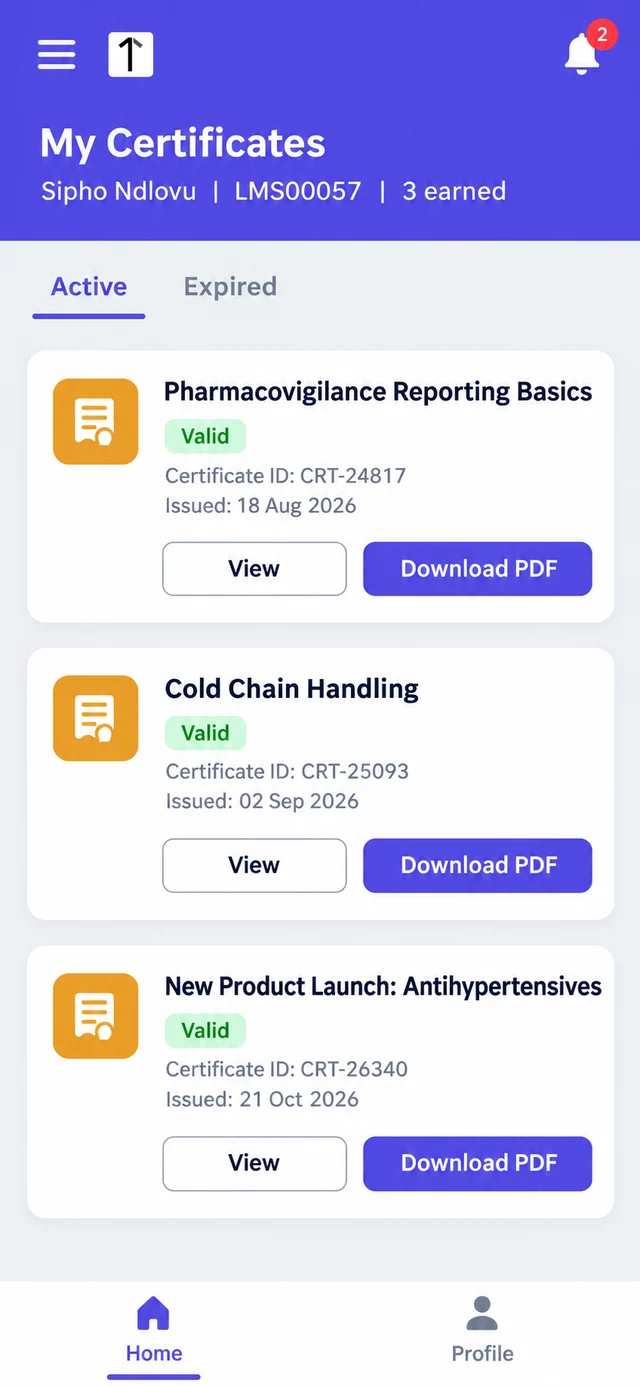
The learner can view each certificate or download it as a PDF from the phone.
The PDF carries the client's logo, the learner's name, the course, the completion date and a sponsor signature line, along with the certificate ID.
Public Verification for Outside Checks
1Channel's certificates are branded and publicly verifiable, so a third party can confirm one is genuine rather than taking a PDF at face value.
For a B-BBEE verification analyst sampling learners, or a query on the Annual Training Report, that turns a file search into a quick check.
Before and After: Two Pharma Training Teams
A generic medicines company in Gauteng. Before, 72 medical reps attend a new-product session in Midrand, and HR builds the April report from four managers' sign-in sheets.
Two sheets arrive in March, eleven reps appear twice under different spellings, and three are missing.
After the switch, the module ends with a quiz at a 70% pass mark, and each rep who passes gets a certificate with its own ID.
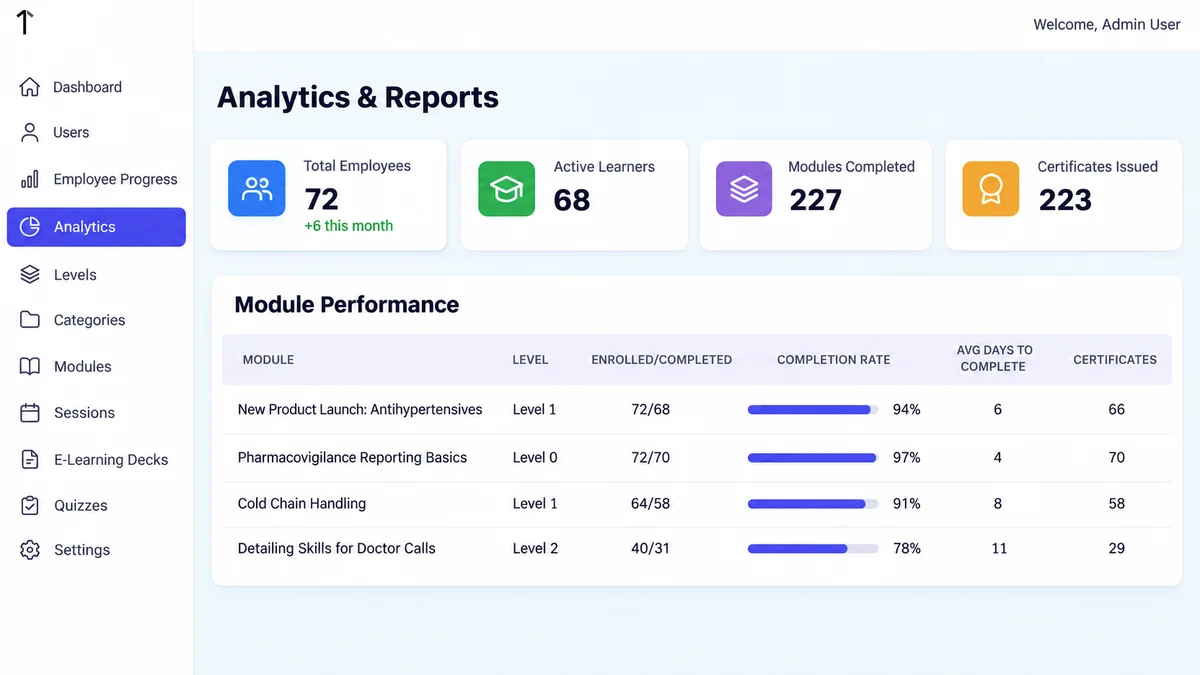
Module Performance in Analytics and Reports shows enrolled against completed reps and the certificates issued for that module.
Employee Progress then exports each rep's record to Excel, so the report is built from one list instead of four.
A consumer health brand in KwaZulu-Natal. Before, trainers coach pharmacy promoters in stores across Durban and Pietermaritzburg, then email photos of handwritten registers.
After the switch, each In-Store session is marked by the trainer from their own login, with a photo of the trainee.
Promoters who pass the product quiz receive a certificate, and Trainer Performance shows sessions conducted and certificates issued for each trainer.
When the verification analyst samples 15 promoters, HR shares their certificate IDs, and each one is confirmed through public verification.
How 1Channel Turns Training Into Evidence
1Channel's sales team LMS keeps sessions, attendance, quizzes and certificates in one cloud system, so each certificate traces back to the training behind it.
Certificate templates are set up for each client, and the app runs in multiple languages configured to the client's requirement.
Give Every Training Record a Certificate ID
See how 1Channel issues verifiable certificates and keeps attendance, quizzes and completions in one place ahead of 30 April.
Explore Sales Team LMS →FAQs
When is the Annual Training Report due?
The Workplace Skills Plan and Annual Training Report go to your SETA by 30 April each year. The report covers training delivered in the year before.
Who pays the Skills Development Levy?
Employers with an annual payroll above R500,000 pay 1% of payroll. An on-time, complete submission recovers 20% of the levy as a mandatory grant.
Does a training certificate count as B-BBEE evidence?
Advisory guidance treats a certificate of completion as supporting evidence for a skills intervention. Confirm the full evidence pack with your verification agency.
Can someone outside the company check a certificate?
Yes. 1Channel certificates are publicly verifiable, and each one carries a unique certificate ID and an issue date.
Note: Software screens may vary based on your business structure and configured workflows.