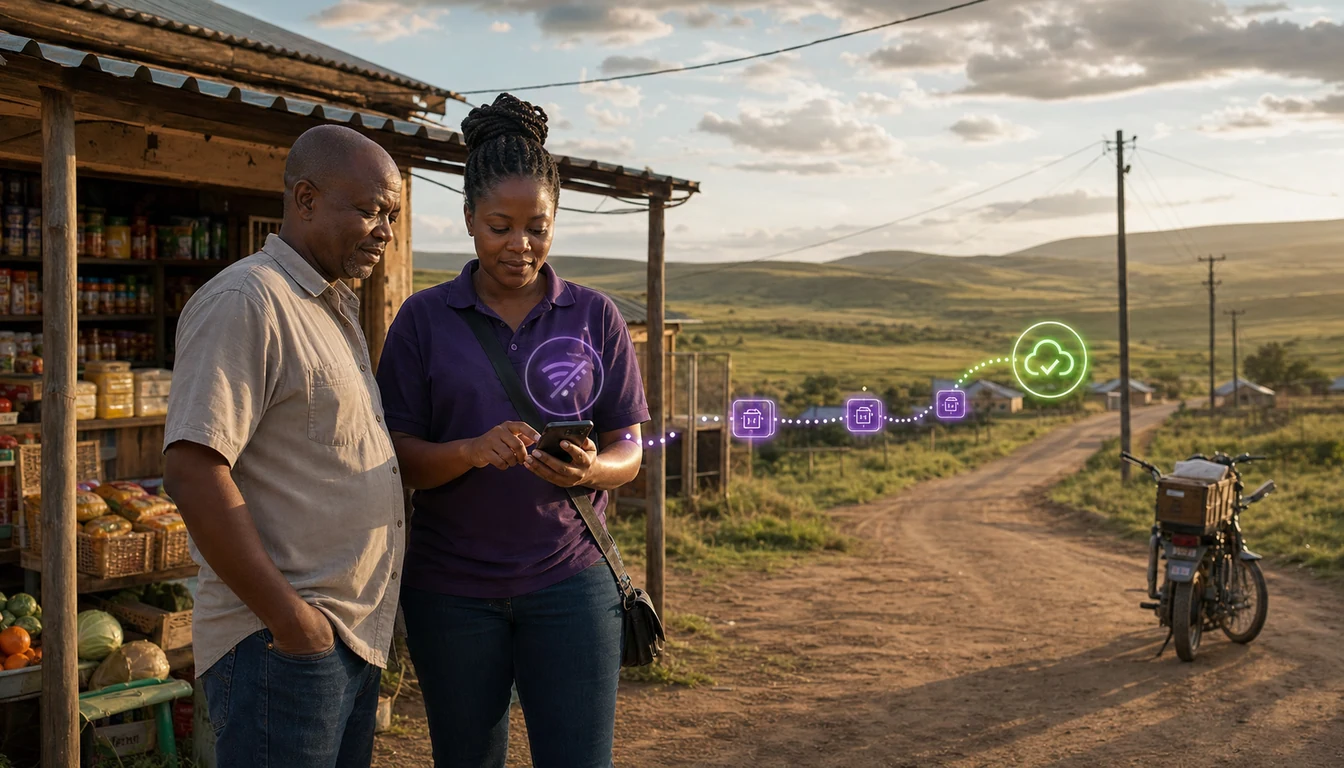
Work a morning of calls around Warwick Junction in Durban. Later in the same week, spaza shops in Tembisa, then a run of tuck shops and forecourts outside Polokwane. Three territories, and your team has sold in three different languages.
That is an ordinary week for a South African field team. One brand can be running reps who close in isiZulu through KwaZulu-Natal, in isiXhosa down the Eastern Cape, in Afrikaans across the Northern Cape and much of the Western Cape, and in Sesotho and Setswana through the Free State and North West.
Head office, meanwhile, writes everything in English. The rep who persuades a spaza owner to take a new line, or talks a tavern through a promotion, does it in the language spoken at that counter and not in the language of the training deck.
Most brands still train the whole force in English regardless. Reps memorise a script they only half follow, pitch a new line badly, get the promotion mechanic wrong, and quietly carry on selling the way they always did. This guide turns that into something you can plan.

Why Language Is Not a Soft Issue on a South African Route
English runs the boardroom, but it seldom runs the sale. All the way down the chain from distributor to independent wholesaler to retailer, the person who actually signs off the order trusts a pitch delivered in their own language.
The spaza owner, the person minding a tuck shop counter, the independent wholesaler working a till inside a busy cash-and-carry — most of them respond far better to isiZulu, isiXhosa, Afrikaans or Sesotho than to a recited English script. When a rep can only repeat English, three things go wrong quietly:
- The product story disappears. New variants, pack sizes and price points get explained badly, so the retailer takes a token quantity or refuses the line outright.
- Promotion mechanics get mangled. A "buy ten cases, get one free" offer that is only half explained turns into arguments, wrong claims and a shop owner who trusts you rather less next month.
- Compliance detail lands approximately. Batch, expiry and storage guidance on SAHPRA-regulated goods has to be understood precisely, and roughly right is not good enough.
Training a rep in the language they sell in is not a courtesy. It is the difference between somebody who can explain your brand and somebody who can only recite it.
Choosing Which Languages to Build, and How Far to Take Each One
You do not need every module in five languages by Monday. That way is slow and it is expensive. The sensible approach maps languages to territories first, then builds each one only to the depth it needs.
Begin where your volume genuinely sits. For most national FMCG operations the picture looks roughly like the table below.
| Province or corridor | Primary field language | Also common |
|---|---|---|
| KwaZulu-Natal (Durban, Umlazi, Pietermaritzburg) | isiZulu | English in modern trade and reporting |
| Gauteng (Johannesburg, Pretoria, Soweto, Tembisa) | isiZulu and Sesotho | Setswana towards the west; English |
| Western Cape (Cape Town, Khayelitsha, Mitchells Plain) | isiXhosa and Afrikaans | English in the national chains |
| Eastern Cape (Gqeberha, East London, Mdantsane) | isiXhosa | Afrikaans in the western districts |
| Limpopo and Mpumalanga | Sepedi, Xitsonga and siSwati | English for supervisors and reporting |
English still carries every supervisor, every national-chain call and all of your reporting. After English, the language worth building next is simply the one spoken where your largest volume already sits.
Tier your content by how much language precision it really needs
- Tier 1, build in local languages first: pitch scripts, objection handling, promotion mechanics and merchandising basics. These get said out loud to a shop owner, so they have to land in the language of that counter.
- Tier 2, English carrying local-language summaries: policy, leave and attendance rules, expense claims and the code of conduct.
- Tier 3, English on its own is perfectly fine: supervisor dashboards, back-office reporting and anything a manager alone ever opens.
Delivering Training That Survives a Dead Signal
The single biggest reason field training fails has nothing to do with language at all. It is that the handset will not load the content during the ten spare minutes a rep actually has between calls.
Coverage thins out fast on a rural route in Limpopo, and it falls away altogether inside a township block or behind the walls of a cash-and-carry warehouse. Mobile data costs real money as well, so reps ration it. Any plan that assumes a live connection and a generous bundle will die on the route.
Design for the handset a rep is genuinely carrying, an entry-level Android on a thin network, and build the whole programme offline-ready:
- Downloadable decks and quizzes. Reps pull the content over Wi-Fi at the distributor point, then learn between calls with no connection at all. Progress and quiz results upload afterwards, once the phone finds a signal again.
- Light media. Short PDFs, compressed images and brief clips beat heavy video that never finishes loading and flattens the battery by midday.
- In-store coaching for the difficult parts. Some skills, such as building a shelf or closing a hesitant wholesaler, are better taught live at the outlet, with the trainer logging a geo-tagged visit.
- Micro-lessons rather than marathons. Five-minute modules fit the rhythm of a route far better than an hour-long session nobody ever reaches the end of.
Writing Content Once and Shipping It in Every Language
The trap most brands fall into is running each language as its own project. English gets updated for a new pack size while the isiZulu and isiXhosa versions quietly go stale, and half the force ends up learning last quarter's price.
Build a workflow that keeps every language moving together. Writing the source material well is what makes everything downstream possible:
- Keep the English source scripts short, concrete and free of idiom that will not survive translation.
- Hold brand names, SKU codes and rand figures (for example R1 250 per case) identical across every language version so nothing drifts apart.
- Have the translation done by people who actually sell in that territory rather than by formal translators alone. A script that reads correctly but sounds nothing like a trader will convince nobody.
Test comprehension in the language of learning
Quiz a rep in the same language the lesson was delivered in. Someone who learned in Sesotho and then passes an English quiz has proved they can read English, not that they understood the pitch.
Set a clear pass mark, allow a sensible number of attempts, and keep the questions short and gamified enough that a rep will finish them on a small screen while waiting outside an outlet.
A Step-by-Step Rollout for a New Line or Promotion
When a new variant or a new promotion launches, the whole multilingual force has to be ready in days rather than weeks. A repeatable sequence keeps every province moving in step:
- Write the English source script covering the pitch, the promotion arithmetic and the obvious objections.
- Have reps who sell in those provinces translate it into your Tier 1 languages.
- File all the language versions together under a single topic so they stay linked.
- Give each rep the track that matches their territory and their role.
- Set the quiz in whichever language the rep learned in, with one pass mark for everybody.
- Release it over Wi-Fi at the distributor point so the route can learn without spending data.
- Watch completion and pass rates by language, and repair a weak translation before it costs you a quarter.
What to Measure, and What Quietly Kills These Programmes
Completion rates on their own tell you close to nothing. A field-force programme earns its budget when the learning shows up in behaviour at the counter and in numbers on the shelf. Watch a small and honest set of signals:
- Reach and completion by language and province, so you can tell whether the isiXhosa track in the Eastern Cape is finished or merely assigned.
- Quiz pass rates by language, which expose a badly translated module within days. Where one track fails consistently the fault is almost always the translation and not the reps.
- Time from launch to trained, which tells you how quickly the whole force is ready to sell a change.
- Behaviour at the outlet, such as new-line stocking, promotion uptake and merchandising compliance, matched against who actually completed the relevant module.
The recurring mistakes are every bit as predictable as the measures. These are the ones to look out for:
- English only, "for simplicity." It looks efficient from head office and then fails silently everywhere else.
- Assuming a live connection. Content that will not open without a signal simply never gets consumed at all.
- Translating once and walking away. Language versions drift away from current prices and promotions unless a single library holds them together.
- Heavy video and machine translation on its own. Both feel modern, and both fall over on an entry-level handset or in a real conversation at a counter.
How 1Channel Helps You Train in the Languages You Sell In
Doing all of this by hand across five or six languages and nine provinces is genuinely hard. A purpose-built learning platform is what keeps the languages aligned and the content sitting on the handset.
1Channel's Cloud AI LMS for Sales Team keeps every language version of a module under a single topic, so a price or promotion change updates all the tracks at once and no province is left teaching numbers that expired weeks ago.
For a South African field team specifically, the platform helps you:
- Deliver the same module as a classroom session, a virtual session, in-store coaching or offline-ready e-learning.
- Set quizzes with gamification, levels, certificates and badges, all in the language the rep learned in.
- Give every rep the language track that matches their province and their role.
- Work on entry-level Android handsets wherever coverage is thin, from Gauteng routes to rural Limpopo.
Train Every Rep in the Language They Sell In
See how the Cloud AI LMS for Sales Team holds every language version of a module in step, quizzes each rep in the language they learned in, and keeps running on an entry-level handset with no signal at all.
Explore the Sales Team LMS →FAQs
Which language should a South African brand build after English?
Build the language of the province carrying your largest volume first. For most brands that means isiZulu across Gauteng and KwaZulu-Natal, or isiXhosa and Afrikaans if your strength sits in the Cape.
Do we really need offline training, or will mobile data cover it?
Offline matters. Coverage thins out on rural routes and inside township pockets, and data bundles cost money reps would rather spend elsewhere, so content has to download over Wi-Fi and then run with no connection at all.
How do we stop the language versions drifting out of sync?
Keep all the language versions of a module under a single topic in one library. When a price or a promotion changes, edit the source and release every track at the same time.
Which numbers tell us the training is actually working?
Look past completion. Track reach and pass rates by language and province, the time from launch to a fully trained force, and what changes at the outlet, such as new-line stocking and promotion uptake.