Vietnam's trade-promotion rules limit how much a promotion can give away, and some programmes must be notified to the authorities before they run.
Yet many dealer loyalty schemes only show their real cost at quarter end, after the points have already been earned.
The gap hurts most in Consumer Durables, Building Materials and Automotive dealer programmes, and in FMCG retailer schemes, where bonus campaigns stack on base earning.
This post pairs four common cost problems with the fix for each: channel caps, an overall cap, a running cost view and checked claims.
Two worked examples follow, written for the finance team that has to sign off the scheme budget.

Problem 1: Bonus Campaigns Stack on Base Points
Most electronics dealer programmes earn points from several places at once, and each place has its own logic.
Points arrive from monthly sales data sent by the brand's ERP or DMS, from QR scans on installed units and from approved purchase claims.
Add a double-points week on inverter air conditioners, and all three channels can overshoot together, with no single rule to stop them.
The Fix: Cap Each Earning Channel, Then the Whole Scheme
1Channel's loyalty engine sets caps per earning channel and overall, so each source of points has a ceiling and the scheme has one more above them.
Tier slabs can carry their own limit too, such as a maximum number of points per dealer each quarter.
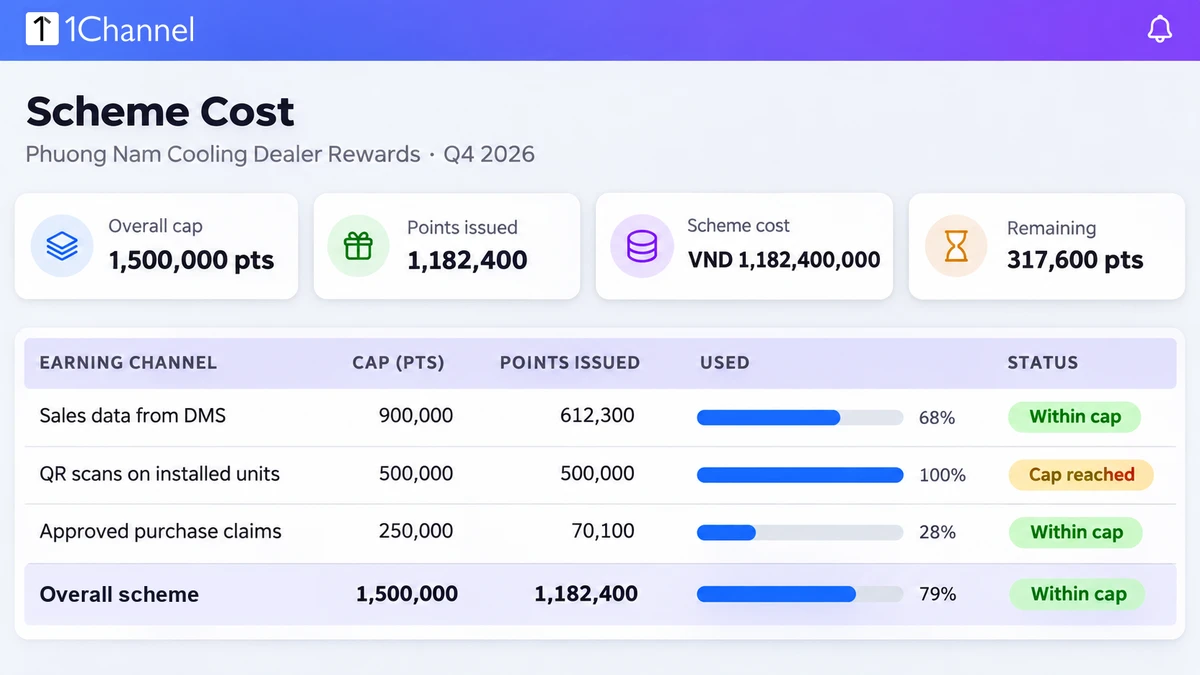
Phuong Nam Cooling Co., an air-conditioner brand selling through 140 dealers around Ho Chi Minh City, budgets VND 1.5 billion for this quarter's dealer scheme.
At a programme rate of one point to VND 1,000, finance turns that budget into caps:
| Earning channel | Cap (points) | Value (VND) |
|---|---|---|
| Sales data from the DMS | 900,000 | 900 million |
| QR scans on installed units | 500,000 | 500 million |
| Approved purchase claims | 250,000 | 250 million |
| Overall scheme cap | 1,500,000 | 1.5 billion |
The channel caps add up to more than the overall cap on purpose. A strong channel can use slack from a slow one, while the total never moves.
When the inverter week pushes QR scans to their 500,000-point ceiling, scan points stop there and the sales-data budget stays untouched.
Problem 2: Finance Sees the Bill After Dealers Earn It
Points are a promise of future cost. If finance only counts them when a quarterly sales file lands, the scheme has already spent the money.
The usual workaround is a spreadsheet rebuilt from exports, which is out of date the day it is finished.
The Fix: Watch What the Scheme Costs While It Runs
The platform gives a clear view of what the scheme costs, alongside points reports, redemption reports and transaction-level data finance can export.
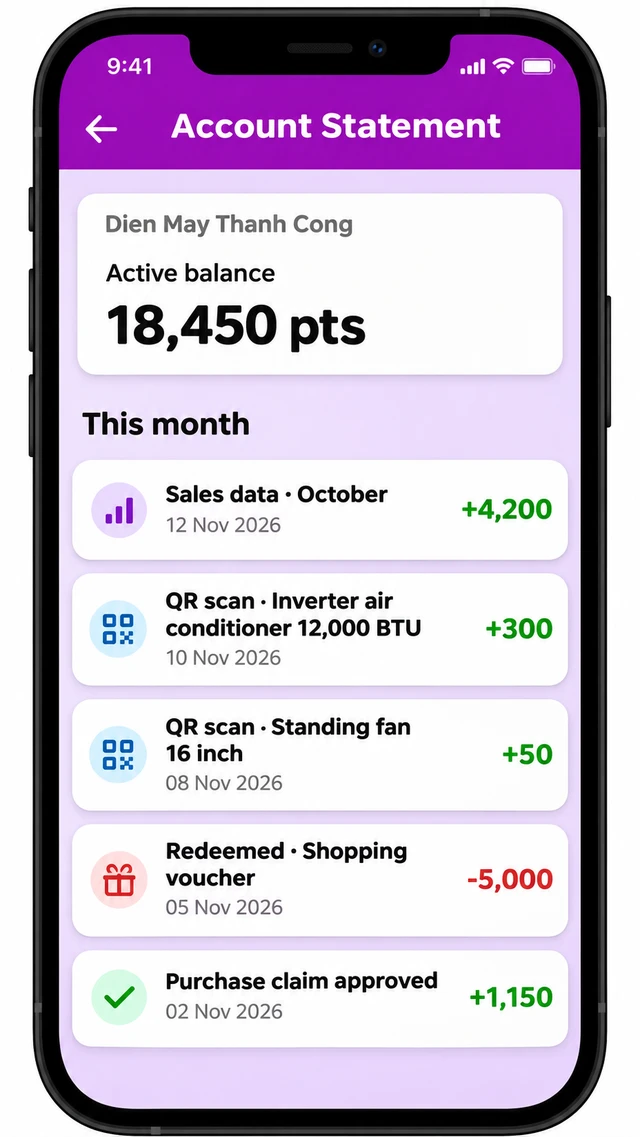
Every point earned and spent also sits in each dealer's wallet history, so a disputed balance traces back to its source transaction.
Points expiry rules and expiring-points alerts keep old balances from sitting on the books indefinitely.
Problem 3: Lucky Draws Carry Costs Beyond the Prizes
Pre-Tet dealer campaigns often add scratch cards or a spin-the-wheel draw. In Vietnam, those mechanics bring rules of their own.
Under Decree 81/2018/ND-CP, as amended by Decree 128/2024/ND-CP and Decree 239/2026/ND-CP, promotional goods are generally capped at 50% of the promoted goods' value.
Half the announced value of any lucky-draw prize left unawarded generally goes to the state budget.
Programmes with total prizes of VND 100 million or more generally have to be notified to the provincial Department of Industry and Trade.
The Fix: Keep Chance-Based Rewards Inside a Campaign
Spin the wheel and scratch cards are configured per campaign rather than always on, and points can accrue campaign by campaign.
That keeps each draw's cost apart from the base scheme, so it never hides inside the quarter's total.
Hanoi Kitchen Appliances JSC planned a pre-Tet scratch-card campaign for 60 dealers across the Red River Delta, with VND 180 million in prizes.
At that size the campaign crossed the VND 100 million line, so the notification went in before launch.
Run as its own campaign, its accrued value was tracked weekly, and finance budgeted for unawarded prizes, since half their announced value would be owed.
The filing itself stays with your own legal or finance team. 1Channel supplies the numbers, not the notification.
Problem 4: Inflated Claims Raise the Bill Quietly
Manual purchase claims are where cost drifts unnoticed: the same invoice twice, an old bill, or a quantity that does not match the purchase.
The Fix: Check Every Claim Before It Earns
Duplicate invoice and QR submissions are detected, purchase-date windows are enforced and the claimed quantity is checked against the purchase.
Claim caps apply per user and period. Approvals follow the client's own hierarchy, with a reason recorded for every rejection or quantity change.
How 1Channel Puts a Ceiling on Scheme Spend
1Channel runs earning rules, caps, campaigns and redemption in one cloud platform, so a scheme's cost and its rules sit in the same place.
Separate programmes for different brands or regions can run side by side, and dealers use the app in multiple languages configured to each client's requirement.
Set the Ceiling Before the Scheme Starts
Cap points by earning channel and overall, and see what every dealer scheme costs while it runs.
Explore Rewards Program Software →Conclusion
A dealer scheme rarely runs over budget because of one bad rule. It runs over because several channels and campaigns earn at once, with no shared ceiling.
Channel and overall caps, a running cost view and checked claims give Vietnamese finance teams that ceiling, with lucky-draw exposure kept separate and known before launch.
This post is general information on Vietnamese promotion rules, not legal advice. Check current requirements with your adviser before launching a scheme.
Note: Software screens may vary based on your business structure and configured workflows.