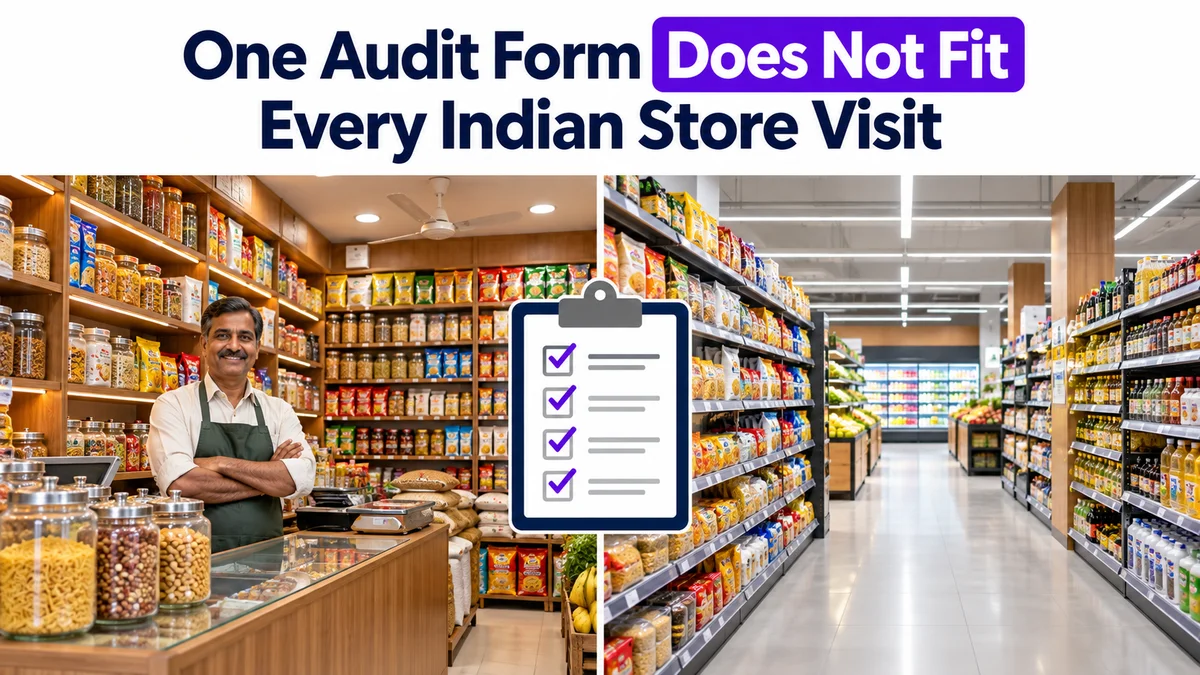
An FMCG sales representative starts the day at a small kirana store, visits a wholesale outlet in the afternoon, and finishes at a modern supermarket. The stores are different, the work is different, but the mobile audit form asks the same questions at every location.
At the kirana store, the representative is asked about promotional display fixtures that do not exist. At the wholesale outlet, questions about consumer-facing shelf arrangements offer little value. At the supermarket, a basic stock checklist misses important merchandising details.
The problem is not that the field team is failing to complete audits. The problem is that the audit form does not match the store or the purpose of the visit.
For Indian brands managing diverse retail networks, a relevant retail store audit checklist is just as important as completing the audit itself.
Why One Audit Checklist Fails Across Indian Retail Stores
Indian retail operates across multiple formats, from neighbourhood kirana stores and wholesale markets to organised supermarkets and large-format retail chains.
These outlets differ in size, product assortment, customer behaviour, merchandising requirements, and sales processes.
When every outlet receives an identical audit form, three problems emerge.
Irrelevant questions waste field time. A representative may have to complete questions about shelf fixtures, promotional displays, or store facilities that do not apply to the outlet.
Important observations get missed. A generic questionnaire may capture basic product availability while overlooking issues specific to a store format or the visit's objective.
Reports become difficult to interpret. When different stores are assessed using inappropriate or irrelevant parameters, aggregated compliance scores may not accurately reflect execution quality.
Standardising data collection is useful, but standardisation should not mean asking every outlet the same questions.
What Should Change From One Store Visit to Another?
A useful store audit begins by understanding what the representative is expected to check.
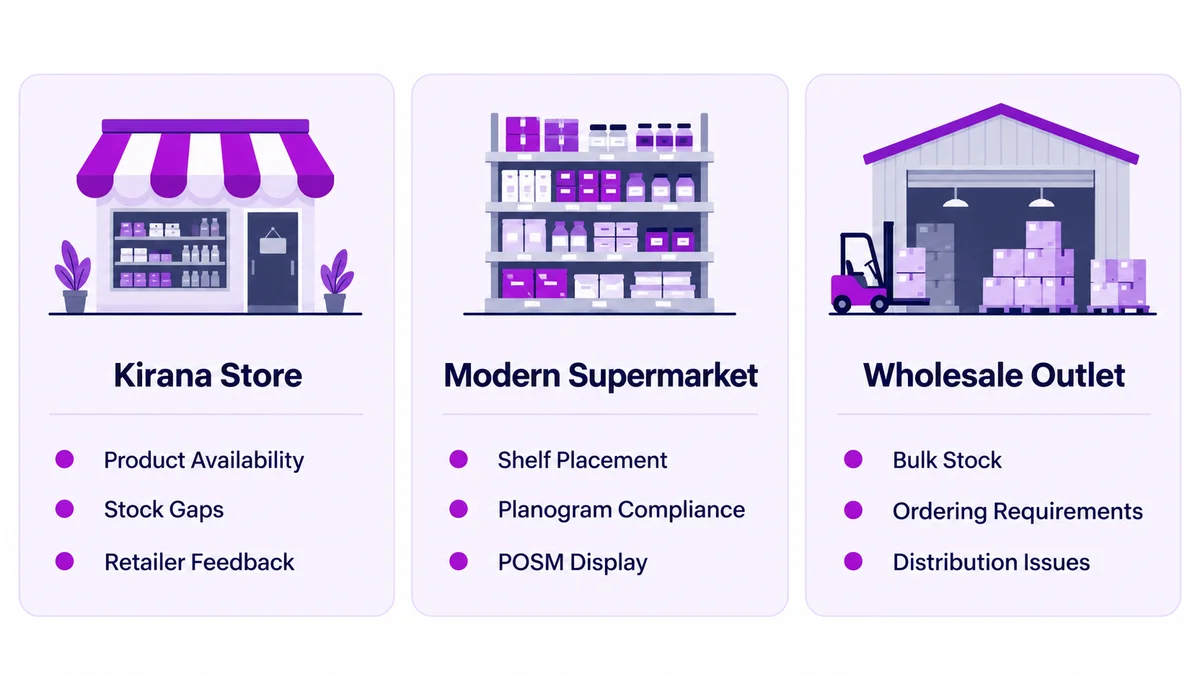
For example, different Indian retail formats may require the following audit priorities:
| Store Format | Illustrative Audit Focus |
|---|---|
| Kirana store | Product availability, stock gaps, retailer feedback |
| Modern trade supermarket | Shelf placement, planogram compliance, promotional displays, POSM |
| Wholesale outlet | Bulk stock availability, ordering requirements, distribution issues |
| Pharmacy | Relevant product assortment, availability, display compliance |
These examples are not fixed templates. Actual questions depend on the brand, product category, campaign, and outlet requirements.
Store format is only one consideration. The purpose of the visit matters just as much.
A stock verification visit may require SKU availability and quantity checks. A merchandising visit may focus on display condition, promotional material, and photographic evidence. A compliance audit may involve defined standards and corrective observations.
Even when two representatives visit the same outlet, they may need different questionnaires because they are performing different activities.
A Better Approach: Audit Questions That Match the Visit
Instead of maintaining one long questionnaire for every store, brands can organise audit forms according to activity type, store category, channel, and field role.
A practical approach involves three elements.
1. Organise Questions by Audit Purpose
Questions should be grouped into relevant categories and subcategories.
For example, a stock audit might cover product availability and quantity, while a merchandising audit might check promotional display execution and visual compliance.
This keeps each questionnaire focused on the information needed for that particular activity.
2. Use Conditional Questions
Not every answer requires the same follow-up.
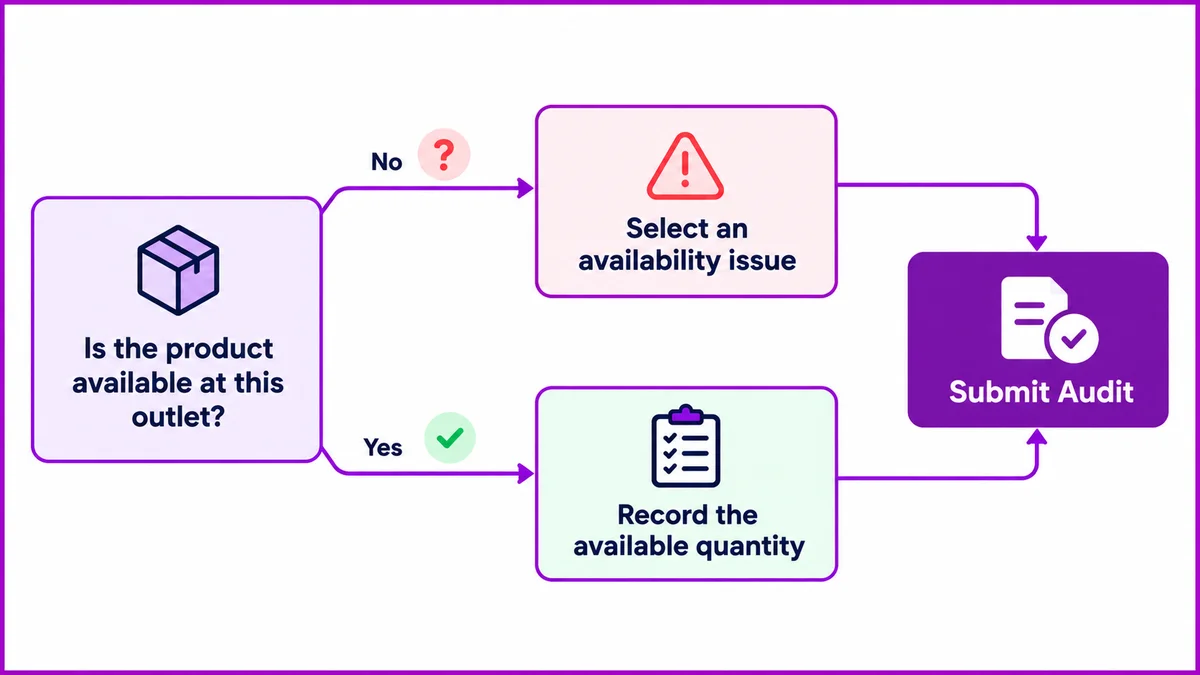
Consider an illustrative product availability audit:
Question: Is the required product available at this outlet?
- Yes: Record the available quantity.
- No: Select the reason, such as out of stock or not stocked by the retailer.
The next question depends on the previous answer, rather than forcing every representative to complete both paths.
This approach helps field teams focus on applicable questions while keeping responses structured for reporting.
3. Assign Activities to Relevant Stores and Teams
A field representative conducting stock verification should not automatically receive every merchandising or compliance questionnaire.
Audit activities can instead be associated with relevant field roles, outlet lists, store categories, or channels.
For example, a merchandising questionnaire can be assigned to applicable outlets, while a separate stock audit is assigned to the team responsible for inventory checks.
This helps make the mobile workflow relevant to the work being performed.
How 1Channel Supports Different Retail Audit Requirements
1Channel Sales Force Automation supports structured retail activities through its Market Working and Retail Intelligence capabilities.
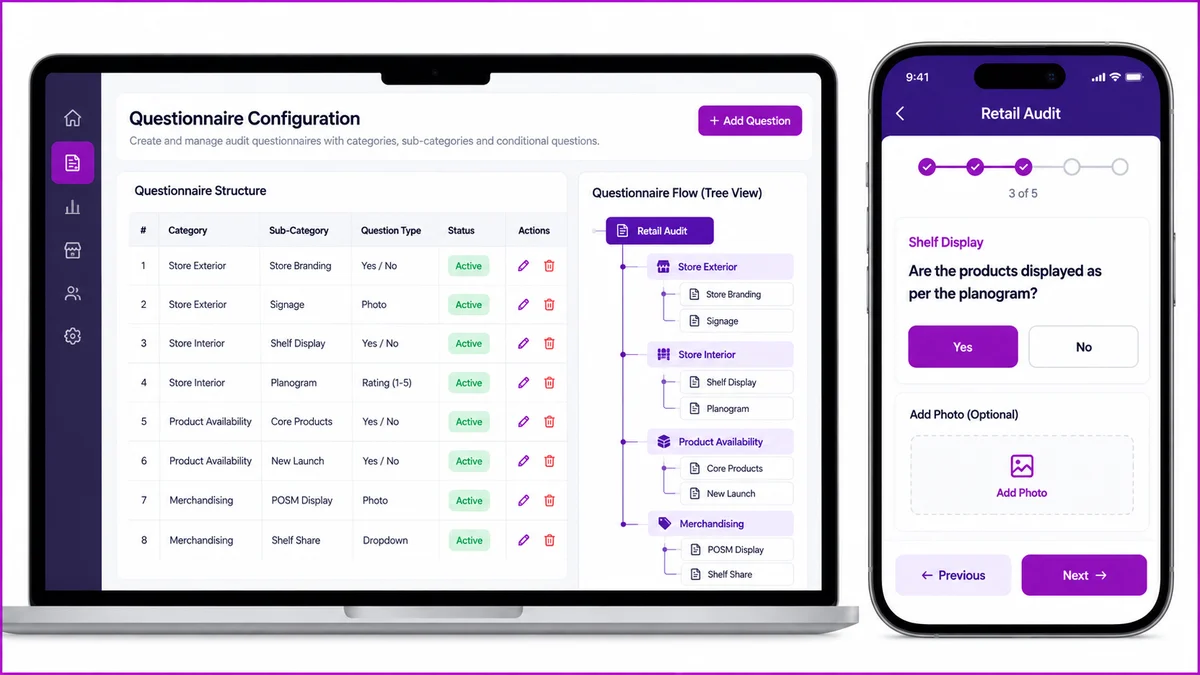
Within Market Working → Questionnaire Management, administrators can organise questions into categories and subcategories, configure question types, and define dependent questions.
Questions can use formats such as text responses, radio buttons, and dropdown selections. Conditional dependencies allow the next set of questions to change based on an earlier answer.
Through Market Working Activity management, businesses can associate questionnaires with specific activities and configure their applicability.
For example, activities can be scoped using:
- Field user roles
- Assigned stores or uploaded store lists
- Store categories, classifications, and channels
- Activity schedules and validity periods
During a store visit, the relevant field employee can complete the assigned questionnaire through the mobile app.
Submitted responses can then pass through review and approval workflows, with completed activities available for reporting.
This helps organisations maintain consistent data collection without requiring every field employee to complete an identical audit form.
For broader store execution requirements, 1Channel Store Audit & Compliance also supports mobile audit submissions, photographic evidence, audit validation, and compliance reporting.
Where AI Adds Value to Retail Audits
Configurable questionnaires improve what field teams are asked to record. AI can complement that process by helping businesses analyse information and verify certain aspects of retail execution.
AI Assistant for Faster Access to Insights
Managers often need to identify outlets with unresolved execution issues without manually opening multiple reports.
The 1Channel AI Assistant supports conversational access to available sales and retail execution information, including identifying outlets with POSM or branding placement concerns.
Image Recognition for Visual Verification
Some retail observations require more than a checklist response.
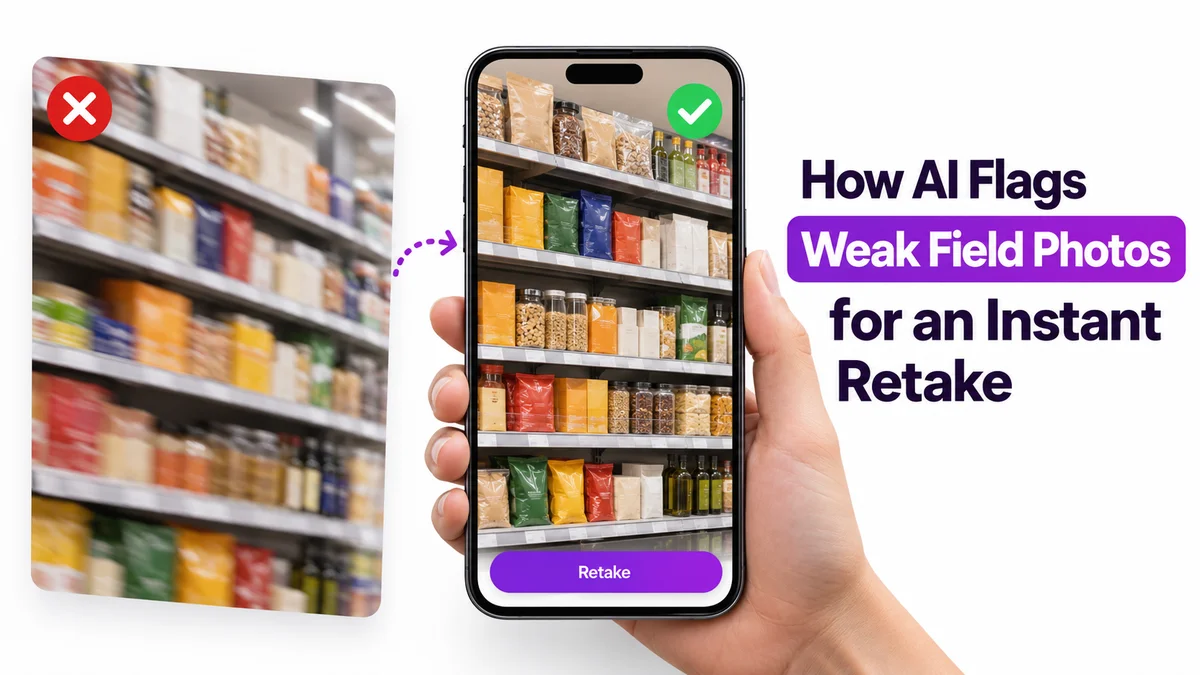
With 1Channel Image Recognition, shelf and promotional material photographs can be analysed for supported visual compliance checks, including product facings and POSM execution.
This adds photo-based verification alongside structured field submissions.
Catalyst for Prioritising Operational Attention
Completed visits, stock information, and sales performance can also inform what managers investigate next.
1Channel Catalyst uses operational data to surface predictive alerts and prioritised actions for field teams and managers.
These AI capabilities complement configurable audit workflows. They do not replace the need to define appropriate questions, outlet applicability, and audit standards.
Why Choose 1Channel for Retail Store Audits?
1Channel brings configurable questionnaires, activity scoping, and audit workflows into one connected platform, so the right questions reach the right stores and teams. AI Assistant and Image Recognition add operational insight and visual verification on top, giving varied Indian retail outlets a consistent yet context-specific auditing foundation.
Explore 1Channel Store Audit & Compliance →Conclusion
A kirana store, a wholesale outlet, and a modern supermarket may all belong to the same retail network, but they do not need identical audit questions.
The objective should be to maintain consistent execution standards while collecting information that is relevant to each store and visit.
One platform can standardise retail auditing without forcing every Indian store visit into one form.
Frequently Asked Questions
1. Why should different retail stores have different audit forms?
Different retail stores have different layouts, product assortments, operational processes, and merchandising requirements. Store-specific questionnaires help field employees collect relevant information instead of completing unnecessary questions.
2. What is a conditional question in a retail audit?
A conditional question changes the next set of questions based on a previous response. For example, a product availability answer can determine whether the representative records stock quantity or an availability issue.
3. Can retail audit questionnaires be assigned by store type?
Yes. Retail audit systems with configurable activity management can use store channels, categories, classifications, or assigned outlet lists to determine where particular audit activities apply. 1Channel supports these configuration options.
4. How does AI improve retail audit processes?
AI can support audits by analysing suitable store photographs, checking visual execution parameters, and making available operational insights easier to retrieve. It complements structured questionnaires and human review.
5. Can one retail auditing platform support multiple visit objectives?
Yes. A configurable platform such as 1Channel can support different questionnaires and activities for stock verification, merchandising, surveys, and other field requirements, based on the business's configuration.
Note: Software screens may vary based on your business structure and configured workflows.