In most order-to-cash write-ups the villain is cash itself: reps carry too much of it, and nobody trusts the number until it is banked. That framing undersells what actually breaks the cycle in Egypt. Cash has not left the counter at the baqala; it has simply been joined by four or five other legitimate ways to settle an invoice.
InstaPay clears an instant bank transfer in seconds. Fawry runs through a vast network of retail payment points and machines. Meeza cards tap or swipe at a growing number of tills. Vodafone Cash and Orange Cash move money between phones for tens of millions of wallet holders. No single one has swallowed the market the way one mobile money service dominates elsewhere; each covers a different slice of the outlet base, and a rep can meet several on the same street.
That plurality, not any one rail, is what makes order-to-cash hard to run cleanly in Egypt. This piece covers why the cycle breaks once payment options multiply, how to tie every collection to the right outlet and invoice on the spot, and how to reconcile a week's takings when several settlement clocks tick at different speeds.
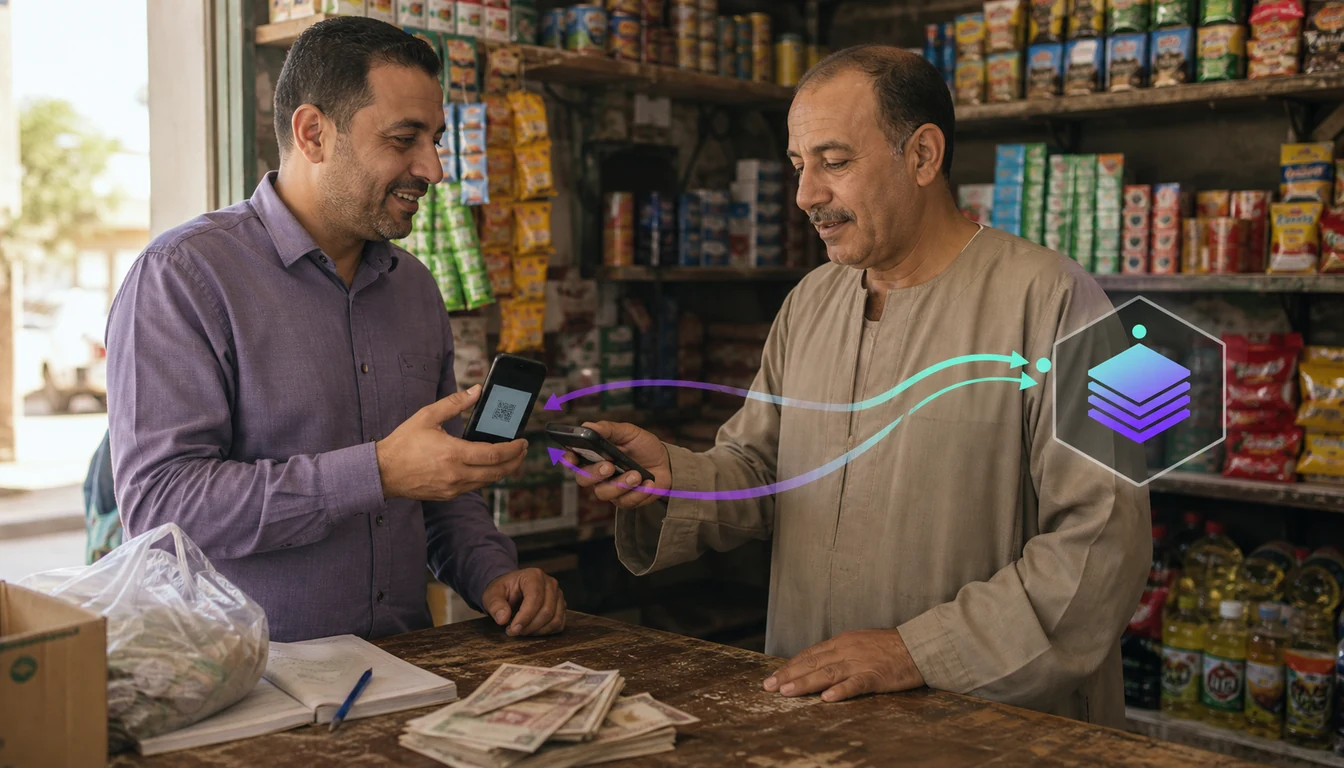
Why the Cycle Breaks Once Payment Options Multiply
The textbook order-to-cash cycle is short: book the order, deliver, invoice, collect, reconcile. With one payment method, the weak point in that chain is rare. With several rails live at once, every collection carries two open questions: which method did the retailer use, and has the payment cleared or is it still a promise.
Multiply that across a beat of a hundred or more outlets and small gaps compound fast. A rep who simply writes "paid" against an order has recorded nothing useful, because finance cannot tell whether that means cash in a bag, a transfer in flight, or a wallet payment mid-settlement. Getting this right starts with a distributor management system built for a multi-rail market, not one retrofitted from a single-payment assumption.
The Payment Picture a Rep Actually Faces
Cash remains the default at the smallest baqalas, especially for frequent low-value top-ups, alongside instant transfers, a nationwide payment network, a national card scheme and telco wallets, often within the same stretch of street.
| Payment mode | Where it turns up | What to watch |
|---|---|---|
| Cash | Smaller baqalas, low-value top-up orders | Sits with the rep as leakage risk until banked and posted against an invoice |
| InstaPay | Wholesalers and better-banked retailers wanting an instant transfer | Fast to clear, but still needs the reference tied to the right invoice at payment |
| Fawry | Outlets near a Fawry-enabled retail point or machine | A payment slip is not the same as a confirmed posting on the distributor's ledger |
| Meeza | Retailers with a card terminal | Settlement can lag the tap, so today's collection may only post tomorrow |
| Vodafone Cash / Orange Cash | Outlets and consumers comfortable with a telco wallet | Wallet transfers still need a captured reference, not just a screen shown to the rep |
The point holds across every row: capture the mode and reference at the moment of collection, not later from memory or a photographed screen. "InstaPay, ref 4471, EGP 3,200 against invoice 8814" can be checked. "Retailer paid" cannot.
Tying Every Collection to the Right Outlet and Invoice
A collection is only useful once pinned to a specific outlet and invoice, which is harder than it sounds where several baqalas share a similar name on the same market street. Two records for one shop, under two spellings, split its balance and history in half.
The fix starts with a clean outlet record pinned to a real location rather than a written address, so the same baqala is never opened twice under two balances. In the tightest parts of Cairo, Alexandria or Giza, where beats are planned street by street rather than by postcode, that fix protects collections data more than retraining reps on payment codes.
Capturing Payment Details Where the Deal Happens
Cairo, Alexandria and Giza carry dense, well-connected streets, but Upper Egypt and the Delta thin out fast, and connectivity thins with them. A process built only for strong signal drops data the moment signal weakens, and one built only in English loses accuracy in a baqala where Arabic is the comfortable language.
A workable field capture habit has three parts:
- Record the payment mode and reference at the outlet, even with no signal, rather than keying it in later at the depot.
- Keep a running on-device cash tally, visible to both the rep and finance.
- Timestamp and geo-tag each receipt at capture, tying it to a real visit on a planned route rather than memory hours later.
A Morning Across a Mixed Beat
Picture a rep on a beat that starts near a depot on the edge of Obour City and moves into denser streets through the morning.
- 8:30 am: A small baqala pays cash for a top-up; the rep logs it against the invoice as the cash tally rises.
- 9:50 am: A larger grocer sends an InstaPay transfer on the spot; the rep captures the reference immediately.
- 11:15 am: Signal drops deeper into the market. A retailer pays through Fawry and reads out the slip number; the rep records it offline.
- 1:20 pm: Back in range, the device syncs; finance sees every mode and reference, with an earlier Meeza tap flagged as pending settlement.
Nothing here is rebuilt from memory; each payment carries a mode, reference and visit behind it.
Credit Limits and the Chain of Trust
A meaningful share of Egyptian general trade still moves on credit, and that is where order-to-cash holds together or falls apart. A wholesaler might carry a larger balance than a neighbourhood baqala; what keeps a distributor solvent is a clear EGP credit limit per outlet and a firm rule for what happens once exposure crosses it.
Because EGP price lists need frequent revisiting, credit limits deserve the same regular review rather than being set once and forgotten. Distributors who tie limits to collections history, not a rep's judgement on the day, catch an over-extended outlet before more stock leaves the van.
Reconciliation When Every Rail Settles Differently
The gap that swallows the most money sits between "the retailer says they paid" and "the money has actually cleared." A transfer confirmation can be stale, a card payment can be unsettled, and a wallet transfer can arrive with no invoice reference at all. Reconciliation closes that gap, and with the ETA's e-invoicing and e-receipt system now in force and steadily widening, matching every receipt to a real invoice is no longer just good bookkeeping. A workable rhythm runs daily, not monthly:
- Match every day. Line up each posted receipt against the bank feed, the card settlement file and cleared cash, so a mismatch surfaces while the rep still remembers the visit.
- Hold unmatched money in a tray. When a transfer or wallet payment arrives without a clear reference, park it as unallocated rather than guessing which outlet it belongs to.
- Allocate part-payments line by line, so an invoice never shows as fully settled when only half has actually cleared.
- Log every override, recording who adjusted a balance or raised a credit note, when, and why.
Fed into one ledger rather than five rail-by-rail spreadsheets, this rhythm shows what is real, cleared money and what is still a promise.
What to Watch Every Week
A cycle you are not measuring stays loose, so a small set of numbers deserves a weekly look, not a month-end surprise:
- Days Sales Outstanding (DSO): how long EGP sits uncollected after a sale; a rising figure is the earliest sign that credit is running loose.
- Ageing buckets: outstanding balances split into current versus 30, 60 or 90 days overdue, broken down by outlet and route.
- Collection efficiency: EGP collected against EGP invoiced, tracked by rep and territory.
- Unbanked cash exposure: how much collected cash is still sitting with reps rather than banked and posted.
- Unallocated receipts by rail: money landed but not yet matched to an invoice, split by InstaPay, Fawry, Meeza and wallet transfers so a slow rail does not hide inside a healthy total.
The Mistakes That Cost Distributors Real Money
The mistakes that erode this cycle are predictable, and every one of them is avoidable:
- Treating a screenshot or a slip number as confirmed, cleared payment.
- Letting reps hold cash for days before it is banked and posted.
- Releasing fresh stock to a baqala already past its credit limit because the order sheet and the ledger live in separate systems.
- Opening a second outlet record for a shop that already exists under a slightly different name or address.
- Reconciling by hand across several rails, a habit that collapses the moment volume rises across Cairo, Alexandria and Giza in the same week.
How 1Channel Helps Egyptian Distributors Close the Loop
Closing an order-to-cash loop in a fragmented payments market means the order, payment and credit check must live in one place, not five. 1Channel brings them together so a rep cannot quietly ship past an outlet's limit, and finance never has to guess which rail a payment came through or whether it cleared.
The platform is built for how Egyptian general trade runs: several rails in active use side by side, connectivity that thins well before Cairo's edge, and outlets needing a real location on record, not a written address. It captures every collection at the point of sale, even offline, then syncs on reconnection. For Egypt's payment mix, the platform handles:
- Capture of cash, InstaPay, Fawry, Meeza and telco wallet receipts in EGP, with mode and reference recorded at the outlet.
- Per-outlet EGP credit limits that gate the next order before goods leave the van.
- Receipt allocation to invoices, part-payment tracking and an unallocated tray for transfers still awaiting a reference.
- DSO, ageing and collection reports, plus unbanked-cash visibility by rep and route.
- Offline capture with an Arabic-first mobile experience for reps working baqalas outside the main cities.
Bring Every Rail Into One Collections Ledger
See how 1Channel's Cloud AI Payment & Credit Management Software captures cash, InstaPay, Fawry, Meeza and wallet receipts in EGP, gates per-outlet credit limits, and reconciles daily, even offline in the field.
Explore Payment & Credit Management →Key Takeaways
Egypt's payment mix will not settle into one dominant rail any time soon. Cash, InstaPay, Fawry, Meeza and telco wallets will keep coexisting and mixing within the same outlet. Keep these points in view:
- Capture the payment mode and reference at the outlet itself, not from the depot hours later.
- Pin every outlet to a real location so the same baqala never carries two balances under two names.
- Build the field workflow to survive weak signal in Upper Egypt and the Delta, and to work comfortably in Arabic.
- Gate credit in EGP before goods leave the van, and revisit limits as often as price lists change.
- Reconcile to cleared money daily across every rail, treating slips and pending settlements as promises, not payments.
- Watch DSO, ageing, collection efficiency and unbanked cash weekly, broken out by rail, not only at month-end.
Get that discipline in place and a multi-rail payments market stops being a liability and becomes just another Tuesday.