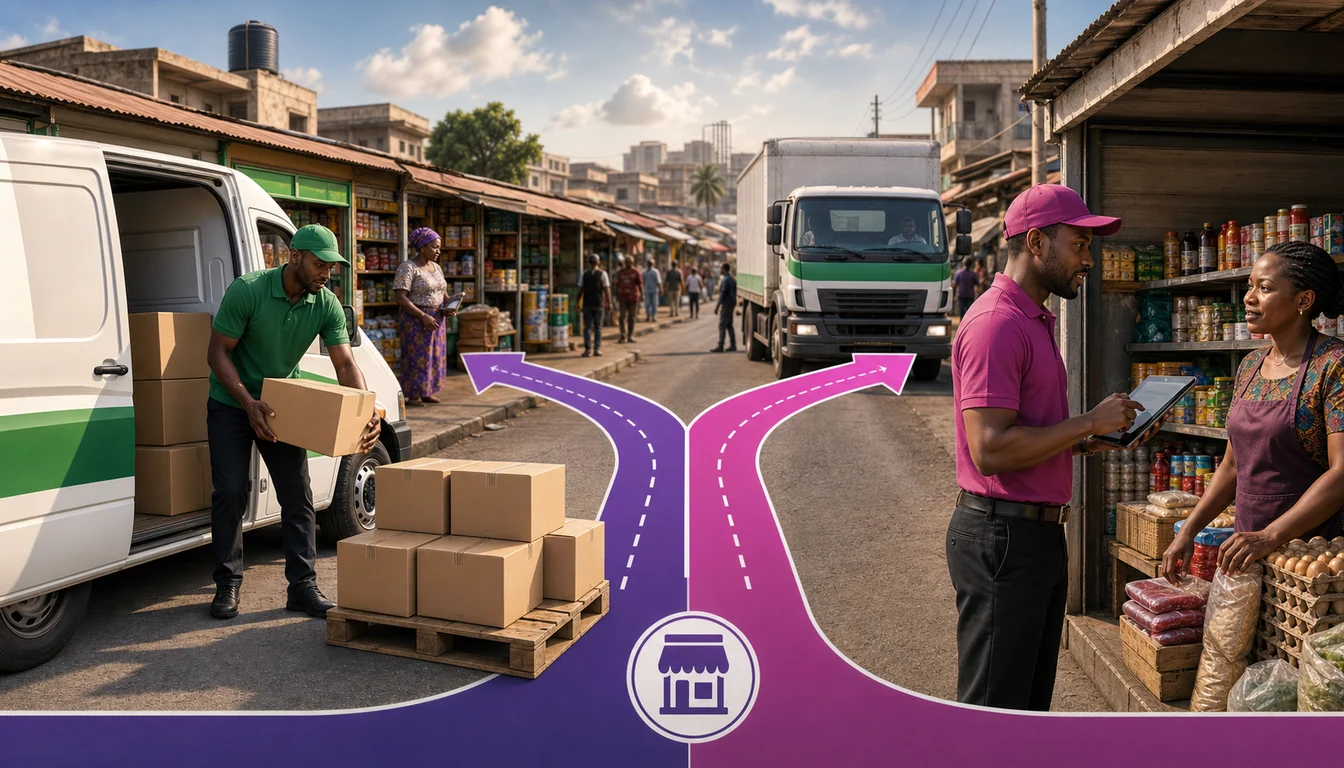
In Nigeria, most packaged goods still reach shoppers through informal trade. That means the provision store on an unnamed street in Ibadan, the kiosk beside a bus stop in Surulere, and the table-top seller in front of a compound in Aba.
Modern trade chains exist and are growing, but they remain a thin slice of the market. Most volume still moves hand to hand through open markets, wholesalers and neighbourhood shops. If your brand wins here, it wins in Nigeria.
Winning in informal trade is not about spending more on trade promotions and hoping stock disappears. It is about seeing what actually happens between your factory gate and the retailer's counter, then building the field discipline to influence it every day.

Map the Real Route to Market First
The Nigerian FMCG chain rarely runs in a straight line. Stock typically flows from the brand to a distributor, then to sub-distributors and wholesalers in trading hubs, and finally out to open-market traders, provision stores and kiosks.
A carton might change hands three or four times before a shopper buys a single sachet. Each hand-off is a place where visibility, pricing discipline and stock freshness can break down.
Before you invest in field teams or software, get honest about how your product actually travels in each region. The pattern is not the same everywhere:
- South-West (Lagos, Ibadan): dense urban routes with a high count of small outlets per street and heavy wholesaler activity in markets like Balogun and Mile 12.
- South-East (Onitsha, Aba): Onitsha Main Market and the Aba trade cluster act as redistribution engines for the whole region, so a large share of volume moves through a few powerful wholesalers.
- North (Kano, Kaduna): long distances between towns, strong traditional wholesale networks in hubs like Kantin Kwari, and routes where a rep may cover far fewer outlets per day.
Once you can describe your route to market region by region, you can decide where you sell direct and where you rely on a distributor's own reps. That map becomes the backbone for beat plans, targets and reporting.
Build for Offline-First Field Work
Any tool you put in a rep's hand has to survive two hard Nigerian realities: an unreliable grid and a patchy network. Reps charge phones during blackouts and walk into markets where signal drops to nothing between two stalls.
If your field process assumes constant power and connectivity, it will quietly fail exactly where your volume is. Here is what offline-first actually means on the ground:
- Capture works without signal. A rep logs the visit, the order, distributor stock and a merchandising photo inside the market, then the data syncs later when the phone finds a network on the main road.
- Low-end Android is the default. Field forces run entry-level phones with limited storage and battery, so the app has to be light and forgiving, not a battery drain.
- Outlets are mapped by GPS and landmark. Most shops have no usable street address, so you locate the kiosk "opposite the filling station" using a geo-tag captured on the first visit.
Get this right and you can trust your coverage data. Ignore it and you end up with reps marking visits from home and managers arguing over numbers nobody believes.
Measure Coverage and Secondary Sales, Not Just Billing
Primary sales, what you invoice to distributors, is the easiest number to see and the most misleading to manage by. A distributor can load up on stock to hit a scheme target and sit on it for weeks, so strong primary numbers can hide weak sell-through.
What tells you whether the brand is really moving is secondary sales: stock leaving the distributor and reaching retailers and open-market traders. The metrics worth watching in Nigerian informal trade are practical and few:
- Outlet coverage: how many mapped kiosks, provision stores and market stalls in a beat were actually visited this cycle.
- Productive calls / strike rate: the share of visits that produced an order, not just a "hello".
- Range selling: how many of your SKUs the average outlet stocks, since informal shops love to carry only the one or two fastest movers.
- Primary vs secondary gap: whether stock billed to distributors is genuinely selling out to retailers or piling up in a warehouse.
A Simple Weekly Rhythm That Works
Set a beat plan per rep, review coverage and strike rate every week, and act on the outliers. Chase routes with high visits but no orders, outlets that dropped off entirely, and distributors whose secondary sales lag their purchases.
This weekly loop, run consistently, does more for growth than a once-a-quarter trade scheme. To run it, field teams need a way to capture geotagged visits, van-sales orders and secondary sales offline, then turn them into clean reports.
Manage Distributor Credit and Cash Collections
Order-to-cash is where a lot of margin quietly leaks. Trade runs heavily on credit: the distributor extends it to the wholesaler, and the wholesaler to the retailer.
Payment is still substantially cash, though bank transfers and POS through fintechs like Opay, Moniepoint and PalmPay are spreading fast. When a rep collects cash in a crowded market, the risk of leakage, mis-posting and disputes is real.
These practical steps reduce leakage and disputes:
- Tie collections to invoices in the field. A rep records the payment, cash or transfer reference, against the specific outlet and invoice at the point of collection, not from memory at day-end.
- Track outstanding by outlet and distributor. Ageing that everyone can see keeps credit from ballooning into bad debt.
- Reconcile transfers the same day. With Naira payments increasingly landing by bank transfer, matching references quickly ends the "I have paid" versus "we have not seen it" standoff.
Win the Shelf and Lead the Field Force
In informal trade the "shelf" is a crowded counter, a hanging strip of sachets and whatever the shopper sees first. Availability and visibility at that counter often decide the sale more than advertising.
That makes disciplined retail execution a daily job, not a campaign. The right SKUs need to be present, priced correctly, and visible. Here is how execution fits informal outlets:
- Photo proof of execution: a quick in-store photo confirms your sachets are hung and your signage is up, which matters when you cannot rely on a formal planogram.
- Must-stock list per outlet type: a kiosk, a provision store and a market stall each carry a different realistic range, so set the target accordingly.
- Watch pricing down the chain: if a wholesaler in Onitsha undercuts, it can wreck retailer margins region-wide, so surface street pricing from the field.
People Are the Real Distribution Asset
Your field force is multilingual by nature. That means English plus Hausa, Yoruba, Igbo and Pidgin depending on the route, and reps are often young, mobile-first and quick to leave for a better offer.
Winning brands invest in clear beat plans, fair targets, and tools that make a rep's day easier rather than harder. When the app helps a rep take an order and get paid faster, adoption takes care of itself; when it only exists to police them, the data rots.
A Lagos Distributor Scenario
Picture a biscuit brand running through one Lagos distributor covering Surulere and parts of the mainland. On paper the distributor buys strongly every month, so head office assumes coverage is healthy.
In practice, three reps cover a few hundred outlets between Balogun Market and the side streets, and nobody knows which kiosks were skipped this cycle. A simple weekly cadence changes the picture:
- Map every outlet once with a geo-tag and a landmark, since the streets have no reliable numbers.
- Assign a beat per rep so the same outlets are visited on the same days each week.
- Capture each visit offline with the order, a shelf photo and any cash or transfer collected.
- Review coverage and strike rate on Monday and reassign the outlets that were missed.
Within a few cycles the gap between what the distributor buys and what actually reaches retailers becomes visible, and the brand can act on it instead of guessing.
Common Pitfalls to Avoid
- Managing by primary sales alone. Loading distributors to hit a target without watching secondary sales just moves the problem down the chain.
- Assuming connectivity and power. Any process that breaks without signal or a charged phone will fail in the exact markets that matter most.
- Chasing outlet count over outlet quality. A thousand outlets visited once are worth less than a focused beat covered reliably every cycle.
- Ignoring pricing discipline. Uncontrolled wholesaler pricing quietly destroys retailer margins and, with them, your distribution.
- Treating the field app as surveillance. If reps see no benefit, they will game the data, and you will manage on fiction.
How 1Channel Helps FMCG Brands in Nigeria
Winning in informal trade needs one connected view of what happens between the factory gate and the retailer's counter. 1Channel brings coverage, orders, collections and execution together in a single offline-first platform built for Nigerian trade.
Reps work on entry-level Android phones, capture visits without signal, and sync when the network returns. Managers get clean coverage and secondary-sales numbers instead of visits logged from home.
On this topic, the platform helps you:
- Map outlets by GPS and landmark, then build beat plans per rep and region.
- Capture geotagged visits, van-sales orders and secondary sales fully offline.
- Tie cash and transfer collections to the right outlet and invoice in the field.
- Run photo-based retail execution and surface street pricing down the chain.
- Track coverage, strike rate and the primary-versus-secondary gap week by week.
Run Your Field Sales the Way Nigerian Trade Works
See how 1Channel's offline-first sales force automation handles geotagged outlet visits, van sales, secondary-sales capture, collections and analytics in one platform built for Lagos, Kano, Onitsha and Aba.
Explore Sales Force Automation →Key Takeaways
Winning in Nigeria's informal trade comes down to a few unglamorous habits done consistently. Keep these in front of your team every cycle:
- Know the route to market. Map how your product really travels, region by region, before spending on teams or tools.
- Build offline-first. Capture every visit even when the grid and network fail, on the phones reps actually carry.
- Manage by coverage and secondary sales. Billing alone hides weak sell-through, so watch what reaches retailers.
- Keep collections tight. Tie payments to invoices in the field and reconcile transfers the same day.
- Treat the field force as the asset it is. Fair targets and tools that help reps beat tools that only police them.
Get those right and growth follows the market's own momentum.