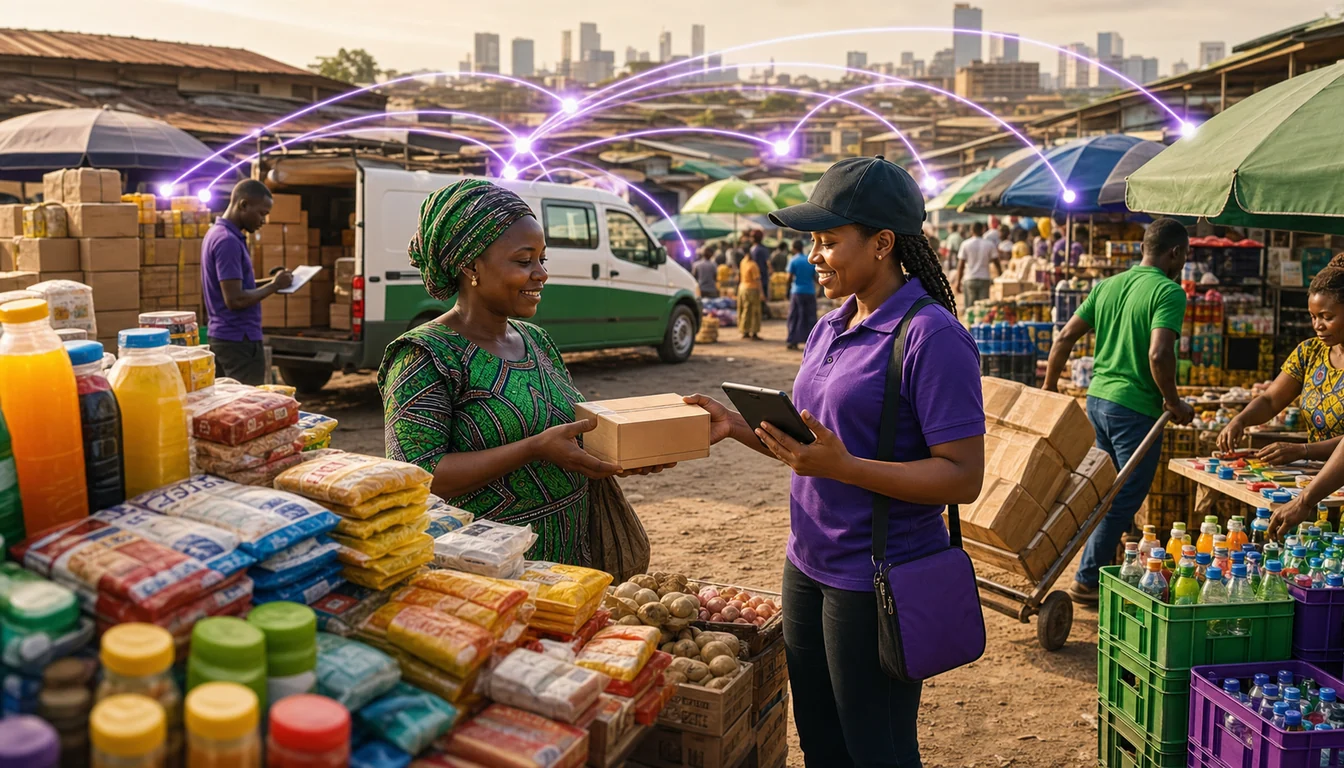
Ask any sales manager moving FMCG volume through Onitsha Main Market, the provision stores of Ikeja or the open markets of Kano how their brand reaches the shelf, and the answer usually comes down to one choice. Does the rep sell straight off a van, or take the order today and deliver it later?
That is the van sales versus pre-sales decision, and in Nigeria it is no small tweak. It shapes your working capital, your distributor relationships and how hard you fight stockouts.
Nigeria's trade is overwhelmingly informal. Most consumer volume passes through kiosks, table-top sellers, neighbourhood shops and open-market traders, reached along a chain of distributor to sub-distributor to wholesaler to retailer. This guide breaks down both models on Nigerian terms so you can decide where each one earns its keep.
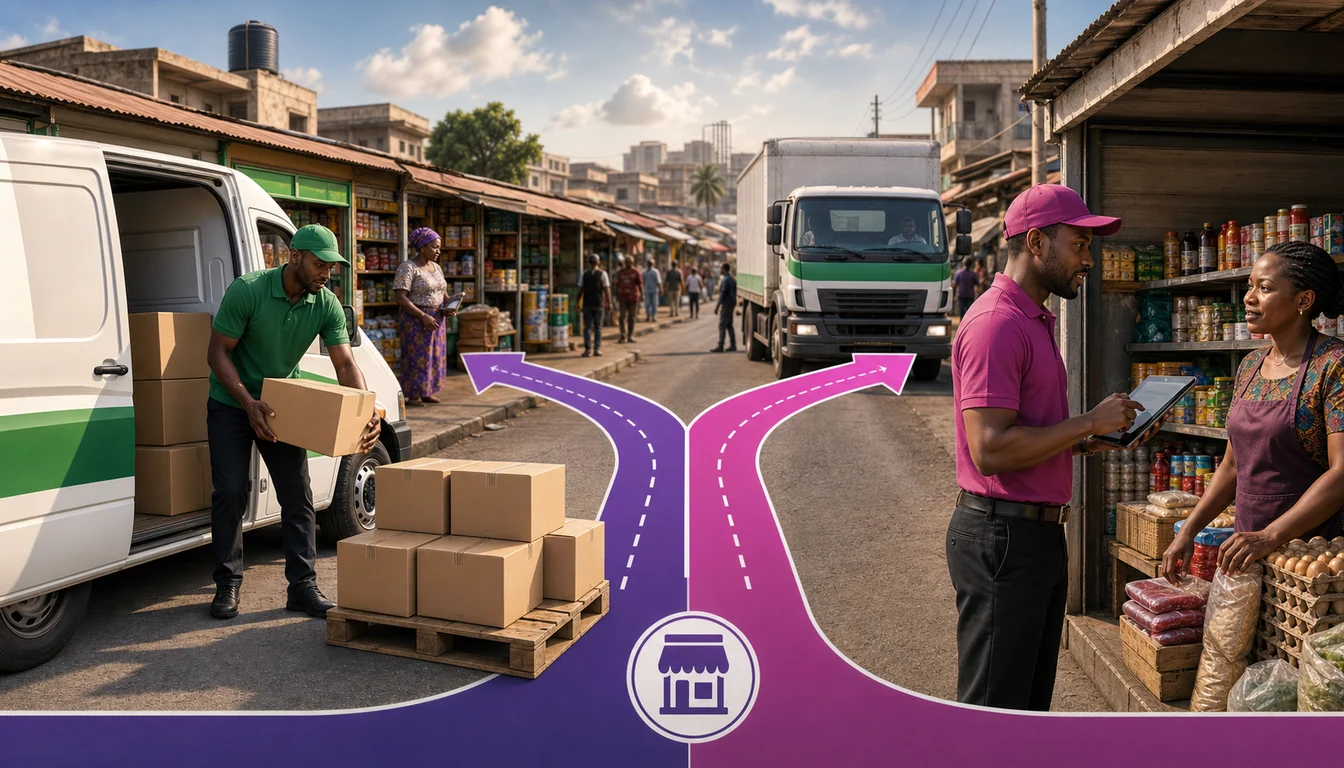
What Van Sales and Pre-Sales Mean on the Ground
Both models describe how a secondary sale happens between your distributor and the retailer. Both are common across Nigerian trade, and many established brands run a mix of the two.
Van sales (load-and-sell)
The rep leaves the distributor's warehouse each morning with a loaded vehicle and drives a fixed route through the market or neighbourhood. Stock is sold directly from the van.
The retailer sees the product, picks what he wants, pays on the spot, and the goods come off the van there and then. Order and delivery are the same event. It is the classic model for fast-moving items a shopkeeper in Aba or Ibadan expects to restock the moment he runs low.
Pre-sales (order-first, deliver-later)
Here the roles split. A pre-sales rep visits the outlet, checks stock, takes the order on a phone or handheld, and moves on to the next shop carrying no goods.
The order is aggregated at the distributor and a separate vehicle drops the stock, usually the next day. This decouples selling from carrying inventory. One rep covers many more outlets in a day, and the distributor plans loads against confirmed demand rather than guesswork.
Van Sales vs Pre-Sales at a Glance
Before drilling into the trade-offs, here is how the two models compare on the factors that matter most in Nigerian trade.
| Factor | Van Sales | Pre-Sales |
|---|---|---|
| Payment | Cash or instant transfer at the counter | Often short credit before goods arrive |
| Best route type | Spread-out provision stores | Dense open-market clusters |
| Outlets per rep per day | Fewer, slowed by the loaded vehicle | More, rep travels light |
| Product fit | Bulky, fast-moving, narrow range | Wider assortment, varied order sizes |
| Main risk | Unsold stock returning to the warehouse | Receivables and credit ageing |
The Real Trade-Offs in the Nigerian Context
On paper the choice looks like a logistics preference. In practice, four Nigerian realities decide which model works for a given territory.
Cash, credit and the naira reality
Van sales is largely a cash-and-carry model. It suits a trade where retailers still settle in physical naira or, increasingly, by instant transfer through Opay, Moniepoint, PalmPay or a bank USSD code.
Money changes hands at the point of sale, so collection risk is low and the cash cycle is short. Pre-sales often runs on short credit, since the retailer commits before goods arrive. With real FX volatility and tight distributor liquidity, that exposure needs clear limits per outlet and disciplined follow-up on balances.
Route density and market geography
- Dense clusters (open markets): In a tightly packed market like Onitsha Main Market or Balogun in Lagos, a van can be a liability. Traffic, narrow lanes and parking make a loaded vehicle slow, and pre-sales reps on foot cover far more shops per hour.
- Spread-out routes: Across scattered provision stores in suburban Abuja or Port Harcourt, van sales shines. The rep is already driving between outlets, so carrying stock and closing on the spot removes a second delivery trip.
- Landmark navigation: Most outlets sit on unnamed streets, so both models depend on GPS and landmark-based outlet mapping rather than postal addresses. Whatever model you run, the outlet's location has to be pinned once and reused.
Product profile
Bulky, low-value, high-frequency lines such as sachet water, soft drinks or seasoning cubes favour van sales. The retailer wants stock immediately, and a dedicated delivery run per order rarely adds up.
Higher-value, slower-moving or wider assortments favour pre-sales. A rep can sell a fuller range without every SKU physically on the van, and the delivery vehicle carries only what was actually ordered.
Power, network and offline-first working
Whichever model you pick, the Nigerian operating environment is unforgiving to anything that assumes constant connectivity. Grid power is unreliable, so low-end Android phones must last a full route on one charge, and the mobile network fades deep inside a busy market.
Any tool your reps use has to capture orders, stock and payment offline and sync later. A pre-sales order that cannot be recorded for want of signal is a lost order, and a van sale that cannot be logged stays invisible to the distributor until the rep returns to the warehouse.
How to Decide Which Model Fits Your Territory
Rather than picking one model for the whole business, map it to the territory and channel. A practical way to think about it:
- Lean van sales when outlets are spread out, the range is narrow and fast-moving, retailers expect instant restock, and payment is cash or instant transfer at the point of sale.
- Lean pre-sales when outlets are densely clustered in open markets, the assortment is wide, order sizes vary, and you want maximum coverage per rep per day with delivery planned against confirmed demand.
- Run a hybrid in most real Nigerian territories: van sales for the top fast-movers and pre-sales for the long tail, or van sales in the outer neighbourhoods and pre-sales inside the congested market core.
The decision is easier to defend when it rests on numbers rather than habit. Follow these steps before you lock a model into a territory:
- Measure the average drop size per outlet under each model.
- Count how many productive outlets a rep can reach per day.
- Compare the cost of a delivery run against the order value it carries.
- Track how much stock returns unsold from the van at day-end.
What to measure once you have chosen
- Outlet coverage and strike rate: how many planned outlets on the beat were actually visited, and how many placed an order.
- Lines and volume per productive call: whether reps are selling the full range or just the easy few SKUs.
- Van returns and fill rate: for van sales, how much stock comes back unsold; for pre-sales, how much of each order the delivery vehicle actually fulfilled.
- Secondary sales versus primary: what the distributor bought in against what genuinely sold through, so you are not mistaking loaded stock for real demand.
- Collection and credit ageing: especially under pre-sales, how quickly outstanding balances are cleared.
Common Pitfalls Nigerian Brands Hit
Both models fail in predictable ways when they are run on paper, memory and trust alone. A few recur across FMCG operators here.
Ghost visits and unverified coverage
When visits are self-reported, a beat can look fully covered on paper while several outlets were never entered. Geotagged, time-stamped visits against a pinned outlet location close that gap, and they matter equally for a van rep and a pre-sales rep.
Confusing primary loading with secondary sell-through
A distributor buying a large primary order does not mean the product reached retailers. Brands that track only primary dispatch get blindsided when stock sits in the warehouse or leaks sideways. Capturing secondary sales at the retailer visit is what turns loaded stock into real market signal.
Uncontrolled credit under pre-sales
Pre-sales without firm credit limits per outlet quietly builds up receivables that nobody notices until a distributor's cash is trapped. Set limits, enforce them at order entry, and age balances weekly.
Treating the field team as one language
Your reps speak English, Hausa, Yoruba, Igbo and Pidgin, and a rep in Kano will not run a workflow built only in the register of Lagos. App prompts and training that reach reps in the language they actually work in get adopted; those that do not get worked around.
How 1Channel Helps You Run Both Models in Nigeria
Both van sales and pre-sales stand or fall on clean field data. 1Channel's Cloud AI Sales Force Automation software is built for Nigeria's traditional trade, so the model you choose becomes a lever you can actually pull.
It works offline-first on low-end Android phones, captures orders and payments when the network fades inside a market, and syncs the moment signal returns.
On one platform, the software helps you:
- Run van sales and pre-sales side by side, matched to each territory.
- Capture geotagged, time-stamped outlet visits against pinned locations on unnamed streets.
- Record secondary sales at the retailer visit, not just primary dispatch.
- Enforce per-outlet credit limits at order entry and age balances weekly.
- Plan beats and read field analytics on coverage, strike rate and van returns.
Run Van Sales and Pre-Sales on One Platform
See how 1Channel's Sales Force Automation software runs offline-first van sales and pre-sales, geotagged outlet visits, secondary-sales capture, beat planning and field analytics for Nigeria's traditional trade.
Explore Sales Force Automation →Key Takeaways
There is no single winner in the van sales versus pre-sales debate for Nigeria. What matters is matching the model to the territory, the product and the way retailers pay.
- Van sales rewards fast-moving lines, spread-out routes and cash at the counter.
- Pre-sales rewards dense market clusters, wide assortments and coverage at scale, provided you manage credit tightly.
- A hybrid suits most real territories, with the split drawn by product and geography.
- Let numbers decide the line, not habit, using drop size, coverage, delivery cost and van returns.
- Both models depend on offline-first field data, honest secondary-sales capture and verifiable coverage.