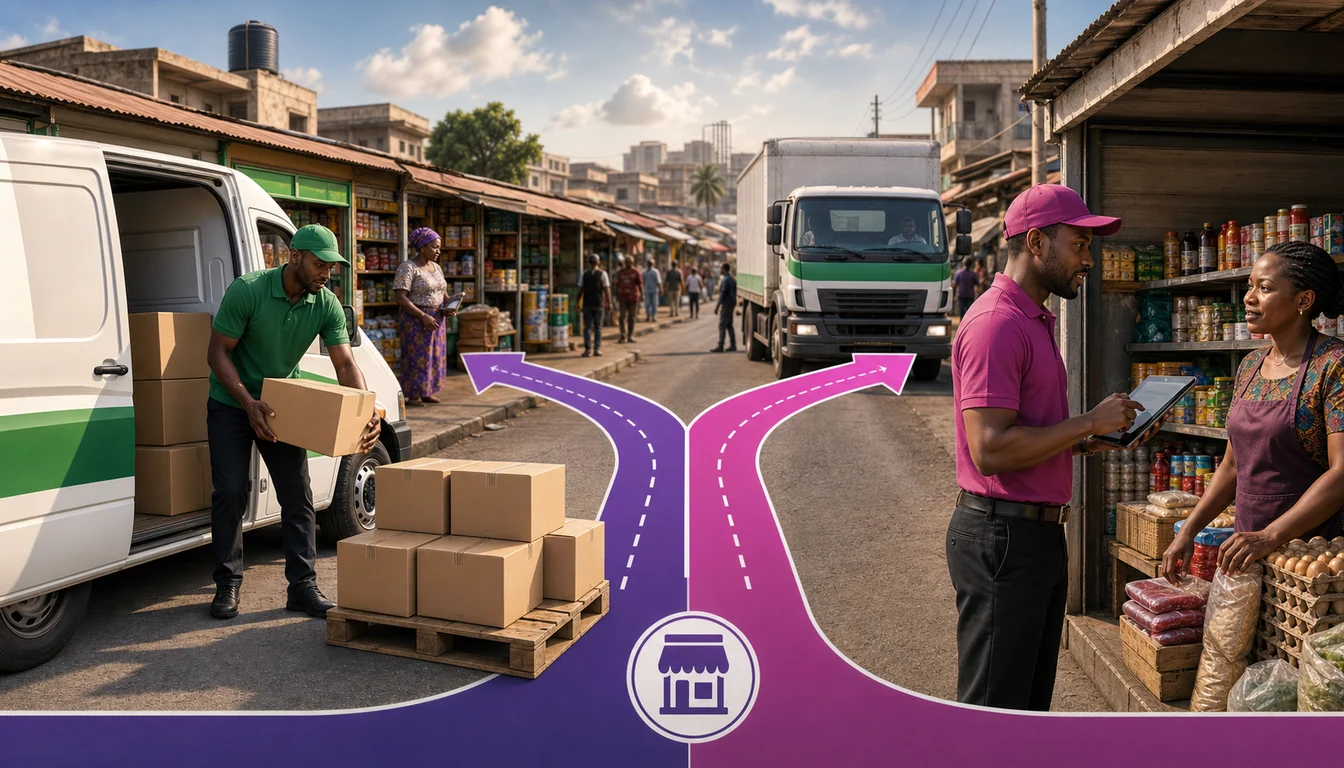
Ask any field sales rep working the routes out of Onitsha Main Market, the stalls of Balogun in Lagos Island, or Kantin Kwari in Kano, and they will tell you the same thing. The sale does not wait for the network.
A wholesaler is ready to place an order, three retailers are queuing behind him, and the rep's phone shows a single bar that keeps dropping. Meanwhile the grid has gone off, and half the shops are running on small generators or nothing at all.
In this environment, a field sales tool that only works with strong signal and full battery is not a tool. It is a liability. This guide walks through what offline-first field sales really means for Nigerian businesses selling through the informal trade.
Why Offline-First Is Non-Negotiable in Nigerian Trade
Most of Nigeria's FMCG volume moves through informal, general trade. Provision stores, kiosks, table-top sellers, and open-market traders are reached through a chain of distributors, sub-distributors, and wholesalers before stock lands on a retailer's shelf.
That trade is dense, cash-heavy, multilingual, and stubbornly offline in the exact places where selling happens. Two realities shape every day on the route:
- Unreliable grid power. Blackouts are routine across Lagos, Ibadan, Aba, and beyond, so both the rep's phone and the retailer's shop can be running on limited battery or a generator.
- Patchy mobile connectivity. Inside a concrete-walled market block, a basement lock-up shop, or a rural route outside Kaduna or Benin City, signal drops to nothing without warning.
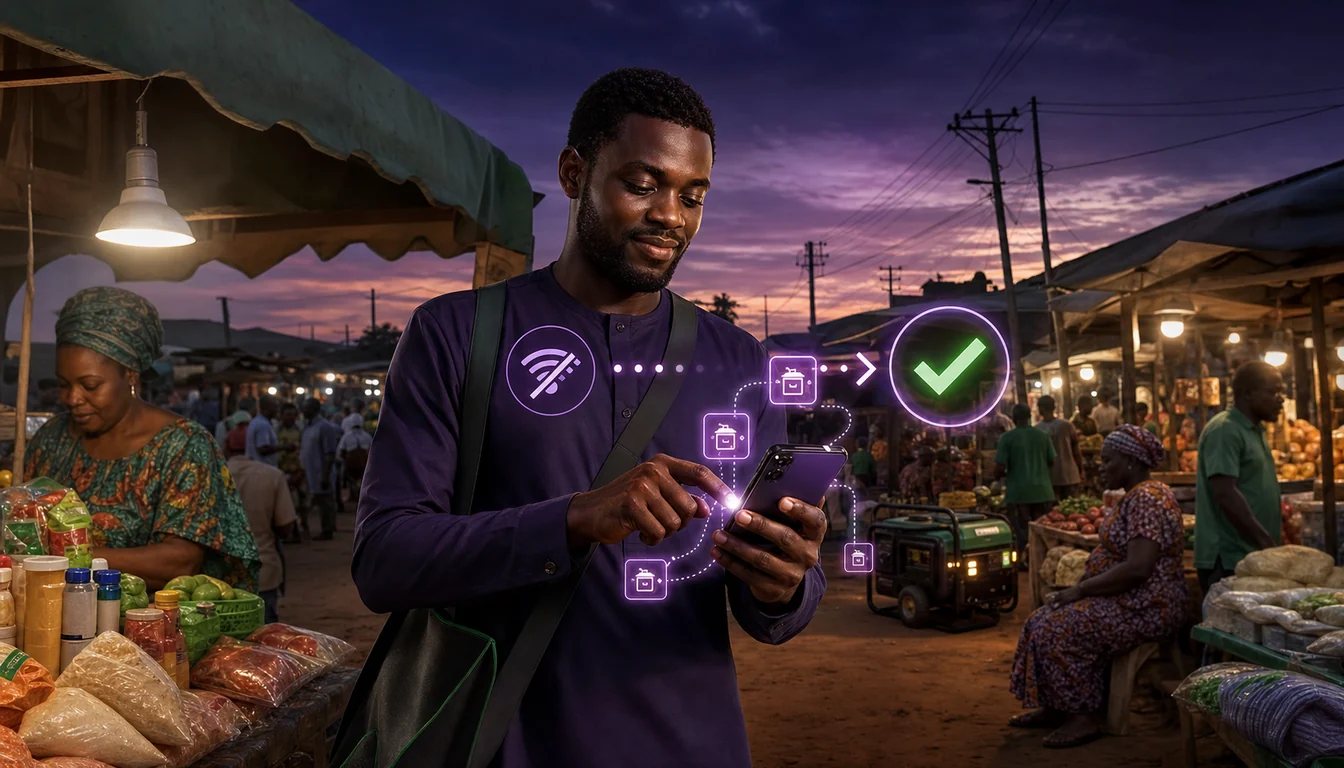
An offline-first field app treats connectivity as a bonus, not a requirement. Everything the rep does is written to the phone first and queued locally. When signal returns, even briefly, the queue syncs to the cloud in the background.
The practical test is simple. Put the phone in airplane mode mid-demo and try to book an order. If the app freezes or refuses, it is online-first software wearing an offline label, and it will bleed you orders every day in the field.
A Blackout-Proof Beat Workflow, Step by Step
Here is what a resilient day on the route looks like when the tooling is built for Nigerian conditions rather than a head office with fibre broadband.
Start of day: attendance and beat load
- Sign in with a geo-stamped photo the moment the rep reaches the territory, captured on the device even when the network is down, then synced later so there is no dispute over who reached where and when.
- Pre-load the full beat overnight. The day's outlets, prices in Naira, active schemes, and distributor stock should already be cached before the rep leaves home, so the route opens instantly even on a dead signal.
- Sequence outlets by proximity and landmark, not by street name. Most market shops have no formal address, so navigation runs on GPS pins and landmarks such as "third stall after the transformer" or "opposite the mosque gate."
At the outlet: capture, don't defer
- Book the order on the spot against live cached stock and the outlet's credit limit, so a rep only promises what the warehouse actually holds.
- Record the payment mode as it happens: cash, bank transfer, USSD, Opay, Moniepoint, or PalmPay. Reconciliation later depends on knowing how each retailer settled.
- Generate a PDF order the retailer can keep, even offline, so there is a shared record the shopkeeper trusts before any money changes hands.
- Register new outlets inline, pinning a fresh provision store, table-top seller, or sub-distributor by GPS and landmark without a trip back to the office.
A field team running this way keeps selling straight through a blackout, then lets the phone sync the whole beat once a usable signal appears. There is no week-end manual roll-up and no orders lost to a flat battery.
What to Measure When You Can't Assume Live Data
When your data arrives in bursts as devices sync, you have to read your numbers with the field reality in mind. The metrics that matter most for an offline-first operation expose both coverage and data health.
| Metric | What it tells you |
|---|---|
| Sync latency per rep | The gap between when an order was captured and when it reached the server. A rep whose data only lands at 6 p.m. may be on a genuinely dead route, or may be gaming the timestamp. |
| Beat compliance and strike rate | How many assigned outlets were actually visited, and how many visits produced an order. Landmark-based GPS check-ins keep this honest where addresses do not exist. |
| Primary vs secondary sales | Factory-out volume to the distributor against what reps sell down to retailers, so you catch stock piling up in a warehouse in Aba or Port Harcourt. |
| Order-to-cash by payment mode | With the shift from cash toward USSD and fintech transfers, tracking collection against each mode shows where leakage and delays creep in. |
Standardising this capture across the whole team is exactly what sales force automation is for: consistent beats, geo-validated attendance, and offline order capture that turns a chaotic route into measurable activity.
Building for Multilingual Teams and Low-End Devices
Offline-first is not only about the network. It is about the whole field environment being harsher than a boardroom demo assumes. Two things trip up teams that get the sync engine right but forget the rest.
The device reality
Your reps are not carrying flagship phones. Expect entry-level Android devices with modest storage, small batteries, and screens that struggle in the harsh midday sun of an open market.
The app has to be light, cache efficiently without filling the phone, and stay usable in low-power mode. A tool that drains the battery by noon has failed before the second half of the beat begins.
The language reality
Nigeria's field force is genuinely multilingual. A rep may speak English, Hausa, Yoruba, Igbo, and Pidgin across a single day's outlets, pitching in whichever language the trader is comfortable in.
Training and in-app guidance should not assume one language works everywhere. Building this into onboarding reduces errors at the point of capture, which is where offline data quality is won or lost.
Common Pitfalls to Avoid
Even teams that invest in field tooling can undermine it with a few avoidable mistakes. Watch for these:
- Treating "offline mode" as an afterthought. If offline is a fallback bolted onto online-first software, expect data loss and conflicts when two versions of an order try to sync. Offline has to be the default path.
- Ignoring conflict resolution. When a rep edits an outlet offline and an admin edits the same record in the portal, the system needs clear rules for which change wins. Otherwise your master data quietly rots.
- Over-trusting timestamps without geo-validation. An order timestamped at 9 a.m. but synced at 6 p.m. from a location 40 km off the beat tells a story. Pair time with GPS to keep the field honest.
- Forgetting the retailer's proof. In cash-heavy trade, a shopkeeper wants a record before paying. An offline-generated PDF order builds the trust that closes the sale on the spot.
- Building around pricing that never changes. With Naira pricing and scheme terms shifting, cached price lists must refresh reliably on every sync so reps never quote stale numbers.
Where regulation touches your data, under Nigeria's data protection regime and product records relevant to NAFDAC and SON in FMCG and pharma, clean geo-validated field data captured offline actually helps. You end up with a defensible trail rather than scattered notes across personal phones.
How 1Channel Helps Nigerian Field Teams Sell Offline
Running an offline-first field operation across Nigeria's informal trade means keeping attendance, order capture, and outlet creation working through blackouts and dead zones. 1Channel brings these activities into one connected platform built for that reality.
The Cloud AI Mobile DMS App is designed for low-end Android phones and the harsh conditions of an open market. Reps keep working whether or not the network is there, and the phone syncs everything the moment a signal appears.
The platform helps Nigerian teams manage:
- GPS-stamped attendance captured on-device, even offline
- Beat planning by landmark and proximity for unnamed streets
- Offline order capture against live cached stock and credit limits
- PDF orders retailers can keep before any cash changes hands
- On-the-spot outlet registration by GPS pin
- Payment-mode tracking across cash, USSD, and fintech transfers
Sell Through Blackouts With the Mobile DMS App
See how 1Channel's Cloud AI Mobile DMS App lets Nigerian reps mark GPS attendance, run the day's beat, capture orders offline during blackouts, share PDF orders, and create outlets on the spot, all from a low-end Android phone.
Explore the Mobile DMS App →Key Takeaways
In Nigeria, the market decides when it will give you signal, and the grid decides when it will give you power. Neither asks your permission. The teams that keep selling are the ones that plan for the worst moment on the route.
- Design for the worst moment. A dead network, a low battery, and a busy trader who will not wait should be the baseline your workflow assumes, not the exception.
- Make offline the default. Attendance, order capture, and outlet creation must all work on-device first, then sync when signal returns.
- Pair time with GPS. Geo-validated capture keeps the field honest and gives you a defensible data trail.
- Build for real devices and real languages. Light apps on entry-level phones and multilingual onboarding protect data quality at the point of capture.
Build the workflow for that worst moment, and every better moment on the route takes care of itself.