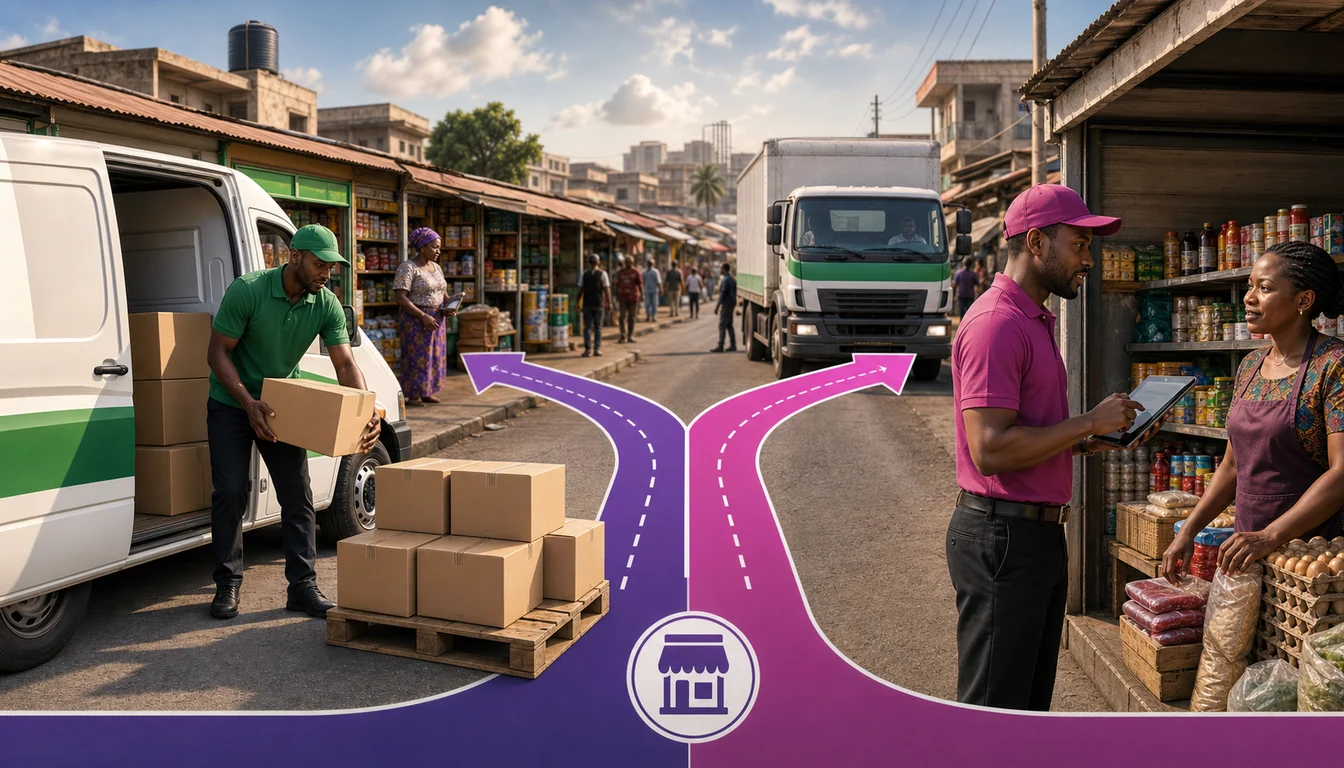
Ask a sales rep in Lagos where an outlet sits and you rarely hear a street name. You hear a landmark: the provision store behind the second filling station on Ikorodu road, opposite the church.
Most outlets that carry Nigeria's fast-moving consumer goods have no usable postal address. Yet these kiosks, provision stores and open-market stalls move the bulk of FMCG volume through the distributor, sub-distributor, wholesaler and retailer chain.
Building a reliable beat plan on top of that reality is one of the hardest and most valuable things a Nigerian distribution business can get right. This guide reshapes how field teams plan beats where streets are unnamed and addresses are unreliable.

Why Street Addresses Fail in Nigerian Trade
Addressing in Nigerian markets works differently from what most software assumes. A distributor covering the sprawl around Onitsha Main Market or the dense lanes of Kano's textile trade cannot hand a new rep a spreadsheet of "No. 14 Such-and-such Street" and expect visits to happen.
Several things get in the way at once:
- Streets are unnamed or informally named. A lane may be known by the trader who has sold there for twenty years, not by any sign. Two reps will write the same spot two different ways.
- Outlets have no fixed number. A table-top seller or kiosk occupies a place described only in relation to its neighbours.
- Markets rearrange themselves. Stalls shift, so a "row 3" today may be a "row 4" next quarter.
- Multiple outlets share one description. "The shop near the bus stop" can point to five provision stores.
The result is address-based routing that produces plans nobody can follow and coverage reports nobody trusts. The fix is not a better address field. It is capturing where an outlet physically is, once, and reusing that forever.
Geotag the Outlet, Not the Street
The single most important step is to onboard every outlet with a GPS pin captured on site. When a rep first visits a provision store, the app records its coordinates and a short landmark note in the language your team actually speaks, whether English, Hausa, Yoruba, Igbo or Nigerian Pidgin.
From then on, the outlet is found by its pin and its landmark, not by an address that was never real.
What to Capture at Onboarding
- GPS coordinates taken while standing at the shopfront, so the pin sits on the outlet, not on a road three streets away.
- A landmark description a stranger could follow: nearest junction, filling station, market gate, place of worship or bank branch.
- A photo of the storefront so the next rep recognises it instantly, even if the owner is out.
- Channel and category tags, for example kiosk, provision store, open-market wholesaler, table-top, or a modern-trade outlet where present.
- The distributor or sub-distributor the outlet is served through, so primary and secondary flow stays connected.
Once outlets carry accurate pins, you can cluster them geographically and hand each rep a beat that is a tight loop rather than a scattered chase across town. Geofencing then confirms a visit happened at the outlet, not near it, which is the foundation of honest beat compliance.
Building a Beat Plan That Survives the Market
A good beat plan balances two forces that pull in opposite directions. Dense market clusters pack dozens of outlets within a few minutes' walk. Sparse routes send a rep driving between towns. Both exist in the same territory, so your plan has to handle both.
Cluster First, Then Sequence
Start by grouping outlets that are physically close, using their GPS pins, into a single day's beat. Inside a market like Balogun in Lagos or Ariaria in Aba, sequence the stops so the rep walks a sensible loop and does not double back through the same crowded lane.
For rural or peri-urban routes around Ibadan or the outskirts of Kano, sequence by driving order to keep fuel and time under control, because logistics cost is a real pressure on margins.
Set a Frequency That Matches the Outlet
| Outlet type | Suggested visit cycle |
|---|---|
| High-throughput wholesalers and busy provision stores | Weekly or twice-weekly |
| Smaller kiosks and table-top sellers | Fortnightly or monthly |
| New or reactivated outlets | Tighter cycle until they stabilise |
Assign beats by rep, territory and weekday, so Monday's Aba route and Thursday's route do not overlap and no outlet is silently dropped. Where a distributor and sub-distributor share geography, map outlets to the right servicing party so coverage credit is not double-counted.
Offline-First, Because Power and Signal Will Not Cooperate
Any routing approach that assumes constant connectivity will fail in a Nigerian market. Mobile signal is patchy inside a large open market and on rural corridors, and grid power is unreliable enough that reps often work on a low battery for hours.
Beat planning has to be built for these conditions rather than fighting them.
Design for the Worst Signal, Not the Best
- Reps must see their full beat and outlet list offline. The plan should be on the phone before the rep walks into the market, not fetched on demand.
- Visits are captured offline with GPS coordinates, timestamp and photos, then synced later once signal or power returns.
- The app should run on low-end Android phones and stay light on battery, since a dead phone at noon means a lost afternoon of coverage.
When capture works offline, you avoid the twin evils of missed visits and fabricated ones. The GPS stamp taken at the outlet is what makes a later compliance report believable, even though it was recorded where there was no signal at all.
What to Measure, and the Pitfalls That Hide in the Numbers
Beat planning is only as good as the metrics you trust. A handful of measures, read together, tell you whether coverage is real.
Metrics That Matter
- Beat compliance: outlets visited divided by outlets planned, per rep per day. This is your headline coverage number.
- Visit productivity: outlets worked per day, distance between stops, and first and last activity times, which expose a rep who starts late or crams everything into one hour.
- New outlet additions: how many previously unmapped kiosks and table-top sellers were onboarded with a proper GPS pin.
- Geofence pass rate: the share of check-ins that fell inside the outlet's geofence rather than a suspicious distance away.
Common Pitfalls
- Vanity coverage. A rep marks every outlet "visited" but spends no time selling. Pair beat compliance with visit duration and order capture so a tick means real work.
- Pin drift. A GPS pin captured from a moving vehicle lands on the road, not the shop. Insist that pins are taken at the shopfront, and review outliers.
- Ghost outlets. Duplicate records for the same store inflate the outlet base. De-duplicate using proximity of pins plus the storefront photo.
- Frequency mismatch. Treating a busy wholesaler and a quiet kiosk on the same cycle wastes rep time on one and starves the other. Tune frequency to throughput.
- Stale territories. When a rep leaves, their outlets must be reassigned cleanly, or a whole cluster goes dark for weeks.
Payments in the trade are shifting quickly from cash toward bank transfer and fintech wallets such as Opay, Moniepoint and PalmPay. Linking a confirmed, geotagged visit to its order and payment reference gives you a clean, end-to-end view of what actually happened on the beat.
A Practical Rollout You Can Run This Quarter
You do not need to boil the ocean. A focused rollout in one strong territory proves the model before you scale it nationwide. Work through these steps in order:
- Pick one territory, for example a distributor's coverage around a single Lagos or Aba market cluster.
- Onboard outlets with GPS pins and landmark notes over the first cycle, capturing storefront photos as you go.
- Cluster and sequence beats from the pins, then assign them by rep and weekday.
- Run offline capture for a full month and watch beat compliance, visit productivity and geofence pass rate.
- Clean the data, de-duplicate ghost outlets, and correct any drifted pins.
- Extend the discipline to Kano, Onitsha, Port Harcourt, Ibadan and Abuja, keeping territories tidy as you grow.
How 1Channel Helps With GPS and Landmark Beat Planning
Beat planning on unnamed streets is not about forcing Nigerian trade into a rigid address system it never had. It is about respecting how reps already navigate, by landmark and by memory, and turning that knowledge into structured, measurable coverage.
1Channel is built for exactly these market conditions. It geotags the outlet rather than depending on a street address, so plans stay accurate even where postal addresses do not exist.
For Nigerian FMCG and distribution teams, the platform helps you:
- Onboard every kiosk and provision store with a GPS pin, landmark note and storefront photo
- Cluster and sequence beats from pins, then assign them by rep, territory and weekday
- Capture visits offline with GPS, timestamp and photos, syncing when signal or power returns
- Confirm visits with geofencing and track beat compliance, visit productivity and geofence pass rate
- Keep territories clean when reps move on, so no cluster silently goes dark
Explore 1Channel Route Planning for Nigeria
See how 1Channel's route planning and beat management software helps Nigerian teams geotag outlets, build GPS-based beats, and confirm every visit with offline-first check-ins.
Explore Route Planning Software →Key Takeaways
- Route to pins, not addresses. Most Nigerian outlets have no usable postal address, so capture GPS coordinates and a landmark note once, then reuse them.
- Cluster before you sequence. Group nearby outlets into a single beat, then order the stops as a walking loop in markets or a driving order on rural routes.
- Match frequency to throughput. Busy wholesalers earn weekly visits; quiet kiosks sit on a longer cycle.
- Build offline-first. Plans and capture must work through weak signal and grid blackouts, syncing later.
- Measure honestly. Read beat compliance alongside visit duration and geofence pass rate, and watch for vanity coverage, pin drift and ghost outlets.