On a map, ten drugstores between Pasig and Ortigas look like a comfortable day for one medical rep.
On the road, the same ten calls can run past the end of the shift. That gap is where many beat plans across the Philippines quietly fail.
It hits Pharma teams calling on drugstores, clinics and hospital pharmacies hardest, though FMCG, Consumer Durables and Cosmetics field teams plan their days the same way.
This post compares a distance-built plan with one built on travel time, works through Metro Manila and Davao examples, and shows what the rep sees each morning.

Before: A Beat Plan Drawn on Distance
Most beat plans start as a grid. A manager ticks which outlets each rep visits on which weekday, using a rough sense of how far apart they are.
Distance is the wrong unit in Philippine cities. TomTom's 2025 Traffic Index ranks Davao City as the most congested city in the country, with Manila close behind.
Metro Manila adds number coding on top. Each car is kept off major roads at peak hours on one weekday, depending on the last digit of its plate.
A plan that assumes free-flowing roads overstates what a rep can cover, and a rep driving a coded car loses the main roads for part of a weekday.
The miss shows up later. The Beat Compliance Report divides stores covered by stores planned, so an impossible plan looks like a rep who did not work.
Where incentives are gated by journey-plan adherence, that rep can also lose the month's payout over a plan that never fitted the road.
After: A Plan Built on Travel Time
1Channel's AI Journey Planner works from one spreadsheet upload: outlet coordinates and visit frequency, plus each rep's start point, end point and weekly day off.
It turns straight-line distance into road distance with a standard multiplier, then into travel time using an average city speed the admin can change.
Time per outlet is adjustable too. Every day is built inside the rep's working hours, and when the visits cannot all fit, the agentic AI says so.
It returns the best possible plan with a separate Visit Shortfall sheet, instead of a plan that looks complete but is not.
Worked Example: A Pasig Medical Rep
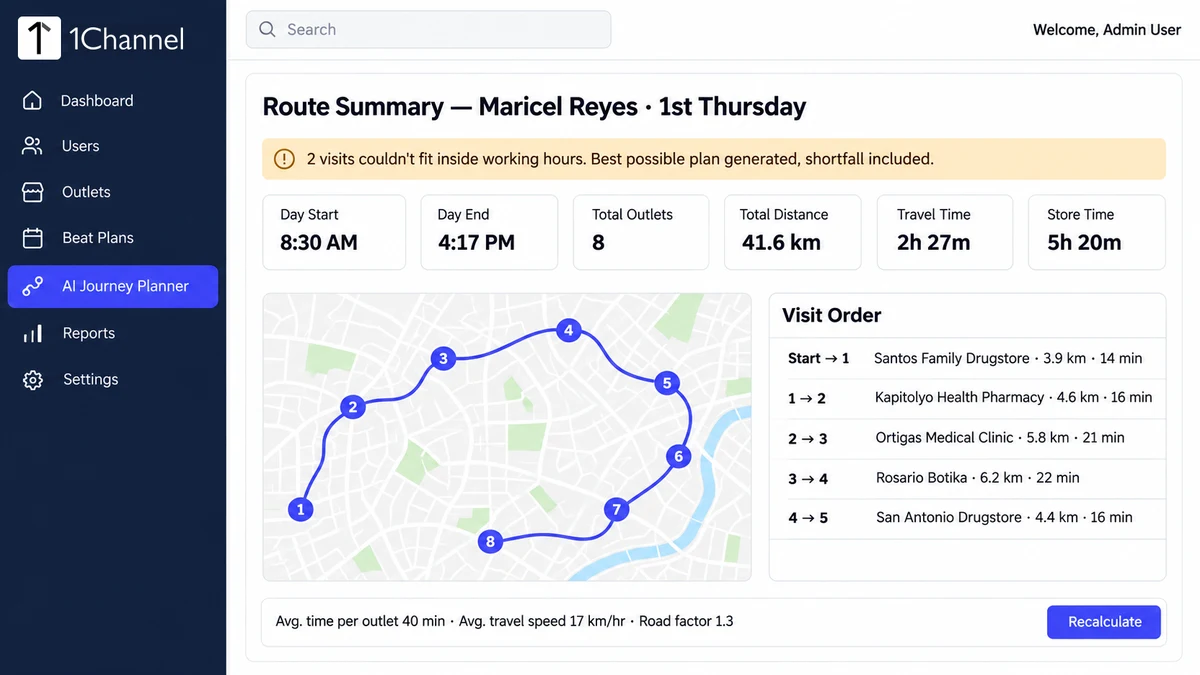
A rep based in Pasig has an eight-hour day and ten drugstores planned for Thursday, at 40 minutes a call.
That is 400 minutes in store, which leaves only 80 minutes for the road between ten stops.
The manager sets the average speed to 17 km/hr instead of the 25 km/hr default, closer to what the team actually manages across a working day.
The planner fits eight drugstores into the day, with 41.6 km and 2 hours 27 minutes of driving, and lists the other two in the shortfall sheet.
The manager learns before Thursday that ten calls were never realistic, and moves those two drugstores to a lighter day.
Worked Example: A Davao Hospital Pharmacy Route
A pharma distributor in Davao City has two reps covering 70 drugstores, clinics and hospital pharmacies, most of them visited twice a month.
Because travel speed is an input, the Davao team's plan does not have to borrow Metro Manila's assumptions. The manager runs it with Davao's own setting.
The shortfall sheet names six outlets in outer barangays that do not fit either rep's working hours at that frequency.
The manager now has a real choice before the month starts: move those six to a monthly visit, or add a third rep.
What the Rep Sees Each Morning
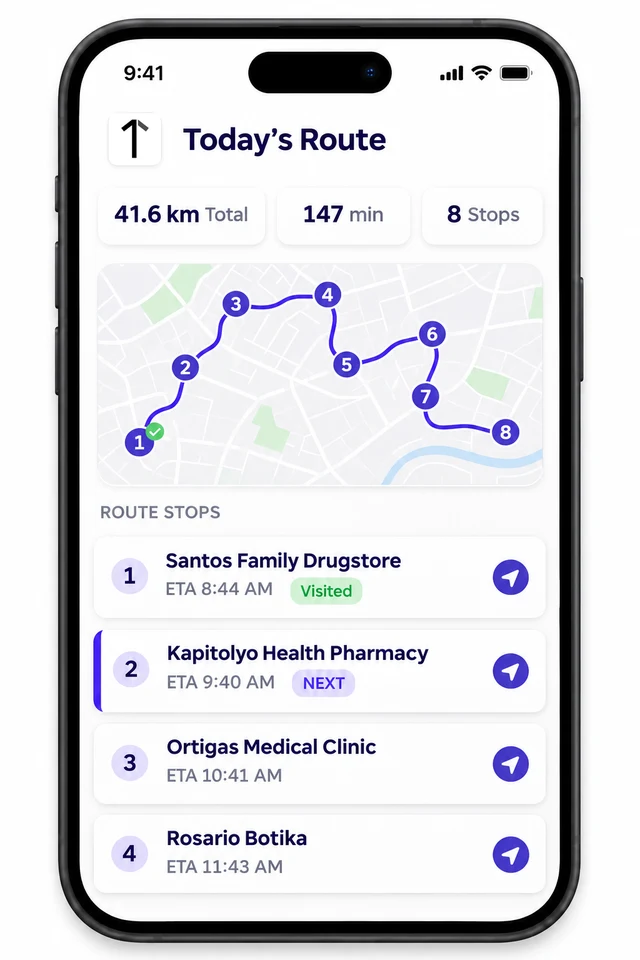
On the phone, Today's Journey shows Total Distance, Est. Duration, Outlets to Visit and Payment Due, with a map of numbered stops.
The route view lists the stops in optimised order with an ETA for each, flags the next one, and hands off to Google Maps for driving directions.
The home screen's Today's progress card tracks planned stores, planned completed and unplanned completed, so the rep sees the gap during the day.
Managers still read the Beat Compliance Report. Now a missed call points to something that happened on the road, not a plan that never fitted.
How 1Channel Plans Routes Reps Can Finish
1Channel links the AI Journey Planner to each rep's daily route and to beat compliance reporting, so the plan and the proof sit together.
Journey plans don't have to go stale either: the AI planner can rebuild beats on a schedule the business sets, improving coverage and cutting travel time.
Plan Beats Around the Road, Not the Map
Build field routes for Metro Manila, Cebu and Davao on real travel time, working hours and day-off rules, with every shortfall flagged before the week starts.
Explore Route Planning Software →Conclusion
A beat plan is only useful if the rep can finish it. In Philippine traffic, that means planning in minutes rather than kilometres.
Set honest travel speeds, read the shortfall before the month begins, and let compliance numbers describe the field rather than the map.
Note: Software screens may vary based on your business structure and configured workflows.