More than 8,000 merchant accounts have been shut down after the central bank found illegal businesses hiding behind ordinary storefronts on e-payment platforms.
The Bangko Sentral ng Pilipinas has now released a draft circular that makes payment providers responsible for vetting the merchants they onboard.
The change matters most for distributors in FMCG, Pharma and Healthcare, Retail and Modern Trade, and Consumer Durables.
This post covers what the regulator found, what the draft rules ask of payment providers, and what a traceable collection trail looks like for a distributor.
What the Central Bank Found
BSP surveillance flagged merchants that looked unremarkable on paper but took thousands of payments, some as small as ₱50, past midnight.
Those payments turned out to be bets on online casinos, with some operators posing as beauty salons and bakeries.
Small neighbourhood stores were among the businesses used, and over 8,000 merchant accounts have since been closed for alleged illegal activity.
Part of the problem sits with merchant aggregators, the intermediaries that link small businesses in far-flung areas to formal payment channels.
What the Draft Rules Ask of Payment Providers
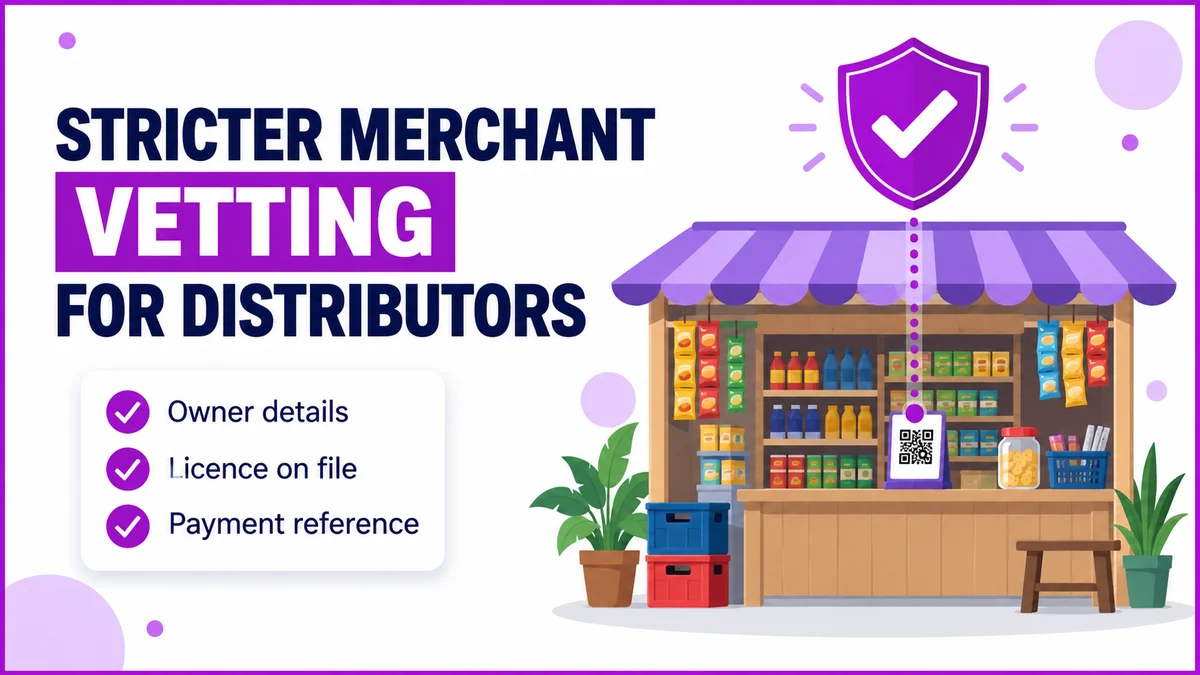
- Collect more information on each merchant, including owner details and licences.
- Set up and maintain databases of legitimate merchants.
- Take accountability for illegal activity on their platforms, with repeated violations risking licence revocation.
BSP Deputy Governor Mamerto Tangonan said tighter checks may briefly slow digital payment growth but should make it more sustainable.
Digital payments already made up around two-thirds of retail transactions in 2025, up from 57% in 2024.
Why This Reaches the Distributor's Ledger
The draft rules are written for payment providers, not distributors.
Yet many sari-sari stores and wholesalers now settle supplier invoices through GCash, Maya or QR payments, so those same accounts face closer review.
If an outlet's payment account changes, or a settlement arrives from an unfamiliar sender, matching it to the right invoice slows down.
| What providers must check | What a distributor should hold |
|---|---|
| Owner details | Outlet owner and contact on the outlet master |
| Legitimate-merchant records | A geotagged list of active outlets by channel |
| Traceable transactions | Every receipt booked with payment mode and reference |
How 1Channel Keeps Outlet Collections Traceable
1Channel's cloud platform keeps a geotagged outlet master of every sari-sari store, chemist and wholesaler, grouped by channel and size.
Reps book GCash, Maya, InstaPay, PESONet and cash receipts with mode and reference, and matching ties each one to open invoices, automatically or by hand.
Finance then reconciles settlements against the bank statement, while an automated credit override audit log records every exception.
Match Every Peso to a Known Outlet
Book e-wallet, bank and cash receipts against known outlets and open invoices, then reconcile them from one cloud portal built for distributors in the Philippines.
Explore Payment Management →Points to Remember
- The rules target payment providers. Distributors are not the regulated party, but their outlets' payment accounts are in scope.
- Expect some friction. The BSP itself expects stricter checks may temporarily slow digital payment growth.
- Clean outlet data pays off. Known owners, locations and paying accounts make settlements quicker to match.
- References beat memory. A receipt booked with mode and reference stays traceable long after the route ends.
Source: BusinessWorld